

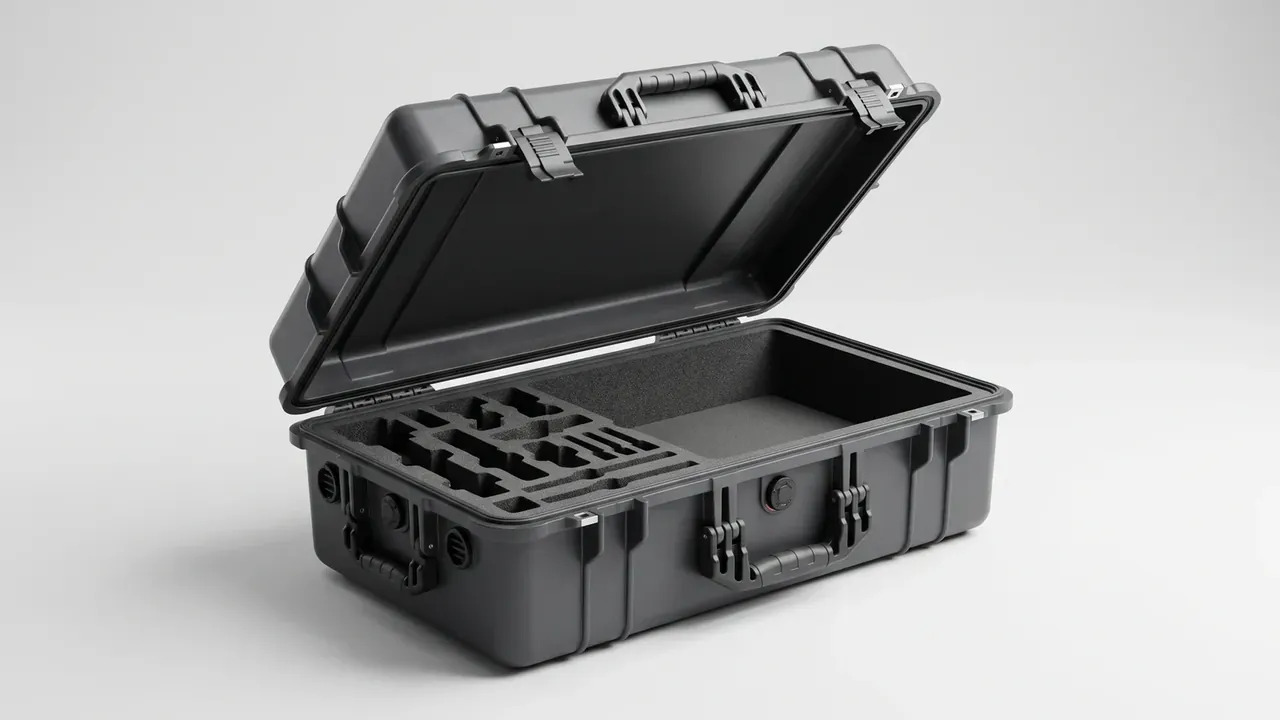
Quick answer: Boarding fit reduces to four numbers: 32 kg per piece, a cabin-equivalent altitude of 2,400 m, four tie-down points, and 90 seconds to reach a part on the apron. Both are measurable at goods-in and checked at the aircraft.
Table of contents
- Where boarding fit starts: four conditions under Category XII
- A cabin-equivalent altitude of 2,400 m: the pressure test
- Four tie-down points against 32 kg per piece
- Chocks and nets in the hold: three fixing actions
- Opening on the apron: the 90 second sequence
- Five rejection reasons seen on the ramp
- FAQ
1. Where boarding fit starts: four conditions under Category XII
Loading is not lifting a box onto an aircraft; it is making an aviation equipment protective case satisfy constraints someone will physically check. ATA 300 Category XII covers reusable rigid cases, and its conditions come down to four: it passes the door, one person lifts it, four points tie it down, and it opens after a pressure change.
Door clearance is missed first. A hold door is curved, so the diagonal fouls first; keep 50 mm on each dimension and count the wheel set on wheeled models.
The 32 kg limit for an aviation equipment protective case is not an airline preference but the ceiling for repeated manual handling.
| Boarding stage | Check item | Limit |
|---|---|---|
| Door clearance | Margin on length, width, height | 50 mm minimum |
| Manual handling | Gross weight per piece | 32 kg maximum |
| Tie-down | Number and position of points | 4, symmetric at the corners |
| Pressure equalisation | Valve cracking pressure | 3 to 5 kPa, both directions |
2. A cabin-equivalent altitude of 2,400 m: the pressure test
In cruise the cabin sits near 2,400 m, and the difference across a sealed case reaches 60 kPa. Without a breather valve the lid is sucked shut on landing, and forcing it open pulls the gasket from its groove.
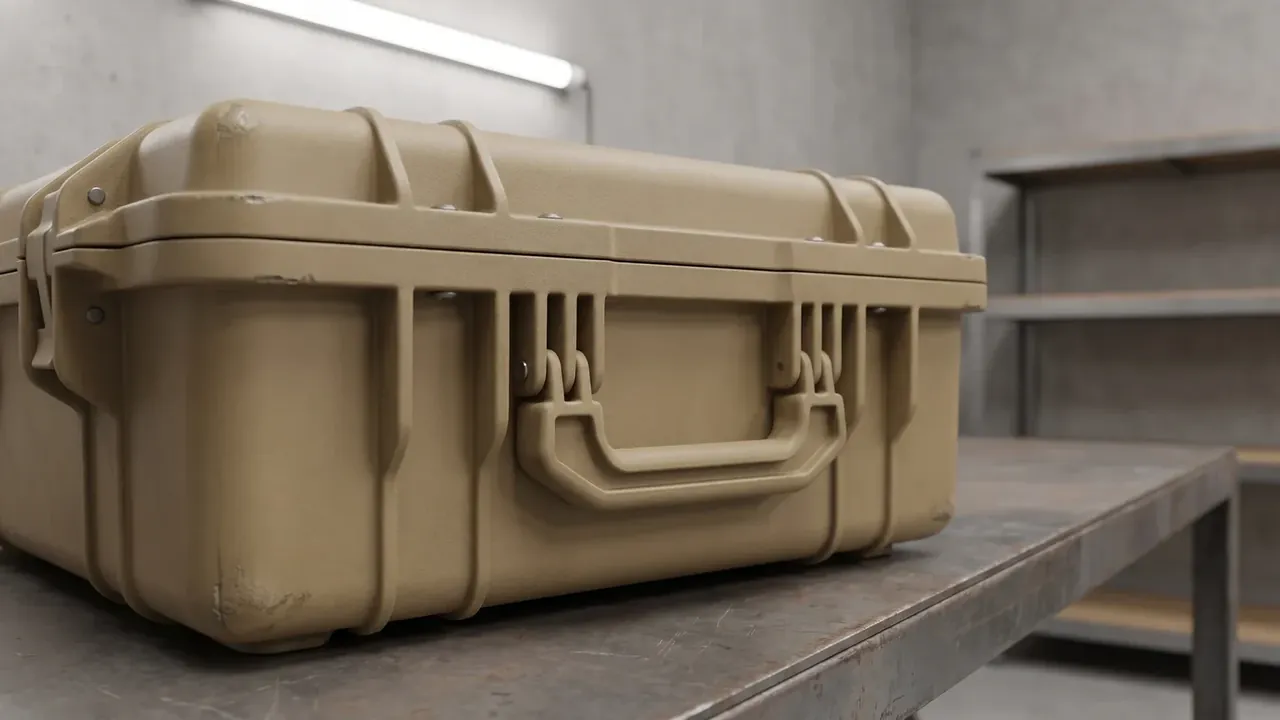
The answer is a valve, not a vent hole. It cracks at 3 to 5 kPa both ways and stays closed until the differential arrives; a vent hole is permanently open and drops an aviation equipment protective case a class.
The test copies directly: empty case into a chamber, climb to 60 kPa, hold 30 minutes, vent in 2 minutes, then open. An opening force above 150 N means the diaphragm never moved.
3. Four tie-down points against 32 kg per piece
The four points sit in reinforced corners of the aviation equipment protective case, not on the lid rim. Each bore carries a 15 mm metal insert for a 12 mm strap hook.
A 32 kg case at 9 g forward works out near 2.8 kN. Spread over four points that is 0.7 kN each, and with a factor of two the drawing should say no less than 1.5 kN.
Misaligned points are a common fault: load concentrates on a diagonal pair and the case creeps. Pull one strap diagonally before boarding; ten seconds shows whether all four take load.
4. Chocks and nets in the hold: three fixing actions
Chocks stop horizontal slip; nets stop vertical bounce.
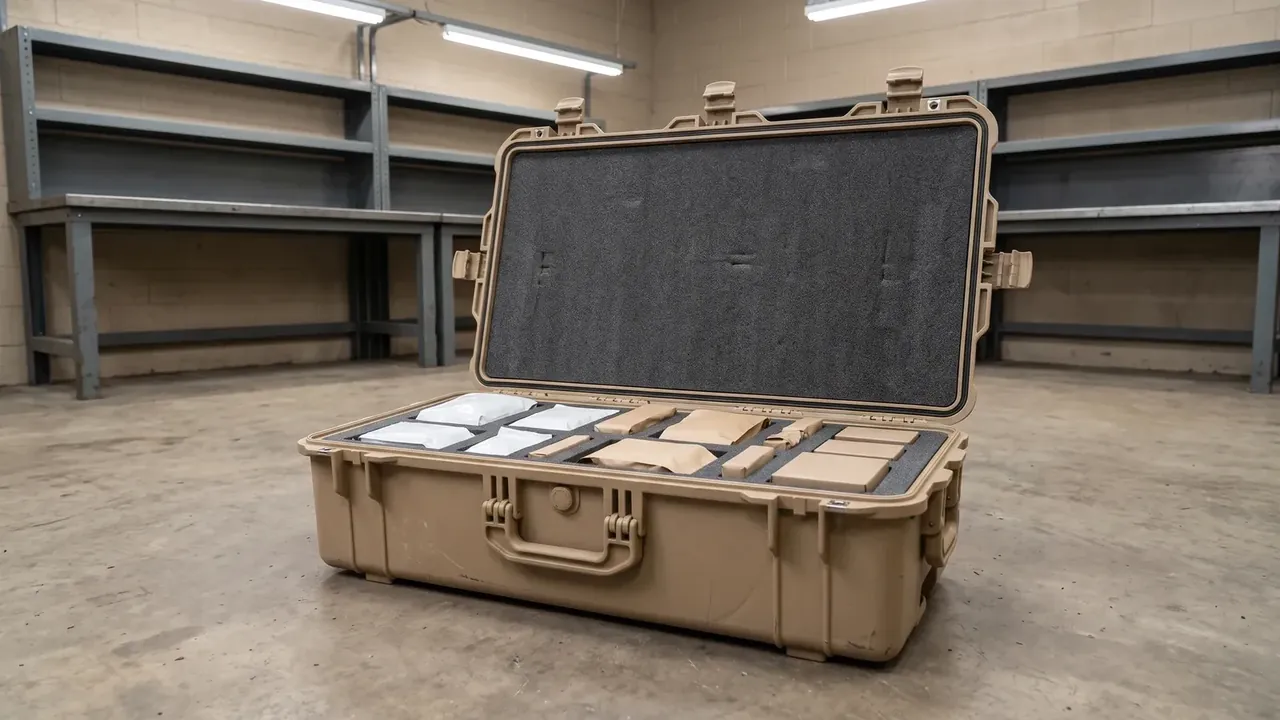
Three actions, in order. Chocks against all four faces, at least 50 mm high, gaps packed solid. The net crosses from four points on 25 mm webbing rated no lower than 2.5 tonnes. Press by hand: more than 25 mm of sag means it is slack.
Sign-off comes within 8 minutes, by a second person: one loads, another checks.
| Boarding stage | Check item | Limit |
|---|---|---|
| Chocks | Height and contact | Above 50 mm, flush on four faces |
| Net | Webbing width and breaking load | 25 mm wide, 2.5 tonnes minimum |
| Tension | Hand-pressed sag | 25 mm maximum |
| Sign-off | Second-person check | Within 8 minutes of closing |
5. Opening on the apron: the 90 second sequence
Time on the apron is counted in seconds. An aviation equipment protective case goes from latched to part-in-hand inside 90 seconds, and sequence beats strength.
Release the two front latches, lift to 100 degrees and lock the stay, pull the tray finger slots, take the part. Let go before the stay locks and the lid falls on your hand.
- Latches: two, one-handed, travel under 20 mm
- Stay: locks at 100 degrees, holds in crosswind
- Finger slots: 15 mm deep, glove friendly
- Position map: stuck outside, readable with the lid shut
- Reset: count empty slots before latching
Ninety seconds is a practised figure for an aviation equipment protective case; a first-timer needs 150.
6. Five rejection reasons seen on the ramp
Five rejection reasons, all visible ten minutes before boarding.
- Wheels left on: an unstripped wheeled model stands 30 mm too tall
- Valve taped over: the strip from post-cleaning never came off
- Points bypassed: straps wrapped round the body, webbing cuts the corner
- Net over the top only: no cross, load runs one way and slackens
- Map facing inwards: label reversed, forty seconds lost each time
None of these is a strength problem for an aviation equipment protective case.
Conclusion
Boarding fit is four numbers: 32 kg, 2,400 m, four tie-down points and 90 seconds. Each maps to a checkable constraint and a failure that shows up on the ramp. Write both into a handover sheet and the rejection rate falls. What decides the outcome is not wall thickness but whether an aviation equipment protective case survives that routine again and again.
This article discusses only the container (case body) side of specifications and design intent, and does not cover any handling, loading or use of the contents.
Related Reading
- How equipment cases are configured for different working conditions
- Fitting points for protective cases in OEM projects
- Compartment layout and pick sequence in camera cases
- Handling and securing large protective cases
- ESD and cushioning setup in electronic equipment cases
Related Products
- 8 Series — Gun Cases; Military Equipment Cases; Camera Equipment Cases; Drone Cases; Watch Cases; Knife Cases; First Aid Cases; Electronics Equipment Cases
- WL8-2812 PP Gun Case — model WL8-2812
- All protective cases and toolboxes: 7 series, 158 models