

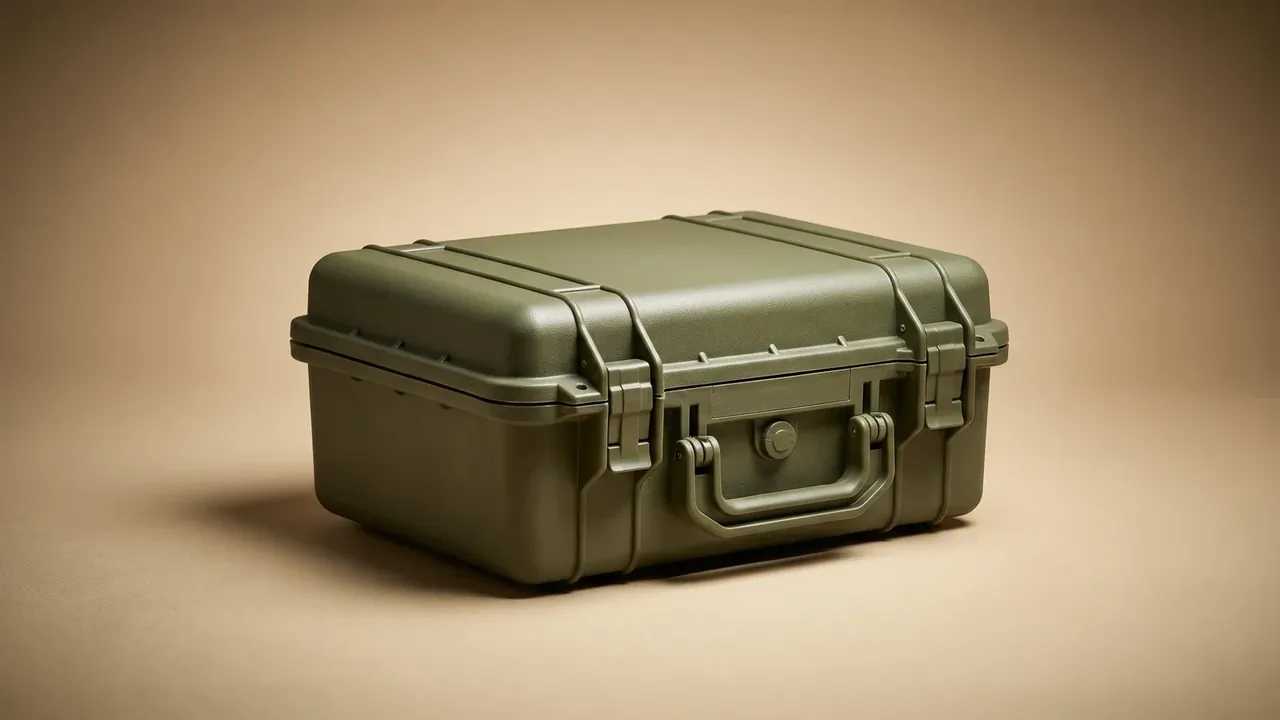
Quick answer: Gun case production is judged on site by four figures: a 100 degree lid, a 15 percent pad squeeze, a stack limit per box, 18 kg carried 200 m.
Table of contents
- Range Vaults: Fixed Points and Lid Angle
- Vehicle and Temporary Sites: Pad Thickness and Strap Height
- Storerooms and Coastal Warehousing: Stack Height and Air Gap
- Field Training and Transfer: Foam Zones and Carry Stroke
- Assembly Checklist: Four Moves and Three Failures
- FAQ
1. Range Vaults: Fixed Points and Lid Angle
Range vaults line up on an epoxy floor. Gun case production molds no anchor holes into the base, so the install starts with a 4 mm steel plate and four M8 anchors rated 3 kN.
Lid angle is missed most often. A case flat to the wall hinges at the back, so the lid stops at 95 degrees and knuckles scrape the rim ribs. Sliding it forward 120 mm clears 100 degrees and cuts draw time from 140 to 90 seconds.
| Site | Fixing | Key number | Mistake |
|---|---|---|---|
| Indoor vault | 4 mm plate, four M8 anchors | 100 degree lid, 750 mm clearance | Against the wall |
| Outdoor point | Plate on 20 mm rubber pad | 15 percent compression | Two diagonal pads |
| Post cabin | Through bolts, 6 mm plate | 0.25 square metre bearing | Bolts into timber |
Leave 750 mm between the sign in table and the case so a crouching hand clears the table edge.
One shell size can take three fixing kits; gun case production supplies dimensions and rib height; the install turns them into moves.
2. Vehicle and Temporary Sites: Pad Thickness and Strap Height
In a vehicle the pad comes before the strap. A 20 mm closed cell EPDM pad sits between base and deck at 15 percent compression. Over compress it and every bump reaches the corners.
Run the strap over the upper third of the shell, cross two points, stop at 350 N. A hand pull plus half a turn; more dishes it.
Press all four corners afterwards. A corner moving over 3 mm means the pad misses part of the base.
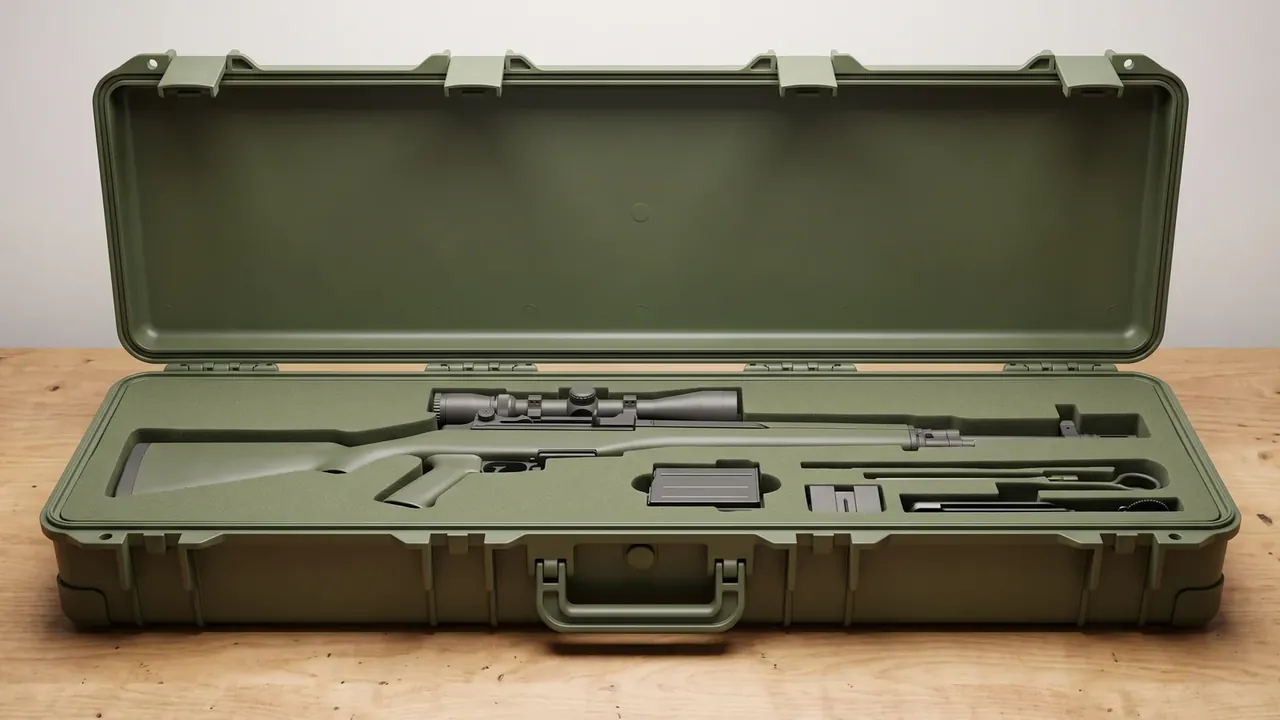
Temporary sites are messier. A cabin floor is timber and anchors will not bite, a tent floor softens after rain, a shelter deck needs lock washers. The substitute is a 6 mm steel plate spreading load over 0.25 square metres, at the price of 40 mm of lift and an off centre load pulling the shell sideways.
3. Storerooms and Coastal Warehousing: Stack Height and Air Gap
Stacking starts with the lid. Gun case production puts three ribs on the lid at 8 mm of height, so a four high stack loads the rib roots hardest.
| Stack | Load per bottom case | Air gap | Store |
|---|---|---|---|
| 2 high | up to 22 kg | 60 mm at the sides | Dry |
| 3 high | up to 33 kg | 80 mm at the sides | Normal |
| 4 high | up to 44 kg | 100 mm plus boards | Short turnover |
Coastal stores run a 96 hour salt spray cycle, and latch pins rust first. Wiping them dry beats greasing.
4. Field Training and Transfer: Foam Zones and Carry Stroke
A field case comes off a truck, crosses gravel, lands on a bench.
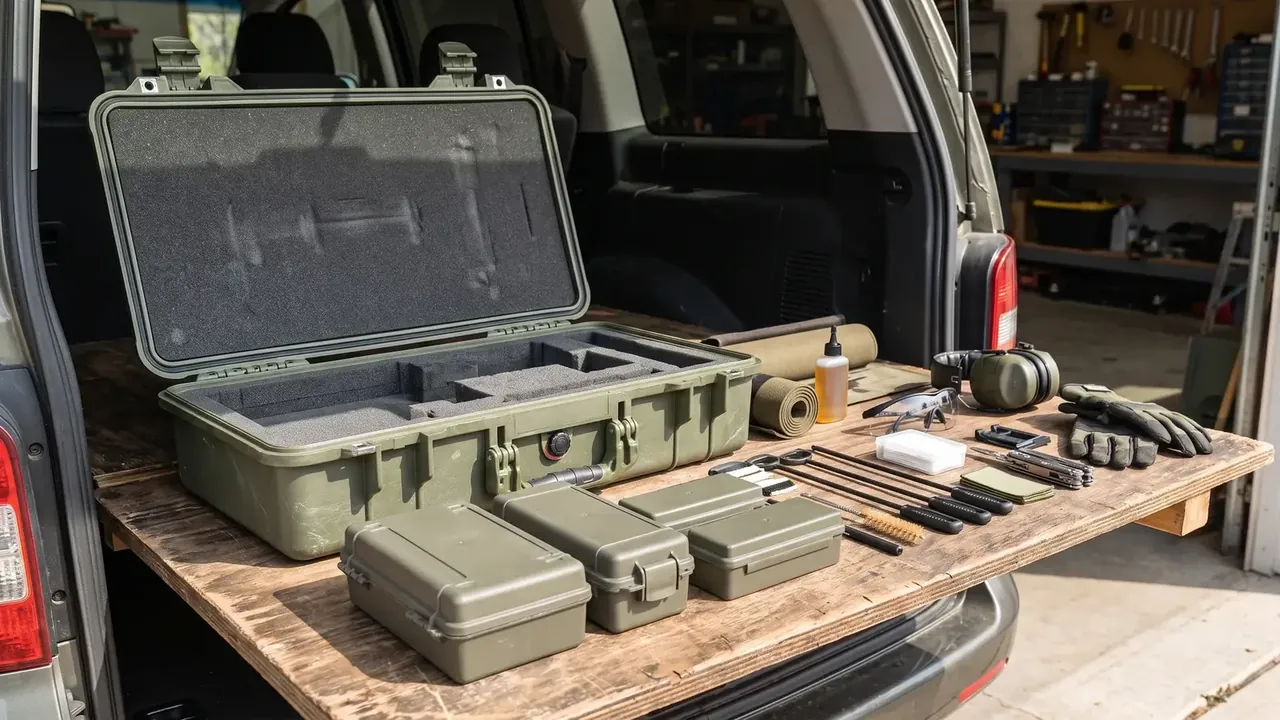
At 18 kg over 200 m, the depth of the finger crease shows whether the handle is wide enough. Below 30 mm of section the grip fails.
Inside, the foam splits into a long cavity, an accessory cavity and a slot for rods and oil, each with a 15 mm lip.
What fails is rarely the foam; it is the lid. In wind it flips back, the hinge loads the wrong way, and the pin deforms.
One habit gets skipped: fastening all four latches before loading. With two closed, the lid shifts 2 to 3 mm on rough ground, and gun case production takes the blame.
5. Assembly Checklist: Four Moves and Three Failures
- Measure the swing: 750 mm in front so the lid passes 100 degrees.
- Lay the pad: 20 mm EPDM across the base, 15 percent compression.
- Fit the anchors: four M8 anchors at 12 N·m, tightened diagonally.
- Test the carry: 18 kg over 200 m, no crease, no rock.
All three failures come at the end of the job. A pad laid only in the middle leaves corners floating, and stress marks show within three months. A strap over the lid dishes it and slows gasket recovery. Standing on the case is the third, because an 8 mm rib keeps a dent after one step.
Conclusion
Four sites reduce to four figures: lid angle, pad compression, stack height, handle section. Fix those and gun case production holds its place.
This article discusses only the container (case body) side of specifications and design intent, and does not cover any handling, loading or use of the contents.
Related Reading
- Gun case production audit: equipment, process and records
- Gun case production: mold, foam and latch in three steps
- Gun case selection: four criteria that decide the shell
- Gun case versus the alternatives
Related Products
- 8 Series — Gun Cases; Military Equipment Cases; Camera Equipment Cases; Drone Cases; Watch Cases; Knife Cases; First Aid Cases; Electronics Equipment Cases
- WL8-2812 PP Gun Case — model WL8-2812
- All protective cases and toolboxes: 7 series, 158 models