

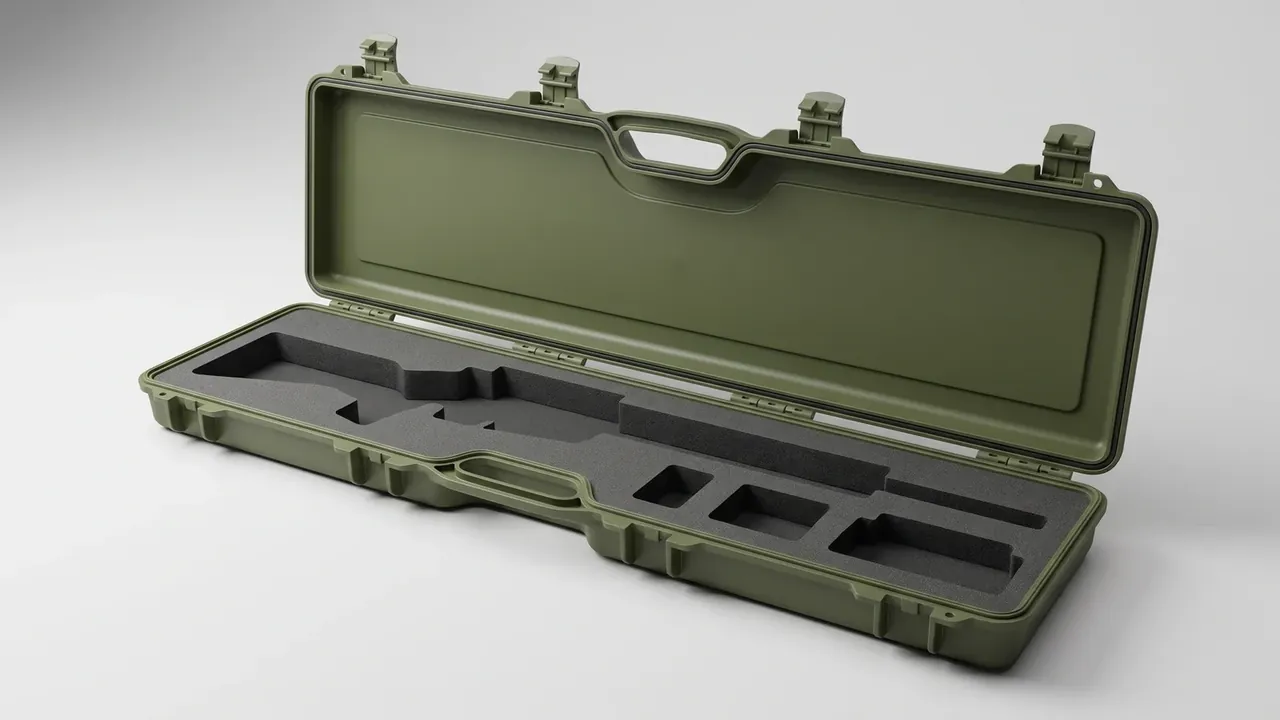
Quick answer: Three jobs should not go down the gun case production route: a case that never moves, one cycled under 20 times a year, one carrying under 3 kg. Where IP67 and ±0.5 mm tolerance matter, nothing replaces it.
Table of contents
- Start by Cutting One Habit: Hard Shells Are Not the Default
- Against Rotomolded: Two Curves of Wall Thickness and Weight
- Against Aluminium and Soft Bags: Three Threshold Numbers
- When Gun Case Production Is the Wrong Route
- FAQ
1. Start by Cutting One Habit: Hard Shells Are Not the Default
Most enquiries open with a request to cut a mold, which is where they drift. A tool takes 6 to 8 weeks, and a cavity change means new slides. The wrong shell shows its cost in month three.
Ask three questions first: how often the case moves, the heaviest load, and whether immersion or washdown is required.
| Route | Wall | Weight | Sealing | Tolerance | Price paid |
|---|---|---|---|---|---|
| Injection shell | 3 mm | 6.4 kg | IP67 | ±0.5 mm | tooling, 6 week lead |
| Rotomolded | 6 mm | 9.8 kg | IP67 | ±1.5 mm | weight, cavity drift |
| Aluminium | 1.8 mm | 7.2 kg | IP54 and up | ±0.8 mm | dents that stay |
| Soft bag | 900D | 1.1 kg | none | none | 800 N crush |
The top two rows differ in weight and tolerance, not ingress rating. Gun case production holds the wall at 3 mm for IP67 at 6.4 kg; rotomolding doubles the wall and lands at 9.8 kg.
Screen by weight, then tolerance, then rating. Reverse it and you pay for unused numbers.
2. Against Rotomolded: Two Curves of Wall Thickness and Weight
Going from 3 mm to 6 mm lifts impact resistance in step, not weight. Rotomolding adds 3.4 kg, and 200 m of carrying changes the job.
Cold is where rotomolding wins. At −25℃ and a 1.2 m drop a PE shell cracks without shattering; an injection PP shell needs impact modifier to match.
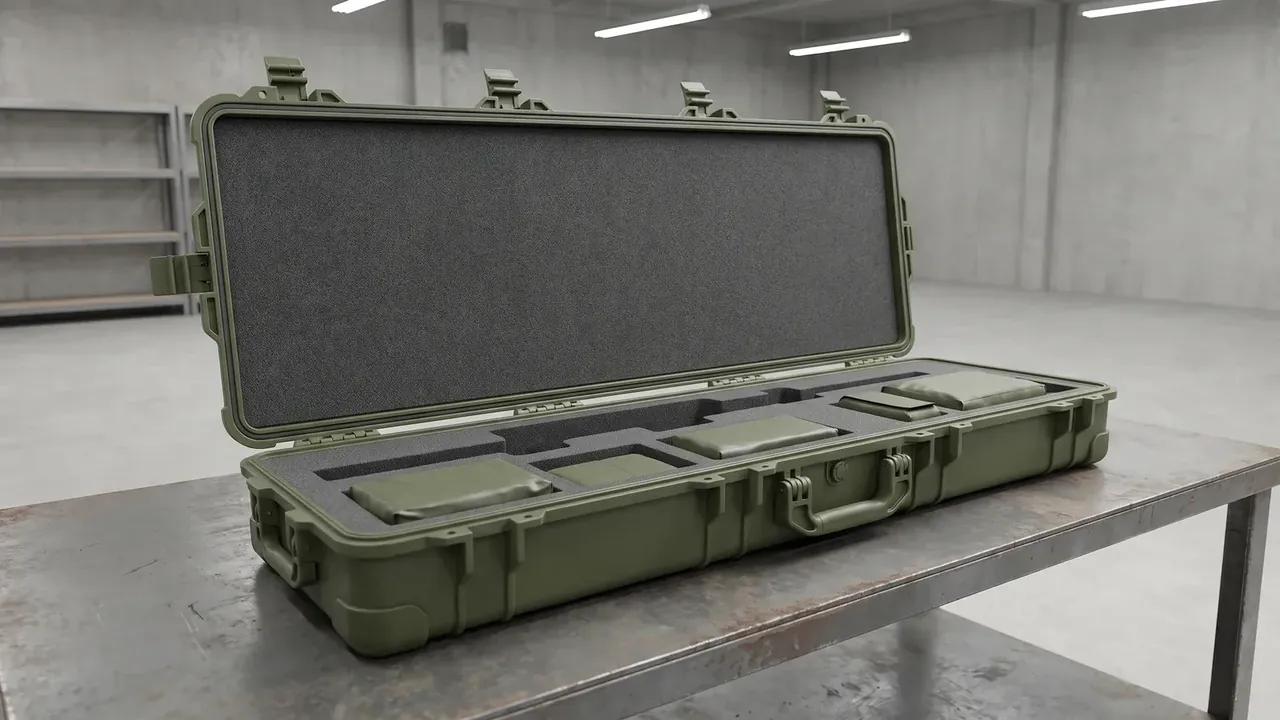
Tolerance is where injection wins. Across a 1200 mm cavity it holds ±0.5 mm, so foam pockets need no allowance. Rotomolding drifts about 1.5 mm batch to batch, so foam is cut per batch: one drawing, three runs, two liner revisions.
3. Against Aluminium and Soft Bags: Three Threshold Numbers
Aluminium sits in the middle at 7.2 kg, from 1.8 mm sheet and a riveted frame. Its weakness is the dent: once a corner folds, the sealing face is out of flat.
A soft bag is lightest at 1.1 kg with 800 N of crush. That covers a narrow job: items under 3 kg, two stacked, no water.
| Criterion | Threshold | Route that fits |
|---|---|---|
| Single case load | above 25 kg | rotomolded with wheels |
| Cycles per year | under 20 | soft bag or aluminium |
| Ingress need | immersion or washdown | injection shell, IP67 |
| Foam fit | ±0.5 mm | injection shell |
| Service temperature | below −30℃ | rotomolded |
None of these is a hard wall. A case cycled 18 times a year is cheaper as a bag replaced every second year; at 200 cycles the bag goes three times.
4. When Gun Case Production Is the Wrong Route
Four jobs where a hard shell does not pay back.
- A fixed store position: under 20 openings a year uses neither seal nor impact resistance, and a steel cabinet costs less.
- Daily carrying under 3 kg: a 1.1 kg bag is enough, the extra 5 kg is dead weight.
- An inspection post opened all shift: four latches take 8 seconds, and 50 cycles a day is 400 seconds.
- Prototypes whose cavity changes per batch: a 6 to 8 week tool plus a revision runs past the slot.
Three jobs cannot leave it: immersion transfer needing IP67, foam cut to ±0.5 mm, a 25 kg load for one person.
A bag looks cheap until it is replaced every second year, three across five, while a shell runs five. That sum spreads over cycles, not price. Aluminium is light, but one dent flattens the sealing face and IP54 falls below IPX2. Rotomolding is tough, yet 9.8 kg turns a 200 m carry into a chore. Injection is limited by tooling and lead time. All four routes return to weight, tolerance and cycles, and gun case production cannot solve a job that barely moves.
What gets rejected is the order of work, not the shell.
Conclusion
A hard shell is one route out of four, not the default. Put weight, tolerance and cycles on paper and any route holds; skip that and gun case production becomes the expensive one.
This article discusses only the container (case body) side of specifications and design intent, and does not cover any handling, loading or use of the contents.
Related Reading
- Gun case production audit: equipment, process and records
- Gun case production: mold, foam and latch in three steps
- Cartridge box materials: four routes compared
Related Products
- 8 Series — Gun Cases; Military Equipment Cases; Camera Equipment Cases; Drone Cases; Watch Cases; Knife Cases; First Aid Cases; Electronics Equipment Cases
- WL8-2812 PP Gun Case — model WL8-2812
- All protective cases and toolboxes: 7 series, 158 models