

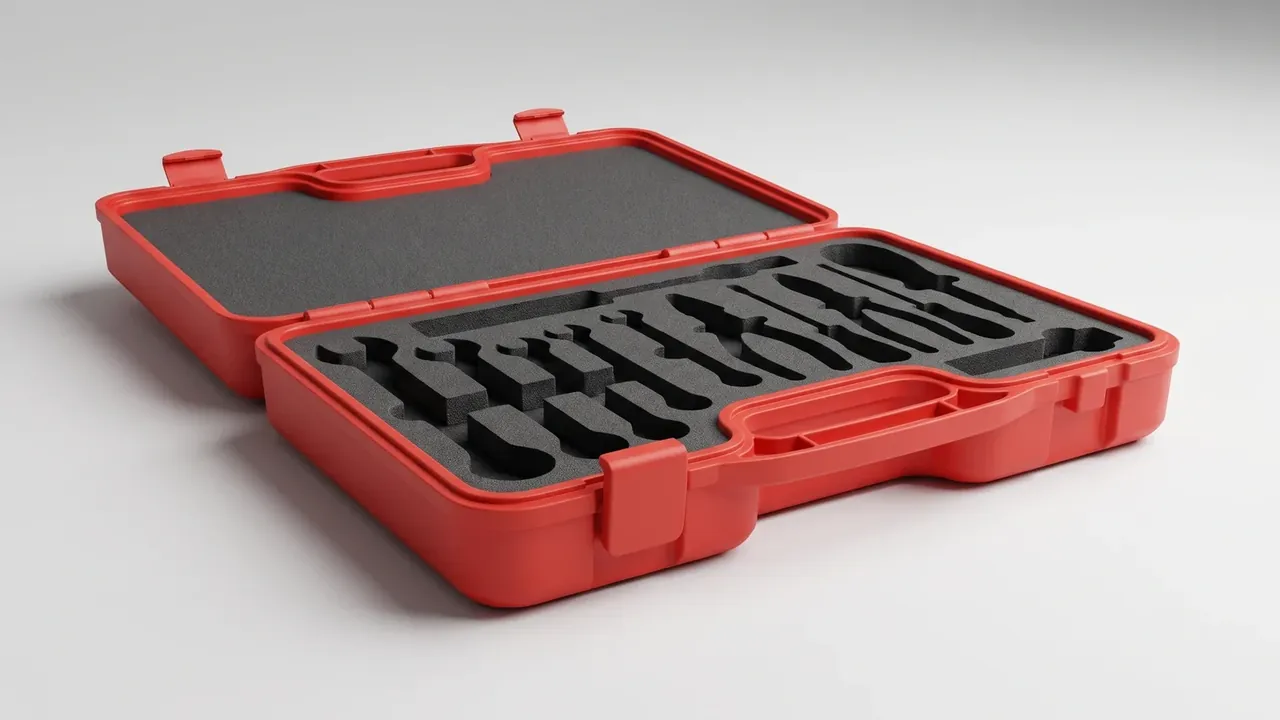
Quick answer: A hand tools case fails in a fixed order — insert first, latch second, handle root last. Maintenance is a schedule rather than a cleaning routine: a 90-second daily check, a 15-minute monthly check and a 30-minute quarterly check, each against a measured limit.
Table of contents
- Hand tools case maintenance: setting the inspection cycle
- Reseating the insert and the dividers
- Reading hinge and latch wear
- Crack checks on the handle and the shell
- Repair or retire: where the line falls
- FAQ
1. Hand tools case maintenance: setting the inspection cycle
Put the check into the shift routine before buying cleaner: after each shift scan the slots, press each latch for the click, shake the handle. Frequency follows opening cycles — a station opening a hand tools case twenty times a day reaches the attention band at 2000 cycles, a spare opened five times a day is still tight after four years.
| Part | Interval | Limit |
|---|---|---|
| Insert slots | Every shift | One empty slot, 1 mm offset |
| Latch | Weekly | Audible click, no slack |
| Hinge | Monthly | Axial play within 0.4 mm |
| Handle | Weekly | No whitening, no free play |
| Wall, corners | Quarterly | Wall loss within 8 percent |
2. Reseating the insert and the dividers
Insert movement is the most underrated failure. Trays locate on the wall and on clips, and tools returned with oil rub the slot edges until they round over within six months. Once a slot is more than 1 mm off the outline, lift the sheet and press it back.
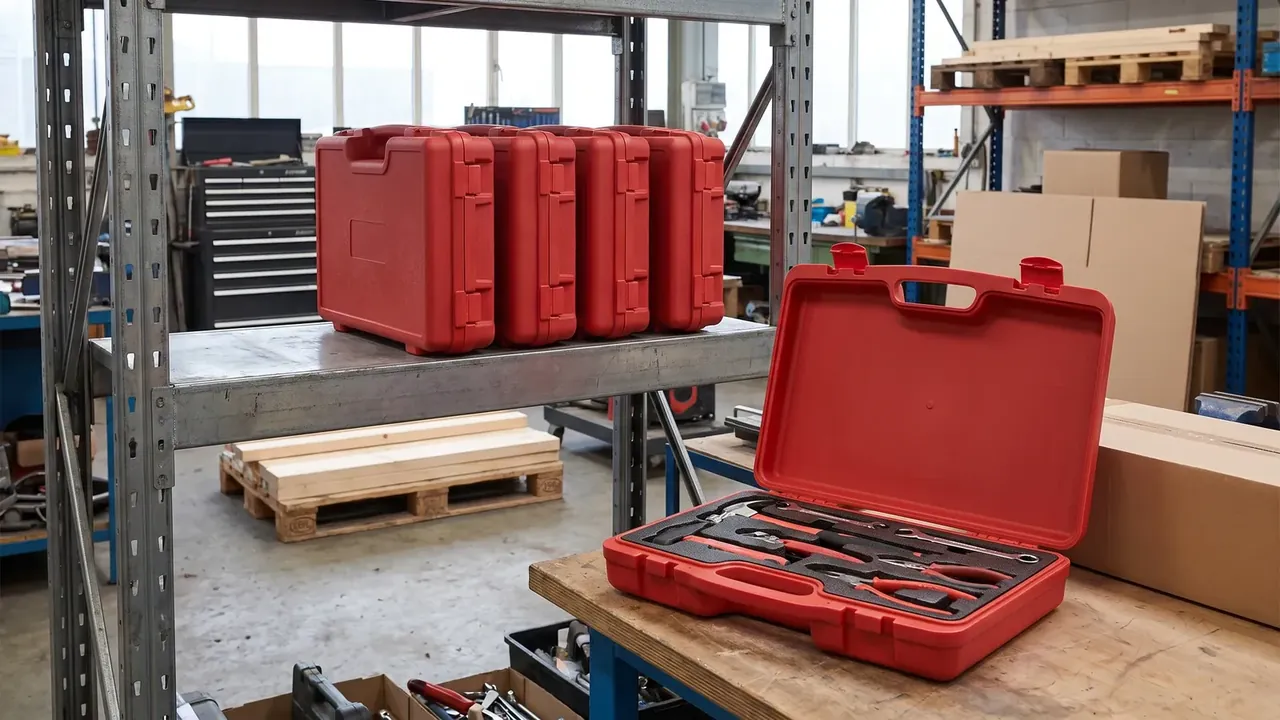
Reseat from the largest slot down, heavy pieces low, precision pieces above. Wipe oiled tools first, since mineral oil swells polyethylene, and replace a divider plate once two clips break — tape only tilts the grid. Clean at pH 6 to 8 below 40 °C and stand the case open for thirty minutes; solvent on foam leaves a crust that sheds at every draw.
3. Reading hinge and latch wear
Open the lid to ninety degrees and press the rim: the vertical movement is axial play at the pin. Past 0.4 mm the seam stops pressing evenly, and once the pin wears oval the gap grows within a month or two — a pin costs far less than a case. Lubricate with one rice grain of silicone grease per end per quarter.
Latch wear is read by force. A new latch closes at 35 to 45 N, and below 25 N the spring is tired and the lid rim lifts by a millimetre or two. Change broken teeth and change parts in pairs; one new latch against a worn one biases the clamp.
| Part | Normal | Stop line |
|---|---|---|
| Hinge play | within 0.2 mm | above 0.4 mm |
| Latch force | above 35 N | below 25 N |
| Handle root | no colour change | crack catches a nail |
| Seam | even contact | lift above 2 mm |
4. Crack checks on the handle and the shell
The handle carries the highest stress: at a 20 kg load the root sees several times the average wall stress, so cracks start at the radius where handle meets lid. Check against the light and with a fingertip; whitening shows as a slight ridge, meaning the chains are orienting.
Once a crack catches a fingernail and passes 8 mm, stop carrying the case and downgrade it to fixed storage. Shell cracks start at corner bumpers and rib roots, which take impact when the case is set down. Polypropylene loses impact strength below −10 °C, so a winter drop outdoors needs an immediate re-check.
5. Repair or retire: where the line falls
A scratch under 0.3 mm closes with a hot-air weld at 220 °C using the same material as filler, then sanding and a mist test. A through crack, a broken hinge seat or cavity distortion over 2 mm is structural: a patch only shifts the stress to either side.
Five parts are worth replacing: latch, hinge pin, handle, insert and ID plate. Wall loss above 8 percent, or a second repair in the same place, sends the case to scrap. Three years or 1000 cycles, whichever comes first, triggers a full assessment in the register.
Conclusion
Maintenance earns its own procedure because a hand tools case fails at maximum load, not on a shelf. Write interval, part and limit onto the shift checklist and repair stops being a matter of judgement. With no grey zone between repairable and scrap, the hand tools case is under control.
This article covers container-side specifications and design implications only, not the handling, loading or use of the contents.
Related Reading
- What a hand tools case is: a unit built for item location
- How a hand tools case differs from its alternatives
- Daily care and corrosion control for metal tool chests
- Common problems with tool box lids and how to handle them
Related Products
- 8 Series — Gun Cases; Military Equipment Cases; Camera Equipment Cases; Drone Cases; Watch Cases; Knife Cases; First Aid Cases; Electronics Equipment Cases
- WL8-2812 PP Gun Case — model WL8-2812
- All protective cases and toolboxes: 7 series, 158 models