

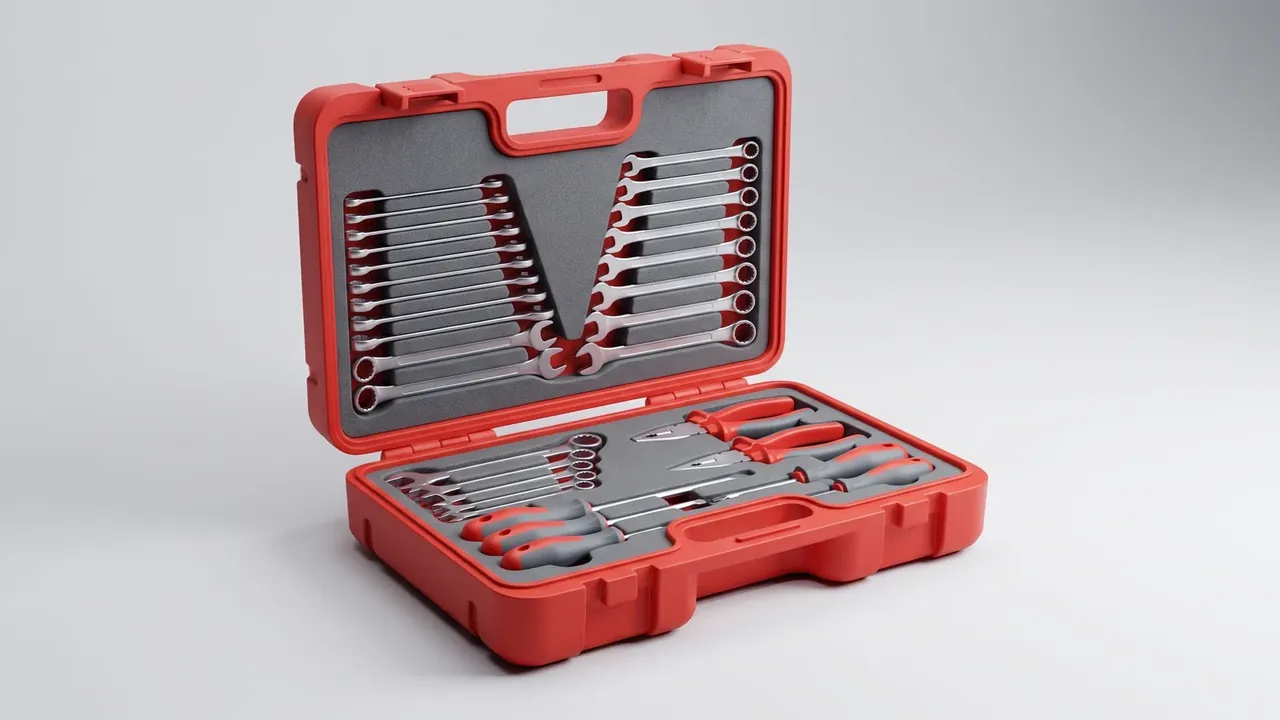
Quick answer: Hand tools case standards rest on seven testable items: appearance, dimensions, insert fit, latch force, drop, stacking and salt spray. Sample to GB/T 2828.1 level II with AQL 1.0 for major defects, 2.5 for minor, zero tolerance for critical. Written into the inspection sheet, the limits give the same verdict whoever repeats the check.
Table of contents
- Hand tools case standards: the seven incoming checks
- Sampling plans and acceptance numbers
- Defect classes and how they are judged
- Six type tests before shipment
- Records, traceability and re-inspection
- FAQ
1. Hand tools case standards: the seven incoming checks
Incoming inspection decides whether a lot can be received.
| Check | Gauge or rig | Limit |
|---|---|---|
| Appearance, colour | Colour chip, 10× loupe | ΔE within 1.5, flash under 0.3 mm |
| Envelope size | Vernier, granite plate | ±2 mm, diagonal within 3 mm |
| Insert fit | Feeler gauge, sample tool | 0.5 to 2 mm gap, no rattle |
| Latch force | Pull gauge, hook fixture | Holding 120 N, opening 45 to 85 N |
| Drop | Drop rig, concrete base | 1.2 m loaded, no crack, latch holds |
| Stacking | Stack frame, weights | 400 kg for 24 h, set within 3 mm |
| Salt spray | Neutral chamber | 48 h, rust under 5 percent |
The last three need equipment and run as type checks: first article, material change, stoppage over thirty days. Insert fit is usually written as "no visible defect", yet no eye sees the 0.3 mm offset that jams pliers.
2. Sampling plans and acceptance numbers
Sample to GB/T 2828.1, normal inspection, single sampling, level II: lot size gives the letter, the letter the sample size, AQL the acceptance numbers.
| Lot size | Code | Sample | AQL 1.0 | AQL 2.5 |
|---|---|---|---|---|
| 151 to 280 | G | 32 | 1 / 2 | 2 / 3 |
| 281 to 500 | H | 50 | 1 / 2 | 3 / 4 |
| 501 to 1200 | J | 80 | 2 / 3 | 5 / 6 |
| 1201 to 3200 | K | 125 | 3 / 4 | 7 / 8 |
Judge major and minor separately; five accepted lots move to reduced inspection, one rejection to tightened.
3. Defect classes and how they are judged
Classification splits "reject" into three actions: critical rejects the lot, major is judged at AQL 1.0, minor at 2.5 can be sorted and resubmitted.
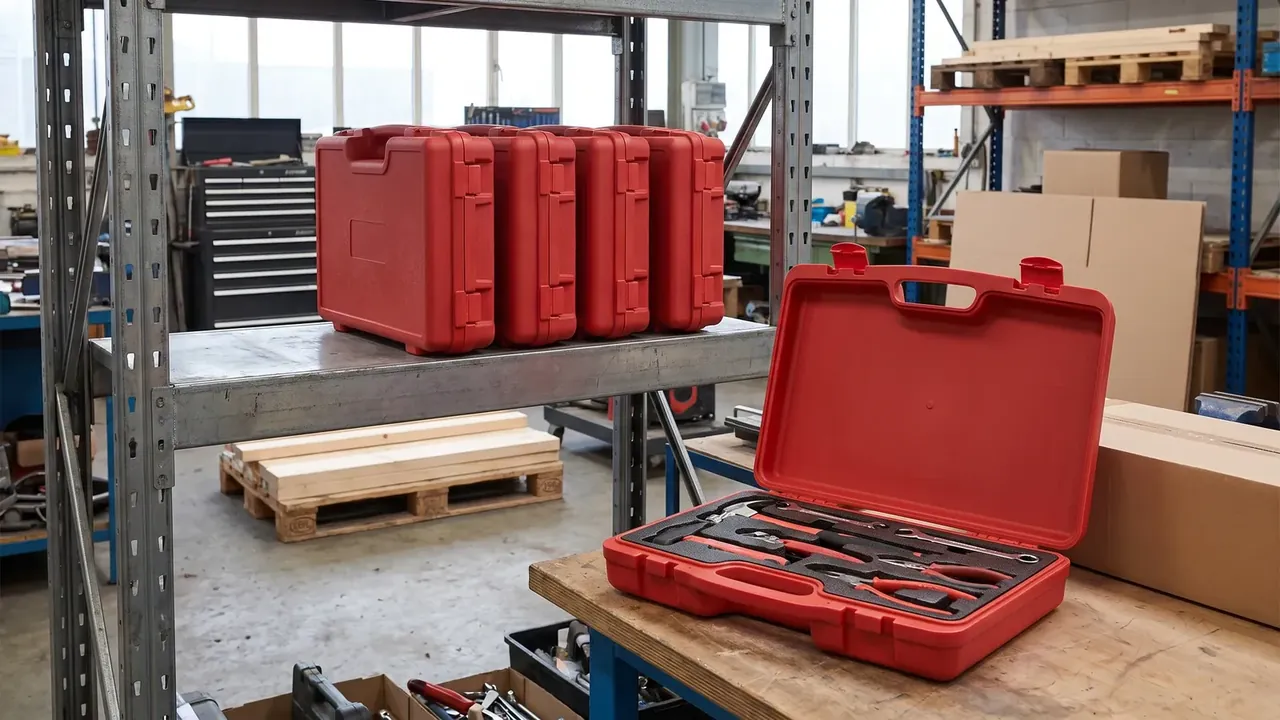
Keep the critical list short: a latch that releases itself when closed, a handle that breaks under load, an insert that lifts to expose metal, a sharp edge within reach. Any one is a design problem, not a sampling issue. Where they blur, ask whether a tool can fall out or a hand tools case can gap in transit.
4. Six type tests before shipment
Type tests judge the model rather than the lot: six of them cover transport, storage and climate stress, and the report travels with the goods.
| Test | Parameter | Pass criterion |
|---|---|---|
| Drop | 1.2 m loaded, ten drops | No crack, latch holds, insert seated |
| Stacking | 400 kg, 24 h | Set within 3 mm |
| Salt spray | Neutral, 48 h | Rust under 5 percent |
| Latch life | 3000 cycles | Holding force within −20 percent |
| Vibration | 10 to 55 Hz, 2 h | No loosening, no rattle |
| Thermal | −20 and 60 °C, three cycles | No crack, no permanent set |
Draw samples at random: units built for the test pass while production does not.
5. Records, traceability and re-inspection
Records narrow the search after a failure. An eight-digit lot code — date, machine, shift, such as 260318A2 — on the base and on the insert back means one lot when both match, mixed production when they do not. A cavity number decides whether a lot or one position is quarantined.
Keep two samples per lot for twelve months, records for three years. Re-inspection triggers: the same complaint twice, a new supplier, stock over six months. The third is forgotten most often: plasticiser migration makes latches brittle, so a hand tools case cracks on opening with no production fault.
Conclusion
A standard does not keep bad units out so much as tell the supplier where the door is: seven items say what to measure, the plan how much, the classes how to judge. In the contract, they give hand tools case quality a floor that holds across shifts.
This article covers container-side specifications and design implications only, not the handling, loading or use of the contents.
Related Reading
- The positioning and structural logic of a hand tools case
- Quality control points in case assembly
- The inspection flow for military supply cases
- Choosing between a hand tools case and other formats
Related Products
- 8 Series — Gun Cases; Military Equipment Cases; Camera Equipment Cases; Drone Cases; Watch Cases; Knife Cases; First Aid Cases; Electronics Equipment Cases
- WL8-2812 PP Gun Case — model WL8-2812
- All protective cases and toolboxes: 7 series, 158 models