

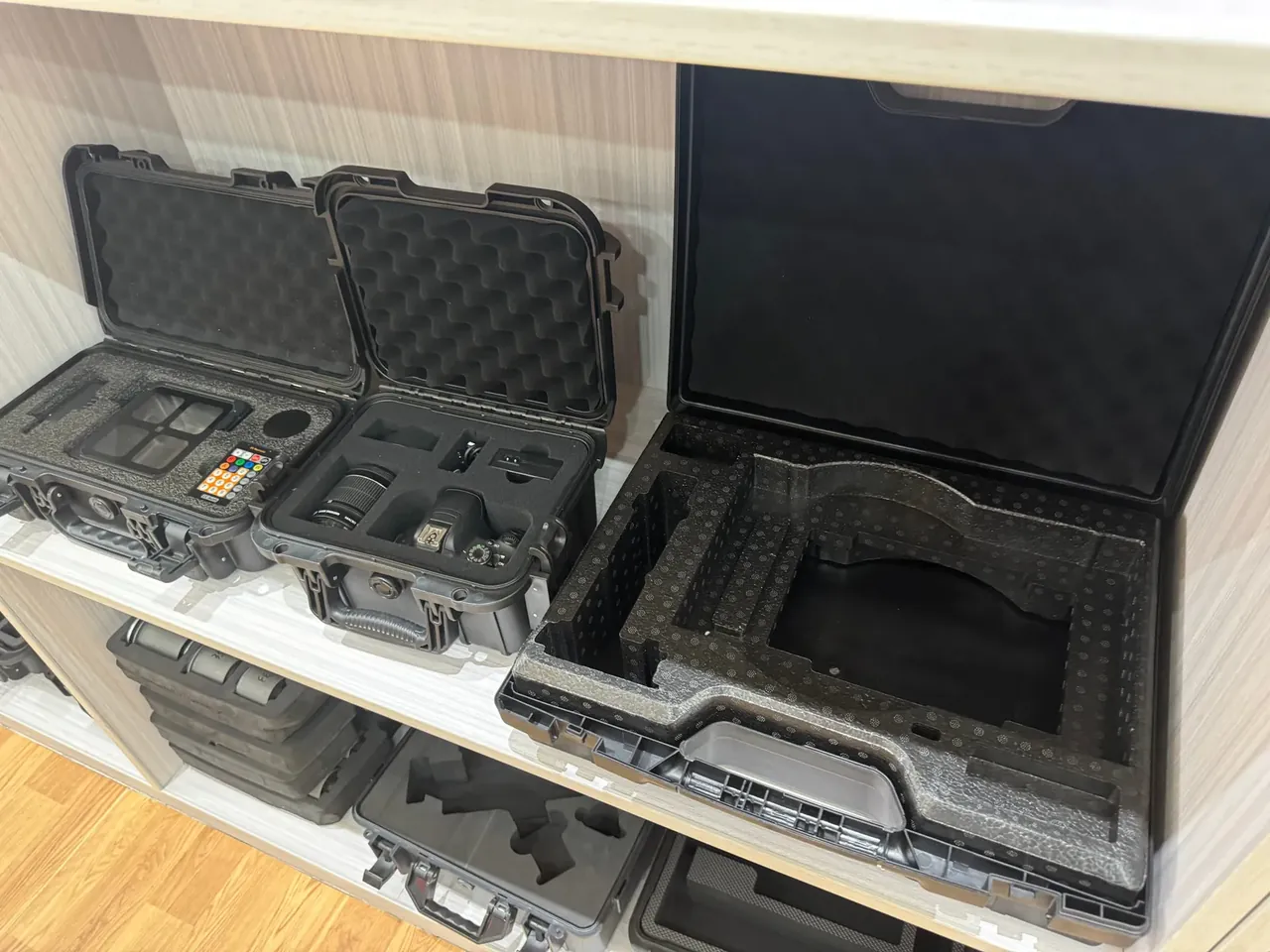
Quick answer: A handheld LED light stick protective box is built against bending, not impact: end bosses and a mid support carry 50 kg of static load off a 60 cm tube.
Table of contents
- Why a light stick fails under load, not impact
- Compression structure of a long case
- Making room for tube and diffuser
- Securing magnetic bases and clamps
- Power accessories and spare battery compartments
- FAQ
1. Why a light stick fails under load, not impact
A tube pressed by other gear inside a bag fails more often than one dropped on the floor. A 60 cm tube measures 42 mm across, with LEDs bonded to an aluminium wall and 1.82 kg with the battery grip. The centre of gravity sits at one end, and a handheld LED light stick protective box must assume the tube gets bent, not dropped.
Impact is short, bending is long. The case can stretch a 1.0 m drop over enough foam travel for the tube to shed energy. It cannot for a 2 kg accessory resting on the lid overnight: the lid dishes 2 mm, the tube follows, and the curve stays.
| Load type | How it shows | What the box does |
|---|---|---|
| Vertical squeeze in a backpack | Slight bow at mid-span, diffuser unclips | Centre rib, 3 mm clearance above and below |
| Lateral stacking in a vehicle | Lid dishes, tube ends push the wall | Thickened end bosses, double-wall lid |
| A single footfall | Local dent over the LED row | Egg-box ribs, load lands on ribs |
| Long static load | Case creeps, the seam opens | 3 mm wall, checked at 50 kg for 1 min |
Only the first row is visible when the lid comes off. That is why a handheld LED light stick protective box is tested with the tube inside, powered to 100% afterwards, looking for a dark patch in the beam.
2. Compression structure of a long case
A handheld LED light stick protective box carries bending on three lines: two long edges and one centre rib. Going from a 2.5 mm wall to 3 mm raises bending stiffness about 1.7 times, since stiffness follows the cube of thickness. The rib then cuts a 600 mm free span into two 300 mm spans, dropping mid-span deflection to roughly a quarter.
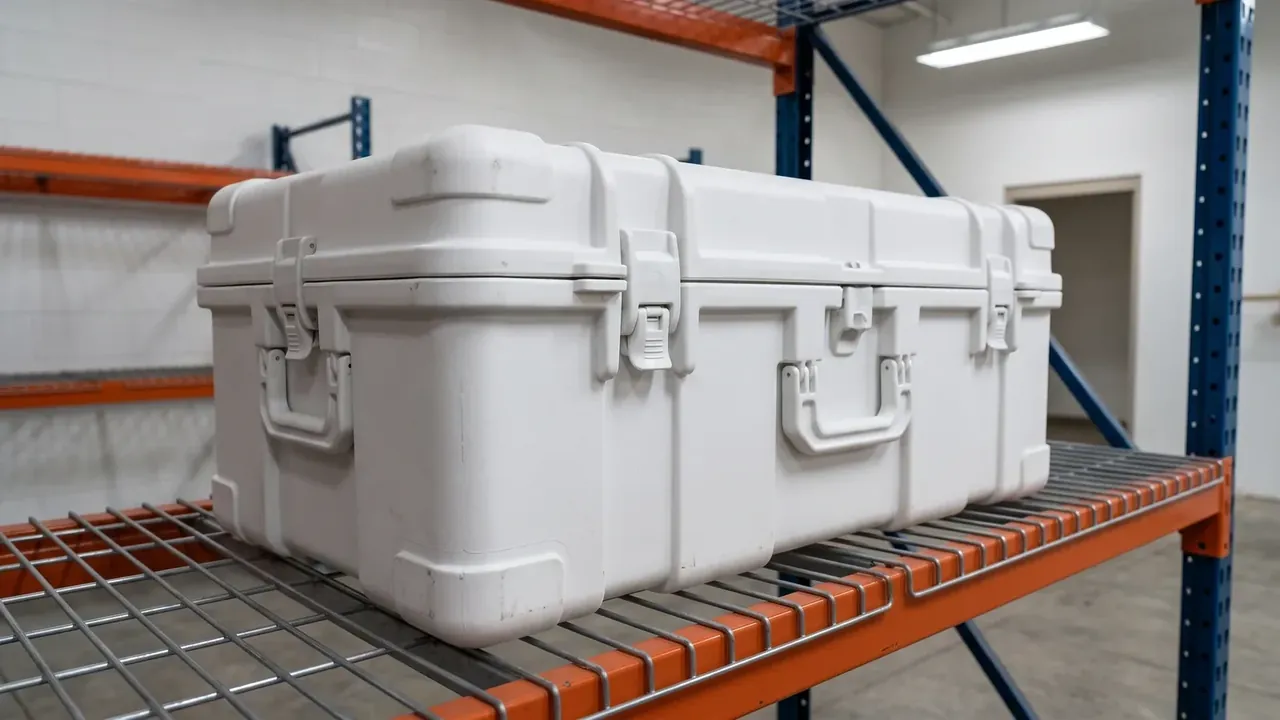
Static load is checked to GB/T 4857.3-2008, with the machine route following GB/T 4857.4-2008, identical to ISO 12048, at 10±3 mm/min and a stacking load at a safety factor of 1.8 to 2.5. A 50 kg rating means those conditions go into the acceptance sheet.
The pass or fail line is short: a tube that shows visible bow after 50 kg of static load for 1 min fails the case. In practice the tube goes into the box, a platen presses the lid for 1 min, and a 300 mm straightedge is laid along the tube; a gap over 0.5 mm counts as bow.
Empty weight belongs between 1 and 2 kg; at a 5 to 1 length-to-width ratio it is too light to build inertia. Longer cases need a handle within 30 mm of the centre of gravity, or the case nods with every step.
3. Making room for tube and diffuser
A handheld LED light stick protective box starts from the factory carton, 680 mm × 130 mm × 120 mm for a 60 cm tube, and adds 5 mm per side. The tube then drops in without force and lifts out without a shake; shrink the cavity and the diffuser takes the load first.
The diffuser is wider than the tube, so the cavity is cut in two lobes. The tube section is bored to 42 mm plus 2 mm, the diffuser section to its outside diameter plus 3 mm, and a 45 degree taper joins them. The taper leaves the clip in open space, where it never bears on a wall.
Extraction should stay under 15 N, enough for a thumb and forefinger on the middle of the tube. Past that, people tip and shake the case, and the threaded hole knocks the wall until the rim burrs.
The egg-crate foam in the lid must not touch the diffuser. Closed, a 3 mm gap held by the double-wall lid; once the foam presses, every closing adds a point load to the tube.
4. Securing magnetic bases and clamps
Magnetic bases hold neodymium discs strong enough to hang the tube from a steel frame. A handheld LED light stick protective box gives each base its own cavity with a 1 mm cold-rolled steel plate bonded to the floor, so the base snaps down and cannot tumble.
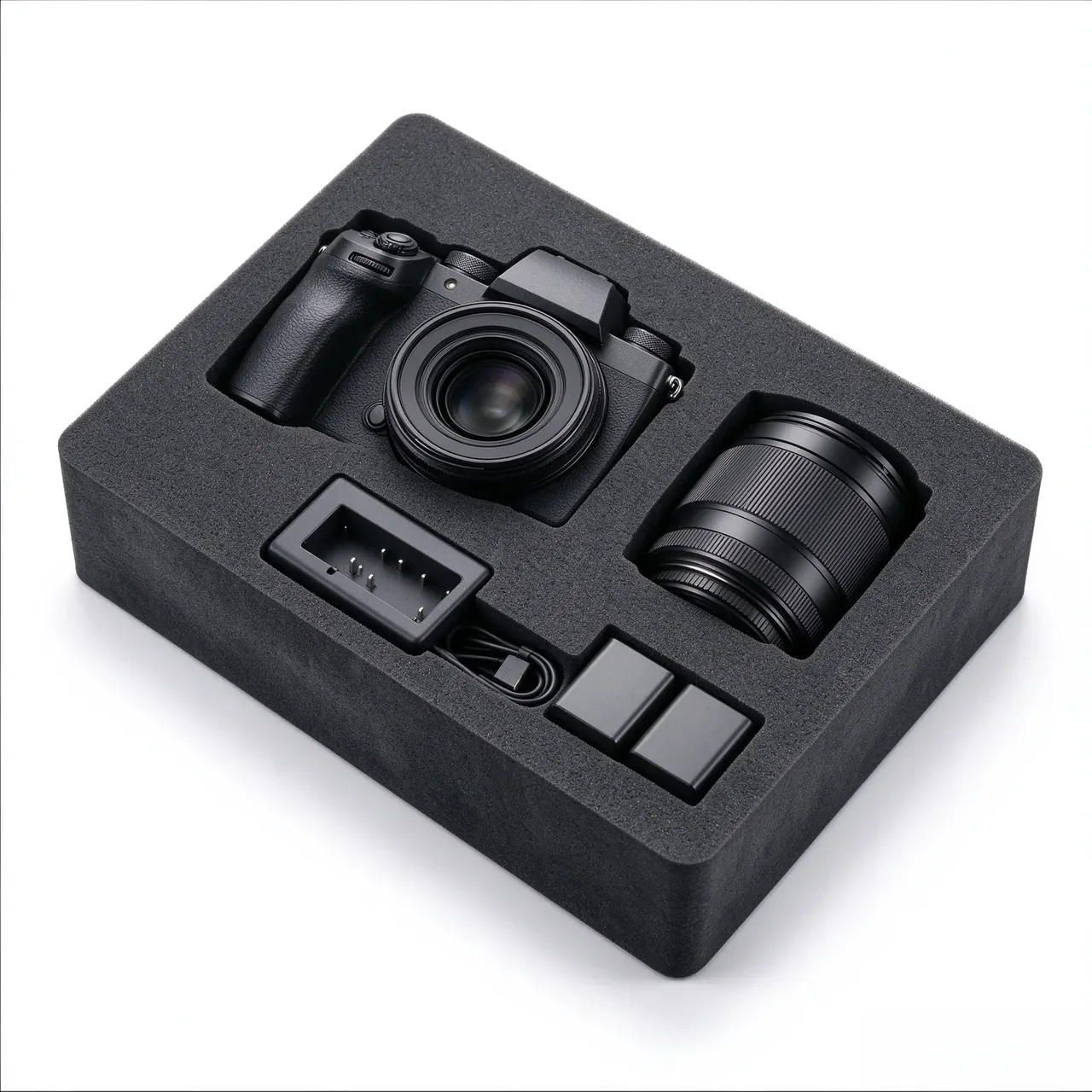
Clamps are the awkward half of the kit: screw clamps, articulating arms and cold-shoe adapters, irregular and all metal. A handheld LED light stick protective box gives each set its own cavity in 45 kg/m³ EVA, with a 20 mm nylon strap across the mouth to press the middle of the clamp.
Magnets should never share a bay with electronics. Keep the bases a bay away from the driver board, with a 10 mm EVA divider; a magnet against a battery terminal collects steel dust until the contact fails. Load everything, close the lid, invert for 30 s, then open: parts that stay seated will stay seated on the road.
5. Power accessories and spare battery compartments
Cells run from 2600 to 5200 mAh, and 60 cm models often carry 5200 mAh for about 4 h at full output. They stand upright with terminals facing up, in slots 2 mm wider than the pack, so fingers grip the sides instead of prying at a terminal.
Inside a handheld LED light stick protective box, chargers and cables get their own bay. A charger is rigid, a cable soft; mixed together the cable takes a kink that breaks strands. Coil it to 80 mm, close it with hook-and-loop, put it in the lid mesh, and give the charger a cavity 5 mm deeper than its thickness.
Temperature needs a margin too. Tubes are rated −10 to 40 ℃, cells lose discharge capability outside that band, and a summer in a trunk above 40 ℃ speeds capacity loss. A handheld LED light stick protective box cannot cool anything, but it can keep the battery bay away from the lid, where solar gain is lowest. Two spare cells cover a shooting day; leave a 10 mm divider so a worn wrapper cannot touch its neighbour.
Related Reading
- Heavy-duty practice for lamps and power banks
- How a hard case and a soft bag divide the work
- Wheeled lens cases on long transfers
- Plastic cases against wooden crates
JUNZHIJIA
Related Products
- 8 Series — Gun Cases; Military Equipment Cases; Camera Equipment Cases; Drone Cases; Watch Cases; Knife Cases; First Aid Cases; Electronics Equipment Cases
- WL8-2812 PP Gun Case — model WL8-2812
- All protective cases and toolboxes: 7 series, 158 models