

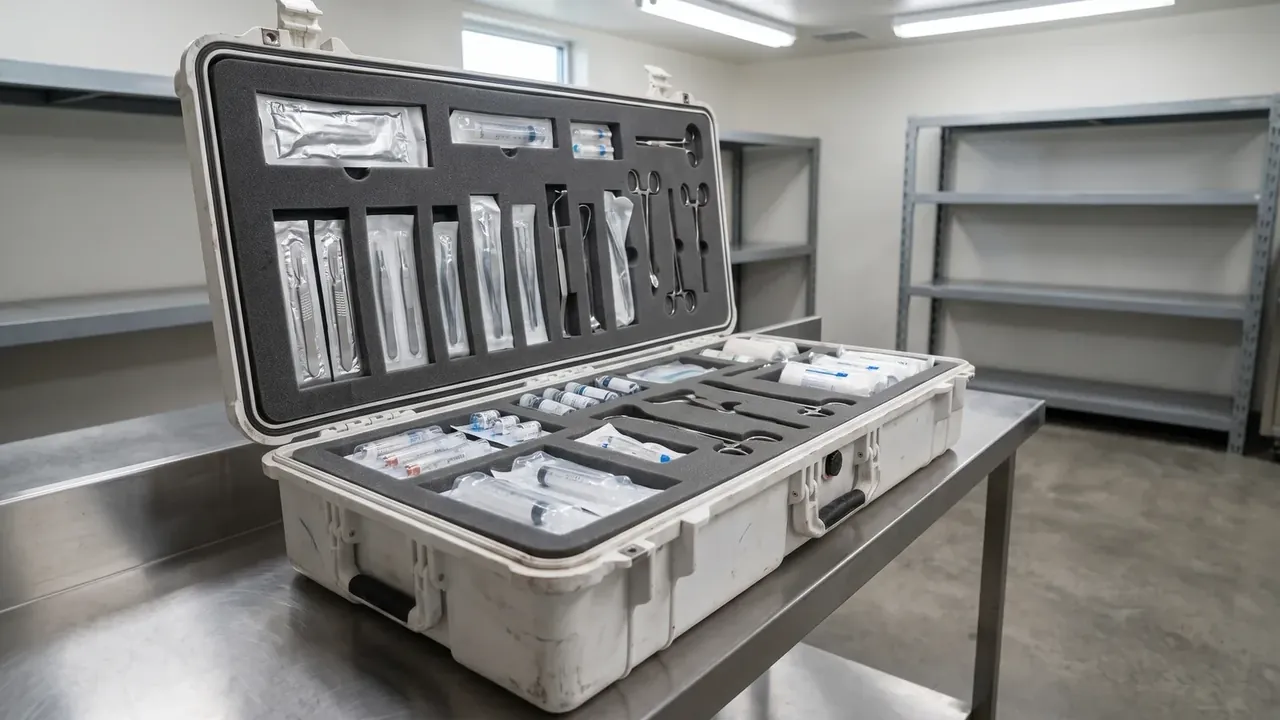
Quick answer: A Camcorder lens dustproof waterproof trolley case limits transmitted acceleration to ≤3 g across 5–200 Hz via a 30 mm pad and four mounts.
Table of contents
- Isolation targets and the sweep band of a Camcorder lens dustproof waterproof trolley case
- A 30 mm base pad and four-point axial support
- Transmissibility limits by frequency band
- Energy dissipation and rebound across the isolation chain
- Pass criteria and the full-duty envelope
- FAQ
1. Isolation targets and the sweep band of a Camcorder lens dustproof waterproof trolley case
A Camcorder lens dustproof waterproof trolley case is judged less by one drop than by continuous low-frequency vibration in transit. The shell measures 600×430×240 mm, the cavity 545×375×195 mm, wall thickness 3.8 mm, empty mass 5.6 kg, rated load 11 kg. These figures fix the pad window. Too soft and it sways near 5 Hz. Too stiff and 200 Hz energy passes straight to the support. The design treats 5–200 Hz as one continuous sweep with a single cap of 3 g at the support. Shell, lid and pad hold stiffness, seal and isolation separately. Across −15 °C to 55 °C the pad drift stays inside the sweep margin.
A 30 mm pad keeps travel in reserve at rated load; four mounts keep axial support off the weak wall mid-span. Thickening the wall only pushes resonance upward, so this two-stage path absorbs impact in the pad and routes the rest into the base ribs.
Isolation here is a division of duties, not extra material.
2. A 30 mm base pad and four-point axial support
The 30 mm pad is cut into bearing blocks with relief gaps. The four suspension points of a Camcorder lens dustproof waterproof trolley case sit inside the base corners, each a shouldered standoff linking pad to rib, sending axial load down while shear absorbs lateral motion. At 5.6 kg empty preload is small; at 11 kg loaded the pad settles near mid-travel.
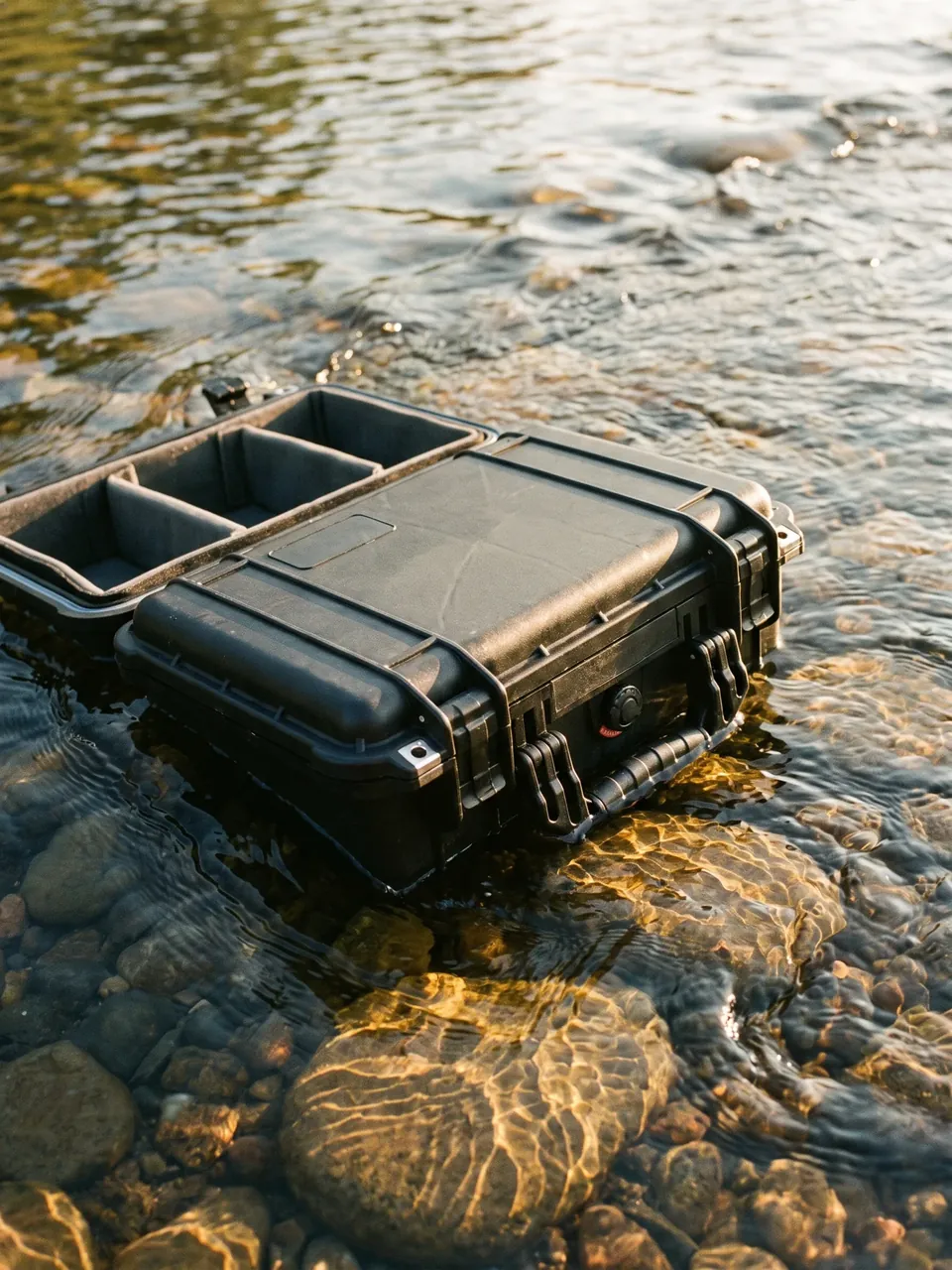
A Camcorder lens dustproof waterproof trolley case is qualified at a 1.0 m drop: guards and shell take the first layer, then energy runs through the four mounts into the pad. Foam rebound ≥95% returns slot depth after the drop. The 410 mm handle and φ58 mm wheels sit clear of the mounts; two latches at 380 N each hold the lid shut.
3. Transmissibility limits by frequency band
A Camcorder lens dustproof waterproof trolley case splits 5–200 Hz into three bands: 5–20 Hz for pad travel, 20–80 Hz for resonance, 80–200 Hz for mount isolation. All three still meet the 3 g cap, and a miss in any one fails the lot.
| Band | Dominant excitation | Transmissibility cap |
|---|---|---|
| 5–20 Hz | Large pad sway | 2.4 g |
| 20–80 Hz | Resonance and axial coupling | ≤3 g |
| 80–200 Hz | High-frequency mount transfer | 2.1 g |
Limits come from one sweep table at 11 kg with the sensor on the support, not the wall, because that is the end being protected. The 20–80 Hz band carries the least margin, flattened by damping in the 30 mm pad while the standoffs keep the peak from growing again.
4. Energy dissipation and rebound across the isolation chain
Energy crosses pad, mounts and support, each removing a share. A Camcorder lens dustproof waterproof trolley case treats them as one chain: the pad dissipates, the mounts guide, the support closes the path, so any stiffness step leaves a spike on the sweep curve. Two latches at 380 N belong to the sealing brief, not to isolation.
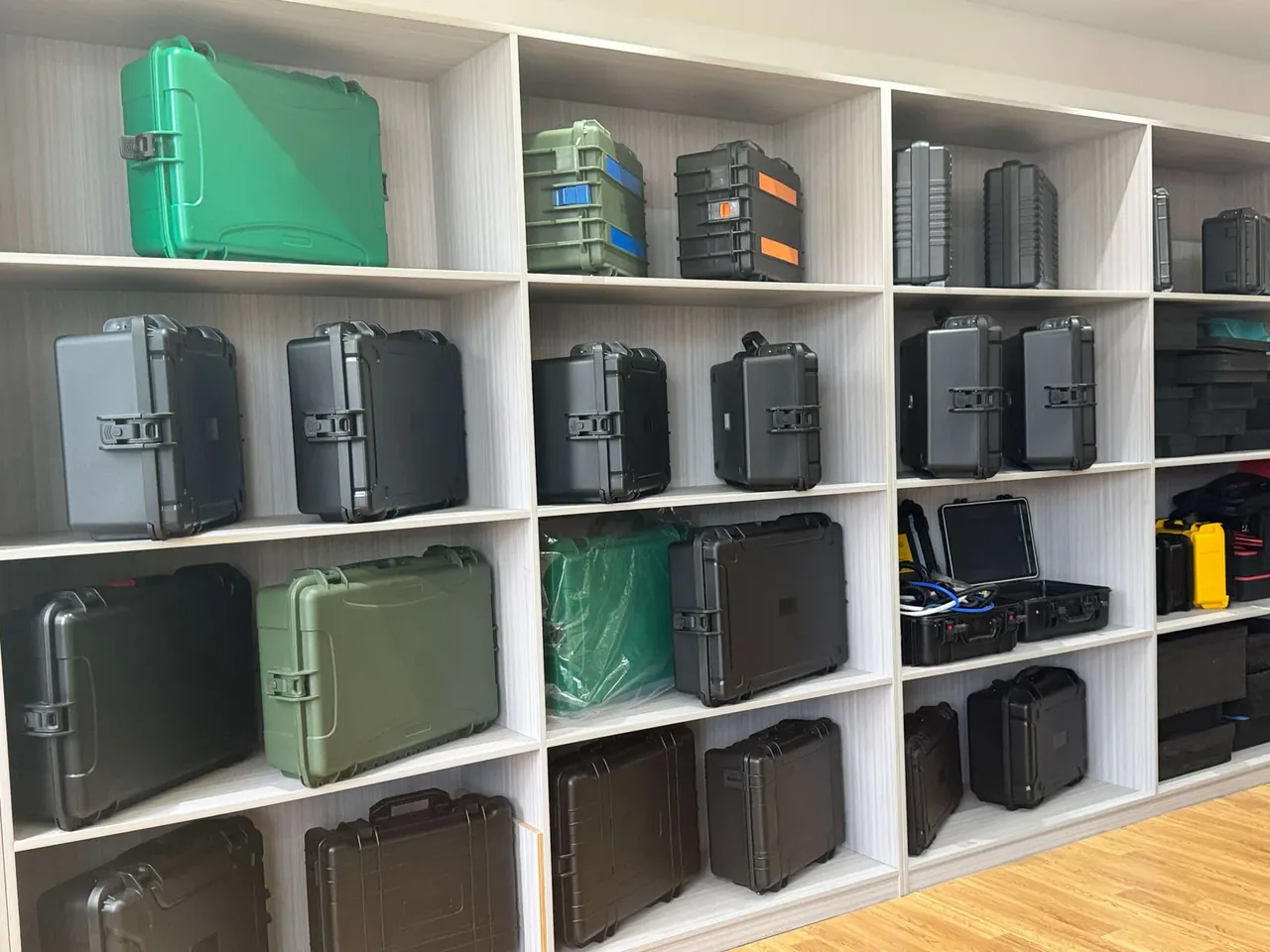
Foam rebound ≥95% means the pad recovers free height after a 1.0 m drop; below that, a second sweep climbs. Drop first, sweep again, compare the two curves, and pass only when the difference stays inside the window. The 4 h thermal hold belongs to lid seal and shell, not to isolation.
| Isolation stage | Stiffness setting | Rebound and criterion |
|---|---|---|
| 30 mm base pad | Mid-travel at rated load | Foam rebound ≥95% |
| Four suspension points | Shouldered standoff guide | No loosening after 1.0 m drop |
| Support and base ribs | Local rib closure | Transmitted acceleration ≤3 g |
The three rows follow the order load travels. Rebound is written as a structural rule that the sweep still passes after a drop, so no extra rig is needed at inspection.
5. Pass criteria and the full-duty envelope
Across the envelope, a Camcorder lens dustproof waterproof trolley case holds ≤3 g over 5–200 Hz, undeformed cavities after a 1.0 m drop with rebound ≥95%, a 4 h hold, IP67, and −15 °C to 55 °C. Transmissibility belongs to isolation, IP67 to the lid seal, the 410 mm handle and φ58 mm wheels to running gear, 380 N latches to closure; none borrows another system's margin.
| Pass value | Test condition | Structural owner |
|---|---|---|
| ≤3 g | 5–200 Hz sweep, 11 kg load | Pad and four mounts |
| ≥95% | Recovery after 1.0 m drop | Foam rebound |
| IP67 | Lid seal compressed | Lid and gasket |
Each cell states who measures what under which condition, so acceptance of a Camcorder lens dustproof waterproof trolley case is signed line by line. The −15 °C to 55 °C drift is priced into the sweep margin. A general tool box quotes one vague drop height; separating transmissibility, rebound and seal is what marks a trolley hard case off from an ordinary shell.
Conclusion
A Camcorder lens dustproof waterproof trolley case uses a 30 mm pad and four mounts to hold transmitted acceleration to ≤3 g over 5–200 Hz. Undeformed cavities and rebound ≥95% after a 1.0 m drop are the floor that keeps the structure valid. Shell, lid and gasket each own one segment, so acceptance is signed stage by stage. For long-haul trolley cases, fixing transmissibility before rebound beats a general claim about shock resistance.
Related Reading
- Selecting a camera equipment case and its insert layout
- Shell structure and sealing of a camera equipment hard case
- Specification bands for broadcast and film equipment cases
- Structural differences between a hard case and a gear bag
Related Products
- 8 Series — Gun Cases; Military Equipment Cases; Camera Equipment Cases; Drone Cases; Watch Cases; Knife Cases; First Aid Cases; Electronics Equipment Cases
- WL8-2812 PP Gun Case — model WL8-2812
- All protective cases and toolboxes: 7 series, 158 models