

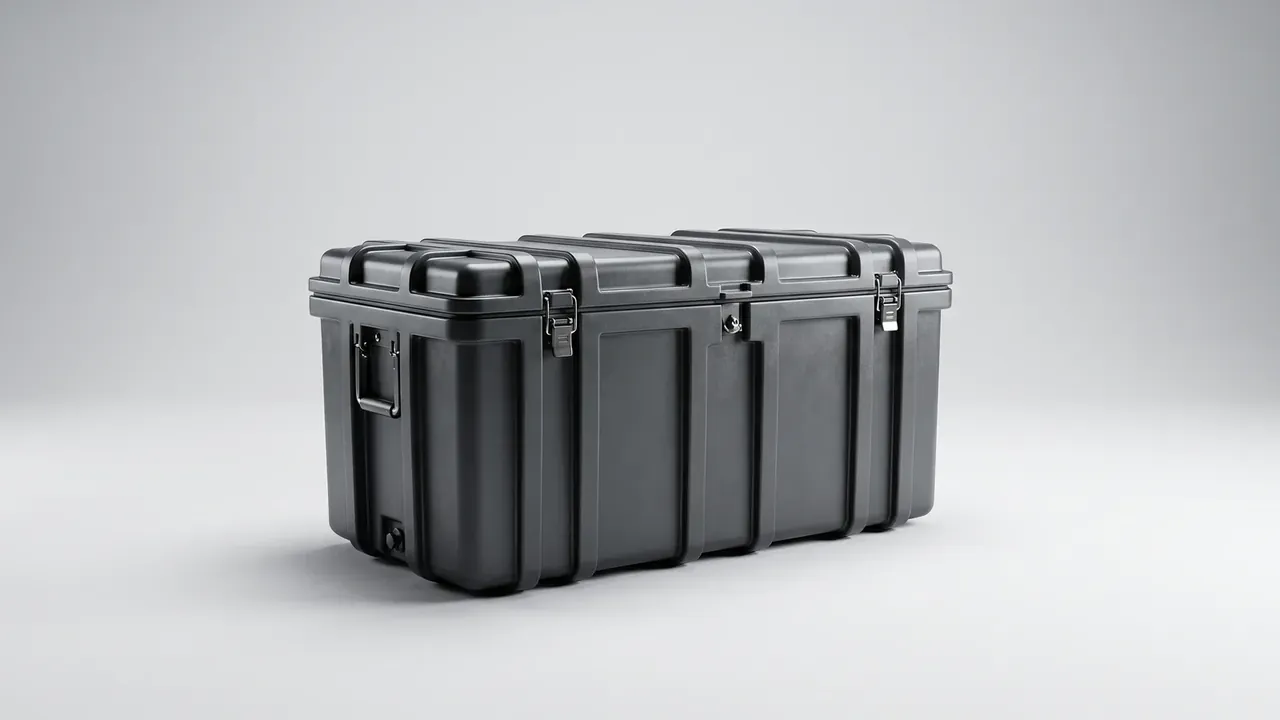
Quick answer: Judge a hard protective case by what the shell can take: wall thickness and corners, rib pitch, compression and drop results, latch and gasket retention, and whether a soft bag would do. The first four show up in a sample and a test report; the fifth stops you paying for rigidity you never use.
Table of contents
- Five criteria for a hard protective case
- Criterion 1: wall thickness and thickened corners
- Criterion 2: rib pitch and direction
- Criterion 3: compression, drop and cold impact
- Criteria 4 and 5: latches, sealing and the soft-bag boundary
- FAQ
1. Five criteria for a hard protective case
The line between a hard case and a soft bag is not surface feel but whether the shell keeps force outside the wall: the shell takes the impact, the insert spreads what is left.
Read inward: thickness and corners decide how much material exists, ribs place it, compression and drop prove both, latches hold the closing face.
| Criterion | Measure | Acceptable line |
|---|---|---|
| Thickness | Wall and base | 3.0 mm plus or minus 0.3 |
| Ribs | Height and pitch | 120 mm or less |
| Compression | Lid load | 2 mm or less |
| Latches | Retention | 1.5 kN or more |
| Soft-bag boundary | Drop height | Below 0.5 m |
2. Criterion 1: wall thickness and thickened corners
A hard protective case commonly runs a 3.0 mm side wall, 3.6 mm base and 2.8 mm lid for 25 kg. Read 30 mm below the rim and above the base, then judge by the lower figure.
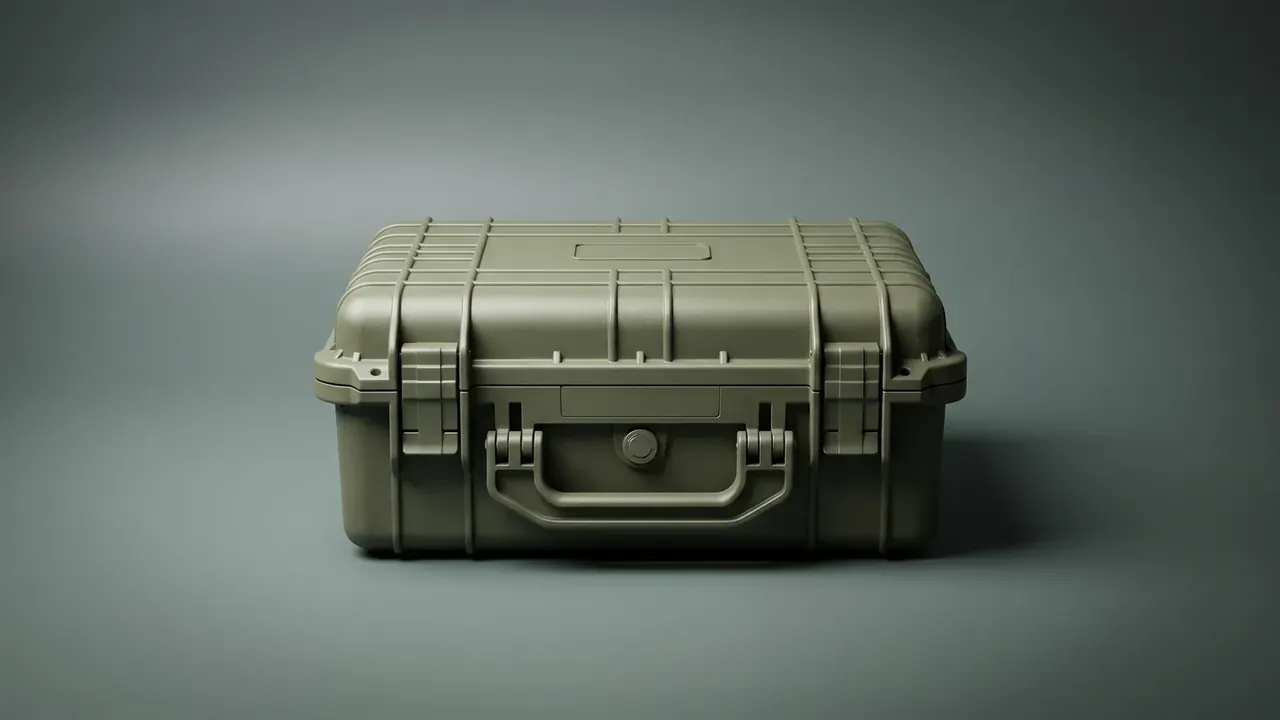
Nine readings should agree within 0.3 mm; a wider spread means uneven mould temperature; the thin patch is where a drop cracks. Corners thicken to 4.5 mm, 60 mm down and 40 mm across.
| Zone | Gauge | Note |
|---|---|---|
| Side wall | 3.0 mm | No cold-drop crack |
| Base | 3.6 mm | Light corner scuff |
| Lid | 2.8 mm | 0.5 mm centre dish |
3. Criterion 2: rib pitch and direction
Ribs turn a point load into a surface load. On a 2.8 mm lid, 8 mm height at 110 mm pitch with a 1.8 mm root holds; under 70 mm pitch, sink marks appear opposite the rib root.
Hoop ribs resist bulging, longitudinal ribs resist bending, crossings want an R3 fillet. Above 10 mm height, stacked weight lands on rib tops and the ribs crush before the lid.
4. Criterion 3: compression, drop and cold impact
Compression runs across the whole lid face: 1,200 N for 24 hours with 2 mm deflection or less. Stacked six high at 130 kg a case, the bottom unit carries 650 kg, not the single-point static rating.
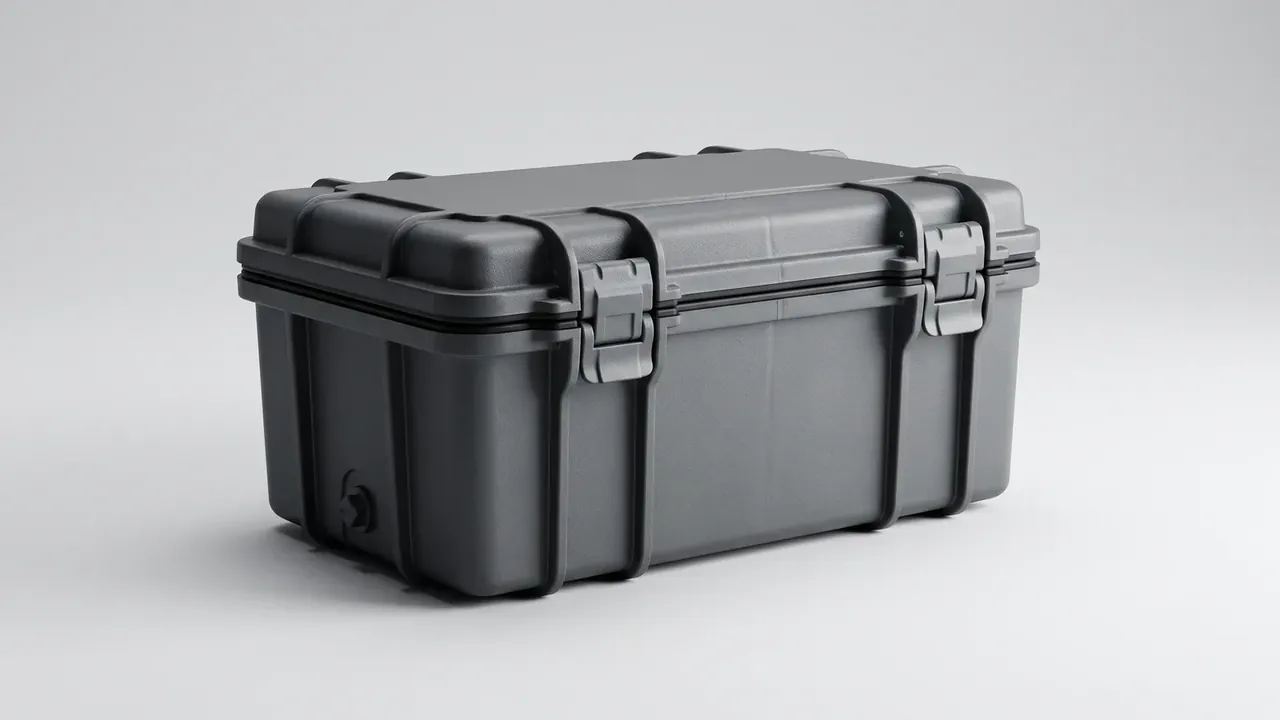
Drop testing runs ten drops at 1.2 m over six faces, three edges, one corner at 25 kg. After four hours at minus 20 C, polypropylene keeps about sixty percent of its impact strength.
| Test | Condition | Pass |
|---|---|---|
| Compression | 1,200 N, 24 hours | 2 mm or less |
| Stacking | Six high, 130 kg | No set |
| Drop, cold | Minus 20 C, four hours | No corner crack |
5. Criteria 4 and 5: latches, sealing and the soft-bag boundary
Latches run 1.5 kN retention and 60 to 90 N to open, higher than a tote box because the gasket compresses first. A 4 mm gasket wants 30 percent squeeze; at 50 percent it hardens and leaks.
The soft-bag boundary is where a hard protective case can lose the argument: Below 0.5 m of drop and 20 trips a year, a 3 mm EVA bag weighs a third of a hard shell; above 0.8 m with stacking, rigidity earns its cost.
| Condition | Hard protective case | Soft bag |
|---|---|---|
| Drop height | Above 0.8 m | Below 0.5 m |
| Trips a year | Over 20 | Under 20 |
| Stacking | Six high | No |
Conclusion
Five criteria come down to one sentence: the shell has to take the hit. Thickness and corners supply material, ribs place it, compression and drop supply evidence, latches defend the closing face, the soft-bag boundary removes unwanted rigidity. What you buy in a hard protective case is certainty about that one impact.
This article discusses only the container (case body) side of specifications and design intent, and does not cover any handling, loading or use of the contents.
Related Reading
- Reading a heavy-duty protective case spec sheet
- Sealing grades for waterproof hard cases
- Rotomoulding and wall thickness
- Selection lines for tactical hard cases
Related Products
- 8 Series — Gun Cases; Military Equipment Cases; Camera Equipment Cases; Drone Cases; Watch Cases; Knife Cases; First Aid Cases; Electronics Equipment Cases
- WL8-2812 PP Gun Case — model WL8-2812
- All protective cases and toolboxes: 7 series, 158 models