

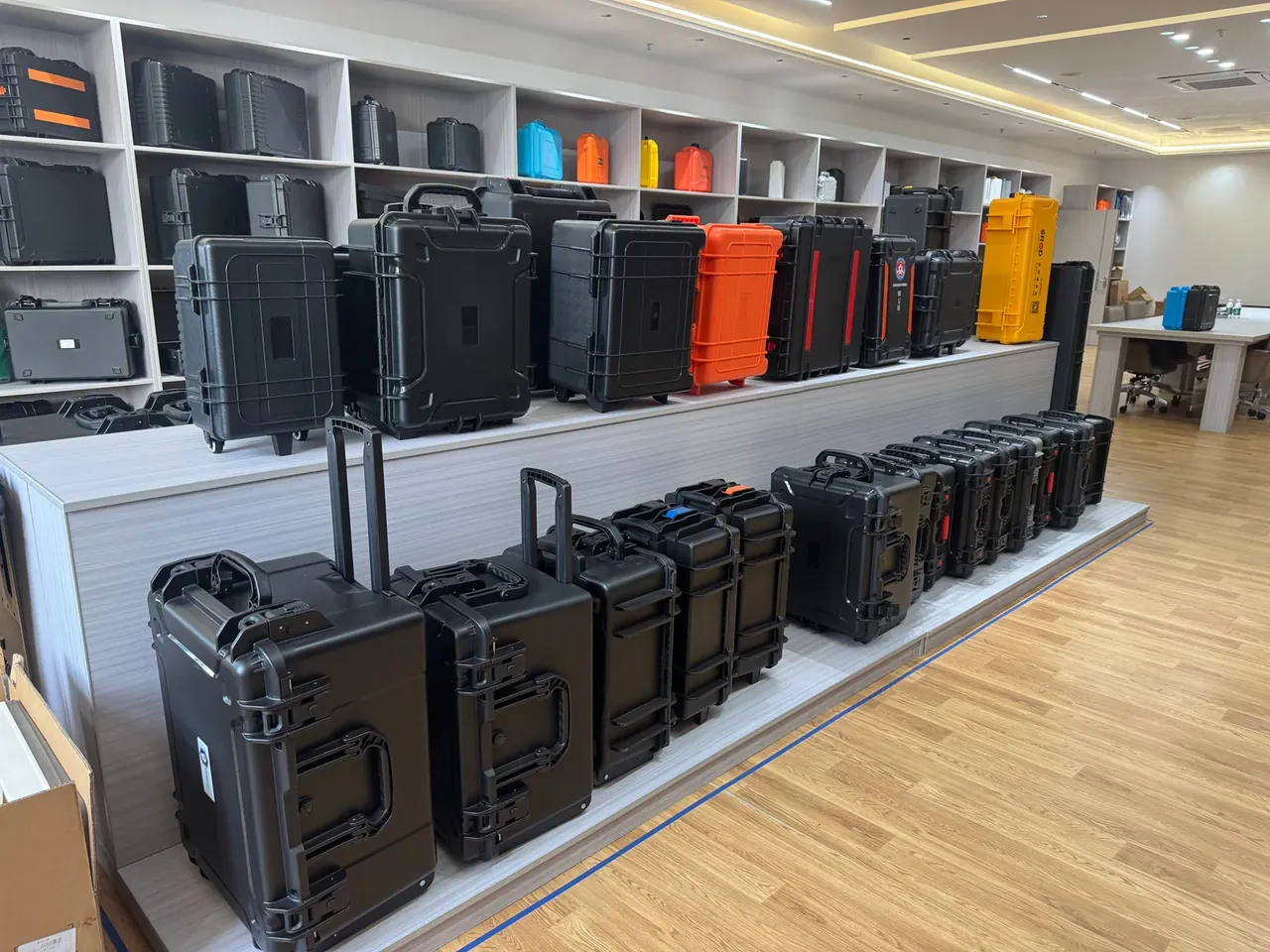
Quick answer: An Aluminum-Frame Trolley Flight Case takes 9, 12 or 15 mm plywood on a 30×30 mm frame, 100 mm castors, and a 200 kg static load for 24 hours.
Table of contents
- Slab thickness: 9 versus 15 mm
- The 30 mm frame load path
- Castors and what a 100 mm wheel clears
- Register between four stacked tiers
- Latches and lifting points
- The time budget of a changeover
- FAQ
1. Slab thickness: 9 versus 15 mm
A single LED moving head weighs 22 to 35 kg. Two side by side fill a 1200×600 mm footprint, and the load reaches the base at four points. An Aluminum-Frame Trolley Flight Case is specified from those four points, not from its outside length.
A 9 mm film-faced plywood slab over two 40 mm square tubes carries cable reels, hook clamps and folding stands to about 20 kg. A 12 mm slab takes three tubes before moving heads and amplifier racks go in. A 15 mm slab needs three 50 mm tubes plus bracing, which is where distribution boards become safe. Each extra 3 mm adds about 3 kg empty.
| Film-faced plywood | Empty weight | Typical load | Base frame |
|---|---|---|---|
| 9 mm | 18 to 20 kg | Cable reels, clamps, stands | Two 40 mm square tubes |
| 12 mm | 21 to 23 kg | Moving heads, amp racks | Three 40 mm square tubes |
| 15 mm | 24 to 26 kg | Amp arrays, distribution boards | Three 50 mm tubes plus bracing |
Thickness settled, the base raises a second question: does the middle sag when the corners take load? Acceptance rule: a 200 kg static load held 24 hours must not deflect the base past 3 mm. The check measures creep, not tier count. A base that has crept 3 mm rocks on stage, and the castors then take a skewed load.
2. The 30 mm frame load path
An impact reaches the panel, the panel passes it to the rivets, the rivets pass it to the extrusion, and the extrusion carries it through the corner blocks into the base. If one link is loose the force bends there: the panel bulges while the frame shows nothing. An Aluminum-Frame Trolley Flight Case proves its path only when the frame completes a full circuit without distortion.
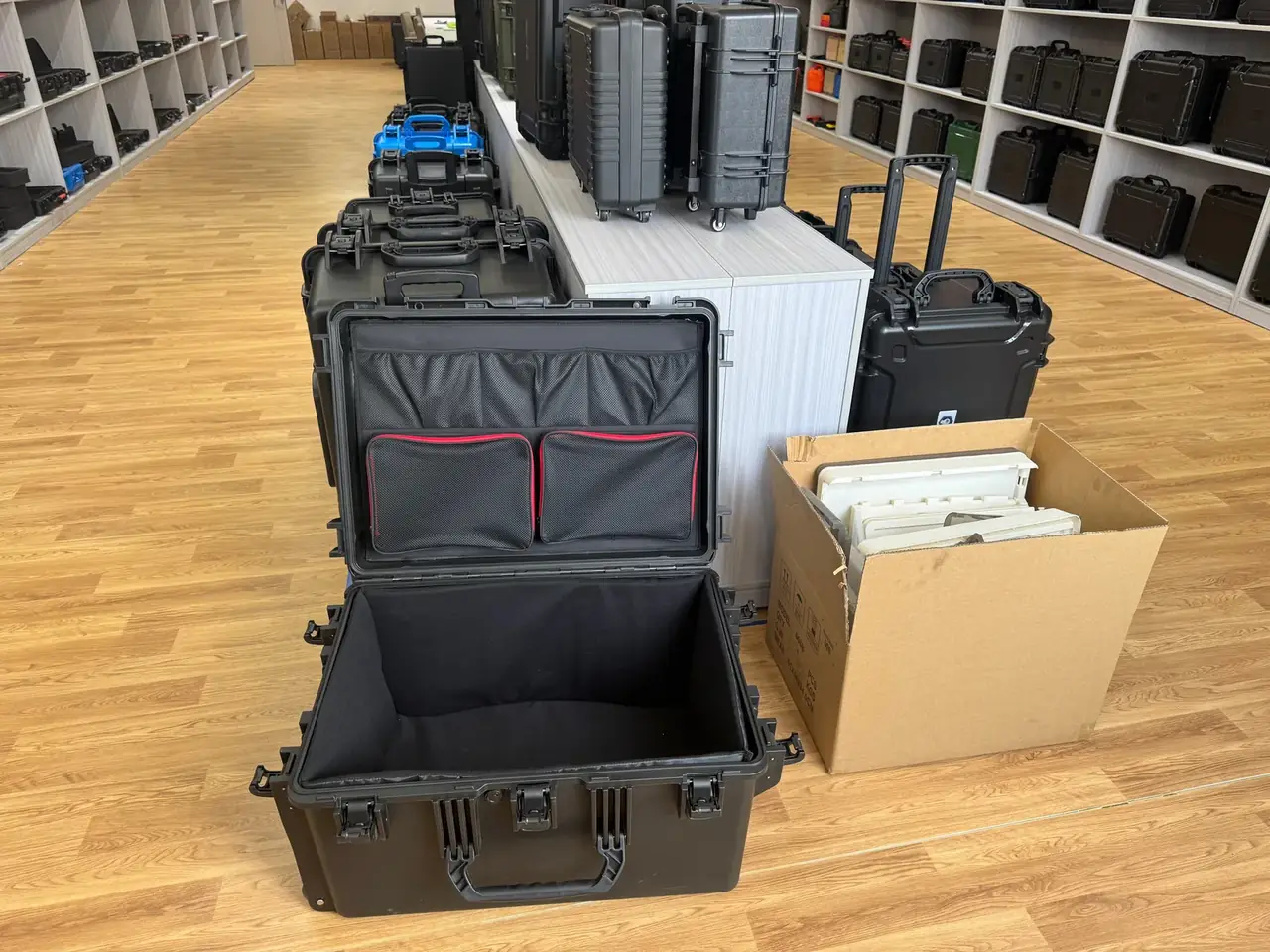
ABS expands at 70 to 90 ×10⁻⁶/K; aluminium sits near a third of that. Across 40 K the two move about 1.5 mm apart, which is why the case uses slotted rivet holes. Drill them round and the panel arches inside the frame the first time a unit comes in from a cold dock.
The corner block squares two extrusions and passes castor load into the base. Undersized blocks fail first when a case lands at an angle on a ramp: one that twists 2 mm leaves the lid needing two people pressing opposite corners to shut.
3. Castors and what a 100 mm wheel clears
A 100 mm wheel is the working size for stage cases. Venue thresholds sit at 15 to 20 mm and cable-trough covers add another 10 mm. A 100 mm castor rolls over that; below 80 mm the crew lifts a case loaded to 200 kg instead.
| Ground condition | How a 100 mm wheel behaves | What to watch |
|---|---|---|
| 15 mm backstage threshold | One person can angle it over | Keep the fork off the lip |
| 10 mm cable trough | Straight push stalls briefly | Tilt forward before pushing |
| 5 mm gravel in the yard | Hard surface only | Polyurethane tread, not nylon |
| 8 mm tail-lift seam | Both wheels cross together | Release the brake first |
Rating divides across four wheels: 200 kg static means 50 kg each, so specify 1.5 times that, or 75 kg per wheel. An Aluminum-Frame Trolley Flight Case with forks under 3 mm bends the fork before the wheel, so check the fork at every swap.
4. Register between four stacked tiers
On an Aluminum-Frame Trolley Flight Case, tiers locate on a shallow recess in each lid corner and a matching boss under each base. Deep engagement puts the fourth tier onto the solid corner of the lid below; shallow engagement drops it onto the lid panel, which dishes and lets the latches loosen.
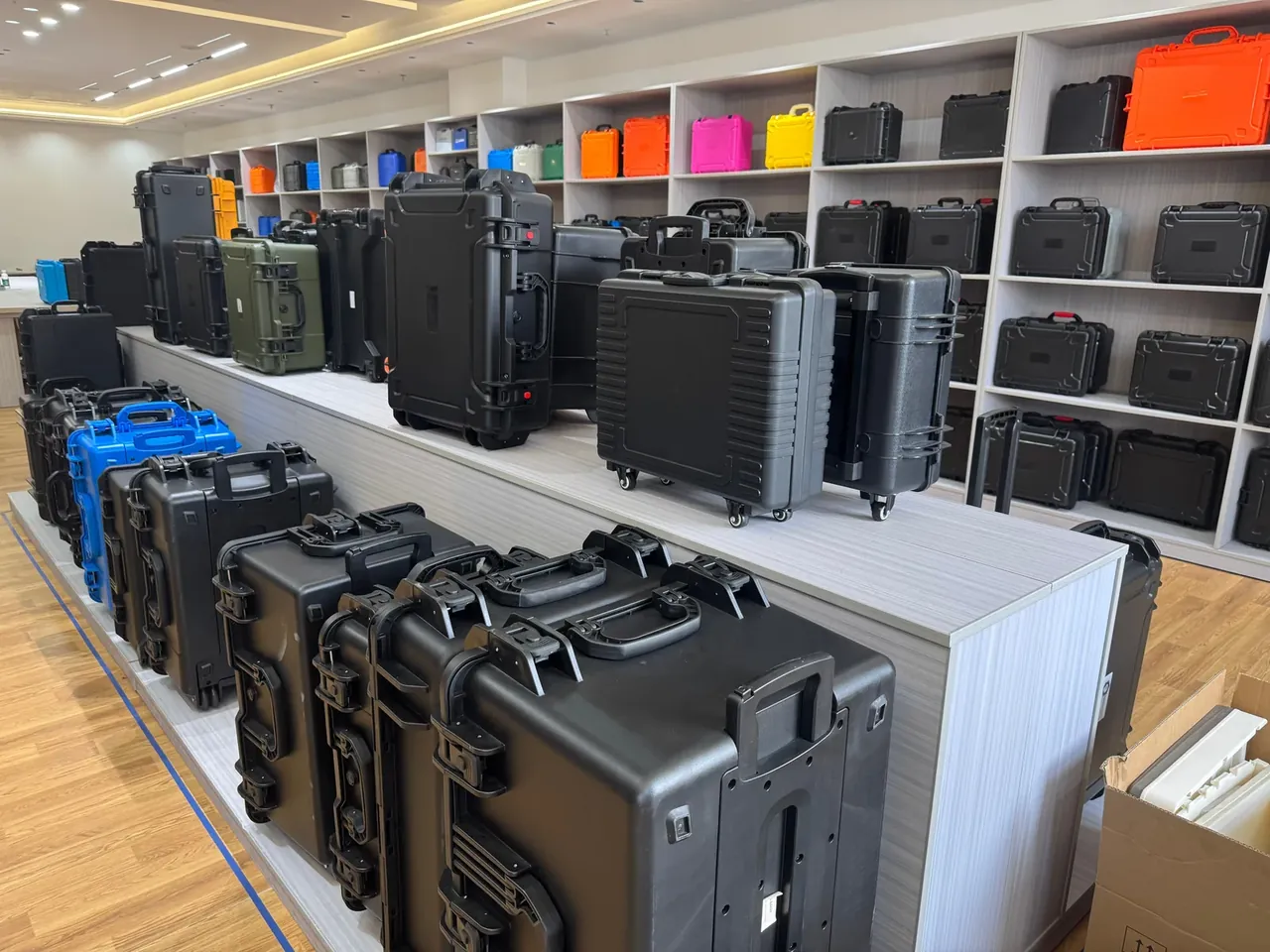
At four tiers the bottom unit carries three above it, 78 kg at 26 kg each, well inside a 200 kg base rating. An Aluminum-Frame Trolley Flight Case fails here on eccentricity rather than pressure: a 5 mm offset at the second tier becomes 20 mm at the top, and one forklift push leans the stack.
Stack four empty units and sight the side seams from two metres. Seams wandering past 10 mm mean boss and recess have worn round and the lid is due for replacement.
5. Latches and lifting points
Latches close the lid; lifting points raise the case. Sharing one extrusion lets the horizontal component of a lift pull the latches out of line, and the crew answers with a rubber mallet. An Aluminum-Frame Trolley Flight Case carries two latches per long side and one per short side, with lifting points above the corner blocks. Below a 45 degree sling angle the block rivets loosen first; move the hook inward where headroom allows.
Latch engagement depends on stamping consistency. A 20 N spread in pull force across one batch makes a crew double-check every closure, and those seconds are what eats an eight-minute load-in.
6. The time budget of a changeover
Eight minutes per case for an Aluminum-Frame Trolley Flight Case assumes four people and cases already on the floor. A twenty-case tour spends 80 minutes lowering and opening alone, and three changeovers turn that into 240 minutes.
| Step | Per case | Twenty cases |
|---|---|---|
| Lower from truck | 1 min | 20 min |
| Open and unload | 3 min | 60 min |
| Empty case back to truck | 2 min | 40 min |
| Close and latch | 2 min | 40 min |
An Aluminum-Frame Trolley Flight Case returns time through two details: a lid held by gas strut or strap needs nobody to hold it, and a 100 mm wheel crosses a threshold without a second pair of hands. The saving is a waiting step removed from the line.
The arithmetic loops back to thickness. A 15 mm case weighs 6 kg more than a 9 mm one, 120 kg across twenty cases. What it buys is static margin for a 200 kg distribution board. Light touring gear takes 9 mm, heavy installed racks take 15 mm, and 12 mm is where most theatres land.
Conclusion
The specification order for an Aluminum-Frame Trolley Flight Case runs slab, frame, castors, tier register, latches, and only then finish. Settle the first four and the changeover arithmetic is fixed; colour and marking only help the crew find a unit backstage.
Related Reading
- Matching castors to a trolley handle
- Castor bearing service intervals
- Lid stay: gas strut or strap
- Plastic case versus wooden crate
JUNZHIJIA
Related Products
- 8 Series — Gun Cases; Military Equipment Cases; Camera Equipment Cases; Drone Cases; Watch Cases; Knife Cases; First Aid Cases; Electronics Equipment Cases
- WL8-2812 PP Gun Case — model WL8-2812
- All protective cases and toolboxes: 7 series, 158 models