

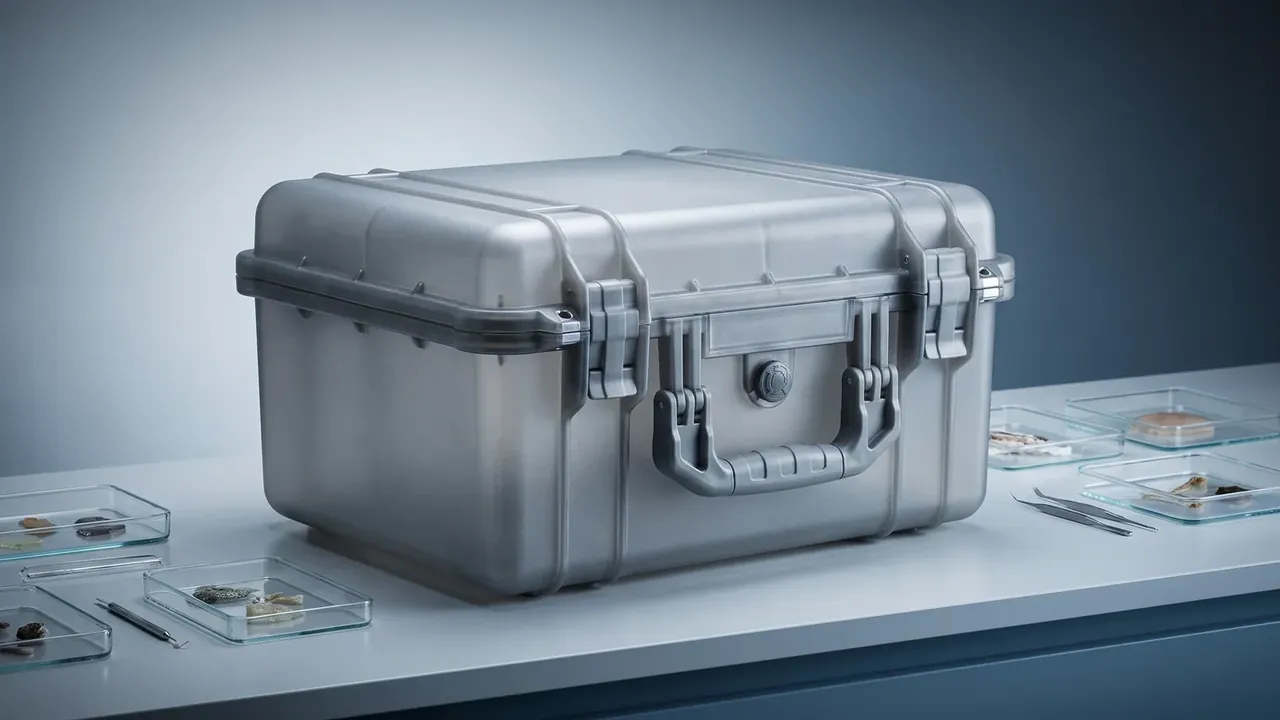
Quick answer: Five details separate a heavy-duty protective case: wall and rib proportions, corner and edge cushioning, the twin-lip seal and valve, the load path through hinges, and rated feet and lifting points.
Table of contents
- How a Heavy-Duty Protective Case Pairs Wall and Ribs
- Corners and Edges: Steering Force Around the Wall
- Sealing and Pressure Relief: Two Lips and One Valve
- Heavy Hinges and Latches: Where Closing Force Comes From
- Feet and Lifting Points: Stacking and Hoisting Arithmetic
- FAQ
1. How a Heavy-Duty Protective Case Pairs Wall and Ribs
A heavy-duty protective case is rotomoulded at 8 to 12 mm; injection stops near 5 to 6 mm, where sink marks take over. Thickness varies: 12 mm at base and corners, 8 mm mid side, 10 mm at the rim.
Ribs cut a panel into short spans instead of adding wall: 25 mm high, 6 mm thick, 120 mm centres. Past three times the wall a rib shrinks at its root, and the crest needs an R3 radius.
| Zone | Wall or size | Why |
|---|---|---|
| Base and corners | 12 mm | Load and drop contact points |
| Mid side wall | 8 mm | Largest area, weight saved here |
| Rim | 10 mm | Bends first when the lid closes |
| Ribs | 25 × 6 mm, 120 mm span | Kept under a 3:1 ratio |
2. Corners and Edges: Steering Force Around the Wall
Drop energy is steered around the wall, not absorbed by soft material. An R35 to R45 radius nearly doubles the contact patch against R20, halving stress, and a gusset splits the force into two walls and the base.
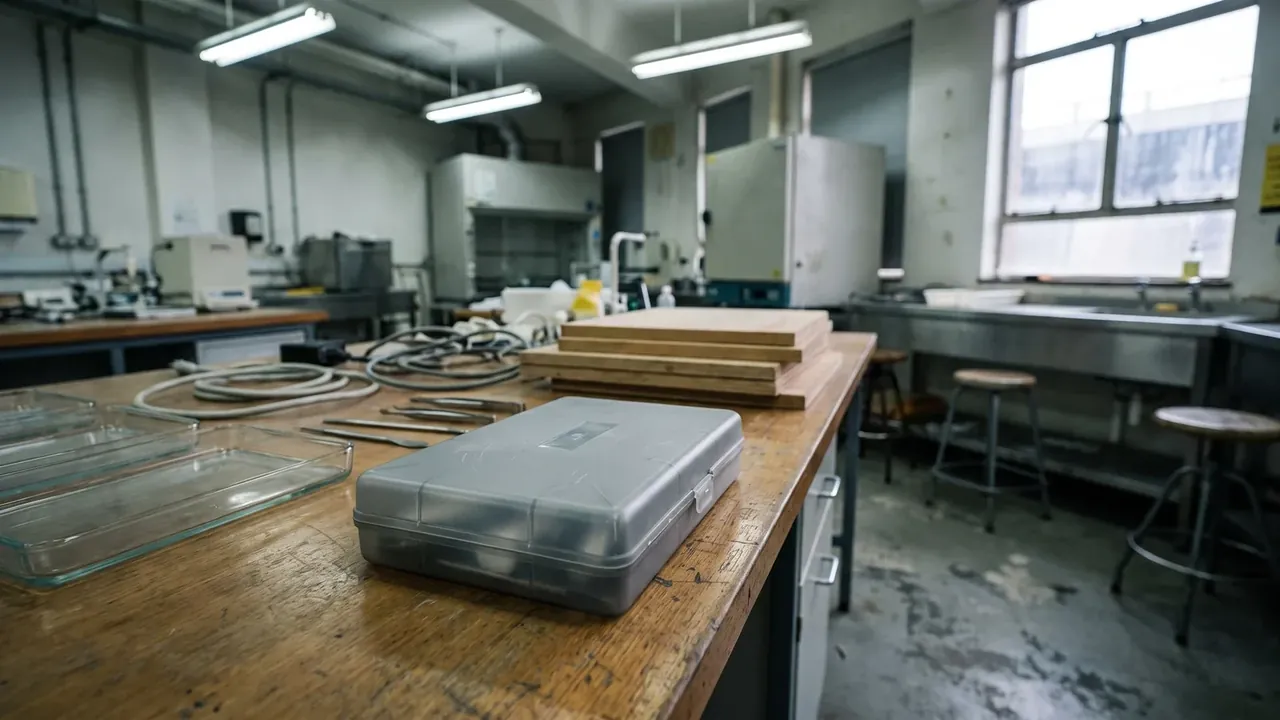
Each upright edge holds a 15 mm double-wall cavity formed in the same cycle, plus a 70 Shore rubber strip at about 8 CNY a metre that survives a 1.5 m drop.
Adequacy shows in the cold: four hours at minus 40 °C, then 1.5 m onto six faces, three edges and one corner. Whitening is yield, a light leak is a crack; peak acceleration must stay under 55 g.
3. Sealing and Pressure Relief: Two Lips and One Valve
Sealing runs on two lips, not one ring. An 11 mm wide, 8 mm deep groove takes a 9.5 mm hollow gasket at 28 to 32% compression; the main lip stops water, the second dust.
Relief is not optional at this size: a 28 kg case moving from minus 40 °C into a 70 °C trailer pushes its lid open, then gets sucked shut hard enough to distort the groove. Cracking pressure is 0.15 to 0.3 bar through a 3 mm membrane.
| Item | Value | Note |
|---|---|---|
| Seal groove | 11 × 8 mm | Takes a 9.5 mm hollow gasket |
| Cracking pressure | 0.15–0.3 bar | Covers -40 to +70 °C |
| Ingress rating | IP67 | One metre of water, 30 minutes |
4. Heavy Hinges and Latches: Where Closing Force Comes From
Hinges carry lid weight plus opening shock: an 8 mm stainless pin in bushings, an 8 mm pad and four M5 screws into inserts at 6 N·m. The target is 20,000 movements.

Four cam latches on a heavy-duty protective case pull 450 to 550 N each over 8 mm of take-up and are rated as three, leaving one reserve. Behind every seat there must be a rib, or the pull bows the wall and it leaks.
5. Feet and Lifting Points: Stacking and Hoisting Arithmetic
On a heavy-duty protective case the feet are four load channels, not pads: 25 mm high on a 14 mm floor, leaving a 110 mm opening for a 100 mm fork. Stacked four high at 220 kg, the bottom case carries 660 kg.
Lifting points are rated as working load, never breaking load. Four M16 eyes carry 400 kg each at a factor of four, and past 60 degrees of sling angle the load per leg rises about 15% per 15 degrees. Strap slots of 50 × 12 mm sit at eye height.
| Interface | Size | Load or dimension |
|---|---|---|
| Feet | 4, 25 mm high | 150 kg per foot |
| Fork opening | 110 mm | Fits a 100 mm fork |
| Lifting eyes | M16, 4 points | 400 kg working load, factor 4 |
Conclusion
Wall, ribs, gussets, twin lips, latches and eyes behave as one load chain: force enters at the corner, spreads through ribs, closes through latches, leaves through feet and eyes. Understate a link and the whole rating drops. Read the chain first, and a heavy-duty protective case datasheet stops being isolated numbers.
This article discusses only the container (case body) side of specifications and design intent, and does not cover any handling, loading or use of the contents.
Related Reading
- Where heavy-duty protective cases are used
- Writing heavy-duty protective case specifications
- Rotomoulding and how wall thickness is controlled
- Injection moulded case bodies and their structure
Related Products
- 8 Series — Gun Cases; Military Equipment Cases; Camera Equipment Cases; Drone Cases; Watch Cases; Knife Cases; First Aid Cases; Electronics Equipment Cases
- WL8-2812 PP Gun Case — model WL8-2812
- All protective cases and toolboxes: 7 series, 158 models