

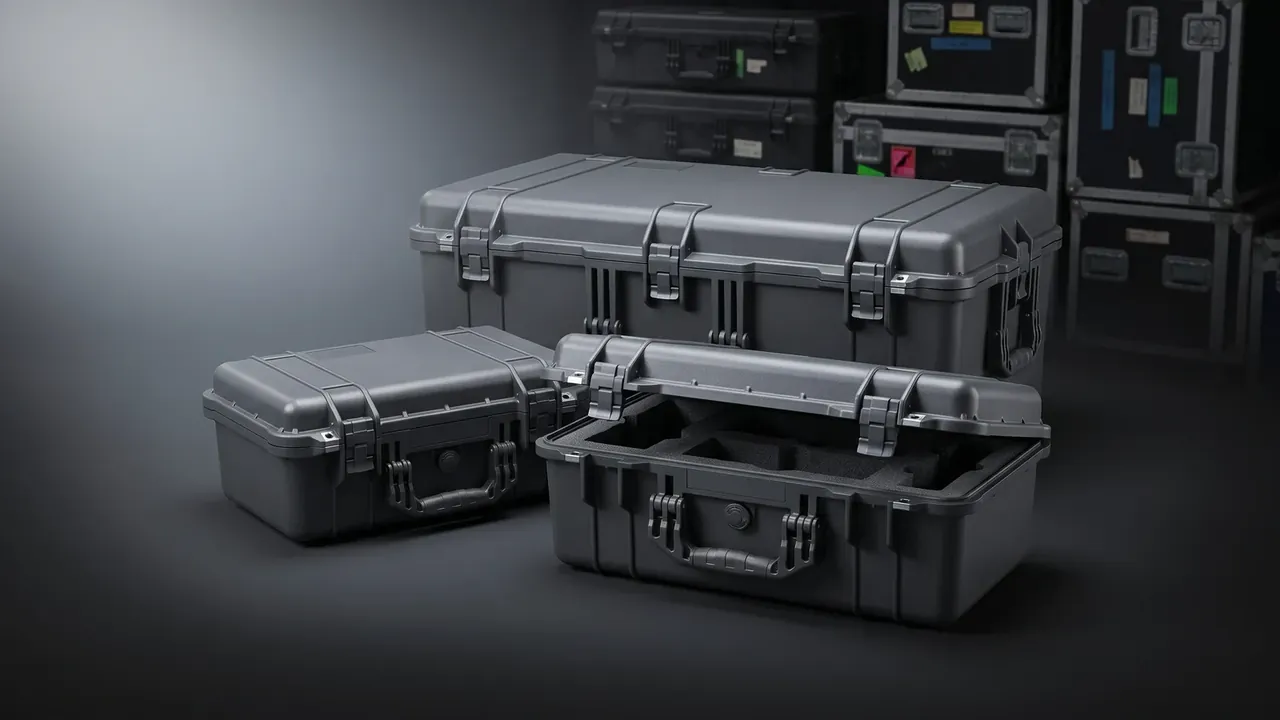
Quick answer: A heavy equipment mobile case works in four settings: in-plant transfer, line-side staging, field installation, and warehouse or long-haul stacking. Scenario sets wheels and lugs, load sets wall and base, distance sets how it is towed.
Table of contents
- How Heavy Equipment Mobile Case Scenarios Are Split
- In-Plant Transfer and Line-Side Staging
- Field Installation and Temporary Sites
- Warehouse Stacking and Long-Haul Transit
- Matching Configuration to Each Scenario
- FAQ
1. How Heavy Equipment Mobile Case Scenarios Are Split
Sort use by three facts, not by industry: distance per trip, load per trip, and whether the case leaves the plant. A heavy equipment mobile case rolling 30 m indoors and one crossing 300 m of yard can share a body, never the wheels or the lugs.
Four settings follow: in-plant transfer, line-side staging, field installation, warehouse stacking. Transfer cares about tread wear, field work about lifting and lashing, storage about stacking. A flat warehouse case sent outdoors gets lifted from below, crushing the base ribs.
| Scenario | Trip distance | Load | Key options |
|---|---|---|---|
| In-plant transfer | 10-50 m | 80-200 kg | 200 mm wheels, brakes |
| Line-side staging | under 5 m | 50-150 kg | fixed wheels, side door |
| Field installation | over 200 m | 200-500 kg | lugs, lashing, pockets |
| Warehouse, transit | long haul | over 300 kg | three-high stack, ribs |
2. In-Plant Transfer and Line-Side Staging
Transfer is the highest-frequency job: a station beside an assembly line moves a case 40 times per shift over 30 m, so the wheels log 30,000 m a year. The wheel plate fails before the tread, since every turn applies a side load.
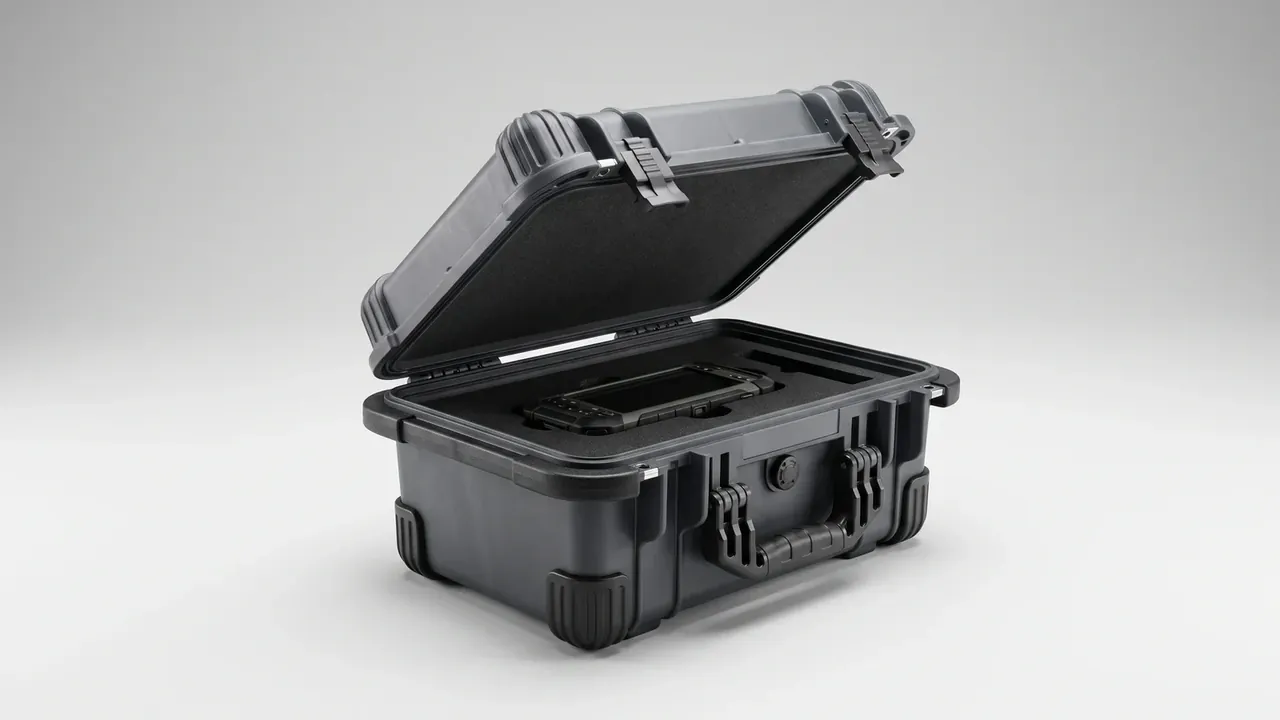
Run 200 mm wheels, two fixed and two swivel, for a 1.2 m turning radius; four swivel wheels steer in a narrow aisle but wander when pushed straight. Six M8 bolts into an 8 mm steel plate outlast four by roughly double.
Staging rarely exceeds 5 m, so the case becomes a mobile workstation. A side door asks for 700 mm of aisle, while a lid needs 1.4 m of headroom. On epoxy, 200 kg starts at 120 N; on gritty concrete it climbs past 180 N.
3. Field Installation and Temporary Sites
Outdoors the first need is lifting, not rolling. Four lugs rated 250 kg each cover a 500 kg case with half the capacity in reserve, sitting symmetrically about the centre of gravity.
Forklift pockets of 120×60 mm sit at both sides of the base behind a 6 mm steel sleeve; without it a fork rounds the plastic in a few lifts. The lid takes 150 kg as a bench, and four corner lashing points work against 3 g.
Across −30 to 70 °C the case builds up to 0.3 bar, absorbed by a relief valve set at 0.35 bar. Sealing follows IP67 at 1 m/30 min, and hardware takes 72 hours of salt spray.
4. Warehouse Stacking and Long-Haul Transit
Storage is a stacking problem. A heavy equipment mobile case is built three high, the bottom unit carrying two cases and their contents, with the lid rated at 400 kg.
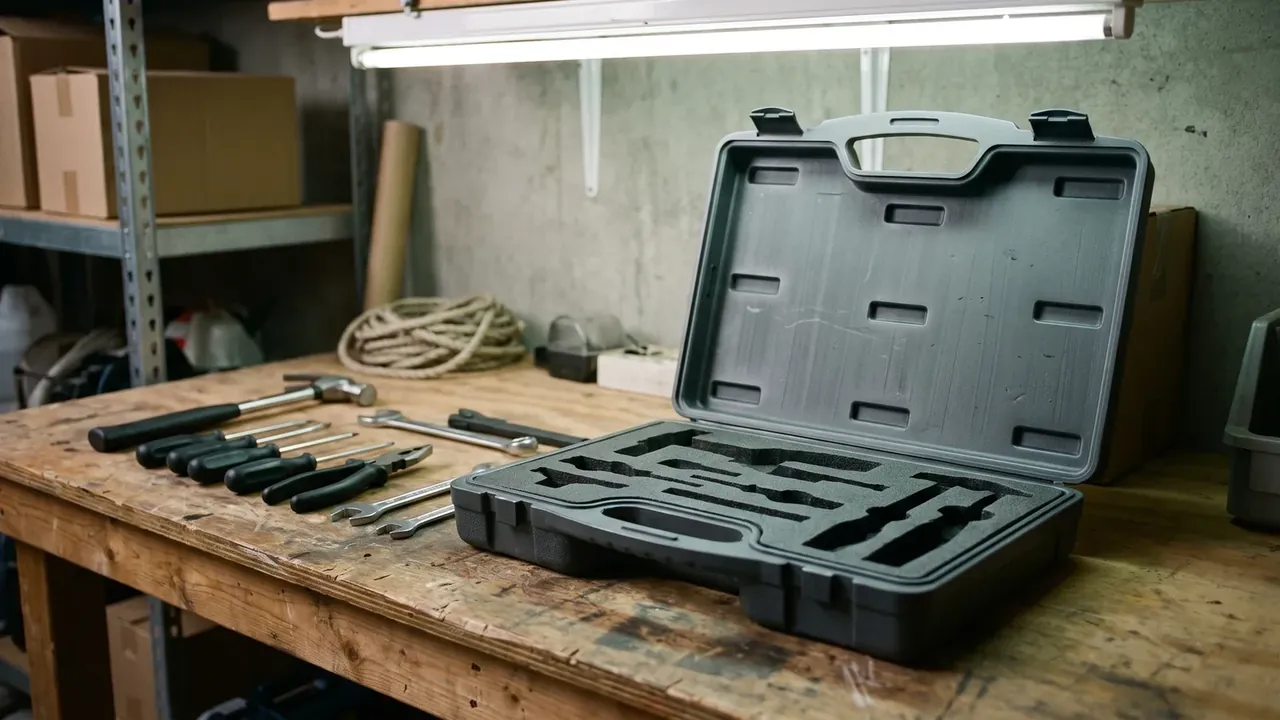
Eight base ribs, 12 mm high, spread that load; shorter ribs sag after 30 days on the third level, and a base dished by 3 mm never sits flat. Transit adds 10–500 Hz at 1.5 g per axis.
A 30 mm EVA insert with 2 mm of interference holds equipment by rebound and loads faster than straps. Slow movers stack high, labels to the aisle; fast movers stay below 1.2 m.
5. Matching Configuration to Each Scenario
Side by side, the four scenarios collapse to four options: wheel set, lifting hardware, door type and insert.
| Option | Transfer | Field | Warehouse |
|---|---|---|---|
| Wheels | 200 mm | 200 mm, wide tread | 100 mm or flat |
| Lifting | none | four lugs, pockets | pockets |
| Opening | side door | lid, two latches | lid |
| Insert | 30 mm EVA | EVA plus desiccant | EVA, full wrap |
| Stacking | none | two high | three high |
Conclusion
Splitting scenarios for a heavy equipment mobile case comes down to three questions: how far it rolls, how much it carries, and whether it leaves the plant. Distance asks for swivel wheels and brakes, load asks for lugs and forklift pockets, and outdoor work asks for a relief valve. Fix the scenario first and the heavy equipment mobile case stays the right tool in month one.
This article discusses only the container (case body) side of specifications and design intent, and does not cover any handling, loading or use of the contents.
Related Reading
- Heavy-duty protective case scenarios
- Where rolling tool cases are used
- Sizes and wall specs for heavy cases
- Choosing a mobile tool cabinet
Related Products
- 8 Series — Gun Cases; Military Equipment Cases; Camera Equipment Cases; Drone Cases; Watch Cases; Knife Cases; First Aid Cases; Electronics Equipment Cases
- WL8-2812 PP Gun Case — model WL8-2812
- All protective cases and toolboxes: 7 series, 158 models