


Quick answer: A High strength impact resistant tactical comms case holds 0.8 mm residual lid set after 600 kg for 24 h, keeps three diagonals within 1.5 mm after 10 drops from 1.8 m, and limits cracks to 2 mm under a 30 J pendulum at -25 °C.
Table of contents
- Shell wall and rib layout of the High strength impact resistant tactical comms case
- Stacking rig on the lid
- Corner shaping for the six-face drop
- Cold pendulum and rib-root embrittlement
- Load re-check on handle and latches
- FAQ
1. Shell wall and rib layout of the High strength impact resistant tactical comms case
The shell runs a uniform 3.2 mm wall, with two horizontal ribs pressed into each long face at 6 mm height and 90 mm spacing, each stopping 15 mm short of the side corner. Ribs do not thicken the wall; they pull bending out of the flat panel into a supported section, so a 600 kg stack spreads over more material instead of being carried by the skin alone. Below 2.8 mm the fillet where a rib meets the wall whitens during ejection, and above 3.8 mm the empty shell climbs from 4.6 kg to 5.9 kg. Rib width is fixed at 4 mm and balanced against wall thickness at 1.25, so changing one alone shows up in the impact test.
Ribs sit 12 mm clear of the mouth land, keeping the sealing face out of the load path. JUNZHIJIA records wall, rib width and rib spacing on one first-article card, and changing any of the three forces both stacking and drop data to be re-run.
| Location | Value | What it decides |
|---|---|---|
| Long flat panel | 3.2 mm wall | Bending baseline |
| Horizontal rib | 6 mm high, 90 mm apart | Section for stack load |
| Rib-root fillet | R1.5 | Whitening at ejection |
| Mouth land | 12 mm from rib | Seal kept separate |
2. Stacking rig on the lid
With the case closed, a 300×300 mm platen is set at the centre of the lid and loaded to 600 kg, held 24 h at 23 °C. After unloading the rig rests 2 h, then the lid is read at four corners and both long-edge midpoints, with residual set capped at 0.8 mm; diagonal height difference is checked in the same pass and anything past 1.2 mm fails as insufficient lid stiffness. Four corners carry the stack and every kilogram runs through the shell, so foam support is never counted as capacity. Passing units are flipped and pressed on the base, whose ribs are offset 45 mm from the lid ribs, so the two faces do not add up and one reading never stands for the whole case.
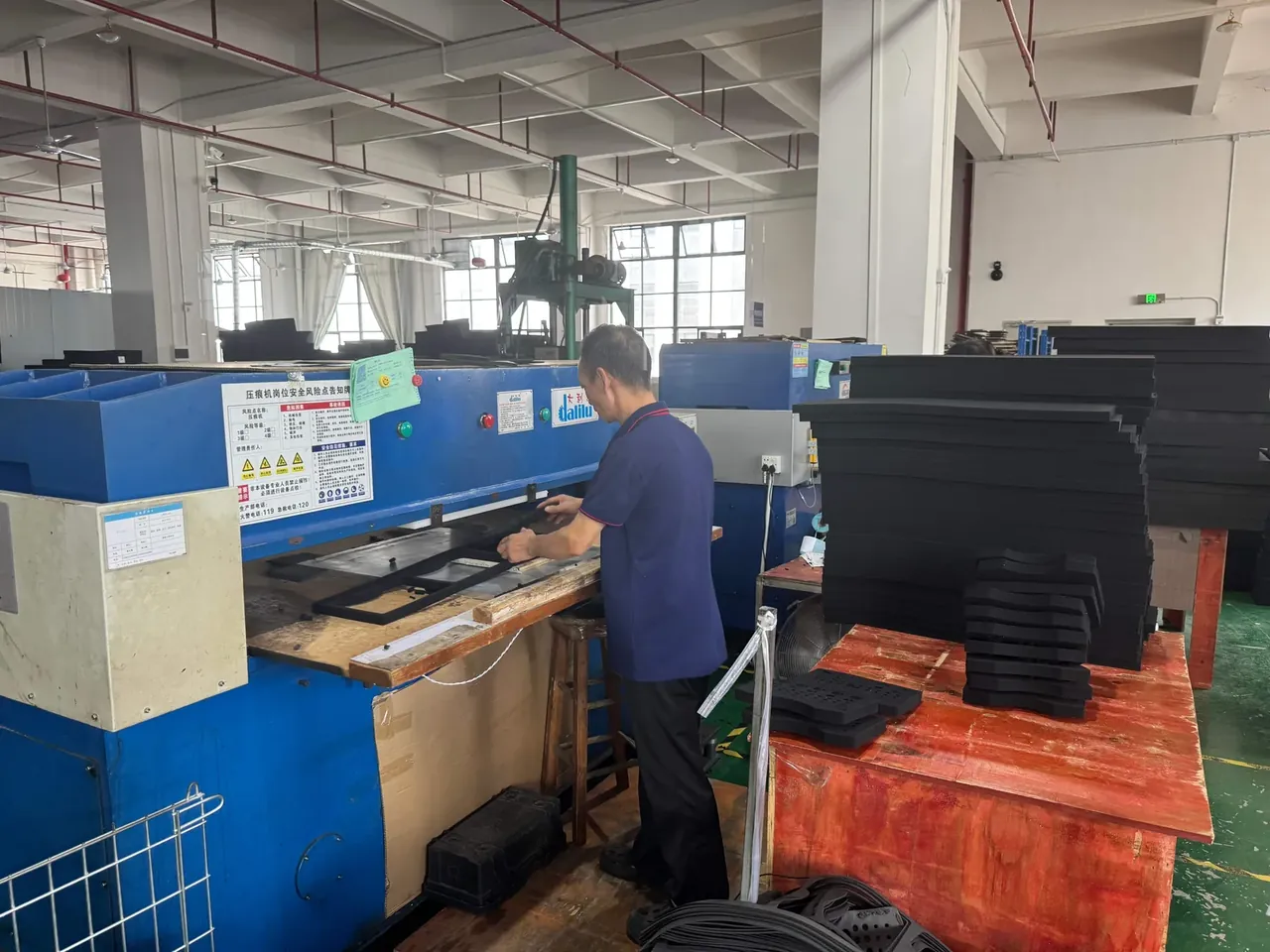
Lid set and foam compression are logged on separate rows and never converted into one figure.
| Stacking item | Setting | Verdict |
|---|---|---|
| Platen | 300×300 mm | Centred on lid |
| Load and dwell | 600 kg / 24 h | Held, not released |
| Residual set | Corners and edge midpoints | ≤0.8 mm |
| Diagonal difference | Two diagonals | ≤1.2 mm |
3. Corner shaping for the six-face drop
Drops run from 1.8 m onto 5 mm steel plate: six faces, three edges and one corner, 10 drops, each impact point marked in pen and never struck twice running. Corner shaping carries the design. The outer corner opens to R8, a 3 mm solid block fills the inner corner, and no sharp edge is left between block and wall, so impact splits along the block into both adjacent walls. Three main diagonals are measured after the series, any change past 1.5 mm stops the run for a rib check, and latches are reset by hand after every drop with self-opening units listed apart.
A thicker block is not better past 4 mm: weight climbs, drop resistance barely moves, and sink marks appear. The compromise is a 3 mm block, an R8 outer corner and a 20 mm transition rib inside each adjacent wall, which turns the impact path at the corner.
4. Cold pendulum and rib-root embrittlement
Samples sit 4 h at -25 °C and are struck within 30 s of removal by a 30 J pendulum, three cut from the flat panel and three from a rib root. Crack length is capped at 2 mm, and a through-crack at the rib root fails the lot for toughening, sending the check to pellet blend and then to injection temperature. Embrittlement appears at the rib root first, where cooling is slowest and internal stress highest, while the flat panel still looks sound. Struck samples return to 20 °C for 2 h and are measured again, and growth beyond 0.5 mm after warming fails as well.
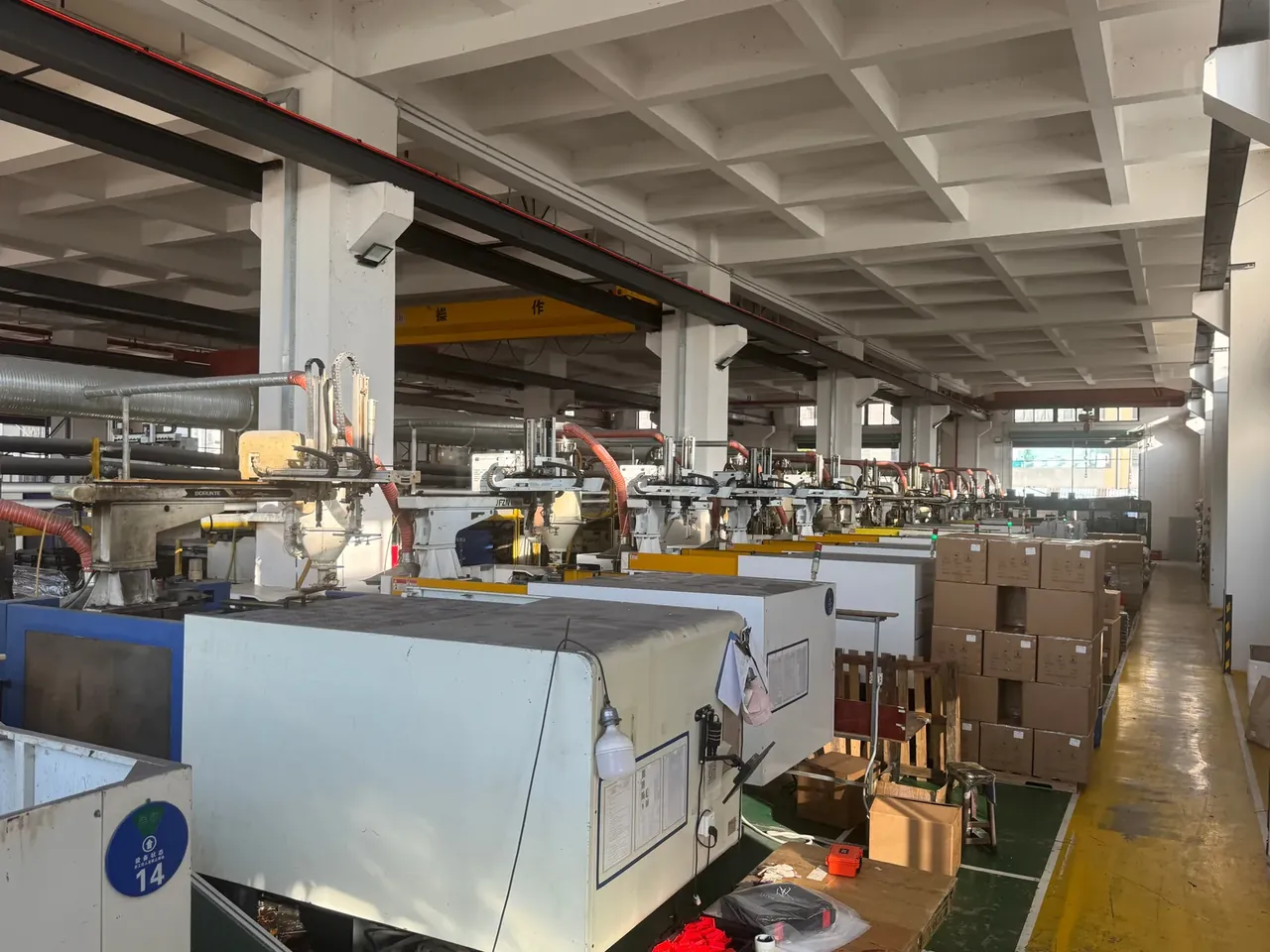
The mouth land is never cut for a sample; the pendulum works on wall and rib root, and seal integrity is guarded by a separate immersion check.
5. Load re-check on handle and latches
The handle takes a 40 kg static load for 10 min, and the gap between mount and shell is read after release, with anything past 0.5 mm taken as creep. The case then runs 5000 open-close cycles at 5 s each, re-measuring the gap at 2000 and at 5000. Latch pull is set at 280 N per latch, 560 N for the pair, and units falling to 240 N work loose under long-haul vibration. Eight hinge pins of 4 mm diameter run at 0.15 mm fit, and a pin is replaced at 0.3 mm. The readings are filed apart, and handle creep is never converted from latch pull.
The insert under the mount is easy to overlook: it sits inside the wall on six self-tapping screws. Under load the insert is compressed first and the shell tensioned after, so creep usually shows as loose screws, and a head standing 1 mm proud calls for a teardown.
Conclusion
The High strength impact resistant tactical comms case links a 3.2 mm wall with 6 mm ribs, 0.8 mm residual set after 600 kg for 24 h, 1.5 mm diagonal change after 10 drops from 1.8 m, 2 mm cracks under a 30 J pendulum at -25 °C, and a 40 kg handle load with 280 N latch pull into one shell-side chain. The five readings sit on the wall, the stacking rig, the drop rig, the cold chamber and the load bench, and none substitutes for another. JUNZHIJIA files the 4 mm rib width, eight hinge pins and R8 corner against that chain.
This article discusses the case side of the specification only and does not cover handling, loading or use of anything carried inside.
Related Reading
- Assembly specifications and fit tolerances for cases
- How foam inserts are layered and bonded
- What air freight declaration asks of case structure
- How to sample incoming case batches
Related Products
- 8 Series — Gun Cases; Military Equipment Cases; Camera Equipment Cases; Drone Cases; Watch Cases; Knife Cases; First Aid Cases; Electronics Equipment Cases
- WL8-2812 PP Gun Case — model WL8-2812
- All protective cases and toolboxes: 7 series, 158 models