

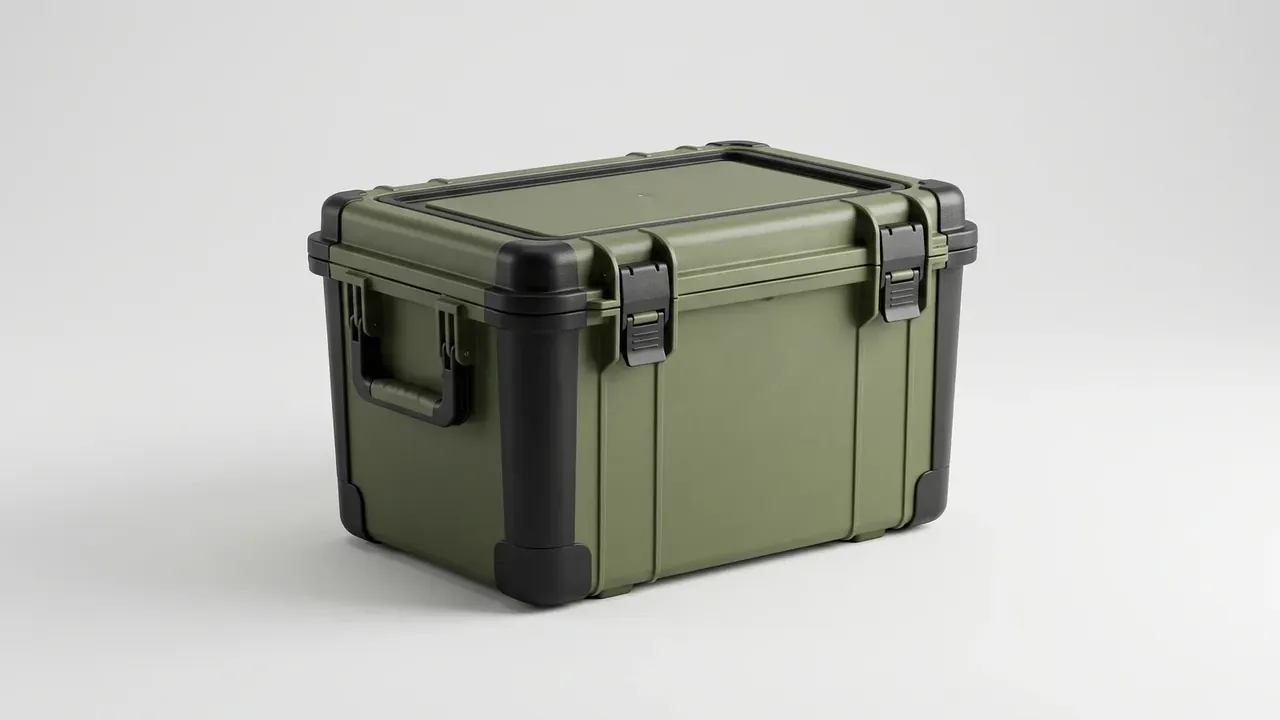
Quick answer: Deformation and Recovery across 7 days at 70 °C comes from crystalline shrinkage and latch preload loss, with diagonals growing 2.1–3.0 mm at oven exit and settling to 0.4–0.7 mm after 24 h.
Table of contents
- How the Seven-Day Soak Is Measured
- Pass Lines: 2 mm Diagonal, 0.3% Flatness
- PP versus ABS: How Much Thermal Headroom
- Seal Compression Set and Latch Stress Relaxation
- FAQ
1. How the Seven-Day Soak Is Measured
A moulded case sits at 23 °C and 50% RH for 48 hours before it nears an oven. Skip that and moisture plus frozen orientation inflate the reading by 0.3–0.5 mm for no visible reason.
The soak is 70 °C ± 2 °C for 168 hours, empty interior, every latch closed, one case per shelf, nothing stacked. Three samples come from one mould and batch so tooling is not mistaken for material behaviour. Ramp at 3 °C per minute.
Four readings carry the test: the two interior diagonals, lid flatness, bulge at the middle of the long wall, and the clear distance between latch seats. Diagonals use a 0–1000 mm tape checked on a CMM, flatness a granite plate with 0.02 mm gauges, bulge a 0.01 mm dial indicator. Read at baseline, within 30 minutes of oven exit, and after 24 hours at 23 °C, with one instrument set and one operator.
| Measurement | Instrument | Unit | Pass line |
|---|---|---|---|
| Interior diagonal | Tape plus CMM | mm | ≤2 mm |
| Lid flatness | Granite plate and feeler gauge | mm and % | ≤0.3% |
| Wall bulge | Dial indicator | mm | ≤1.5 mm |
| Latch seat spacing | Vernier caliper | mm | ≤0.8 mm |
Chamber volume should be five times the sample, with no air onto a wall and the nine-point spread under 1.5 °C. A corner reaching 72 °C first reads 0.2 mm wide and looks like a resin failure.
2. Pass Lines: 2 mm Diagonal, 0.3% Flatness
The 2 mm limit is derived. On a 520 mm interior diagonal it equals 0.38%, and at 30% gasket compression the sealing face tolerates about ±2 mm of lateral mismatch. Past that, front and rear walls no longer load the seal equally.
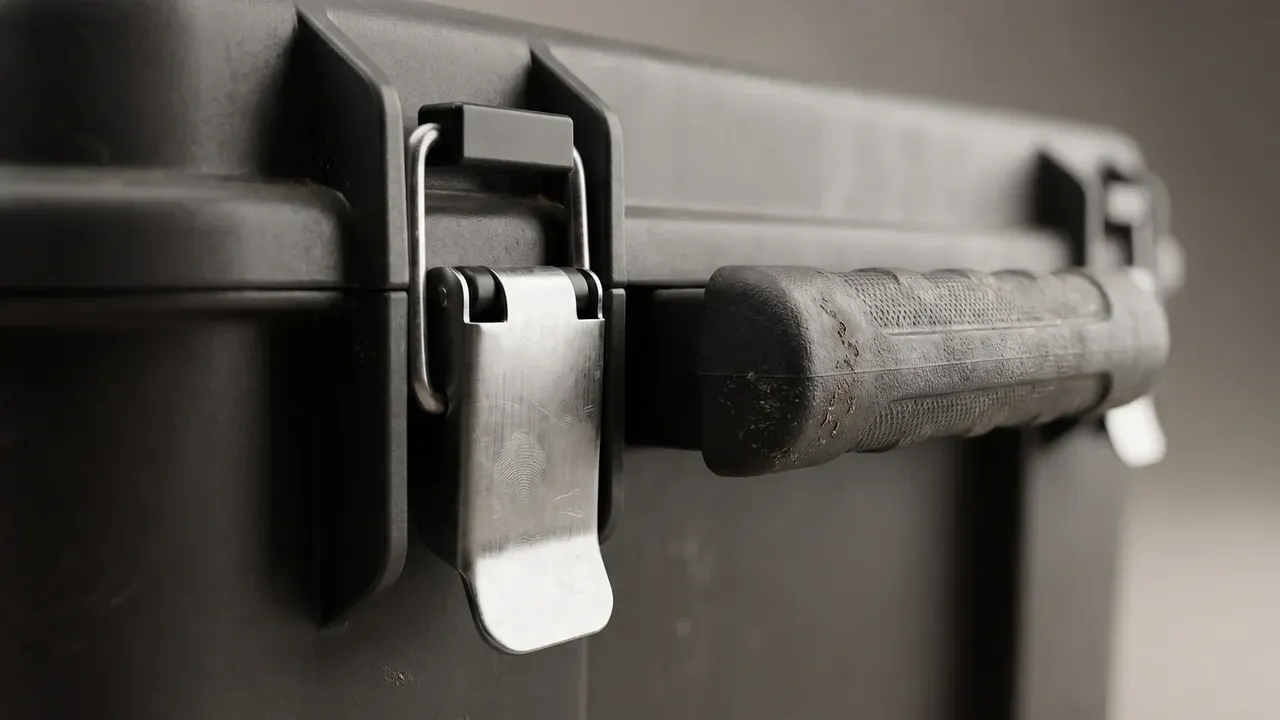
Flatness is normalised against span: a 600 mm lid face at 0.3% allows an 1.8 mm gap. The three samples sat between 1.1 mm and 1.7 mm, but S3 at 1.7 mm had spent 94% of its allowance and lost pressure first after 300 cycles.
Keep the limits apart. The diagonal governs how lid and body mate, so oversize shows as a stiff latch; flatness governs gasket contact, so oversize closes cleanly but will not hold pressure.
Recovery is (oven reading − 24 h reading) ÷ oven reading × 100%. Below 70% points to unannealed stress rather than expansion. The three samples landed between 77% and 81%.
3. PP versus ABS: How Much Thermal Headroom
At 70 °C, polypropylene is comfortable while ABS is brushing its softening range. Homopolymer PP carries a deflection temperature under load of 100–105 °C, copolymer PP 95–100 °C, ABS only 88–95 °C.
The arithmetic is blunt: 70 ÷ 95 ≈ 74%. An ABS case spends three quarters of its thermal capability in one soak, so the question is not softening but creep rate. Over 168 hours ABS moves 0.8–1.0 mm further than copolymer PP.
| Material | Deflection temperature at 0.45 MPa | Share of 70 °C | Expansion coefficient | 7-day diagonal change |
|---|---|---|---|---|
| Homopolymer PP | 100–105 °C | 67%–70% | 1.1–1.6 ×10⁻⁴/°C | 2.1–2.4 mm |
| Copolymer PP | 95–100 °C | 70%–74% | 1.2–1.8 ×10⁻⁴/°C | 2.4–3.0 mm |
| ABS | 88–95 °C | 74%–80% | 0.7–0.9 ×10⁻⁴/°C | 3.2–3.8 mm |
| Glass-filled PP, 20% | 125–130 °C | 54%–56% | 0.4–0.6 ×10⁻⁴/°C | 1.2–1.6 mm |
ABS has roughly half the expansion coefficient of PP yet moves further, and the butadiene phase explains it: at 70 °C that phase loses modulus, frozen orientation releases, and the diagonal drifts. Reading only the expansion coefficient is a reliable way to pick the wrong resin.
Glass filling is not free. Twenty percent glass lifts the deflection temperature to 125–130 °C and cuts the seven-day change to 1.2–1.6 mm, but notched impact strength drops about 25% and corners crack sooner at −10 °C.
4. Seal Compression Set and Latch Stress Relaxation
Half the measured change sits in the gasket. An EPDM sponge seal at 70 °C, 25% compression and 168 hours ends at 26%–32% set, while a 24-hour control reads 15%–19%. That 11-point gap is the difference between one day and seven.
Silicon stock pulls set down to 18%–23% at 30%–40% higher cost, and 40 Shore A silicon rebounds fast enough to make the draw latch hard to close. EPDM stays sensible at 70 °C while compression stays under 30%.
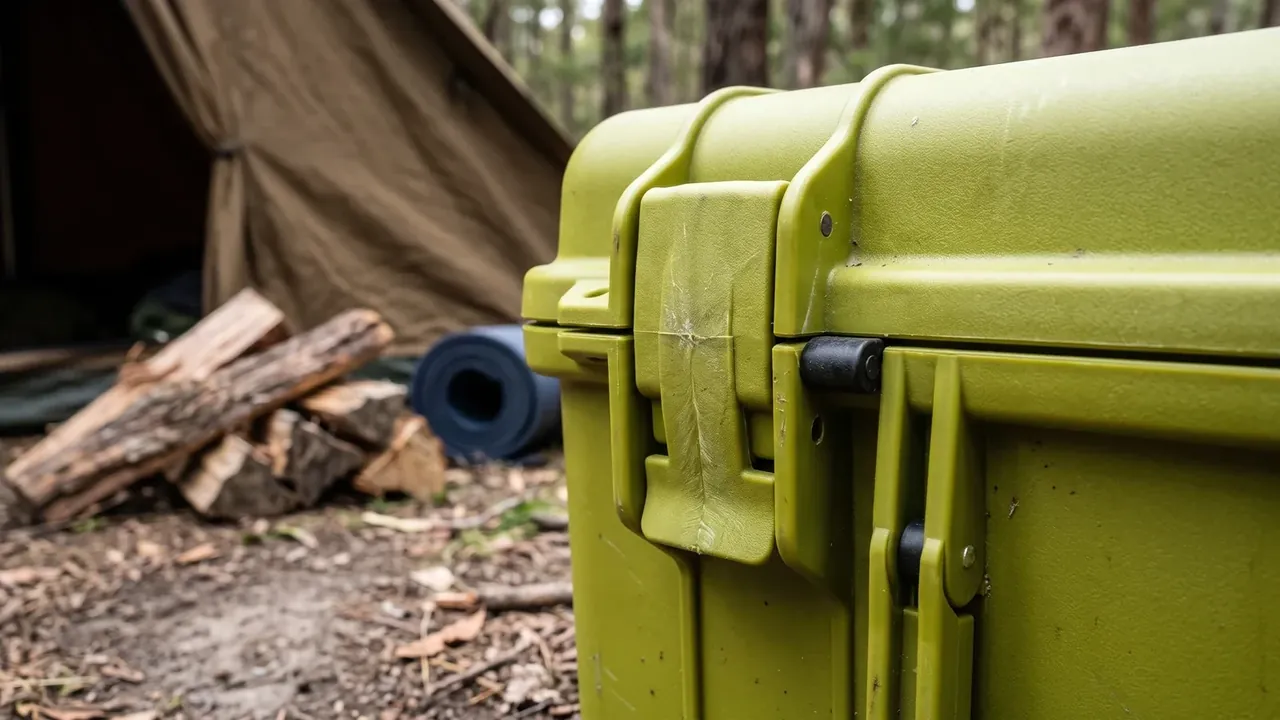
Latch preload is the second curve. A draw latch set to 180 N measured 152 N on the day it left the oven, a 15.6% loss, and returned to 168 N after 24 hours, still 6.7% under baseline. That residue shows in leak-down, rising from 22 Pa/min to 31 Pa/min at 500 Pa start pressure.
| Part | Item | Before | At oven exit | After 24 h |
|---|---|---|---|---|
| EPDM gasket | Compression set | 0 | 26%–32% | 24%–29% |
| Stainless latch | Clamp force | 180 N | 152 N | 168 N |
| Hinge pin | Axial clearance | 0.05 mm | 0.12 mm | 0.07 mm |
Hinge pin clearance is the quiet one: 0.05 mm to 0.12 mm sounds like nothing, but the lid picks up 0.5° of skew and the long-side gasket compresses 0.15 mm less at one end.
Conclusion
Three reading sets belong on one sheet: baseline, oven exit, 24 hours later. The checklist is four lines — diagonal change ≤2 mm, flatness ≤0.3%, recovery ≥75%, gasket set ≤32%. When a line is crossed, check thermal headroom first, then annealing and mould temperature, then structure. Seven days at 70 °C is ordinary service inside a tropical freight container, so these figures belong in the specification, not a retrofit test.
Related Reading
- Alternating high and low temperature test records
- How to state the temperature range of an IP67 case
- Temperature-controlled case selection and cooling options
Related Products
- 8 Series — Gun Cases; Military Equipment Cases; Camera Equipment Cases; Drone Cases; Watch Cases; Knife Cases; First Aid Cases; Electronics Equipment Cases
- WL8-2812 PP Gun Case — model WL8-2812
- All protective cases and toolboxes: 7 series, 158 models