

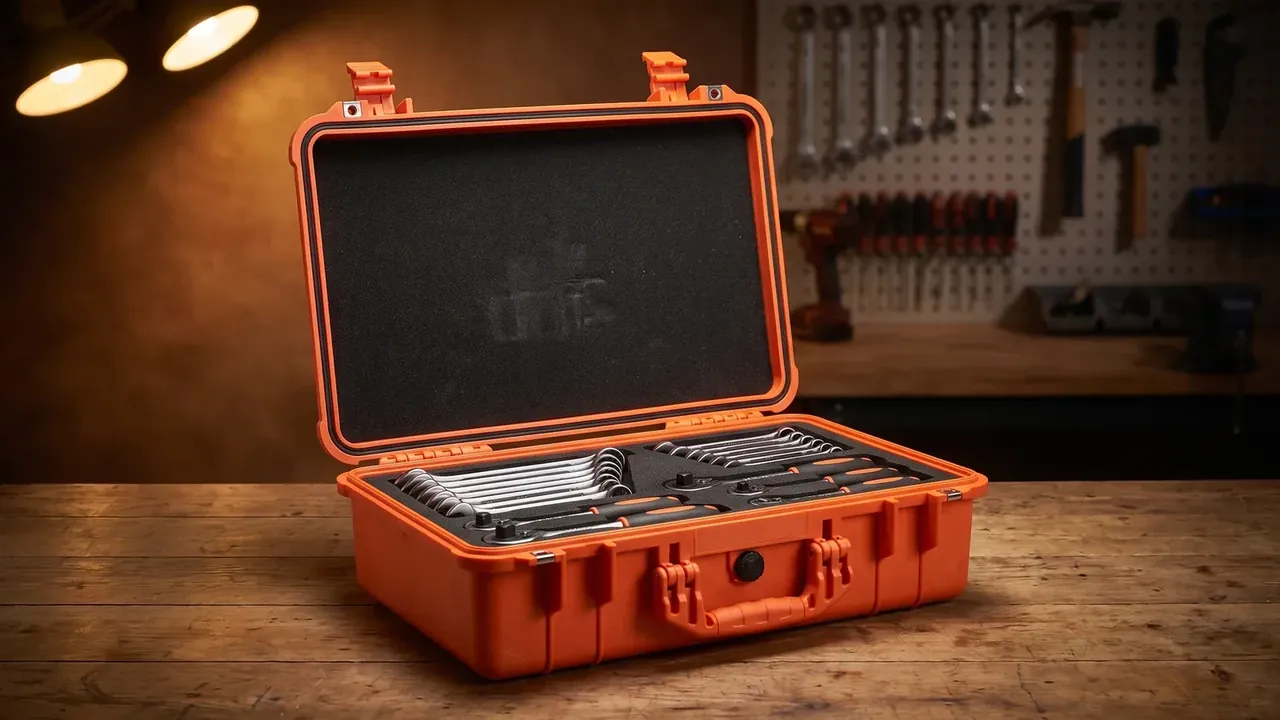
Quick answer: Impact Protection for Instrument Cases rests on buffer stroke: a 1.2 m drop stopped over 20 mm in about 10 ms holds peak acceleration near 40 g.
Table of contents
- Drop Attitude and the Worst Corner
- Buffer Stroke and Stopping Distance
- Corner and Base Transitions
- Internal Shift and Secondary Impact
- What to Inspect After a Drop
- FAQ
1. Drop Attitude and the Worst Corner
A unit usually fails while the shell is still intact, because it stopped too fast. Corner first, edge first and face first are three different events. A corner landing touches on the smallest area and drives the load into one spot, compressing the guard and the lining together; a face landing spreads the same energy and reads far lower. Impact Protection for Instrument Cases is worked out on the corner nearest the latches or handle, because the centre of gravity puts that one down first.
| Attitude | First contact | Where the load goes | What the design watches |
|---|---|---|---|
| Corner | One corner lands | Guard and opposite lining corner | Thicker wall and a generous radius |
| Edge | One edge lands | Both walls beside the edge line | Wall thickness and rib direction |
| Face | Flat landing | Lid face or base | Lid foam and base ribs |
| Oblique | Between corner and edge | The outermost part of the unit | Secondary impact gap |
Corner and edge drops differ by more than contact area. On a corner the load splits along three edges and pushes the unit toward the far corner of the cavity; on an edge the whole wall works, and parallel ribs add little. Impact Protection for Instrument Cases checked against the corner covers the rest.
2. Buffer Stroke and Stopping Distance
Once the case leaves the hand the speed is fixed, so the only variable is how far the unit travels before it stops. A 20 mm stroke over roughly 10 ms keeps peak acceleration near 40 g. Halve the stroke and the same speed is shed in half the distance, which lifts acceleration straight up. Most of the engineering lives in those 20 mm.

| Parameter | Value | Where it sits in the chain |
|---|---|---|
| Drop height | 1.2 m | Sets the speed at contact |
| Buffer stroke | 20 mm | Sets the stopping distance |
| Deceleration time | 10 ms | Time taken to reach zero |
| Peak acceleration | 40 g | What the unit actually feels |
Foam comes in 20, 30 and 40 mm layers, with 5–10–15 mm sheet filling local gaps. EVA runs 25–45 kg/m³ and PU 30–60 kg/m³; denser foam compresses less at equal thickness, so the stroke shortens as density rises. Impact Protection for Instrument Cases is calculated at the thinnest point, where the unit bottoms out first.
Forty g is a property of the equipment, not the case. Impact Protection for Instrument Cases exists to keep base acceleration below what the unit tolerates, which is why a stiffer shell is not automatically better.
Foam also has to spring back: a compression set of 5% or less, measured at 25% compression over 24 h at 23 °C, means the layer returns to near its original thickness and the second drop gets the same stroke.
3. Corner and Base Transitions
Corners run at 3.5 mm while the rest of the wall sits at 2.0–3.5 mm, and the step needs a transition, not a butt joint. Thick and thin sections cool at different rates, and with ABS shrinking 0.4% to 0.7% against 1.0% to 2.5% for PP, a sink mark forms where the wall jumps. That sink is the crack starter, which is why Impact Protection for Instrument Cases fails at abrupt steps rather than thin corners.
Impact Protection for Instrument Cases softens that step three ways: open the outer radius, add a triangular rib inside the corner, or taper the wall at 45 degrees. The base takes face drops and stacking, so its ribs form a connected grid rather than isolated pads.
Corner guards are consumables: a bolt-on guard pushes the hit into a replaceable part at the cost of a wider outline, while a moulded thick corner keeps the outline and loses the case when it splits.
4. Internal Shift and Secondary Impact
The unit rebounds after the first hit. The foam pushes it back, and with no gap between unit and wall the rebound lands on hard plastic. A secondary gap of 3 mm or more gives that return somewhere to go.
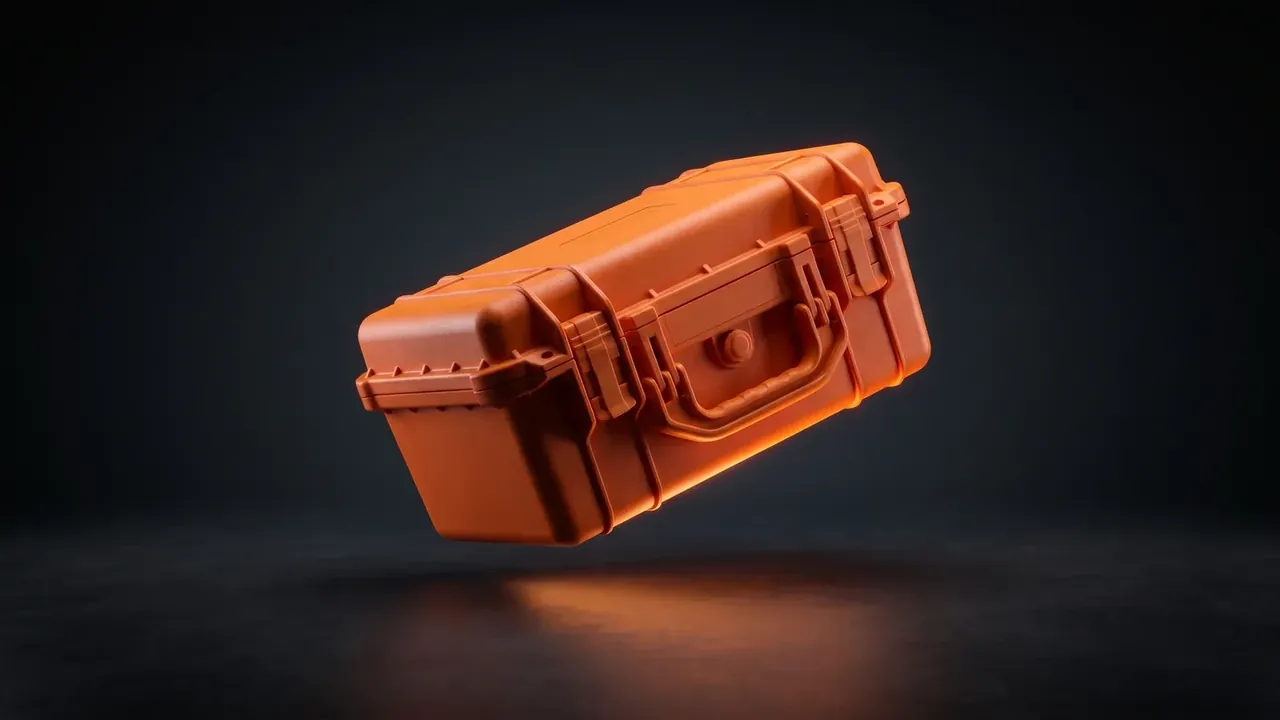
Shift comes from three sources: too little foam compression, a cavity cut larger than the unit, and a latch side never pressed home. Impact Protection for Instrument Cases slips here because nothing shows from outside. Shake the closed case: a rattle means the load is still free.
Cable routing adds a fourth source: a coil pressed into the cavity acts like a spring and lifts the unit on impact. Impact Protection for Instrument Cases cannot dictate how a cable is coiled, but a moulded channel gives it somewhere to sit. Side sheets of 5–10 mm hold the unit laterally while the top needs travel.
5. What to Inspect After a Drop
Four places get checked after any drop: guards, latches, buffer and the unit itself. Impact Protection for Instrument Cases is verified in that order, by failure probability: guards for cracks, then latch condition and retention, then foam thickness, and only then power on the equipment.
| Check point | What to look at | Reject when |
|---|---|---|
| Guards and corners | Cracks, whitening, chipped edges | Any through crack retires the case |
| Latches | Tongue distortion and retention | Below the lower end of 200–400 N |
| Buffer | Thickness recovery and dents | Permanent set past 10% |
| Unit | Function, housing, connectors | Any fault means a full re-review |
A drop that leaves the unit working but the foam flattened has still failed: a permanent set above 10% leaves no stroke for the next one. Latch retention of 200–400 N is the normal band, and a lower reading points to a deformed tongue. Hinge life of 20000 cycles is a separate test, never a substitute.
Related Reading
- The order of a drop test sequence
- Falling ball impact and local strength
- Rib layout and load paths
- Cold drop testing and brittle margins
JUNZHIJIA
Related Products
- 8 Series — Gun Cases; Military Equipment Cases; Camera Equipment Cases; Drone Cases; Watch Cases; Knife Cases; First Aid Cases; Electronics Equipment Cases
- WL8-2812 PP Gun Case — model WL8-2812
- All protective cases and toolboxes: 7 series, 158 models