

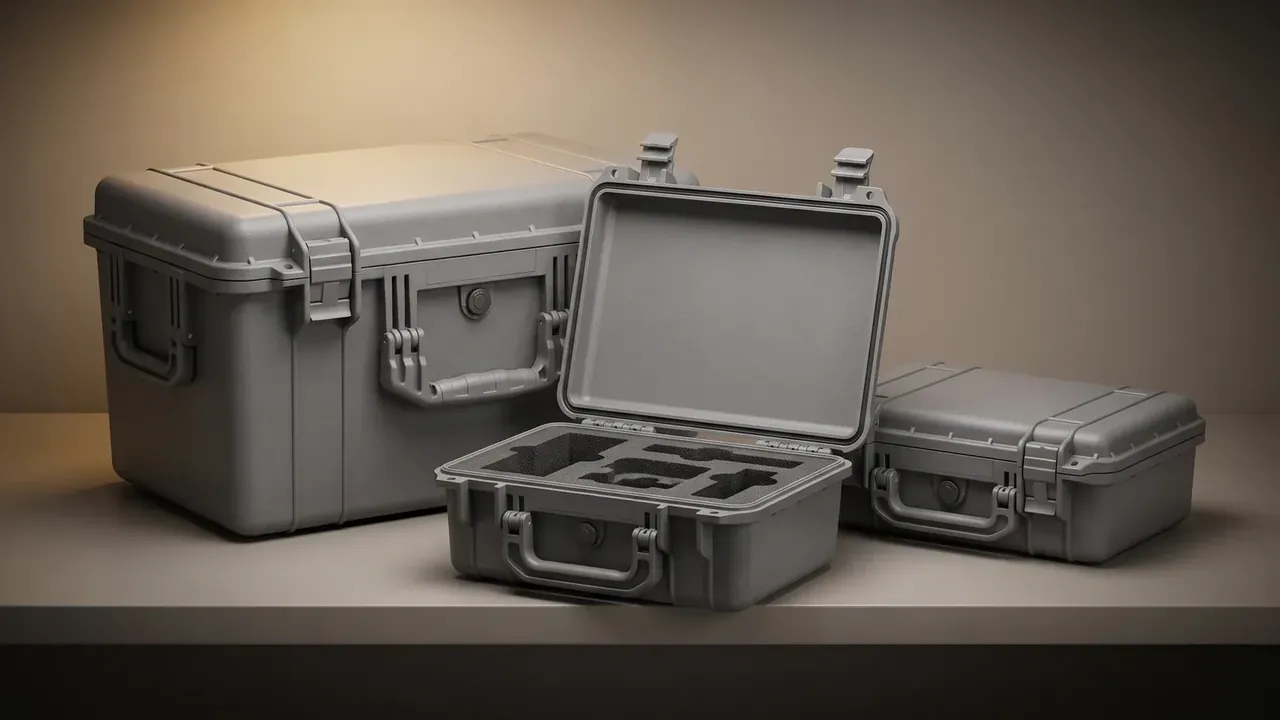
Quick answer: An Impact-Resistant Construction Tool Case falls from 28 kJ/m² at 23 °C to 12 kJ/m² at −20 °C, and a 5 kg ball from 1.0 m must leave cracks under 3 mm.
Table of contents
- Cold-Weather Duty for an Impact-Resistant Construction Tool Case
- The Notched Impact Curve Against Temperature
- Pairing Ball Mass with Drop Height
- Reading Corner Crack Length
- Cold-Site Values a Crew Can Use
- FAQ
1. Cold-Weather Duty for an Impact-Resistant Construction Tool Case
A winter morning on a northern site sits well below freezing, and a case that drops off the truck either cracks or does not.
At 440 × 320 × 180 mm outside and 395 × 275 × 140 mm inside, with a 4.4 mm wall and 3.8 kg all up, first contact is nearly always a bottom corner over a few square centimetres. Cold rewrites the event: polypropylene turns glassy near −10 °C, and once the chain segments freeze, impact energy has nowhere to go but into fracture. The same Impact-Resistant Construction Tool Case dropped from one height can differ by an order of magnitude between 23 °C and −20 °C.
Below freezing the modulus rises and elongation falls, so a 4.4 mm wall that bent in summer can only split in winter. An Impact-Resistant Construction Tool Case also needs about 4 h at −20 °C before the wall core reaches ambient.
2. The Notched Impact Curve Against Temperature
An Impact-Resistant Construction Tool Case reads 28 kJ/m² at 23 °C and 12 kJ/m² at −20 °C from one batch, a retention near 43%. The method is GB/T 1843: an Izod bar with an A-type notch, broken in one swing, reported per unit of notched area.
The slope is not unique. Homopolymer polypropylene manages 3 to 6 kJ/m² warm and falls to 1 to 2 kJ/m² at −20 °C; impact copolymer grades run 8 to 30 kJ/m² and usually hold 4 to 10 kJ/m² cold. The rubber phase makes the difference, since its particles still cavitate and blunt the crack tip. Brittleness temperatures follow: −25 °C to −45 °C for copolymer against −5 °C to −15 °C for homopolymer.
Notch sensitivity is often missed: the same compound loses 20% to 50% when the notch runs across the flow, and a corner is where melt fronts meet last. Bars therefore come from near a corner.
| Low-temperature step | Soak | How the value reads | Where it is used |
|---|---|---|---|
| 0 °C | 4 h | Close to the warm figure | Mild coastal winters |
| −10 °C | 4 h | Clearly on the way down | Early northern winter |
| −20 °C | 4 h | Lands on the 12 kJ/m² step | Cold-region stock |
3. Pairing Ball Mass with Drop Height
Five kilograms and 1.0 m are a matched pair. Energy follows E=mgh, so a 5 kg ball from 1.0 m arrives with about 49 J; a 2 kg ball from 2.5 m carries the same energy over a longer contact and a lower peak, leaving a different crack pattern. A cold site produces a short, sharp hit on a corner, which is why an Impact-Resistant Construction Tool Case uses the heavy ball at low height.
Method anchors: GB/T 14152 for falling-ball impact on plastics, ISO 6603 for rigid plastics, with balls commonly 0.5 to 10 kg and heights from 0.3 to 2 m. The case takes 5 kg from 1.0 m onto four bottom corners, 3 rounds in all.
| Ball round | Point of impact | What is watched | Release condition |
|---|---|---|---|
| First | Each of four bottom corners | Dent, whitening | No penetration |
| Second | The same corners again | Whether cracks extend | Cracks do not join |
| Third | Mid-point of a side edge | Deformation | 1.8 mm or less |
4. Reading Corner Crack Length
The 3 mm limit is the only dimensioned line here. Caliper jaws go to both ends and the straight distance is read, a wandering crack end to end; a 5× magnifier is enough, since a crack past 3 mm already shows branching.
The line marks whether a crack has reached the structural layer. The corner radius spreads stress, so a shallow crack stops in the resin skin under 0.5 mm; past 3 mm it has crossed the root of the radius into the main wall, and the next impact follows the old path.
Read at once, a fresh crack hides silvering that has not opened; read after 24 h, the figure grows by 0.3 to 0.5 mm, so an Impact-Resistant Construction Tool Case is read once, a day after the drop. Hinge life sits alongside: 3900 cycles with hinges and latches on the same cold samples, because a latch tongue is more brittle and must still close one-handed. IP65 covers jets only, so a case dropped cold is re-checked with a jet.
5. Cold-Site Values a Crew Can Use
The −20 °C step is kept only while three rounds of ball drops leave corner cracks shorter than 3 mm; anything colder calls for a toughened grade.
That sentence locks temperature, rounds and crack length together: minus twenty covers most northern mornings, three rounds cover repeated hits, 3 mm is the edge of the radius. If one fails, the grade changes before the wall thickens — 3.8 kg is already the limit for one person on scaffolding.
| Crack reading | Where it sits | Action |
|---|---|---|
| 1 mm or less | Stops in the skin | Record, keep in service |
| 1 to 3 mm | Into the radius | Downgrade the duty |
| Over 3 mm | Past the radius root | Withdraw |
Stacking is read by season. Six high is fine at room temperature; in a cold store the shell stiffens: creep falls but resistance to local crushing falls with it, so an Impact-Resistant Construction Tool Case goes four high there.
Conclusion
Cold-region reliability in an Impact-Resistant Construction Tool Case comes down to one temperature curve and one pair of calipers. Fix 28 kJ/m² warm, 12 kJ/m² at −20 °C, a 5 kg ball from 1.0 m and a 3 mm corner crack, and three rounds of drops give a figure worth comparing. Whether it splits is written by grade and structure together.
Related Reading
- Wear Surfaces on Site Tool Cases
- Weighing Wooden Crates Against Plastic Cases
- How Corner Radii Eat Usable Length
Related Products
- 8 Series — Gun Cases; Military Equipment Cases; Camera Equipment Cases; Drone Cases; Watch Cases; Knife Cases; First Aid Cases; Electronics Equipment Cases
- WL8-2812 PP Gun Case — model WL8-2812
- All protective cases and toolboxes: 7 series, 158 models