

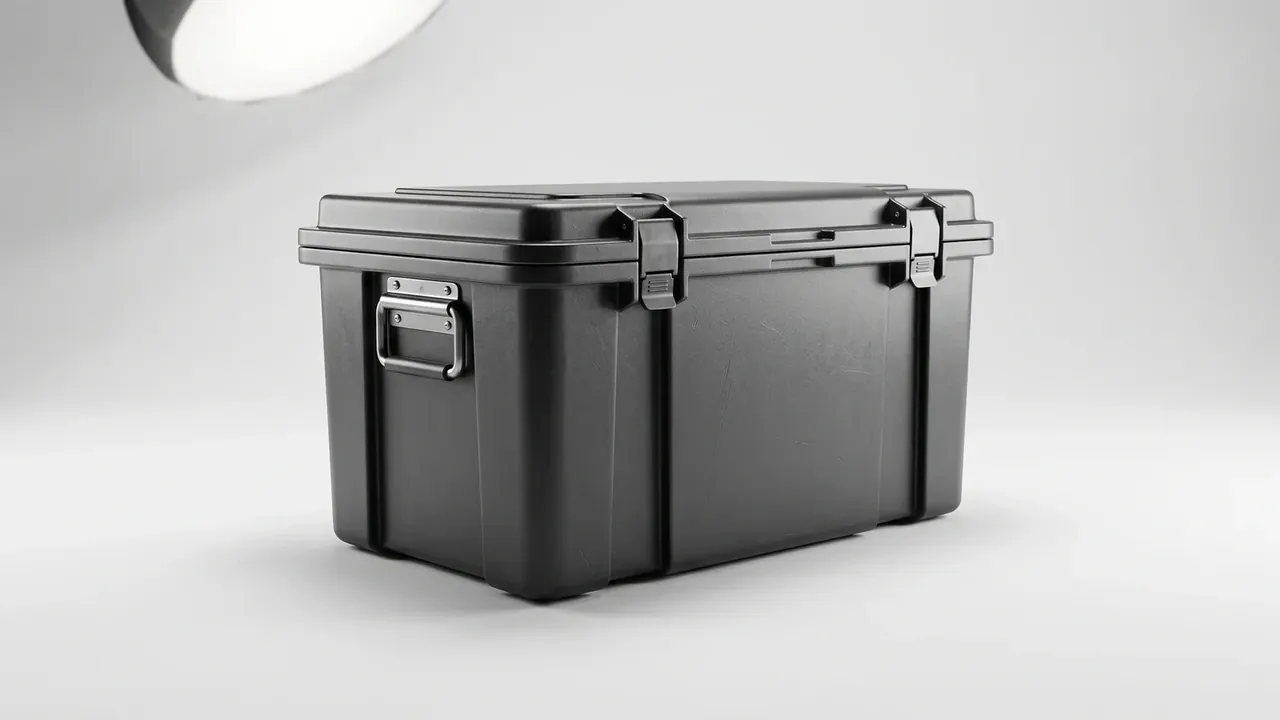
Quick answer: Judge an impact-resistant protective case by shape, latch action and seal contact after the drop, not by wall thickness. Attitude, energy and limit make the sheet.
Table of contents
- Acceptance Levels for an Impact-Resistant Protective Case
- Turning Impact Energy into Drop Height
- Judging Corners, Edges and Faces
- How the Two Drop Standards Differ
- Preconditioning, Recheck and Pass Limits
- FAQ
1. Acceptance Levels for an Impact-Resistant Protective Case
Acceptance turns one fall into three facts: which attitude hit the floor, how much energy it carried, which dimensions stayed inside the limit. Leave one out and the report falls back on no visible damage.
Three levels, none replacing another. A type test uses three samples and allows zero failures. A first-article check records readings from a new mould. A batch sample follows AQL 2.5 for appearance and latch action.
| Level | Samples | Verdict |
|---|---|---|
| Type test | 3 | All pass, zero failures |
| First article | 1 | Key items pass |
| Batch sample | AQL 2.5 | Appearance and latch |
An impact-resistant protective case is accepted empty and loaded too. An empty shell has no mass on the cushion, so a corner splits first; a loaded one carries more energy but the insert absorbs part.
2. Turning Impact Energy into Drop Height
Height is the visible half; what breaks a shell is kinetic energy at contact, mass times gravity times height. One impact-resistant protective case at 12 kg and at 25 kg carries more than twice the energy from one height, yet one limit is often written for both.
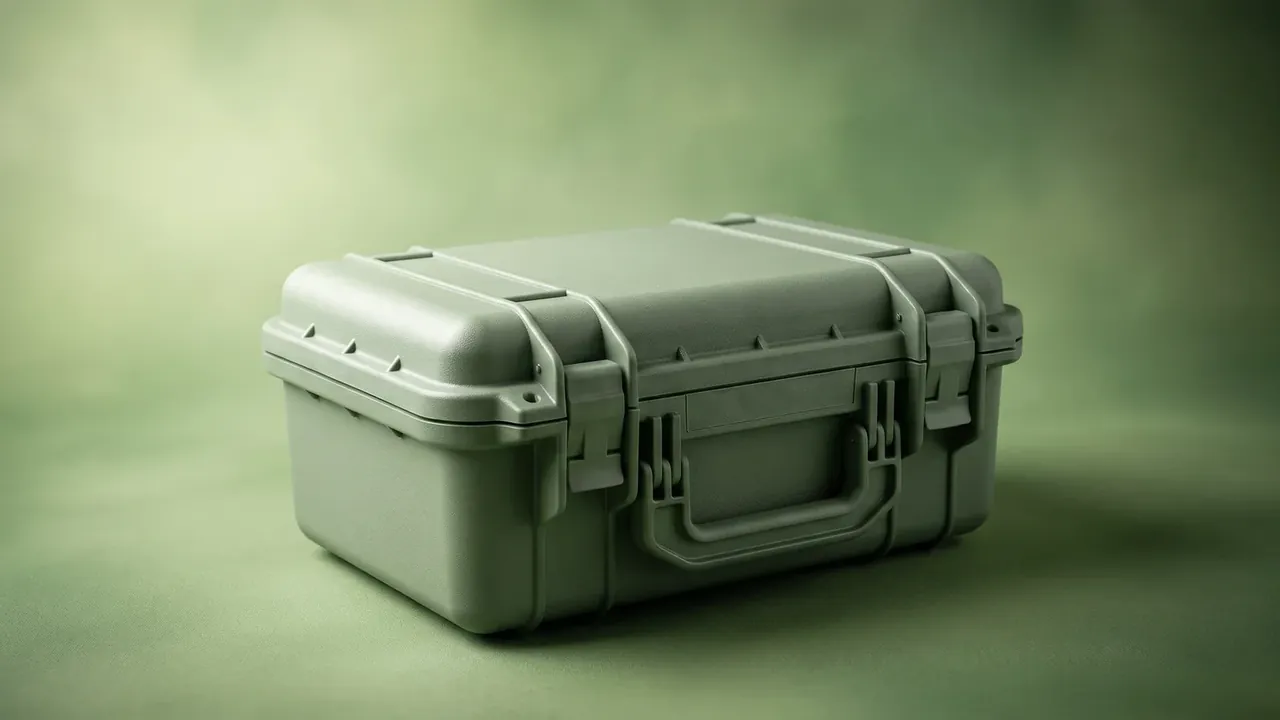
Start with rated load: 1.0 times for most industrial buyers, 1.2 for aviation. Ballast sits at the geometric centre; once it shifts, a face impact becomes a corner.
| Test mass | Drop height | Impact energy |
|---|---|---|
| 12 kg | 0.76 m | about 89 J |
| 18 kg | 1.22 m | about 215 J |
| 25 kg | 1.50 m | about 368 J |
ISTA steps by weight: 76 cm below 9 kg, 61 cm to 18 kg, 46 cm to 27 kg, 38 cm to 45 kg. Military programmes fix 1.22 m, or 48 inches, whatever the mass.
3. Judging Corners, Edges and Faces
A corner drop is the hardest attitude: the blow lands on one vertex, few millimetres deform, and the peak can reach twice the face value.
Faces are judged on denting: a centre dent within 3 mm, no through crack, no whitening at rib roots. Edges on crack length: up to 15 mm without crossing the wall passes; a through crack drops local wall from 4.5 mm to 3 mm.
Corners turn reports vague. Measure distortion within 2 mm, no split longer than 10 mm at the radius, and a latch closing one-handed with lid gap under 1.5 mm.
4. How the Two Drop Standards Differ
ISTA serves packaging, MIL-STD-810 serves equipment. The first asks whether goods arrive intact, the second whether hardware still works. Export work follows ISTA; police and aviation follow Method 516.7, numbered 516.8 in revision H.
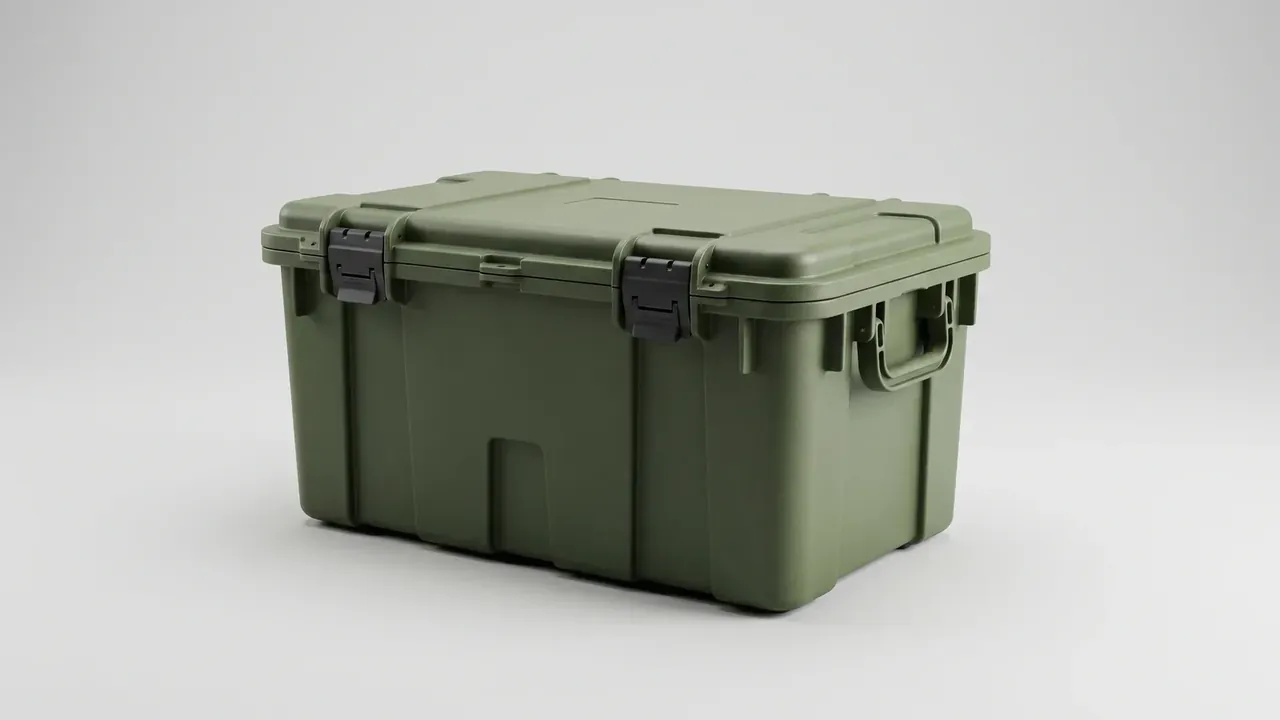
Sequence differs. ISTA runs vibration, incline impact, rotational edge drop, then free drop. The military transit drop runs 26 drops over 8 corners, 12 edges and 6 faces, checking appearance and function after each. Steel gives a short contact and a high peak; plywood reads one or two tenths lower.
5. Preconditioning, Recheck and Pass Limits
Shells are usually moulded in high-density polyethylene, whose impact strength moves fast with temperature. At minus 20 a falling-weight test may read half the room value, so preconditioning comes first: 4 hours at minus 20, 4 hours at plus 60, 24 hours at 95 percent humidity.
Recheck runs appearance, dimensions, latch action, then seal. Air decay is quickest: charge to 20 kPa, hold 60 seconds, pass at 0.5 kPa loss or less.
| Item | Method | Pass limit |
|---|---|---|
| Face dent | Depth gauge | 3 mm or less |
| Edge crack | 5x magnifier | 15 mm or less, not through |
| Corner distortion | Plate and feeler gauge | 2 mm or less |
| Lid gap | Feeler gauge | 1.5 mm or less |
| Latch action | Three cycles | All three close |
| Air decay | 20 kPa, 60 seconds | 0.5 kPa or less |
Write limits as absolutes, never as no visible damage: another operator, another rig, the same number.
Conclusion
An impact-resistant protective case is accepted on three sheets: energy against height, corner, edge and face limits, and the recheck after preconditioning. Together they turn one fall into a number. Absolute limits are what make an impact-resistant protective case defensible.
This article discusses only the container (case body) side of specifications and design intent, and does not cover any handling, loading or use of the contents.
Related Reading
- Reading a shockproof case specification sheet
- Wall thickness and load rating of heavy-duty cases
- Test requirements for military air transport cases
- Grades and inspection of waterproof hard cases
Related Products
- 8 Series — Gun Cases; Military Equipment Cases; Camera Equipment Cases; Drone Cases; Watch Cases; Knife Cases; First Aid Cases; Electronics Equipment Cases
- WL8-2812 PP Gun Case — model WL8-2812
- All protective cases and toolboxes: 7 series, 158 models