

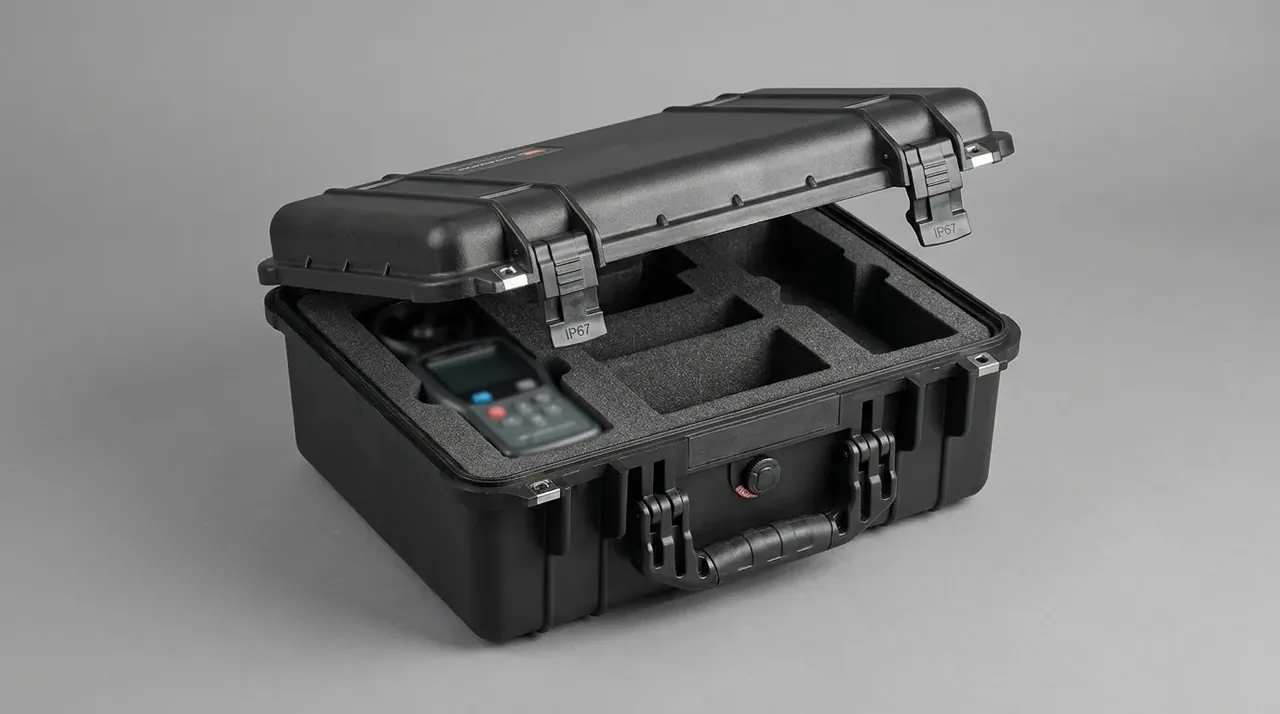
Quick answer: An Industrial 3D printer parts protective box ties 0.12 mm pin-hole coaxiality to a 5.4 mm latch seat, then reads seat cracks at cycle 5000.
Table of contents
- Pin-hole coaxiality on an Industrial 3D printer parts protective box
- Wall thickness of the latch seat
- Cracks after five thousand open-close cycles
- Lid-mouth offset after re-latching
- Wall setting for the parts batch
- FAQ
1. Pin-hole coaxiality on an Industrial 3D printer parts protective box
The latch seat cracks first or the lid mouth shifts: coaxiality decides which, and with enough cycles a wall difference becomes a reading difference. The shell is 560 by 400 by 220 mm outside, 495 by 340 by 155 mm inside, with a 4.1 mm wall and one pin hole at each lid end held to 0.12 mm. An off-axis hole rubs one side of the seat first, loading it harder through 5000 cycles. An Industrial 3D printer parts protective box logs coaxiality as the ledger's opening line; move the hinge tool or hole and that grade is struck.
Tight, nominal and loose shells share one cycle rig and one hinge set. Slip past moulding tolerance and the crack figure bends before the seat wall shows.
| Coaxiality grade | Pin-hole coaxiality | Latch seat wall |
|---|---|---|
| Tight | 0.08 mm | 5.4 mm |
| Nominal | 0.12 mm | 5.4 mm |
| Loose | 0.16 mm | 5.4 mm |
The loose grade stretches the five-thousandth crack to 1.1 mm; the tight grade pulls it to 0.5 mm but sharpens closing toward the 390 N limit. Only 0.12 mm holds crack and offset together. On an Industrial 3D printer parts protective box the loose grade is no resin failure: a skewed pin hole is not rescued by a 5.4 mm seat wall.
2. Wall thickness of the latch seat
A 5.4 mm latch seat wall is the second grading quantity, the stock from shell wall to catch groove bottom. Four latches at 390 N must spread their clamp force through this seat, not just press the lid down. Two seals at 19% sit on the same sheet as the wall figure; leave a cell blank and that shell is dropped from the ledger.

Four latches closing one by one are not enough. A diagonal wall difference beyond 0.3 mm lifts one lid corner first, and a long crack is then wrongly charged to coaxiality. An Industrial 3D printer parts protective box keeps wall and latch force on one sheet, freezing 5.8 kg empty, 13 kg loaded and the -10 °C to 50 °C swing; swap the hinge tool and both restart.
3. Cracks after five thousand open-close cycles
The run is fixed at 5000 cycles on a -10 °C to 50 °C swing rig, stopping every 1000, with the seat-root crack read under a loupe to 0.05 mm. Judgment uses the five-thousandth reading, not a total, since the limit asks whether pin hole and wall still hold the seat. An Industrial 3D printer parts protective box gates on cycle five thousand; the four earlier stops are trend only.
| Cycle index | Latch seat crack | Lid-mouth offset |
|---|---|---|
| 1000 | 0.2 mm | 0.08 mm |
| 3000 | 0.5 mm | 0.18 mm |
| 5000 | 0.8 mm | 0.30 mm |
The crack reads 0.2 mm at 1000 cycles, 0.5 mm at 3000 and 0.8 mm at 5000, growing faster late as off-axis loading builds. A crack of 0.8 mm and an offset of 0.30 mm must both be entered on the release sheet; logging just one is no pass. An Industrial 3D printer parts protective box archives past five thousand without a grade; the ledger closes on the last row.
4. Lid-mouth offset after re-latching
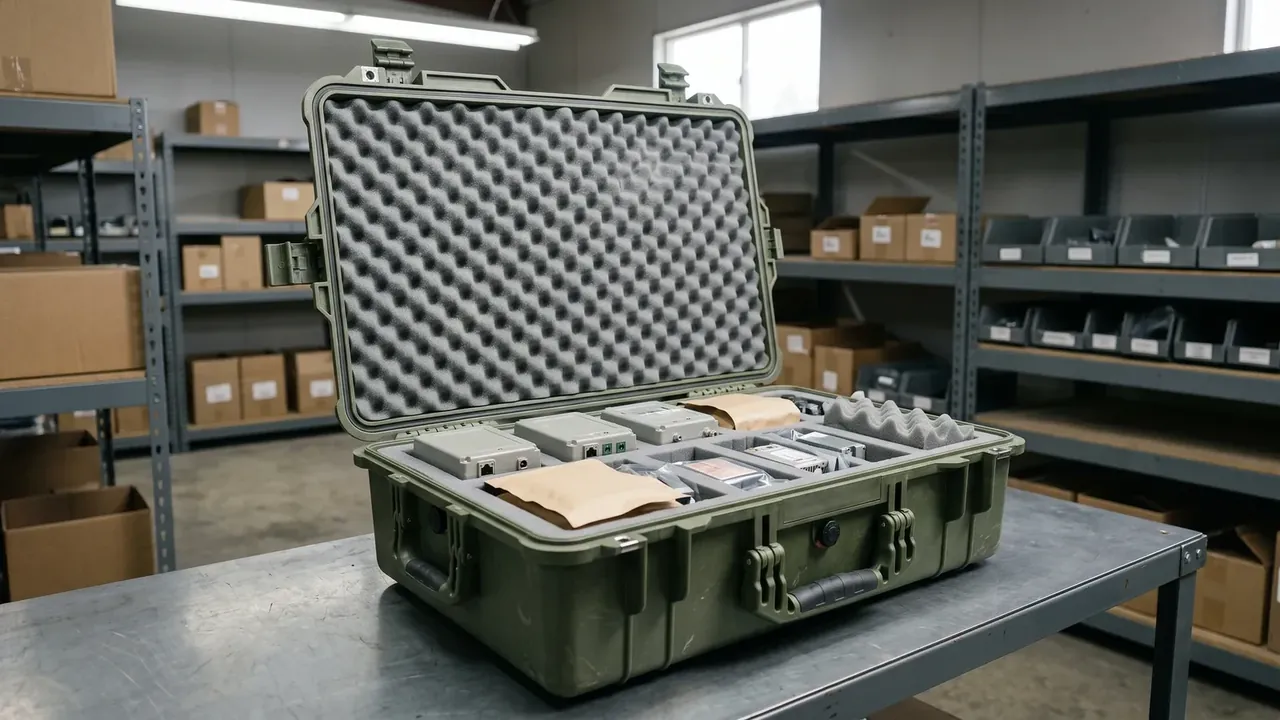
The run does not stop at a verdict: the four latches close again and the mouth is remeasured. Offset is the widest rim-to-mouth gap after closing, the largest of four feeler-gauge points. Crack asks whether the seat split; offset whether the lid sits square.
| Crack value | Lid-mouth offset | Open-close cycles |
|---|---|---|
| 0.2 mm | 0.08 mm | 5000 |
| 0.5 mm | 0.18 mm | 5000 |
| 0.8 mm | 0.30 mm | 5000 |
Compare the rows: 0.2 mm of crack brings 0.08 mm of offset, 0.8 mm brings 0.30 mm, so a crack near the limit means the pin hole has drawn the lid off square. A shell never re-latched earns no grade, and offset counts only after 5000 cycles. Both cells go on one sheet for the Industrial 3D printer parts protective box; a blank stops release.
5. Wall setting for the parts batch
One line settles the parts batch. The wall setting locks onto the thinnest seat still keeping the five-thousandth crack under 0.8 mm; thinner stays off the drawing. A batch freezes 5.8 kg empty, 13 kg loaded, the -10 °C to 50 °C swing, 5000 cycles and four latches at 390 N; a new hinge tool restarts the checks.
The batch is not signed off by one shell. Every Industrial 3D printer parts protective box hands in coaxiality grade, seat wall, five-thousandth crack and re-latched offset; four agreeing cells are needed and one crossed cell returns that shell alone. Moulding settings and cycle readings sit apart for an Industrial 3D printer parts protective box, with IP66 noted against a benchmark, never as a grade.
Conclusion
Three readings, not one crack number, close the parts batch on an Industrial 3D printer parts protective box: 0.12 mm coaxiality caps the crack at 0.8 mm, a 5.4 mm seat carries four latches at 390 N from -10 °C to 50 °C, and re-latched offset settles at 0.30 mm. One crossed cell returns that shell alone, borrowing nothing from a neighbour. JUNZHIJIA keeps 5000 cycle rig records by batch; Kexin New Materials (Guangdong) Co., Ltd. issues the drawing tolerances.
Related Reading
- Combine Harvester Parts Cases: Transport Protection for Headers & Threshing Drums
- Collaborative Robot Transport Cases: Protection for Arms & Teaching Pendants
- 3D Printing Resin & Filament Storage Cases: Moisture & Light Control
- Industrial laser marking machine accessories box
Related Products
- 8 Series — Gun Cases; Military Equipment Cases; Camera Equipment Cases; Drone Cases; Watch Cases; Knife Cases; First Aid Cases; Electronics Equipment Cases
- WL8-2812 PP Gun Case — model WL8-2812
- All protective cases and toolboxes: 7 series, 158 models