

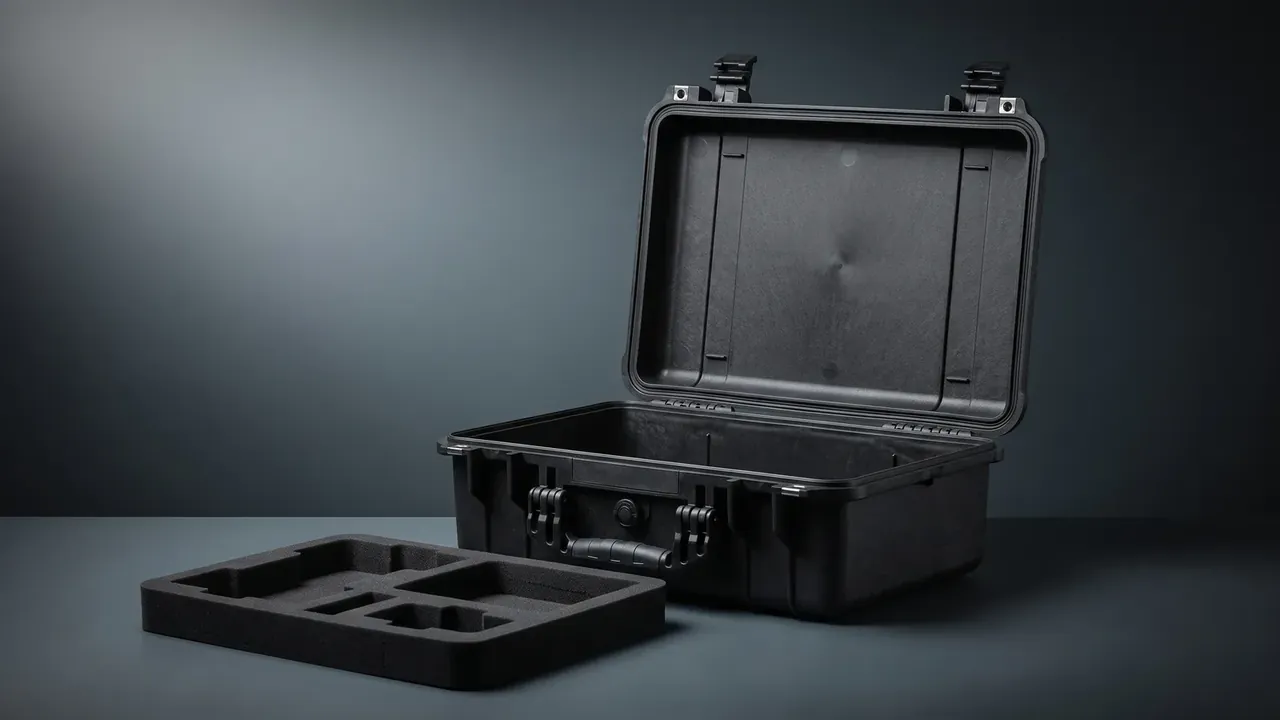
Quick answer:Industrial Case Product Catalog groups 18 sizes into 6 series, inside 300 mm to 1200 mm, with 2 or 4 latches, 3 insert grades and 2 caster sets.
This article covers the case side only: inside sizes, latches, insert grades and mounting points.
Table of contents
- Catalog logic behind inside-size tiers
- How case type maps to latches
- The three insert grades
- Caster sets and accessory mounting points
- Custom entry beyond the catalog
- FAQ
1. Catalog logic behind inside-size tiers
The first page of an Industrial Case Product Catalog should be an inside-dimension table, not a wall of photographs. Outside size answers whether a case fits a boot or a pallet row; the inside answers whether the equipment fits at all.
Inside dimensions run 300 mm to 1200 mm over 6 series of 3 sizes, 18 in total, the top of one tier meeting the bottom of the next.
Tiers follow the inside because rotomolded walls are not constant. A shell runs 3–6 mm, ribs, latch seats and hinge bosses each take a slice, and two cases of equal outside length can differ by a finger width within. An Industrial Case Product Catalog tiered by outside size produces returns at the first fit check.
The second line drawn through the catalog is the insert. The 3 sizes inside one tier share one cutting die, and crossing a tier means a new die, so tier edges cannot be shifted for convenience.
| Tier | Series | Sizes | Inside size | Latches | Casters |
|---|---|---|---|---|---|
| Small | 1–2 | 6 | from 300 mm | 2 | none |
| Middle | 3–4 | 6 | continues small | 2 or 4 | 2 sets |
| Large | 5–6 | 6 | to 1200 mm | 4 | 2 sets |
Read it left to right: inside size lands on a row, and the same row carries the latch count and the caster option.
2. How case type maps to latches
Latch count in an Industrial Case Product Catalog is structural, not decorative. Two latches belong to the carry case and four to the trolley and heavy-duty types, and the count sets how evenly the rim is pulled down, so a TPE seal at Shore A 50–60 closes along its length instead of pinching at the ends.
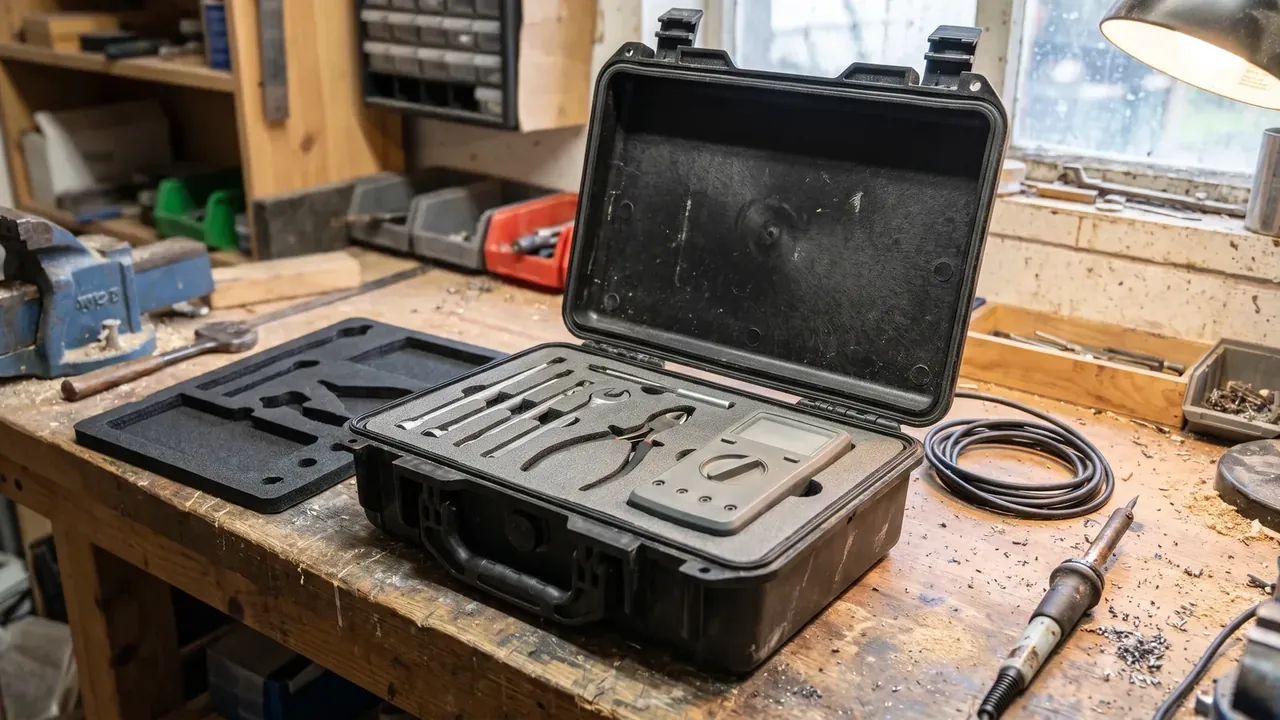
In an Industrial Case Product Catalog the holding force is specified at 200–400 N. Under 200 N a loaded case that falls once is likely to pop a catch, while a value near 400 N leaves a gloved hand needing both thumbs. Pick by opening frequency: below 3 a day, take the middle of the range; above 20, take the low end.
Case type also fixes the hinge. The carry case uses one long hinge, the trolley case two segments, the heavy-duty version a wider boss, all rated at 20,000 cycles. Hinge length is constant within a tier, which is why two neighbouring tiers cannot share a page.
Latches sit clear of the handle: the handle takes the middle third of the long side and the latches fall on the two third points, so a carried case loads the rim symmetrically.
| Case type | Latches | Holding force | Hinge rating | Usual handling |
|---|---|---|---|---|
| Carry | 2 | 200–400 N | 20,000 cycles | hand carry, short trips |
| Trolley | 4 | 200–400 N | 20,000 cycles | wheeled, long trips |
| Heavy duty | 4 | 200–400 N | 20,000 cycles | forklift and stacking |
3. The three insert grades
An Industrial Case Product Catalog reduces inserts to 3 grades so a buyer need not know foam first. Grade one is flat EVA at 25–45 kg/m³, one sheet in base and one in lid, enough when the equipment carries its own housing.
Grade two adds an egg-crate lid and slotted dividers, so the teeth press from above and loose instruments stay where they were put.
Grade three cuts a cavity to the outline, with a pickup notch on one wide side. It needs a 3D model or the unit itself; the catalog shows only a diagram. Compression set stays between 10% and 20% at 25% compression, 23 ℃, 22 h, so a cavity loaded weekly for a year does not sag into a bowl.
The 3 grades in an Industrial Case Product Catalog do not interchange: flat foam cannot hold a standing instrument, and a grade-three cavity is scrap once the equipment changes. Catalog ruling: if 2 or more insert specifications inside one inside-size tier fail to interchange, or a printed dimension is off by more than 5 mm, the catalog needs reissuing.
| Grade | Material | Density | Process | Suits |
|---|---|---|---|---|
| One | flat EVA | 25–45 kg/m³ | sheet cutting | housed instruments |
| Two | egg-crate and dividers | 25–45 kg/m³ | die cutting, slots | loose tools and cable |
| Three | cut EVA | 25–45 kg/m³ | profiled cavity | irregular equipment |
4. Caster sets and accessory mounting points
Two caster sets appear in an Industrial Case Product Catalog: detachable and fixed. The detachable set clips a base plate onto the floor and comes off to lie flat in a van; the fixed set is moulded into a thickened floor. If the same crew lifts the case all day, detachable; if a carrier takes it, fixed.
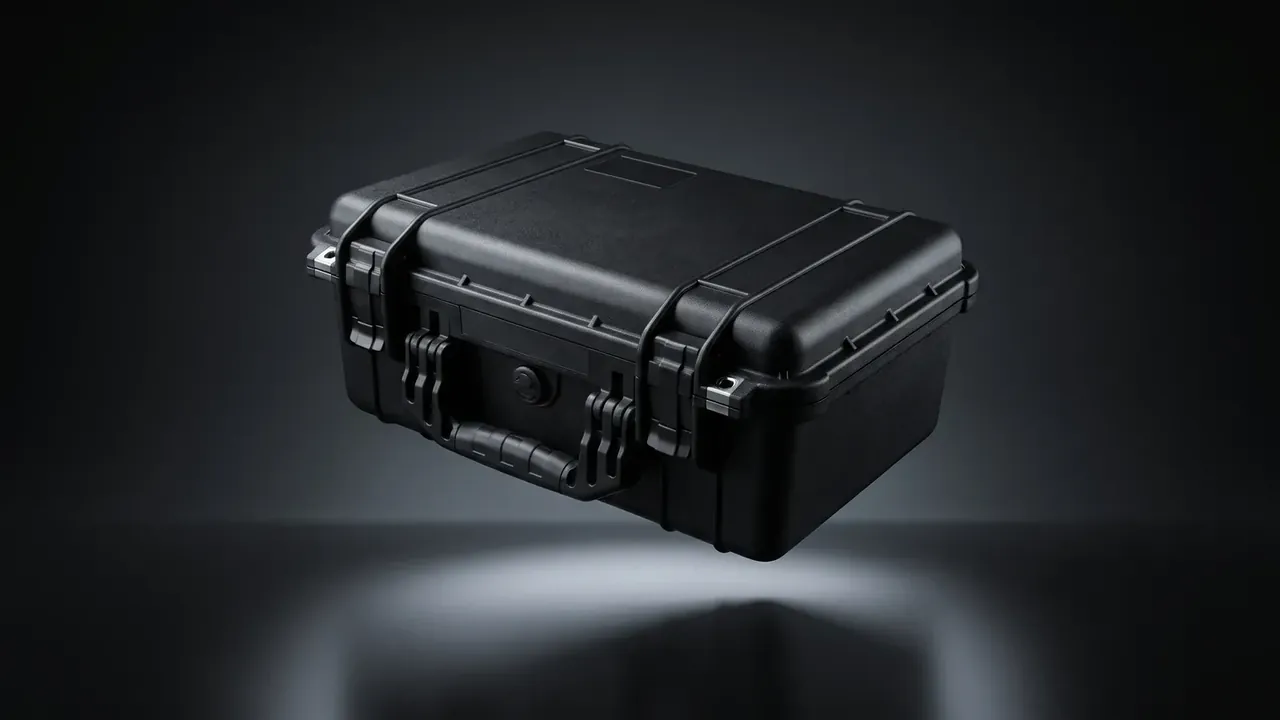
Three mounting points are built into the tool: feet pockets at the floor corners, a label pad on the side wall, a document pocket inside the lid. Each is a flat pad, so an accessory is screwed on without piercing the wall. An unused pad costs a blind plug; a missing one costs an external bracket.
Pallet figures in an Industrial Case Product Catalog belong on the same page. A Euro pallet is 1200×800 mm and a 40HQ measures about 12.03×2.35×2.39 m, so the tier decides the cases per row and per layer.
5. Custom entry beyond the catalog
Four cases fall outside 18 sizes: inside length beyond 1200 mm, one insert cut for 2 pieces of equipment, colour and print matched to a company mark, and a cable port through the wall. The Industrial Case Product Catalog closes with a page stating what such a request must supply.
Three items come back: a 3D model or the unit, the working scene, and quantity with a required date. The first two fix shell and insert, the third fixes the schedule. Rotomolding consumes 15–45 minutes per case in the oven before tooling time is added.
Custom in an Industrial Case Product Catalog is not redesign. Where one of the 6 series can be adapted, the insert and cut-outs change and the shell stays; an oversize unit alone justifies a new tool.
Related Reading
- Industrial case OEM manufacturer
- Usable volume and the corners you lose
- Foam insert solutions for industrial cases
- Lid depth and the space left for accessories
JUNZHIJIA
Related Products
- 8 Series — Gun Cases; Military Equipment Cases; Camera Equipment Cases; Drone Cases; Watch Cases; Knife Cases; First Aid Cases; Electronics Equipment Cases
- WL8-2812 PP Gun Case — model WL8-2812
- All protective cases and toolboxes: 7 series, 158 models