

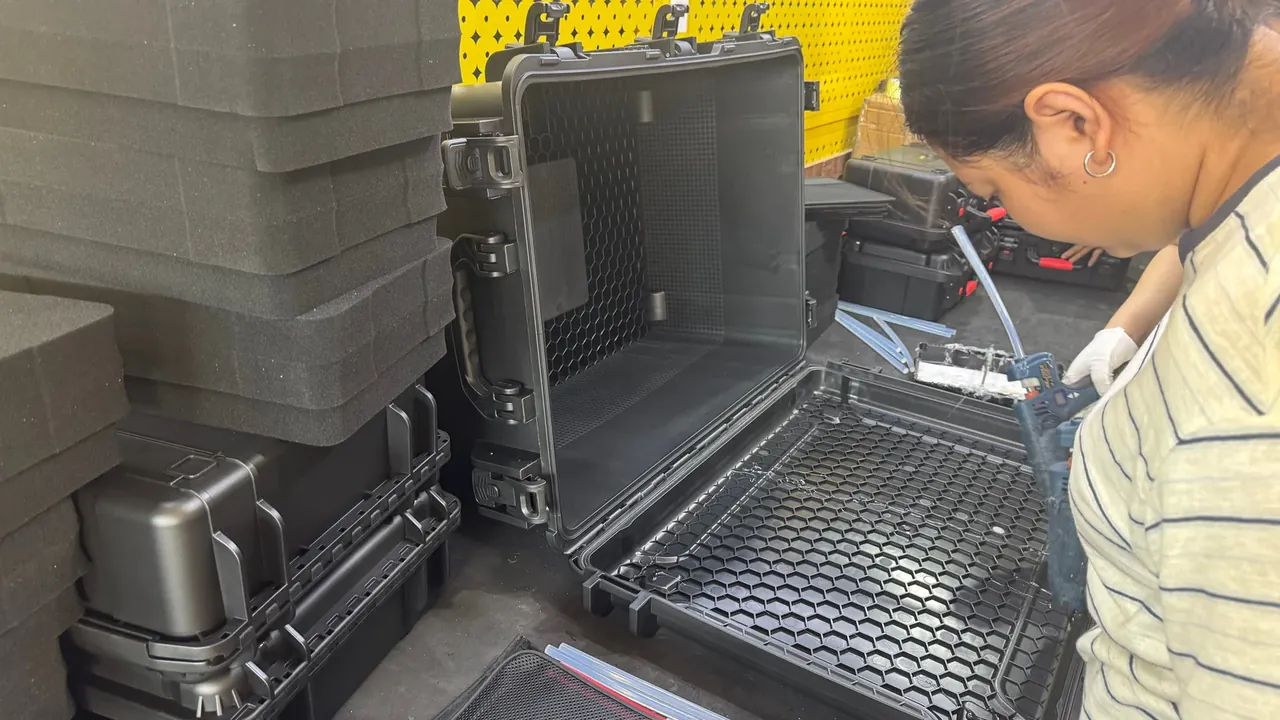
Quick answer: Industrial case quality inspection items come down to 8 checks in 30 minutes: colour, size, immersion, latches, hinges and insert fit.
Table of contents
- Appearance and colour: what to check first
- Re-measuring size and volume
- Seal and immersion checks on site
- Latch and hinge life sampling
- Insert and accessory consistency
- FAQ
1. Appearance and colour: what to check first
Industrial case quality inspection items open with the two checks that need no tools, because a lid comes up in seconds. Hold a fixed order: grain, parting line, print, then latch colour against the body. A grain break sits near the parting face on a moulded shell and at the end of the powder flow on a rotomoulded one, and a fingertip across it feels like sandpaper.
Industrial case quality inspection items judge colour at ΔE 2. Lay the standard chip and the incoming body on one white sheet, compare under natural light at 45 degrees, and read the meter against the surface. At or under 2 the case passes, 2 to 3 goes into a hold pile for the buyer, past 3 it fails. Rotomoulded colour drifts further, because oven temperature wanders across 250–300 ℃.
Surface defects split by whether a fingernail catches them. A catch under 10 mm is logged without failing the case, while cuts showing the base colour or sharp flash fail outright. Black shells hide all of it, so tilt the case into the light.
| Check point | Method | Criterion |
|---|---|---|
| Grain on lid and base | side light, fingertip | continuous, no break |
| Parting line | eye plus fingertip | offset under 0.3 mm |
| Print and label | straight-on light | centred, no missing stroke |
| Latch colour | visual match | ΔE 2 or less |
2. Re-measuring size and volume
Industrial case quality inspection items measure internal dimensions only, since outside numbers say nothing about what will fit. Take length, width and depth with a steel tape and a square, two readings per side, then average; ±2 mm is the release band. Close the lid without latching it, because a latch pulls the rim down by about 1 mm.
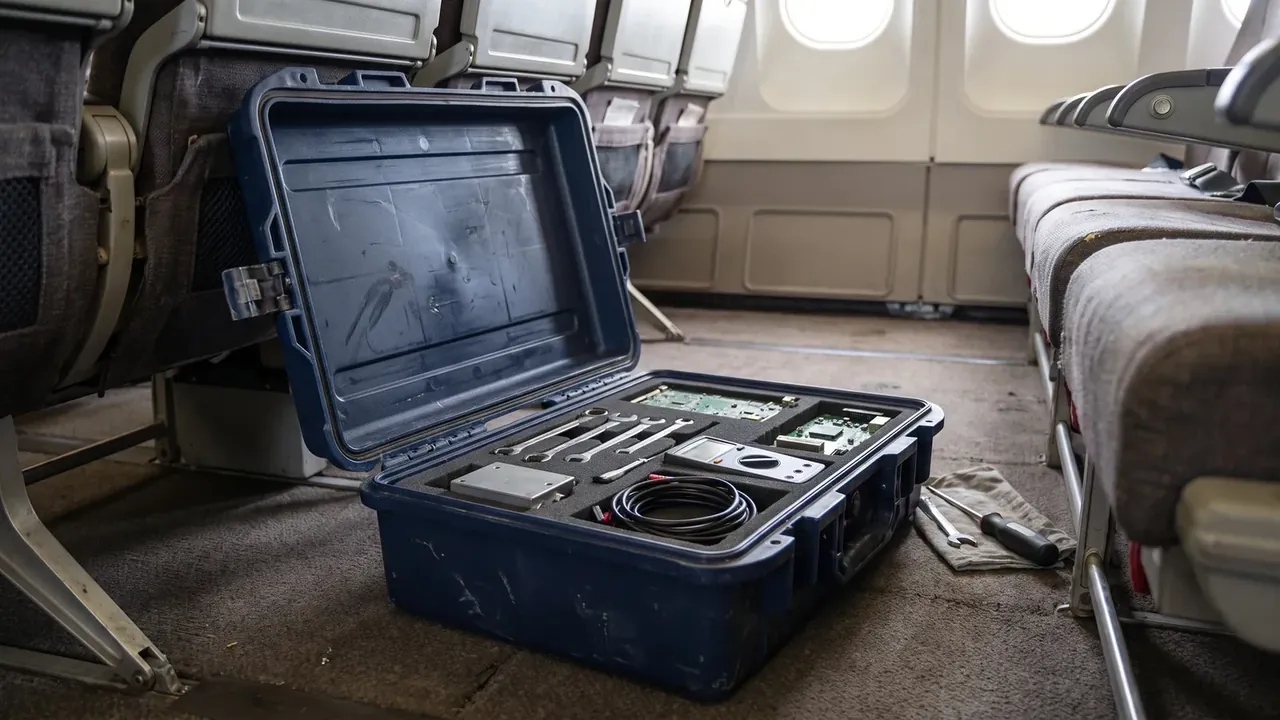
Industrial case quality inspection items turn those numbers into volume, deducting 3% to 5% for corners and ribs instead of quoting the raw product. Subtract foam as well: EVA at 20–30 mm per side eats 40 mm of width on a case lined both ways.
Wall thickness is read with an ultrasonic gauge, one point per side. Between 3 and 6 mm is normal, and a single thin reading earns a second pass; two in a row point to shot weight drifting. Allow ±10% to 20%, because latch screws stop biting below that band.
| Measurement | Instrument | Tolerance |
|---|---|---|
| Internal length | steel tape and square | ±2 mm |
| Internal width | steel tape and square | ±2 mm |
| Internal depth | depth gauge | ±2 mm |
| Wall thickness | ultrasonic gauge | 3–6 mm, ±10% |
3. Seal and immersion checks on site
Industrial case quality inspection items include the only step that needs water. Follow IP67: 1 m of depth for 30 min, sample and water within 5 K of each other, then dry the outside and open the lid to look for traces. Run it the day the goods land, since a submerged case cannot return to stock as new; draw the 5 samples and tag them.
Industrial case quality inspection items also allow an air test ahead of the water, which saves half the wasted dips. Latch the case, feed low-pressure air through the drain valve, hold for 1 min, and trace a drop beyond 0.5 kPa to a gasket with debris under it. TPE seals at Shore A 50–60 compress enough to close the gap without fighting the latches.
Verdicts follow the batch rule: 8 items with 2 failures, or any visible trace of water inside after the dip, and the lot goes back. Judge traces by position, not area. Mist in the bottom corners already fails, while water in the seal groove with a dry interior earns one retest.
4. Latch and hinge life sampling
The fourth group of industrial case quality inspection items is built from cycle counts. Latches run 500 open-close cycles and hinges 10,000 lid swings. A pneumatic rig with a counter finishes the 500 in about 8 min, while a motor swings the lid under 20 cycles per minute so the pin does not heat and shorten the measured life.
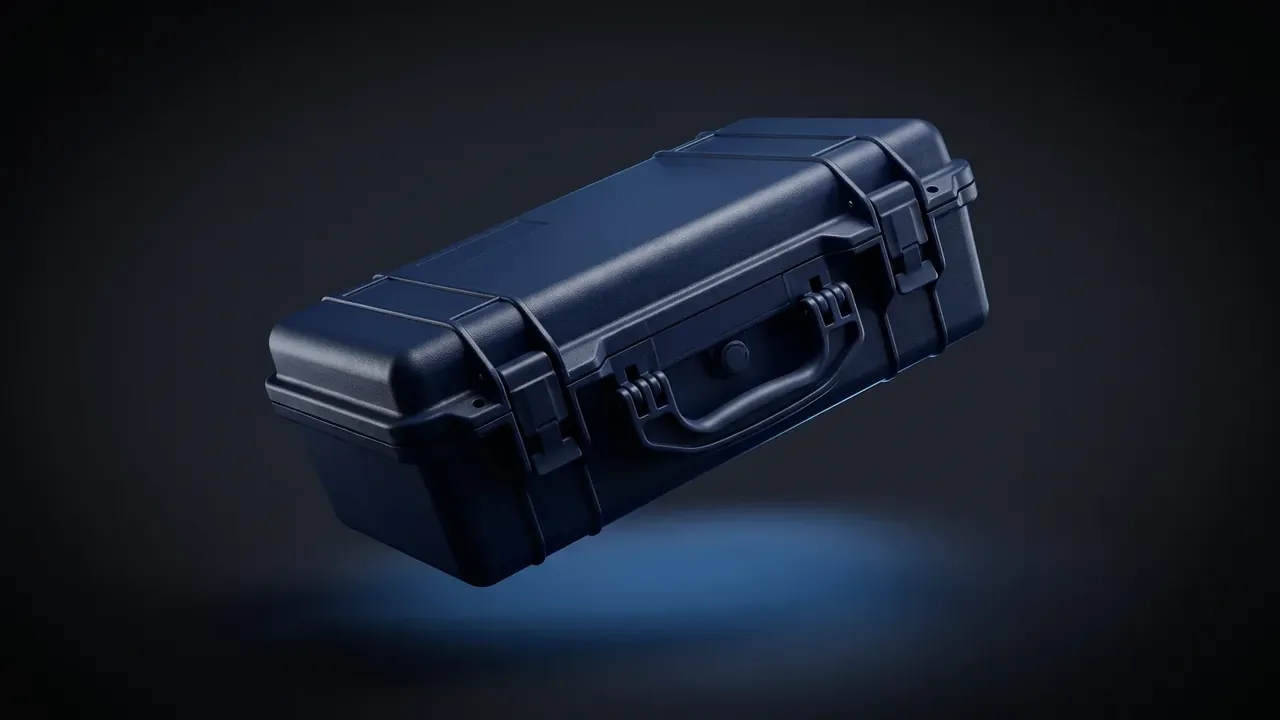
Industrial case quality inspection items read holding force next. Pull vertically at the tongue with a gauge: 200–400 N is normal, under 200 N means the latch pops open in a loaded drop, over 400 N means a gloved operator cannot get it open. Sample 5 cases, two latches each, and judge on the lowest reading.
Hinges fail at the pin first. Open the lid to 90 degrees and let go; a lid that falls back has a worn pin and bush. Play past 2 mm means the gasket no longer compresses evenly, which also sinks the immersion result.
| Part | Cycles | What to watch | Criterion |
|---|---|---|---|
| Latch | 500 open-close | tongue wear, spring | 200–400 N holding |
| Hinge | 10,000 swings | pin play, rim contact | play under 2 mm |
| Handle | 1 h at full load | root crack, screw | no crack, no turn |
| Gasket | air retest | compression mark | unbroken, under 0.5 kPa |
5. Insert and accessory consistency
Industrial case quality inspection items close with the insert, compared against the drawing rather than against taste. Check pocket position, depth and corner radius; any one of the three off and the insert fails. EVA runs 25–45 kg/m³, and a wide spread across a batch shifts the device inside its cutout.
Industrial case quality inspection items measure compression set at 25% compression, 23 ℃, 22 h, with 10%–20% as the band. That number decides whether the insert still grips after a year: cut 3 samples of 50 mm square, press to 75% of thickness, release and measure after 30 min.
Industrial case quality inspection items finish on accessories, counted one line at a time; a missing divider, strap or key holds the whole case. The 30 min budget splits into 8 min appearance, 7 min size, 10 min immersion and 5 min for latches, hinges and insert.
Related Reading
- How to lay out an incoming case checklist
- Running a batch incoming inspection
- Waterproof testing a case on site
- Using AQL 2.5 sampling on case lots
This article covers the case side only: shell, seal, hardware and insert, not the goods that travel inside.
JUNZHIJIA
Related Products
- 8 Series — Gun Cases; Military Equipment Cases; Camera Equipment Cases; Drone Cases; Watch Cases; Knife Cases; First Aid Cases; Electronics Equipment Cases
- WL8-2812 PP Gun Case — model WL8-2812
- All protective cases and toolboxes: 7 series, 158 models