

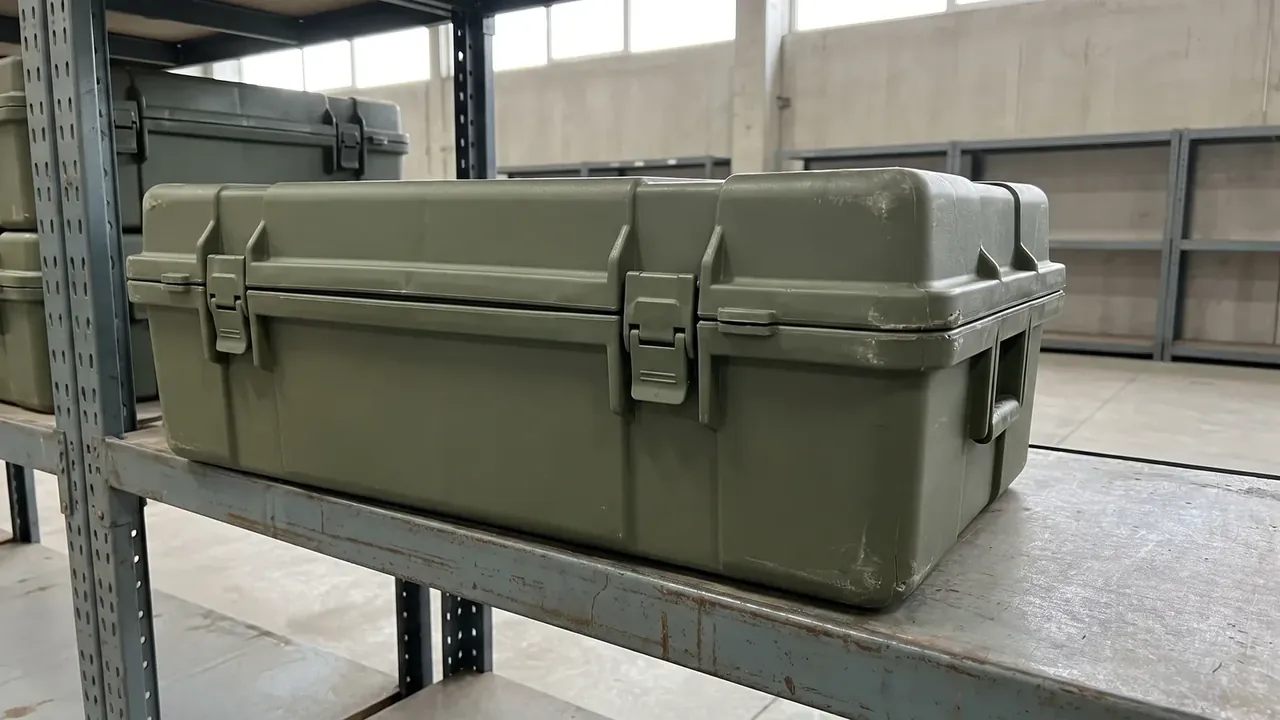
Quick answer: An industrial cleanroom specialized protective box passes on Ra 1.6 μm, under 3500 particles/m³ of its own, and 100 wipes with 70% IPA.
Table of contents
- Access Rules for an Industrial cleanroom specialized protective box
- Surface Roughness and Particle Shedding
- Wipe Resistance and Colour Migration
- Pressure Valve Across the Airlock
- Pass Box Size and Shell Outline
- FAQ
1. Access Rules for an Industrial cleanroom specialized protective box
A box reaches a clean area through the wipe bench before it reaches a door. Air showers are for people; an industrial cleanroom specialized protective box travels by pass box, and meets a cloth soaked in 70% isopropyl alcohol first.
The route has three legs: receiving bay, airlock, bench inside. The bay tests the grit on the outer face, the airlock tests how the body breathes as pressure shifts, the bench tests what the lid throws up when opened.
The format is 520×380×220 mm outside and 480×340×185 mm inside on a 4.0 mm wall at 6.4 kg. Holding the wall at 4.0 mm keeps stiffness within that weight, since nobody wants to carry even ten kilos of industrial cleanroom specialized protective box down a thirty-metre corridor.
Two latches close at 300 N each. No clean area hoses a box down, so IP65 keeps wipe water out.
2. Surface Roughness and Particle Shedding
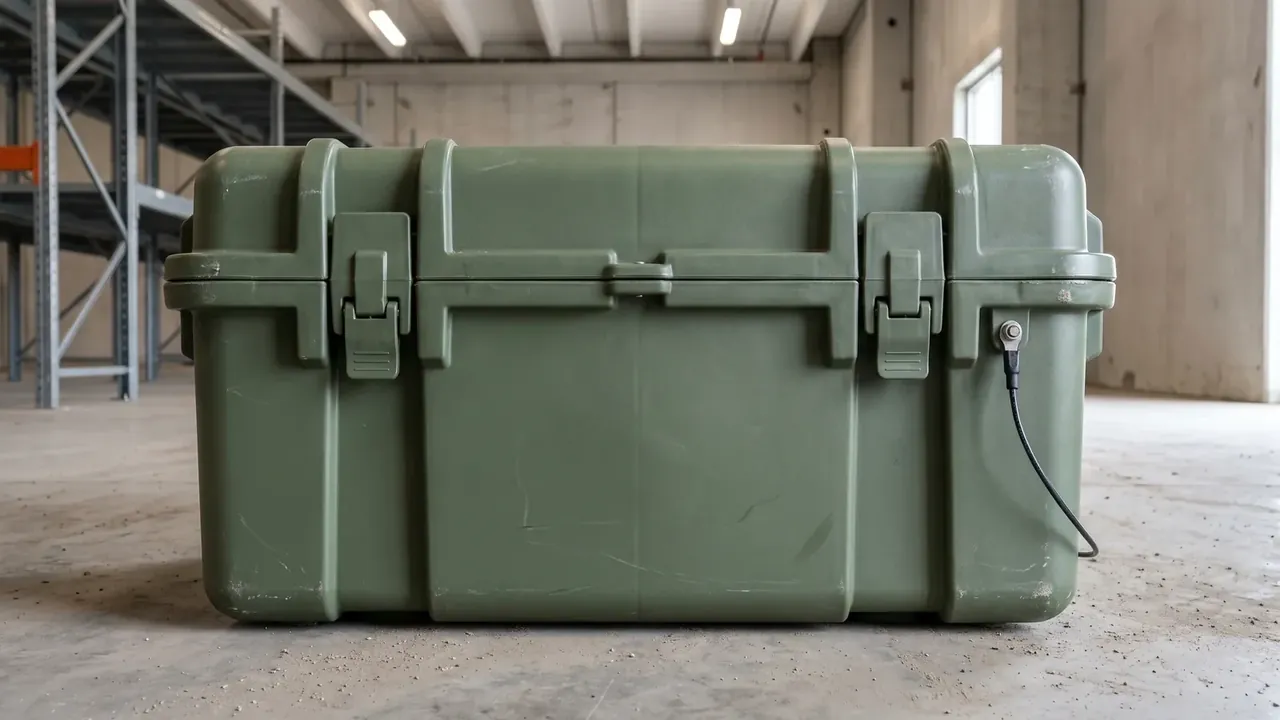
Ra 1.6 μm comes off the polished cavity, not from a finishing step. Moulding copies the tool surface, so a cavity at Ra 0.8 μm yields a part near Ra 1.6 μm, and pushing lower doubles the polishing passes.
Roughness decides whether a wipe can seat. On an Ra 1.6 μm face the fibres reach the base of the micro-peaks and lift a whole patch; past Ra 3.2 μm the peaks hold the cloth off and valley particles only get pushed.
Shedding is read in a 1 m³ chamber: once an industrial cleanroom specialized protective box sits still, the rise in ≥0.5 μm particles must stay at or under 3500 per m³. The ISO 7 limit is 352,000 per m³, so the shell adds under one percent.
| Surface roughness | Cavity polish | What one wipe lifts |
|---|---|---|
| Ra 0.8 μm | Mirror grade, double passes | Peaks and valleys both seat |
| Ra 1.6 μm | Standard fine polish | Whole patch, corners need a second go |
| Ra 3.2 μm | Cutter marks removed | Valley particles pushed, not lifted |
3. Wipe Resistance and Colour Migration
For an industrial cleanroom specialized protective box, 70% isopropyl alcohol is the mild case: after 100 wipes the face shows no whitening, crazing or loss of gloss. Above 90%, alcohol with little water present penetrates the skin and PP hazes.
Colour migration is grade 4 on a five-step grey scale. Dark shells wiped with alcohol carry pigment onto the cloth and then the next box; grade 4 means slight transfer.
Resistance follows ASTM D543: immersion, or a saturated cloth rubbed back and forth, then mass change and appearance. PP barely moves in short contact; the risk sits with masterbatch grades.
| Shed grade | Particles per wipe | Area it may enter |
|---|---|---|
| G1 | Almost none on the cloth | ISO 7 airlock and filling periphery |
| G2 | A few specks on the cloth | ISO 8 change room and buffer |
| G3 | Visible across the cloth | General plant and receiving |
The 100 wipes must run over one patch. Moving the cloth samples fresh surface each time, returns an average, and hides the corner that furred first.
4. Pressure Valve Across the Airlock
An industrial cleanroom specialized protective box opens its valve at 3 kPa. Airlock gradients run near 15 Pa, two orders of magnitude lower, so the disc never moves while doors open; latches and gasket seal there.
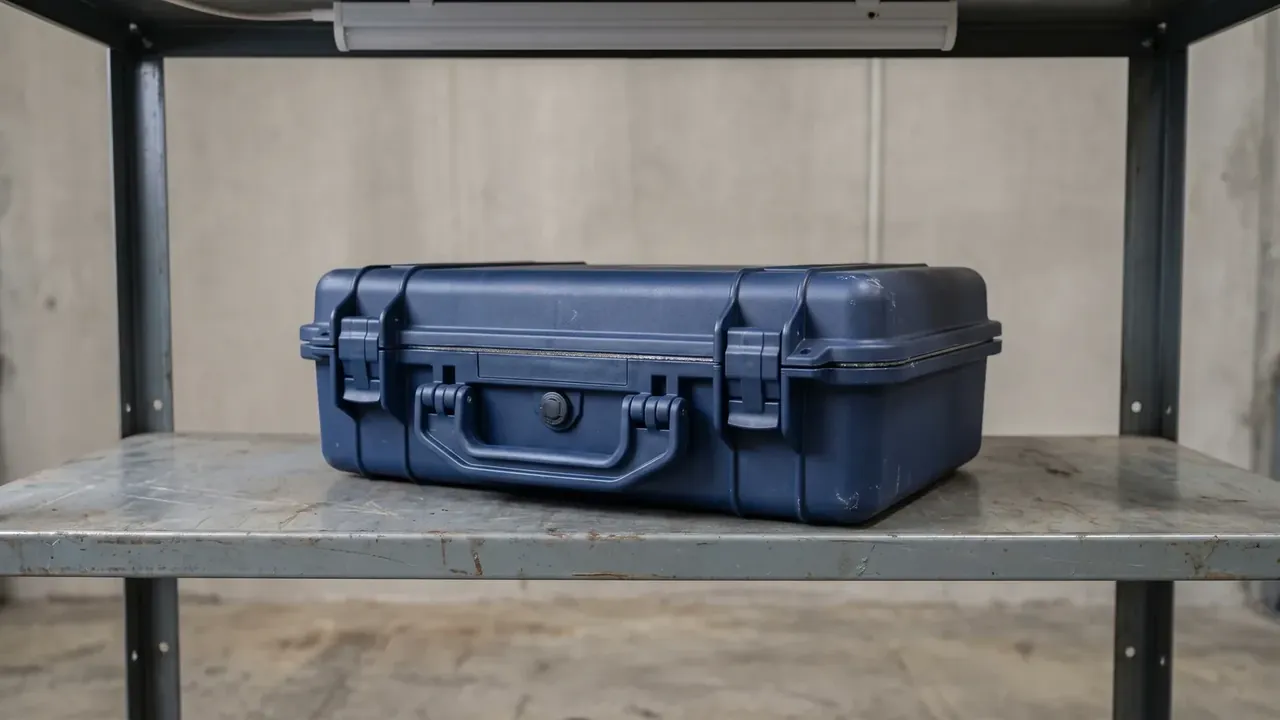
The valve covers the rest of the trip. Shut the lid and haul the box through a day of sun, and temperature difference drives internal pressure into the kilopascal range; at 3 kPa the disc lifts and the lid is neither bulged nor sucked flat.
| Airlock differential | Where it sits | Valve state |
|---|---|---|
| 5 to 10 Pa | Clean area to pass box | Fully shut |
| 10 to 15 Pa | Pass box to uncontrolled side | Fully shut |
| 15 Pa | Daily gradient across the airlock | Fully shut |
A hydrophobic membrane behind the disc stops particles and passes air. Cleaner loading stiffens it and slows the return, so the disc shuts without pressing home; 4 kPa is the point to swap.
5. Pass Box Size and Shell Outline
A pass box cavity is commonly 600×600 mm, and the 520×380 mm outline of an industrial cleanroom specialized protective box leaves 40 mm on the long edge and 110 mm on the short. More clearance is not better: a loose shell rocks, and the draught off an opening door lifts dust.
The 40 mm figure comes from the hand: a gloved palm is about 30 mm thick and fits the gap; narrower and only a hook works, and a hook scores the corner.
Three high is the ceiling inside the clean area. Floor return air stays open, pallets stand 200 mm clear, and a three-high stack of industrial cleanroom specialized protective box units sits below the 23 °C supply air.
An industrial cleanroom specialized protective box at Ra 1.6 μm with a shed grade of G2 stays outside an ISO 7 airlock.
When the numbers do not fit, change the shell rather than the window. Altering a pass box stops the line and forces a new leak test; trimming 20 mm off a 520×380×220 mm outline is one slide adjustment.
Conclusion
An industrial cleanroom specialized protective box is judged on surface first and pressure second: Ra 1.6 μm lets the cloth seat, 3500 per m³ keeps it from becoming a source, and grade 4 colour migration decides whether it stays on the line. A 520×380×220 mm outline at 6.4 kg with 40 mm of margin passes a 600×600 mm window.
Related Reading
- Volume Check for Cleanroom Transfer Boxes
- Pressure Balance Across an Airlock
- Material Choice Around Cleanrooms
Related Products
- 8 Series — Gun Cases; Military Equipment Cases; Camera Equipment Cases; Drone Cases; Watch Cases; Knife Cases; First Aid Cases; Electronics Equipment Cases
- WL8-2812 PP Gun Case — model WL8-2812
- All protective cases and toolboxes: 7 series, 158 models