

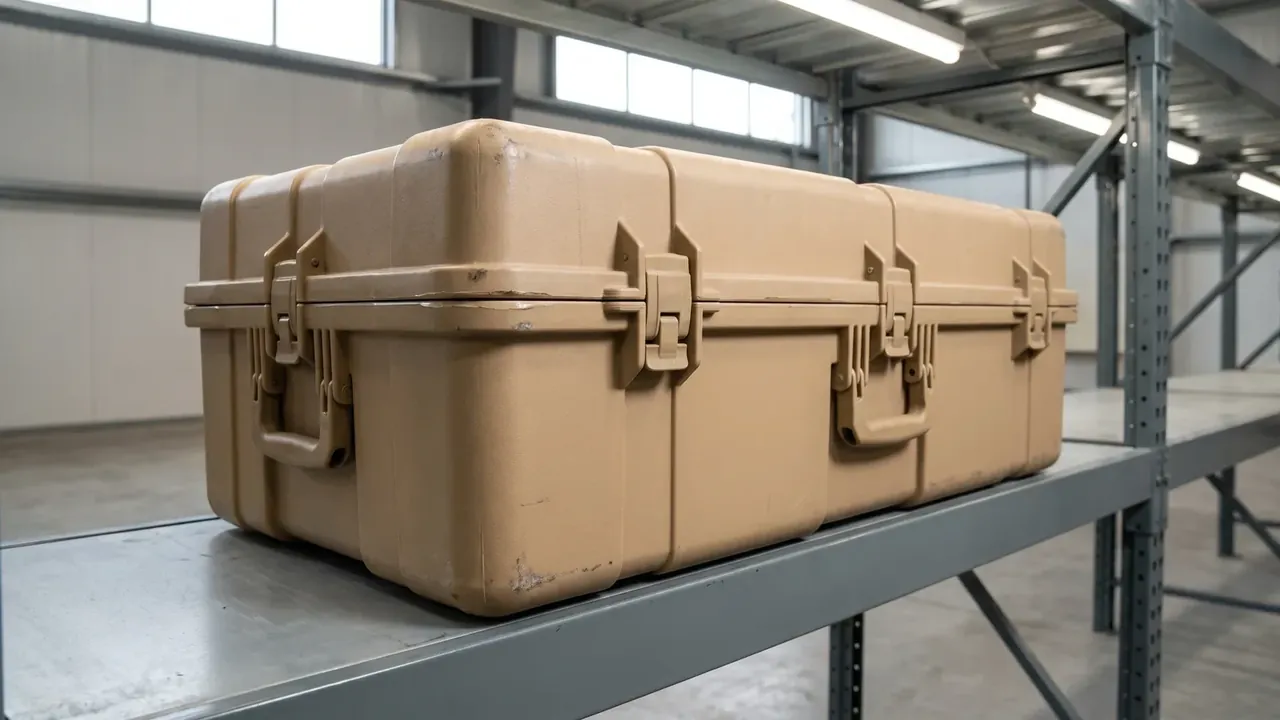
Quick answer: An industrial grade PP plastic heavy load container holds 500 kg over 4 tiers for 30 days at 23 °C with 0.8 mm of creep margin left.
Table of contents
- Where the Static Limit Sits on an Industrial grade PP plastic heavy load container
- PP Creep and Stacking Time
- Support Faces and Load Path
- Rib Section and Bending Resistance
- Long-Cycle Full-Load Stacking
- FAQ
1. Where the Static Limit Sits on an Industrial grade PP plastic heavy load container
A heavy load rating describes a floor that stays put after a quarter under load, not an impact that was survived. Fill an 800×600×500 mm body and stack it 4 high, and the bottom unit of an industrial grade PP plastic heavy load container carries three above it.
Static and dynamic limits run on separate tracks. The 500 kg figure is a constant push on the base; 200 kg is the peak inside a forklift set-down. Creep decides the first, notched impact the second, and 6 kJ/m² read warm falls below that at −20 °C.
| Static load tier | Weight on the base | Stacking and setting |
|---|---|---|
| Light tier | Up to 150 kg | 2 high, in-plant moves |
| Standard tier | Around 300 kg | 3 high, short store stays |
| Heavy tier | 500 kg | 4 high, quarter-long storage |
Inside, a 740×540×450 mm cavity sets the load, a 6.5 mm wall and 9 ribs carry it down, and PP at 0.905 g/cm³ keeps the shell light. The window runs −20 °C to +60 °C, and IP65 covers a jet, never immersion.
2. PP Creep and Stacking Time
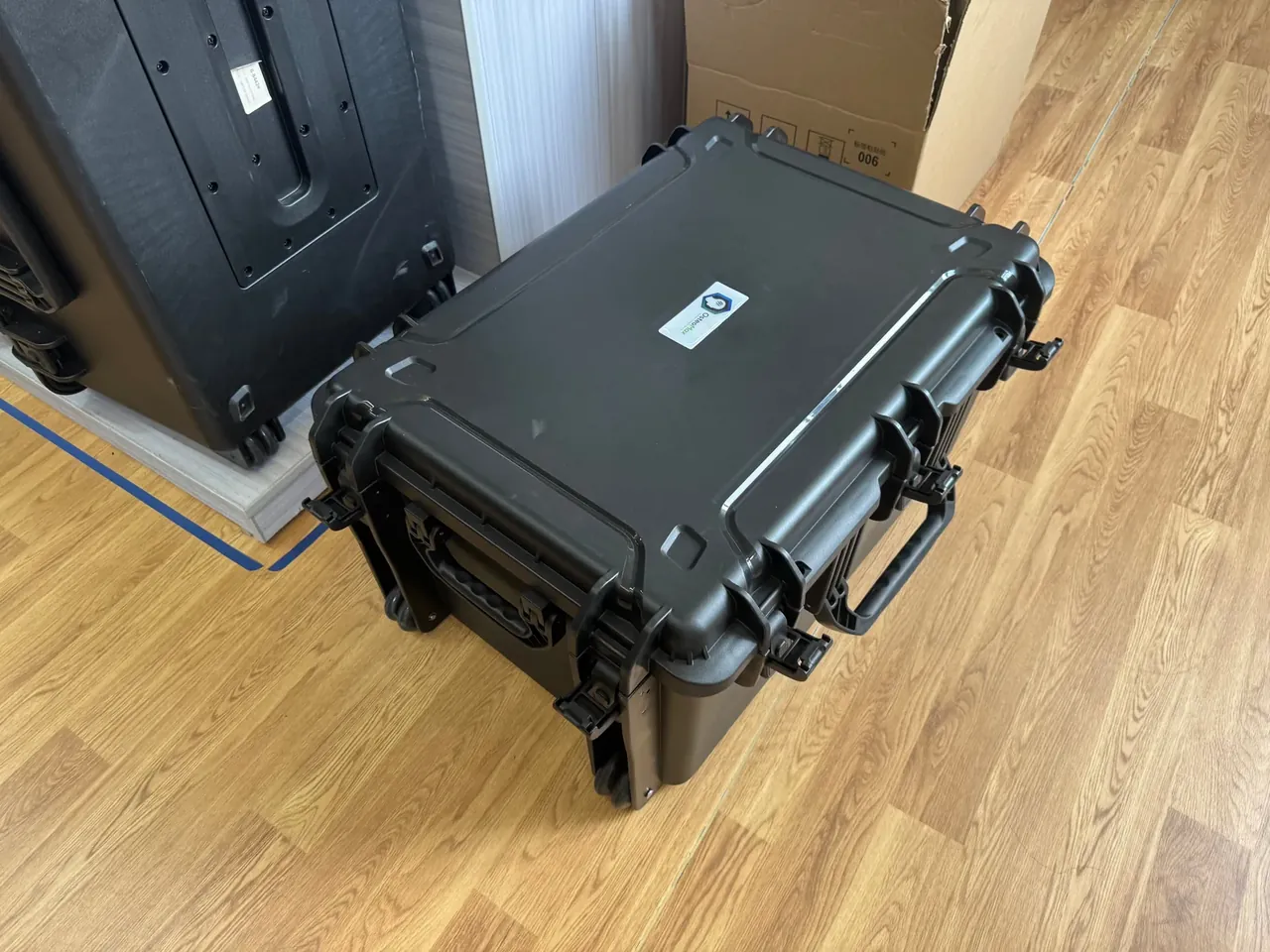
On an industrial grade PP plastic heavy load container, deformation arrives in two parts: an elastic dip as the load lands, then a slow flow for months after. At 23 °C under 5 MPa, PP gathers about 1.5% creep strain in a year; at 60 °C the same stress reaches 2.5%.
Heat bends the curve harder than stress. Creep at 40 °C runs 5 to 10 times faster than at 23 °C, so an uncontrolled store covers in one quarter what a tempered room needs years to reach. GB/T 4857.3 holds 24 h, or 48 h and 72 h for creep-sensitive packs.
At 500 kg the base meets day 30 with 0.8 mm of margin, and an extra tier turns that sag permanent.
| Creep margin | Base at day 30 | Next move |
|---|---|---|
| 1.5 mm | Face flat, roots clean | One tier may be added |
| 0.8 mm | Visible bow | Hold at 4 high |
| 0.3 mm | Whitening at the roots | Unstack, retire |
Shrinkage compounds it: a 1.6% rate pulls roughly 12.8 mm out of the 800 mm length, so the cavity is cut oversize, and ribs drift against pads until a stack of this industrial grade PP plastic heavy load container leans.
3. Support Faces and Load Path
The base does not lie flat. Six support faces cut the load into six legs: an 80×80 mm pad per corner and one at each long-side midpoint, with the rest of the floor held 4 mm clear of grit and nail heads.
On the heavy tier a corner takes about 110 kg and a side pad 60 kg; four corners total 440 kg, two midpoints 120 kg, and the surplus absorbs the off-centre load a forklift delivers.
| Support face | Position | Load per face |
|---|---|---|
| Corner pad | One per corner, 80×80 mm | About 110 kg |
| Side pad | One per long-side midpoint | About 60 kg |
| Full contact | No pads, floor flat down | 9 ribs spread it |
Offset is the real hazard. Shift an industrial grade PP plastic heavy load container 50 mm sideways and the mass lands on the lid centre below; the lid bows, the gasket squeezes unevenly, and the IP65 jet test fails first.
4. Rib Section and Bending Resistance
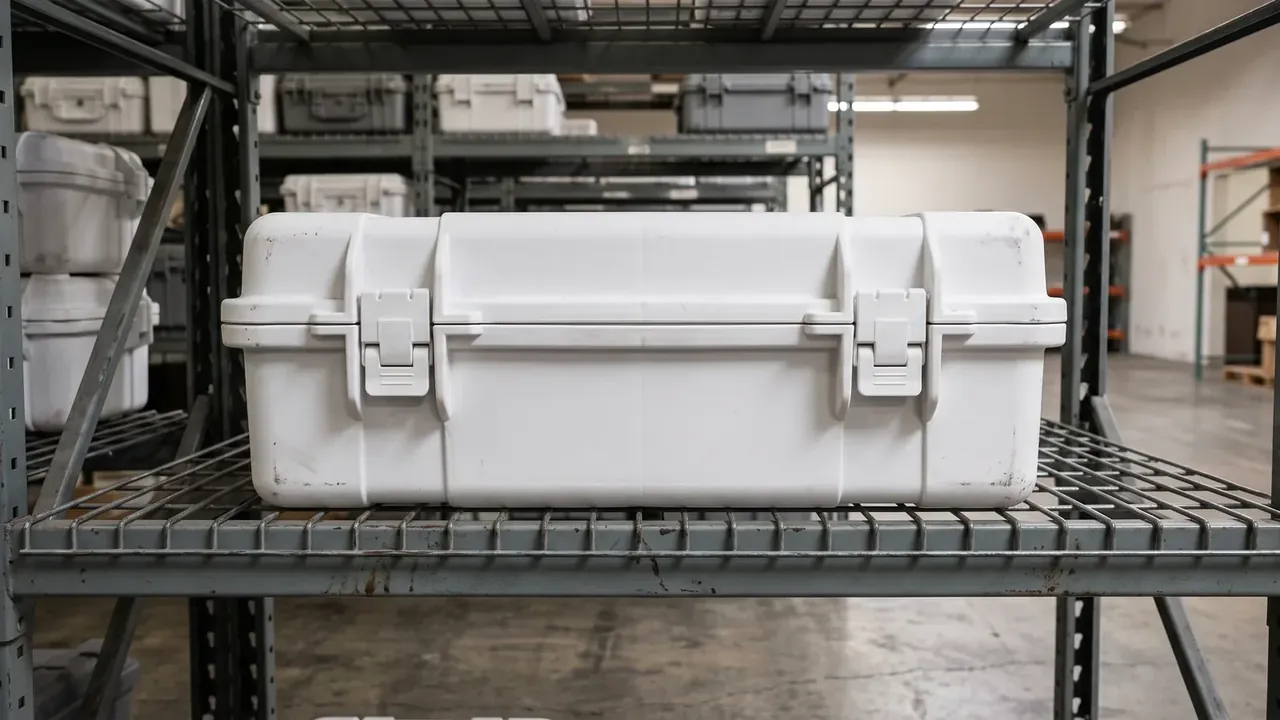
The nine base ribs on an industrial grade PP plastic heavy load container cross the 600 mm direction at 18 mm deep and 8 mm thick. Bending capacity follows the cube of depth, so 12 mm to 18 mm more than triples floor stiffness.
Slice 170 mm of that band: nine ribs at 18×8 mm give 1296 mm², the 6.5 mm plate gives 1105 mm², and together they reach 2400 mm². Only depth, thickness and plate gauge move that number.
An 8 mm rib outweighs the 6.5 mm wall, so a sink mark shows on the face behind it; on a base rib that face is the underside, and a faint sink pays for a root that will not yield first. Fillet at R2 to R3, or frozen-in stress opens the first cold crack.
5. Long-Cycle Full-Load Stacking
For an industrial grade PP plastic heavy load container, GB/T 4857.3 builds the load from tiers minus one, times unit weight, times a safety factor that tracks storage length: 1.6 below 30 days, 1.65 to 100, 2.0 beyond. Four tiers at 125 kg each call for about 619 kg on the platen.
Conditioning is not optional: 24 h at 23 °C and 50% humidity, a platen flat within 2 mm, a plate overhanging every lid edge by 100 mm, and error inside ±2%.
In the plant those 30 days run as one cycle, base height logged daily and corner drops on day 7, 14 and 30. After 24 h of rest, residual sag at or under 0.8 mm with clean roots passes the batch. The 5% rule means 25 mm on a 500 mm body; split one batch of industrial grade PP plastic heavy load container units into 23 °C and 40 °C groups, and the gap between sags is what heat bought.
Conclusion
Capacity on an industrial grade PP plastic heavy load container lives in the base section and the creep margin, not the outside dimensions. Pair 500 kg static, 4 tiers and 0.8 mm with 9 ribs at 18×8 mm, and the floor springs back after 30 days at 23 °C; move the same shell to 60 °C and it drops to 3 high. Fix the store temperature and stack height first, then size pads and ribs.
Related Reading
- Plastic versus Wood in Heavy Loads
- Volume-to-Weight Ratio in Large Cavities
- Base Structure for Heavy Part Transit Cases
Related Products
- 8 Series — Gun Cases; Military Equipment Cases; Camera Equipment Cases; Drone Cases; Watch Cases; Knife Cases; First Aid Cases; Electronics Equipment Cases
- WL8-2812 PP Gun Case — model WL8-2812
- All protective cases and toolboxes: 7 series, 158 models