

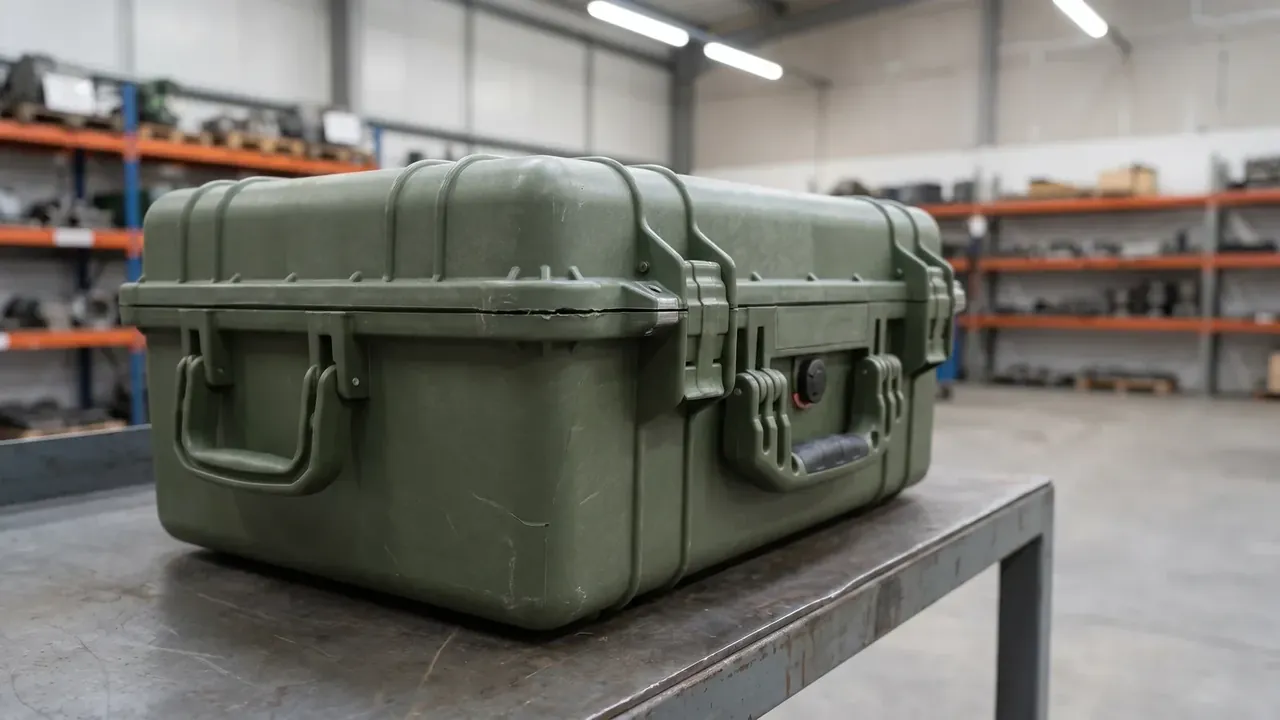
Quick answer: An industrial high-altitude anti-drop tool box hangs on two anchors and a 2.5 m tether, holding 6.8 kg of shell and 420 N of latch force after a 2 m drop.
Table of contents
- Tethering Layout of an Industrial High-altitude Anti-drop Tool Box
- Anchor Points and Lifting Eye Size
- Tether Length and the Swing Radius It Sets
- Latch Retention After a Fall Impact
- Release Order: Tool First, Case Last
- FAQ
1. Tethering Layout of an Industrial High-altitude Anti-drop Tool Box
Anything leaving a platform at height falls for two seconds nobody can shorten. An industrial high-altitude anti-drop tool box splits them into two shorter trips: the shell stays tied to the structure, the tools stay tied to the shell.
On an industrial high-altitude anti-drop tool box the two chains never touch. One goes from a rail to the lid anchors and carries the whole case; the other runs from tether posts to single tools and carries whatever gets laid on the lid lip.
Empty weight is 6.8 kg and a full load adds 15 kg, so 21.8 kg hangs on the anchors. Held still that mass pulls with 214 N. Give it speed and the same case hands over more than ten times as much.
2. Anchor Points and Lifting Eye Size
The shell measures 500 × 380 × 200 mm outside and 460 × 340 × 165 mm inside. It carries 2 anchors, 60 mm in from each side wall and lined up with the main ribs. They sit off-centre on purpose: a pull at the middle of the lid bows the panel, and a bowed panel lifts the gasket out of its groove.
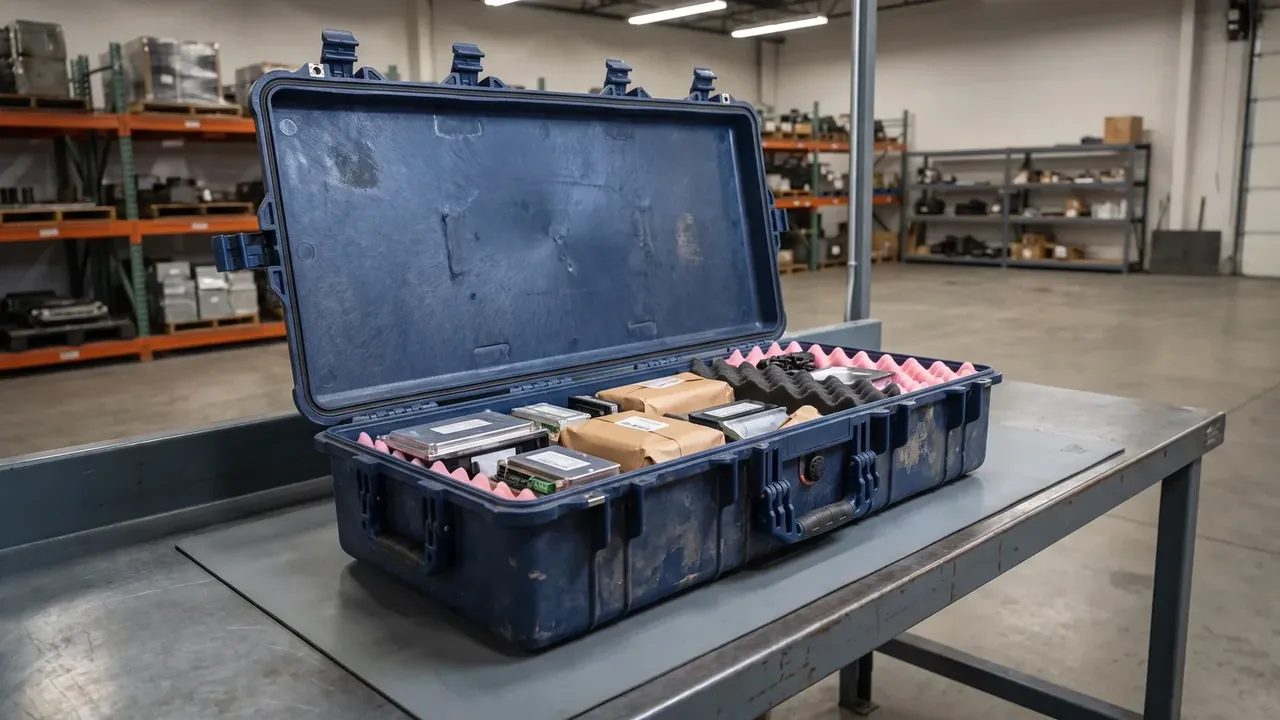
Each eye on the industrial high-altitude anti-drop tool box is φ10 mm on an M10 coarse thread, rated near 230 kg at a 5:1 factor. The 800 kg static figure is a different claim. It is the proof load on the boss where it fuses to the shell, 800 kg across the pair, with wall thickness built from 4.6 mm to 9 mm.
| Anchor strength | Arrangement | Case weight it suits |
|---|---|---|
| 400 kg single | One eye centred on the lid | Under 8 kg |
| 400 kg each, two | Symmetrical, 320 mm apart | The 15 kg class |
| 300 kg each, four | One per corner, slung frame | Above 25 kg |
What separates those rows is the load path. One eye lets the case rotate about the hook; four eyes spread the pull to the corners.
3. Tether Length and the Swing Radius It Sets
On an industrial high-altitude anti-drop tool box a 2.5 m tether sets a 2.5 m swing radius, because the two numbers are one dimension read from opposite ends. Speed at the bottom of the arc comes from √(2gL): about 7.0 m/s, where 21.8 kg carries roughly 530 J.
Energy climbs with the square of the radius while the contact patch on a wall barely moves. Too short a rope and the case swings against the body; too long and the wall absorbs the surplus. Proof rules take free fall as twice the rope, so 2.5 m is tested against 5 m.
| Swing radius | Tether length | Speed at the low point |
|---|---|---|
| 0.8 m | 0.8 m | About 4.0 m/s |
| 1.5 m | 1.5 m | About 5.4 m/s |
| 2.5 m | 2.5 m | About 7.0 m/s |
Every extra metre of tether on an industrial high-altitude anti-drop tool box buys reach and pays for it at the wall.
4. Latch Retention After a Fall Impact
The drop for an industrial high-altitude anti-drop tool box is 2 m, a gap found on platforms and suspended baskets alike. A 21.8 kg case stopping over 30 mm peaks near 2.7 kN, twelve times its static pull. Shorten the stop to 5 mm on concrete and the peak passes 6 kN.
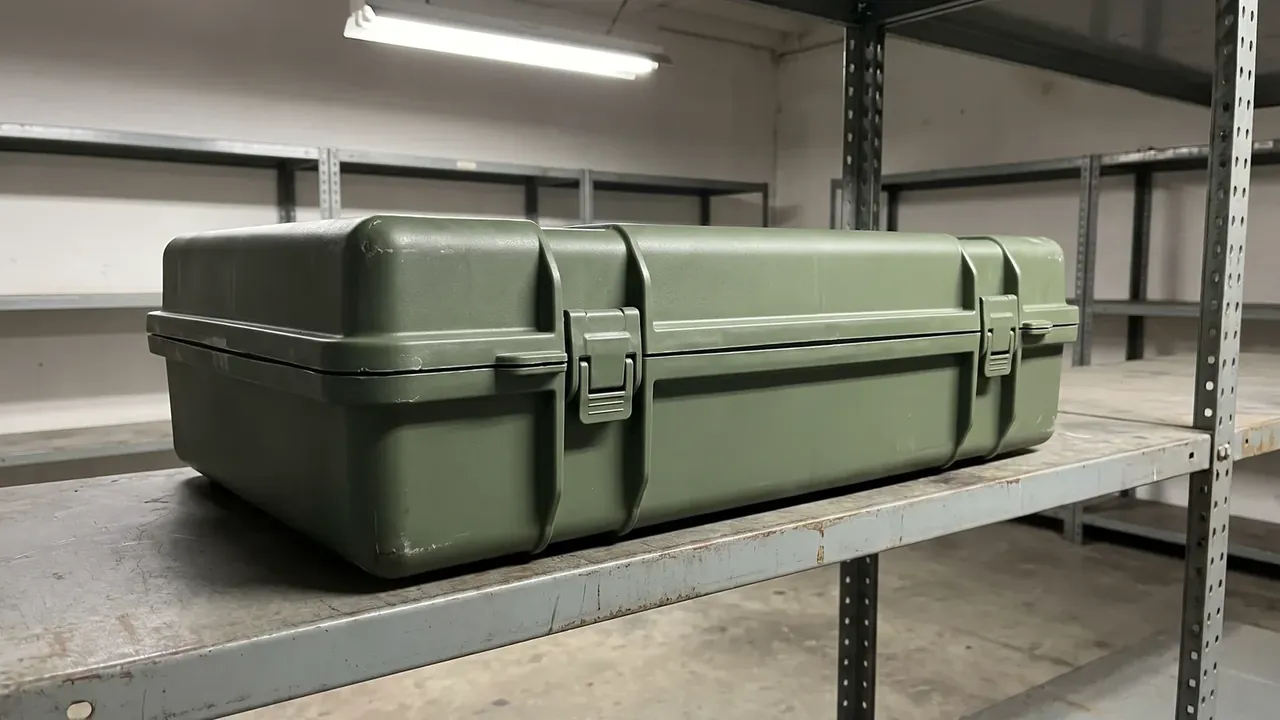
Retention is written ≥420 N and measures what a latch still applies to the lid lip, not what destroys it. Two latches at 480 N give 960 N together, and the pair may not fall below 840 N. The latch survives by carrying nothing: impact runs through the φ6 mm hinge pin and the lid lip seat.
| Post-impact retention | Test condition | Verdict |
|---|---|---|
| ≥420 N | Single latch after 2 m | Pass |
| 300–420 N | Hook shows plastic offset | Ground transit only |
| <300 N | Lid gap visible | Retire the latch |
Once pin clearance wears to 0.5 mm the lid shifts, the seat misaligns and the gasket gets cut. That is the failure the industrial high-altitude anti-drop tool box is built to postpone.
5. Release Order: Tool First, Case Last
The lid of an industrial high-altitude anti-drop tool box opens to 105° and parks behind the body. Treat the case as the anchor: undo the tool tether first, close the lid and fasten both latches second, unclip the case tether last. Reverse it and tools still hang from rope while the case leaves.
Tether posts sit in shallow pockets along the hinge side, so a released tool drops back in. The rope well sits on the anchor side, where 2.5 m coils in three turns under 180 mm. At −20 °C PP loses half its notched impact strength and a thin hook snaps rather than bends, so let the shell reach 0 °C first. The band is −20 °C to +55 °C.
Conclusion
Two 400 kg anchors, a 230 kg eye body and the 7.0 m/s a 2.5 m tether generates hold the industrial high-altitude anti-drop tool box in balance. Match them and 420 N of retention after a 2 m drop means something, because it is leftover grip on the lip rather than latch strength. A 6.8 kg shell and a 4.6 mm wall handle 3-high stacking and IP65; neither handles a rope that paid out 5 m.
Related Reading
- Packing Choice for Work-at-Height Tools
- Cavity Allocation for Tethered Tools
- Compartment Layout for Field Instruments
Related Products
- 8 Series — Gun Cases; Military Equipment Cases; Camera Equipment Cases; Drone Cases; Watch Cases; Knife Cases; First Aid Cases; Electronics Equipment Cases
- WL8-2812 PP Gun Case — model WL8-2812
- All protective cases and toolboxes: 7 series, 158 models