

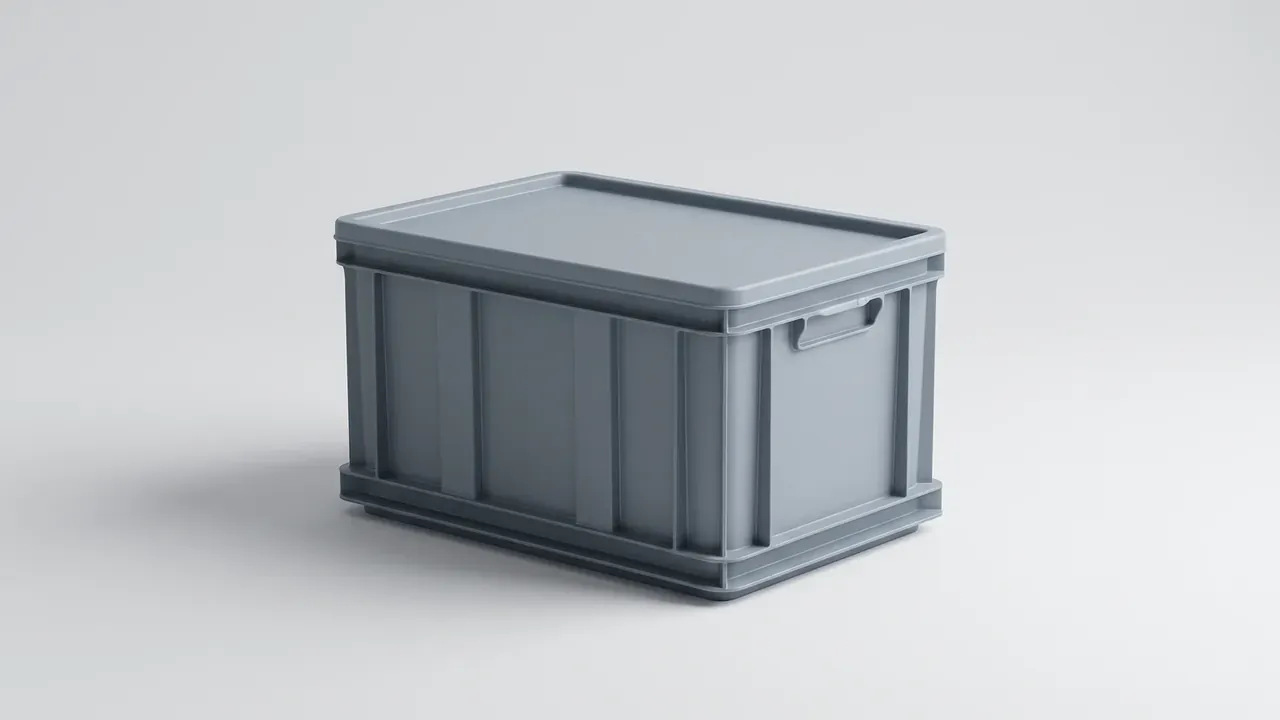
Quick answer: This retrofit started at the rack, not at the catalogue. Four beam levels, 1350 mm of clear height, a 25 kg ceiling per unit and five-high floor stacking fixed everything else, and only then did the industrial plastic storage containers settle at 40 to 80 litres.
Table of contents
- Industrial plastic storage containers on a four-tier rack
- 40 to 80 litres: what five-high stacking loads
- Colour zones and label pockets for 5S
- Forklift and trolley handover: 42 minutes to 13
- FAQ
1. Industrial plastic storage containers on a four-tier rack
This plant builds low-voltage control cabinets, where old shelving stood two metres with two levels, the top empty. In March 2025 new uprights went in at 4500 mm, four beam levels, 1350 mm clear at the bottom and 900 mm above, so a 600x400x280 mm industrial plastic storage container slides in upright and its lid still opens flat.
Load on these industrial plastic storage containers was worked backwards from the beam. At 25 kg a base may deflect no more than 2.5 mm, or it rests on steel, sliding becomes dragging and the feet round off.
| Level | Clear height | Unit ceiling | Colour and zone |
|---|---|---|---|
| 1 (160 mm off floor) | 1350 mm | 25 kg | Dark grey, incoming |
| 2 | 900 mm | 18 kg | Blue, released |
| 3 | 900 mm | 14 kg | Yellow, in process |
| 4 | 900 mm | 10 kg | Green, finished |
A 1350 mm bottom level is not waste: the 80 litre tier holds terminal blocks at 31 kg and can only live at floor level.
2. 40 to 80 litres: what five-high stacking loads
On quiet nights the cases stack five high on the floor, so the bottom lid carries 100 kg. The thin crates used before dished at the third layer and the stack leaned. Acceptance became a 72 hour static stack with no more than 1.5 mm of residual dishing.
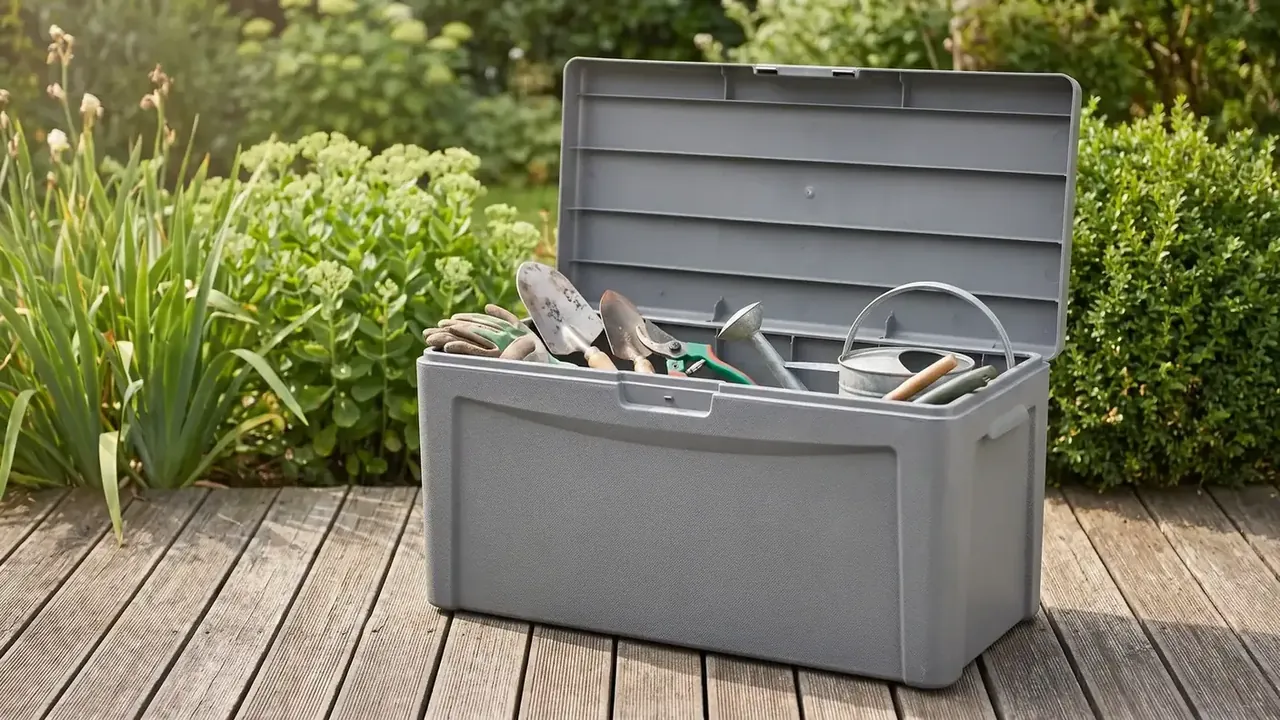
The 40 to 80 litre band was squeezed out by the 25 kg ceiling. Forty litres weighs 12 kg and wastes half a position; eighty litres reaches 31 kg and runs part full. The plant took 55 litres for relays and 68 for harness bundles, which cover seven positions in ten.
| Nominal | Internal | Loaded | Level |
|---|---|---|---|
| 40 litres | 566x366 mm | 12 kg | 3 and 4 |
| 55 litres | 566x366 mm | 19 kg | 2 |
| 68 litres | 566x366 mm | 23 kg | 2 |
| 80 litres | 566x366 mm | 31 kg | 1 |
One base mould for four heights was deliberate. Every footprint is 600x400 mm, so each beam needs one locating block, and the shared internal size of 566x366 mm takes six 200 mm part bins.
3. Colour zones and label pockets for 5S
Dark grey, blue, yellow and green mean incoming, released, in process and finished on every rack, and the pigment goes into the melt because oil lifts adhesive inside two months.
- Colour changes run only at the moulding stage, one tonne per colour minimum.
- Every label pocket sits on a short side: a 100x60 mm recessed slot for an A6 card.
- The slot starts 30 mm below the rim so a gloved hand can pull the card without lifting the lid.
- A board at the aisle end carries four rows for four colours, rewritten every two hours.
Colour zoning is easy on the case and hard on the habit. A dark grey incoming case gets pushed into the blue zone, the two greys pass at a glance, and the count turns into an argument. So the plant painted each zone's beam ends to match. A misplaced case now shows a shade that does not fit, and anyone walking past sees it. Label pockets moved to the short side for the same reason: from the aisle a clerk reads the part number without pulling the case out. Three months on, misplaced cases had gone from 37 to 2.
4. Forklift and trolley handover: 42 minutes to 13
Two vehicles cover the floor. A 3 tonne forklift moves full pallets, four cases per 1200x1000 mm pallet and twenty per five-high load; a trolley serves line-side replenishment on 125 mm wheels that clear a 20 mm threshold.
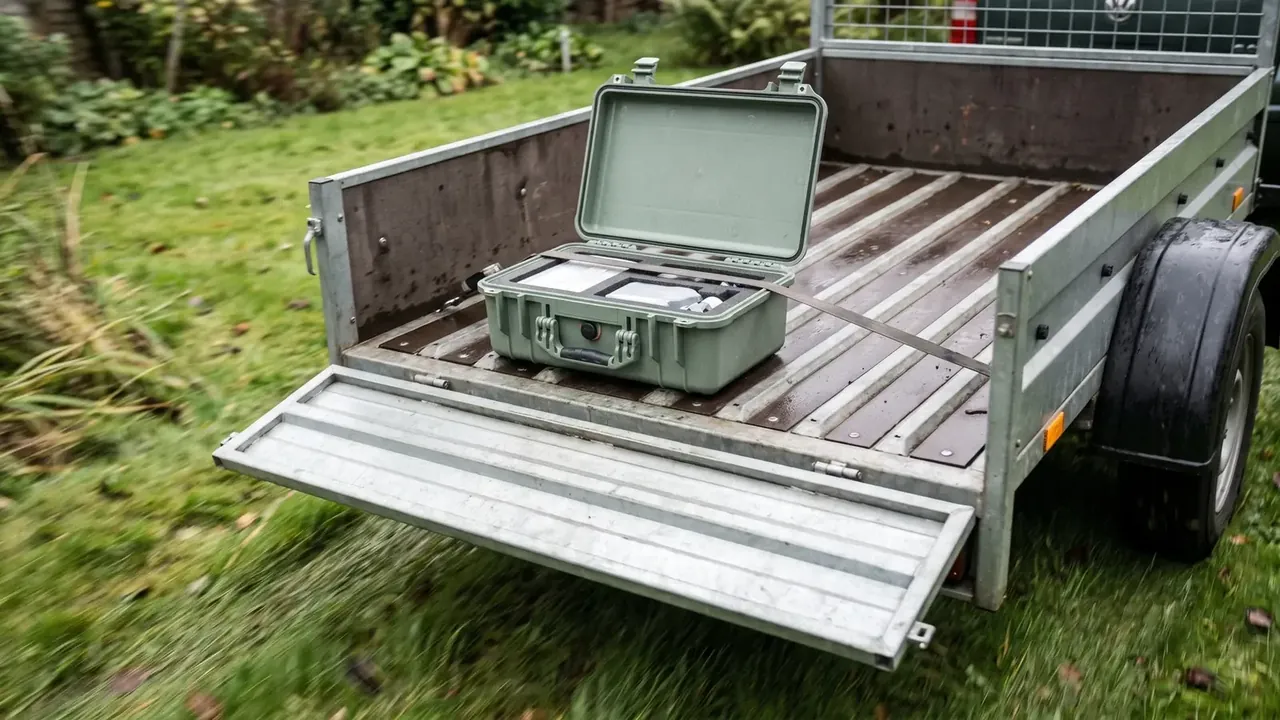
Counting follows position, not arithmetic. Each position carries a 40 mm strip on the beam, so a case pushed flush leaves a gap when it is missing. With labels on the short side, two clerks read from opposite ends and finish 620 cases in 13 minutes, against 42 before.
Winter is the trap. The shop is unheated and the rack reads 6 C in January, when a fork tine that only whitens a corner in summer will chip it. Dropping the entry height to 80 mm and adding a 5 mm rubber pad took chips from nine a month to one.
Chipping on these industrial plastic storage containers tracks temperature more than wall thickness. The same bodies dropped in July whitened at the corner; dropped in January they split 60 mm along it.
Conclusion
What changed was not the case but four relations: clear height so a lid opens flat, a 25 kg ceiling that holds base deflection, a five-high stack that pins dishing at 1.5 mm, and a short-side label that brings counting to 13 minutes. Once those agree, capacity settles at 40 to 80 litres on its own; buy boxes first and the money goes into reworking the rack. Choosing industrial plastic storage containers is choosing positions that can be counted again and again.
This article discusses only the container (case body) side of specifications and design intent, and does not cover any handling, loading or use of the contents.
Related Reading
- Configuring purpose-built shipping and storage cases
- Storing and maintaining case moulds
- Zoning a vertical storage cabinet
Related Products
- 8 Series — Gun Cases; Military Equipment Cases; Camera Equipment Cases; Drone Cases; Watch Cases; Knife Cases; First Aid Cases; Electronics Equipment Cases
- WL8-2812 PP Gun Case — model WL8-2812
- All protective cases and toolboxes: 7 series, 158 models