

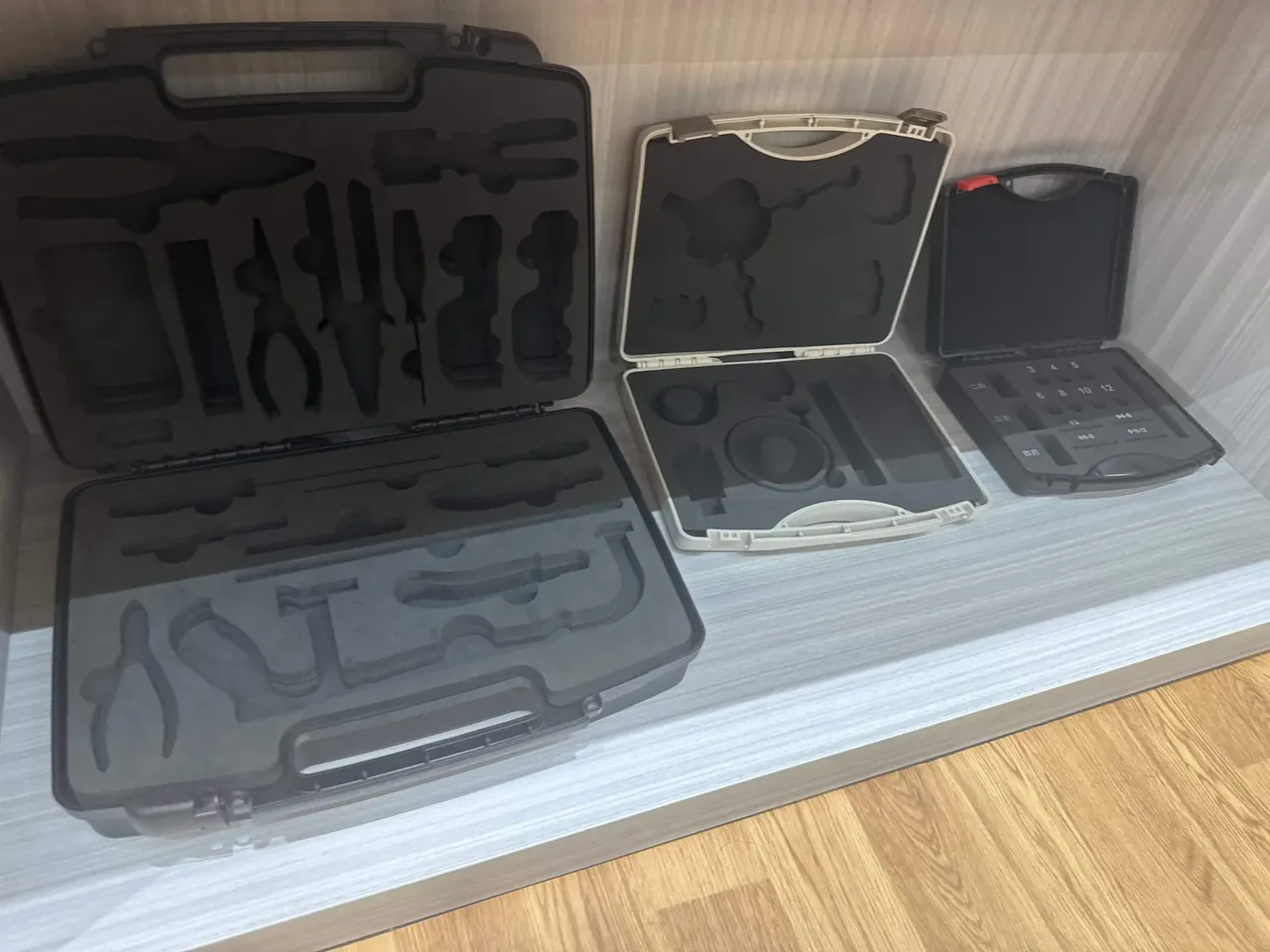
Quick answer: An industrial portable welding equipment box is sized 620×460×340 mm with a 5.0 mm wall and a 25 kg rating, spreading that load through a 6 mm base plate onto four 30×30 mm pads, with the rim gap still under 1.2 mm after a 1.2 m drop.
Table of contents
- Base plate and load distribution of the industrial portable welding equipment box
- Side rib pitch and lateral crush resistance
- Handle tube and wheel set assembly clearance
- Bumper thickness split for a 1.2 m drop
- Load split between carry handle and handle mount
- FAQ
1. Base plate and load distribution of the industrial portable welding equipment box
The industrial portable welding equipment box measures 620×460×340 mm outside and 560×395×290 mm inside, at a 5.0 mm wall, 8.6 kg empty and a 25 kg rating. A 6 mm PP plate rests on four 30×30 mm pads aligned with the bottom of the side ribs. Those pads share the 25 kg at roughly 61 N each, and the base middle keeps over 4 mm of clearance.
Bond the plate flat and the load presses on a wide, thin floor, which sags 2.5 mm at 40°C; leave 4 mm and the load lands on four pads with 0.8 mm of sag. Four M5 countersunk screws into brass inserts hold it at 2.5 N·m; more torque presses a white ring into the wall.
| Load item | Value | Reading use |
|---|---|---|
| Base plate | 6 mm PP | Spreads the 25 kg |
| Load pads | 4 at 30×30 mm | About 61 N each |
| Base clearance | 4 mm | Sag control at 20°C and 40°C |
| Screw torque | 2.5 N·m | Ceiling for the brass insert |
Above 25 kg the plate goes to 8 mm with six pads; too few pads deflect the plate 3 mm at centre and the wheel end takes the worst of it.
2. Side rib pitch and lateral crush resistance
Seven vertical ribs run down each side, 6 mm tall at 85 mm pitch, starting 30 mm below the rim and closing into the base fold. Where they meet the horizontal base ribs at the corners the wall reaches 6.2 mm, the thickest section in the box. Lateral crush is tested at 800 N distributed load, with mid-wall deflection held to 2 mm and residual deflection after unloading to 0.6 mm.
Open the pitch to 130 mm and mid-wall deflection reaches 3.4 mm under the same 800 N, with no recovery; close it to 55 mm and the empty box climbs to 9.4 kg. Ribs are drafted 1.5°; less draft scuffs 0.2 mm at the root, where stress starts.
The load head is a rigid 200×200 mm plate at the side centre, advancing at 10 mm/min. Both the loaded and residual values count; a report with only the loaded figure has not measured recovery.
3. Handle tube and wheel set assembly clearance
The trolley handle has three sections of 22 mm tube at 1.5 mm wall, seated in an 8 mm thickened zone on the back of the box. Two 75 mm rubber-tyred wheels sit 380 mm apart on steel bushes through the base, with 0.3 mm of clearance between bush and axle. Under 0.15 mm the wheels seize on a damp floor; over 0.5 mm they track sideways and the box swings as it rolls.
| Part | Size and clearance | Check |
|---|---|---|
| Handle tube | 22×1.5 mm, three sections | Extend each section, reject on binding |
| Handle mount | 8 mm thickened zone | 600 N held for 1 min |
| Wheel set | 75 mm, 380 mm apart | Axle clearance after 2 km of rolling |
| Axle clearance | 0.3 mm | Plug gauge, replace bush past 0.5 mm |
Extension force runs 40–70 N; looser and the handle slides out while rolling, tighter and one hand cannot pull it. The mount takes a 600 N static pull for 1 min without a crack at the back joint, and axle clearance is re-read; a gain over 0.1 mm says the base has deformed.
4. Bumper thickness split for a 1.2 m drop
The industrial portable welding equipment box is dropped from 1.2 m on edge, corner and face, carrying 26 kg, after 4 h at -10°C. Each corner takes an 8 mm bumper, 90 mm long and wrapping 45 mm down each side; edges take a 5 mm bumper 120 mm long. The corner bumpers stretch impact time past 6 ms and pull peak acceleration from about 180 g down to 120 g.
Thickness is not spread evenly. A corner loads at three points and a 5 mm pad lets the plastic collapse 2 mm; an edge loads along a line and an 8 mm pad lifts the centre of gravity enough to tip the box. After the drop, three items are re-read: rim gap under 1.2 mm, axle clearance gain under 0.1 mm, and plate screws still tight. Any one out of tolerance means replacement rather than repair.
5. Load split between carry handle and handle mount
The folding handle sits at the midpoint of the long side, its seat moulded with the shell, on a 5 mm stainless pin, rated 450 N. The trolley mount carries horizontal force while rolling and is never a lifting point: two 5 mm ribs run from under the handle seat to the base fold, while the mount relies on its 8 mm zone and four inserts.
Lifting by the trolley handle is the most common misuse of this format. The carry handle holds 450 N static for 1 min without ovalizing the pin bore, and a bore growing past 0.2 mm fails; lifting eyes, if needed, go at the short-side centreline, 150 mm clear of the seat.
Up to 1 mm of axial play is allowed after 3000 cycles, past which the pin is replaced. Nothing is cored out within 20 mm of the seat; coring thins that area, and the pull test cracks it exactly there.
Conclusion
Five figures carry the structure of an industrial portable welding equipment box: a 6 mm plate spreading 25 kg onto four pads, seven ribs at 85 mm pitch holding 800 N of side load, a 22 mm three-section handle with 0.3 mm axle clearance, 8 mm corner and 5 mm edge bumpers for a 1.2 m drop, and a 450 N carry handle kept apart from a 600 N trolley mount. Each maps to a tool dimension, and moving one forces the other two to be re-checked. How a welder is wired or switched on inside the box is outside this page.
Related Reading
- Selection list for case accessories
- How assembly standards are applied in practice
- Instrument case structures and where they are used
- Specification items and weight limits for air transport cases
Related Products
- 8 Series — Gun Cases; Military Equipment Cases; Camera Equipment Cases; Drone Cases; Watch Cases; Knife Cases; First Aid Cases; Electronics Equipment Cases
- WL8-2812 PP Gun Case — model WL8-2812
- All protective cases and toolboxes: 7 series, 158 models