

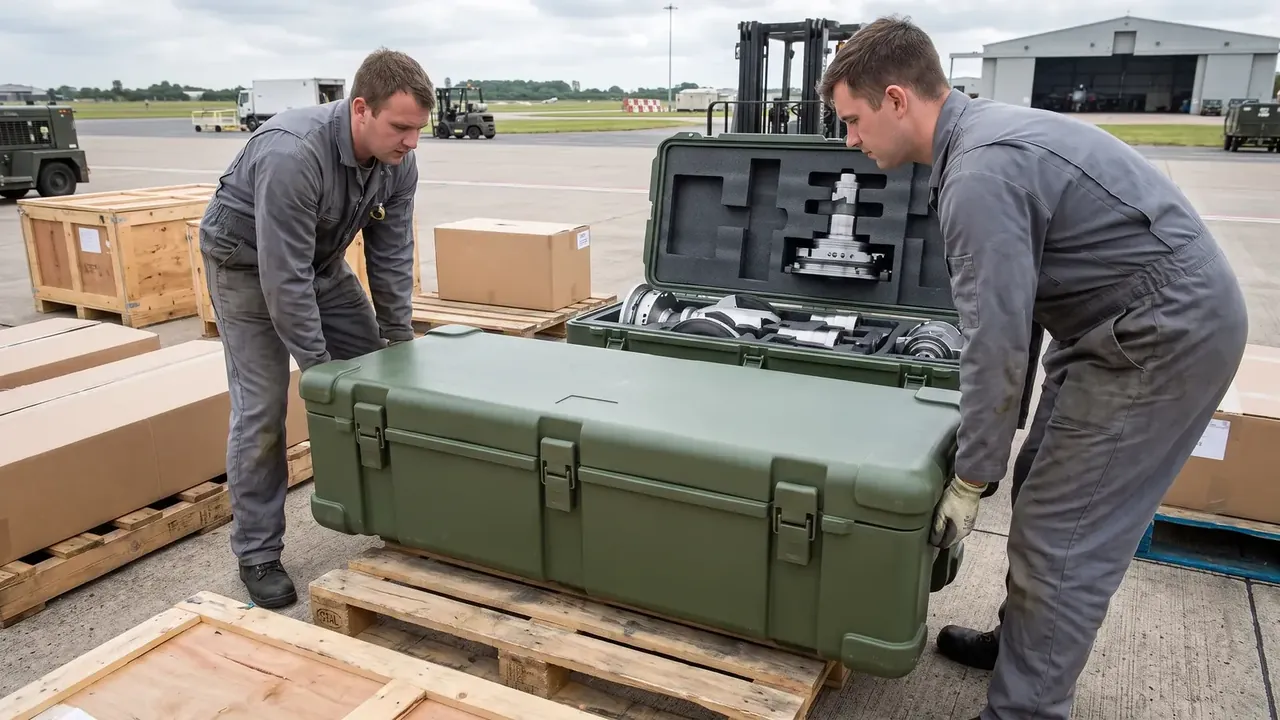
Quick answer: A Military Air Transport Case is specified from the cavity outward: packed envelope to inside size, a per-side allowance to outside size, a 3.2 mm base wall, rib pitch at 45 times that, then stack and tie-down checks.
Table of contents
- Sizing a Military Air Transport Case from the Inside Out
- Wall Thickness and Rib Pitch
- Load Rating and Stack Checks
- Tie-Down and Lifting Points
- Sealing Class Temperature Range and Tolerances
- FAQ
1. Sizing a Military Air Transport Case from the Inside Out
Specify the cavity first: packed envelope plus cushioning. The outside adds wall, rib height, corner wrap and shrinkage; reverse the order and the lid land absorbs a 10 to 15 mm error.
From a 1120 × 420 × 310 mm cavity, 28 mm per side — 3.2 mm wall, 9 mm rib, 12 mm corner wrap, 3.8 mm shrinkage — gives 1176 × 476 mm. A 26 mm base with 13.8 mm feet and a 30 mm lid with 17.8 mm overlap give 366 mm.
| Item | Value | Basis |
|---|---|---|
| Cavity | 1120 × 420 × 310 mm | Envelope plus cushioning |
| Allowance | 28 mm per side | 3.2 + 9 + 12 + 3.8 |
| External size | 1176 × 476 × 366 mm | Cavity plus allowance |
Two cases span 952 mm on a 1200 mm pallet; at 1210 mm only one fits, adding 30 percent to shipping volume. Gross mass is 56.3 kg: 38 kg contents, 15.2 kg case, 3.1 kg insert.
2. Wall Thickness and Rib Pitch
Wall thickness on a Military Air Transport Case is a set of numbers: 3.2 mm base panel, 4.6 mm corners and floor, a 1.44 ratio near the limit of rotational moulding.
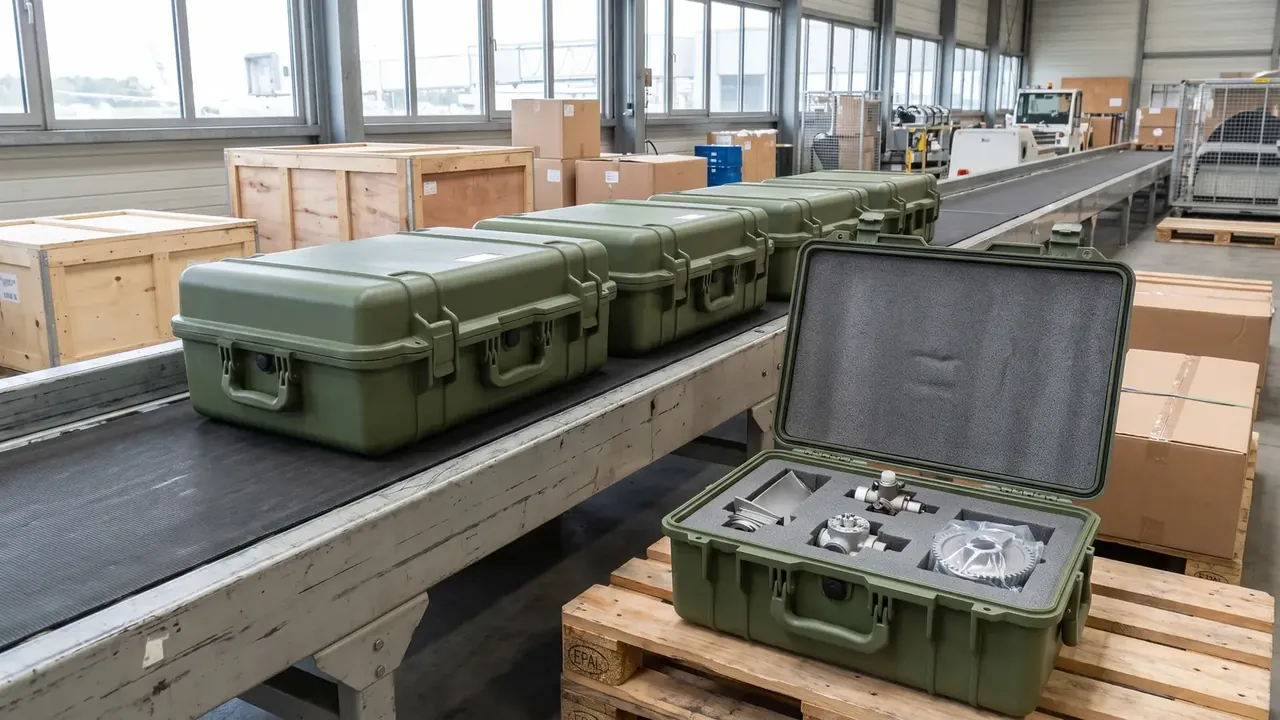
Rib pitch caps at 45 times the wall, 145 mm at 3.2 mm: seven ribs across 1120 mm, three across 420 mm, 9 mm high, 7 mm root, 1.5 degrees of draft. The lid runs 3.6 mm with 160 mm pitch.
A 1200 mm edge drop dents 0.4 mm at 145 mm pitch and 0.8 mm at 190 mm. Shot weight: 2.36 square metres at 3.2 mm takes 7.1 kg, or 7.9 kg with 11 percent build-up.
3. Load Rating and Stack Checks
Payload and bearing are separate. A Military Air Transport Case rated 38 kg with a 15.2 kg body weighs 56.3 kg, feeding both stack and tie-down sums.
Five high, four cases press 225 kg on the bottom lid, limited to 1.5 mm; after 72 hours the reading is 1.1 mm, and a sixth layer leaves 0.6 mm.
| Condition | Value | Part | Criterion |
|---|---|---|---|
| Five-high stack | 225 kg | Lid centre | Within 1.5 mm |
| Edge drop | 1.2 m | Bottom edge | No puncture |
| Corner drop | 0.9 m | Bottom corner | Latches hold |
Die-cast corners 8 mm thick take 90 kg each, 720 kg across eight. The lid fails first.
4. Tie-Down and Lifting Points
Six points at 1500 N cover 3313 N from 56.3 kg at 6 g; M8 inserts break at 2600 N, a 1.7 factor. Centres sit 95 mm from the end face and 40 mm above the base, on 25.4 mm rail pitch.
Four lifting points take vertical or 60 degree slings, breaking at 400 kg against 100 kg working; each leg carries 0.58 of the load, 32.6 kg here.
5. Sealing Class Temperature Range and Tolerances
Write IP67 plus the proof: 30 minutes at 1 m, 30 minutes of rain at 100 mm per hour. Silicone at Shore A 62, compressed 22 to 28 percent, sets 25 percent after 24 hours at 70 °C. Groove: 7.2 mm wide, 5.5 mm deep, 6.5 mm cord.
Storage spans -46 °C to 71 °C, operation -40 °C to 60 °C, with IP67 re-tested after ten cycles.
| Item | Tolerance | Method |
|---|---|---|
| External size | ±3.0 mm | Tape, three readings |
| Lid joint gap | Within 1.5 mm | Feeler gauge |
| Insert position | ±0.6 mm | Dedicated gauge |
Holding the outside to ±1.5 mm forces secondary straightening and adds 8 to 12 percent to unit cost for a dimension stacking never uses.
Conclusion
Three numbers hold the specification: outside size from the cavity, rib pitch at 45 times the wall, and the 1.5 mm lid deflection allowed five high. Miss one and the case either cannot be moulded or cannot fly stacked. Draw them with a tolerance table that tightens only mating faces, and it is release-ready as a Military Air Transport Case specification.
This article discusses only the container (case body) side of specifications and design intent, and does not cover any handling, loading or use of the contents.
Related Reading
- Which standards a military air transport case has to meet
- How a military air transport case compares with alternatives
- How to read military flight case specs
- How rotational moulding shapes a case body
Related Products
- 8 Series — Gun Cases; Military Equipment Cases; Camera Equipment Cases; Drone Cases; Watch Cases; Knife Cases; First Aid Cases; Electronics Equipment Cases
- WL8-2812 PP Gun Case — model WL8-2812
- All protective cases and toolboxes: 7 series, 158 models