

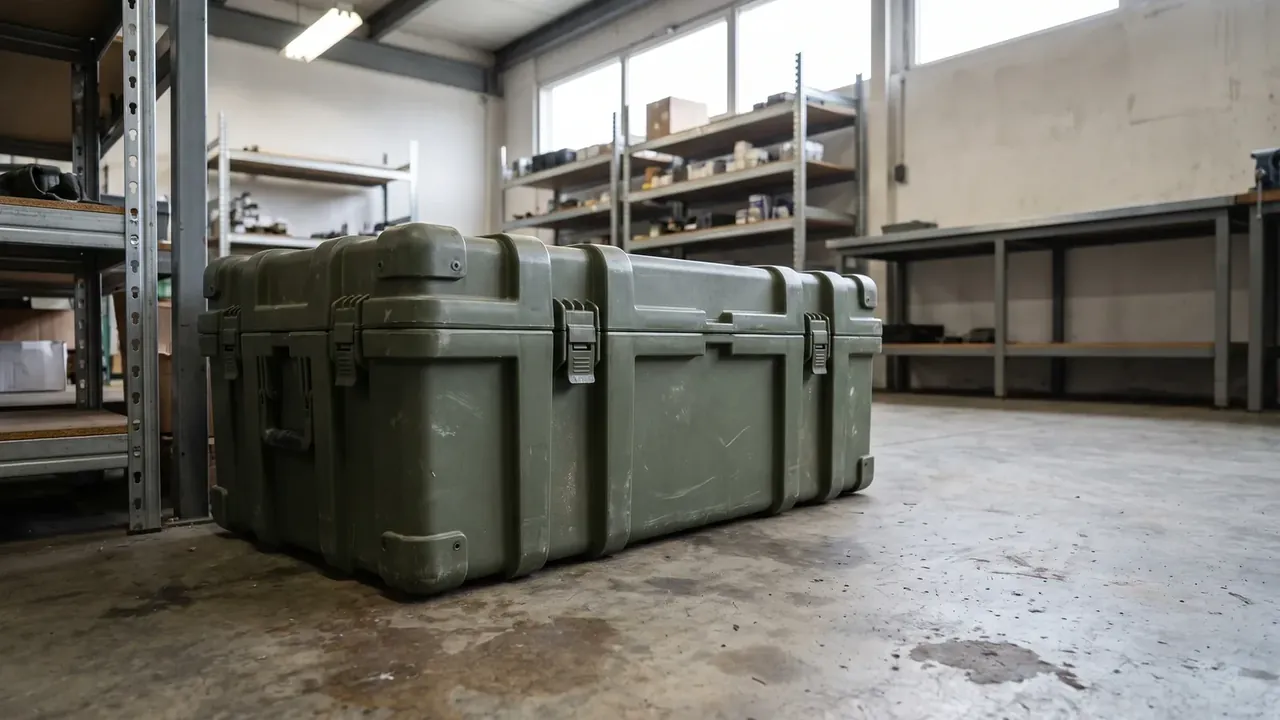
Quick answer: A military flight case fits an aircraft when three geometric conditions are met: the external envelope clears the cargo door, the footprint sits inside the floor load limit and the tie-down grid, and the weight and centre of gravity stay within what ground equipment can handle. Work backwards from the door and the floor, not forwards from the cavity. Measure the envelope with latches, handles and corner blocks included, and keep a passing clearance.
Table of contents
- Military flight case: door, floor and restraint constraints
- How the outer dimensions are set
- Weight and centre of gravity
- Stacking and lashing interfaces
- Fitting common loading units
- FAQ
1. Military flight case: door, floor and restraint constraints
A military flight case is cleared for air transport on geometry, not shell strength. The door decides whether it enters, the floor where it sits, the restraint how it flies. If one fails, the other two are academic.
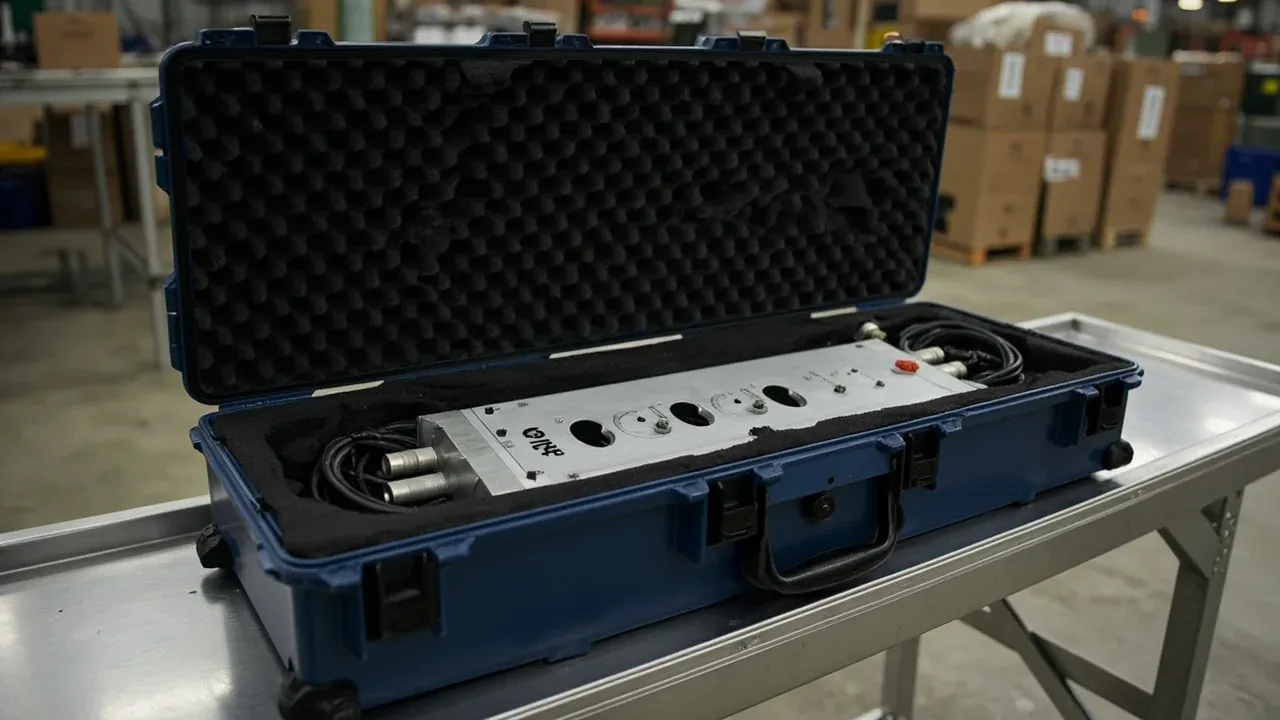
Measure the door at its tightest section: the frame carries a seal lip, the sill carries rails. In the photograph the lid stands open over black egg-crate foam, a silver module and cables seated below. Floor rails are pitched, so a hole that misses a node forces a transfer beam and eats clearance.
2. How the outer dimensions are set
The outer size of a military flight case is the last value in a chain that starts at the cavity: liner, wall, ribs, hardware. A moulded lid has thickness too, so the highest point when open is its rear edge. That swing is easy to miss.
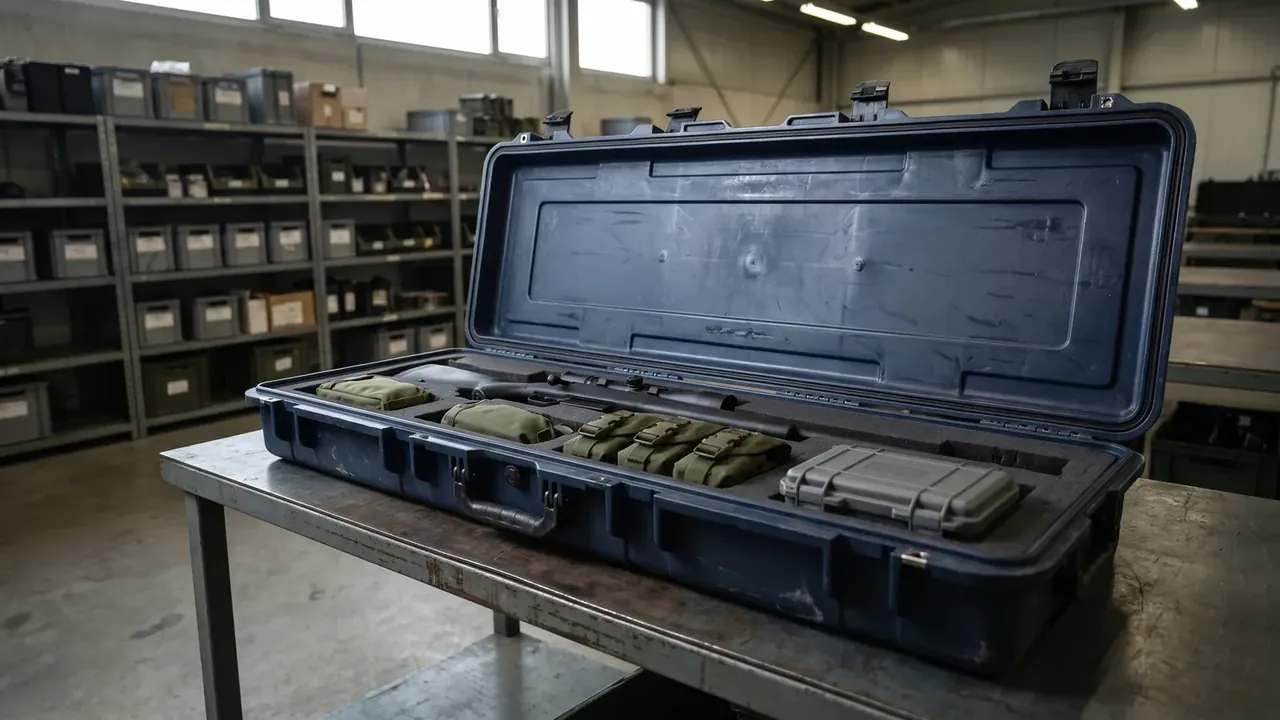
Fix the cavity from the largest item plus cushioning, take liner thickness at working compression, decide whether ribs face in or out, then add latches, hinges and corners folded flat. Leave about 50 mm per side and measure height to the lowest corner block. Name the preconditions on the drawing.
3. Weight and centre of gravity
Weight decides how a military flight case is moved, centre of gravity the attitude it takes. Under 25 kg one person shifts it, 25 to 50 kg needs two people or a wheeled frame, above 50 kg a pallet. Thicker walls buy less strength than they cost in handling.
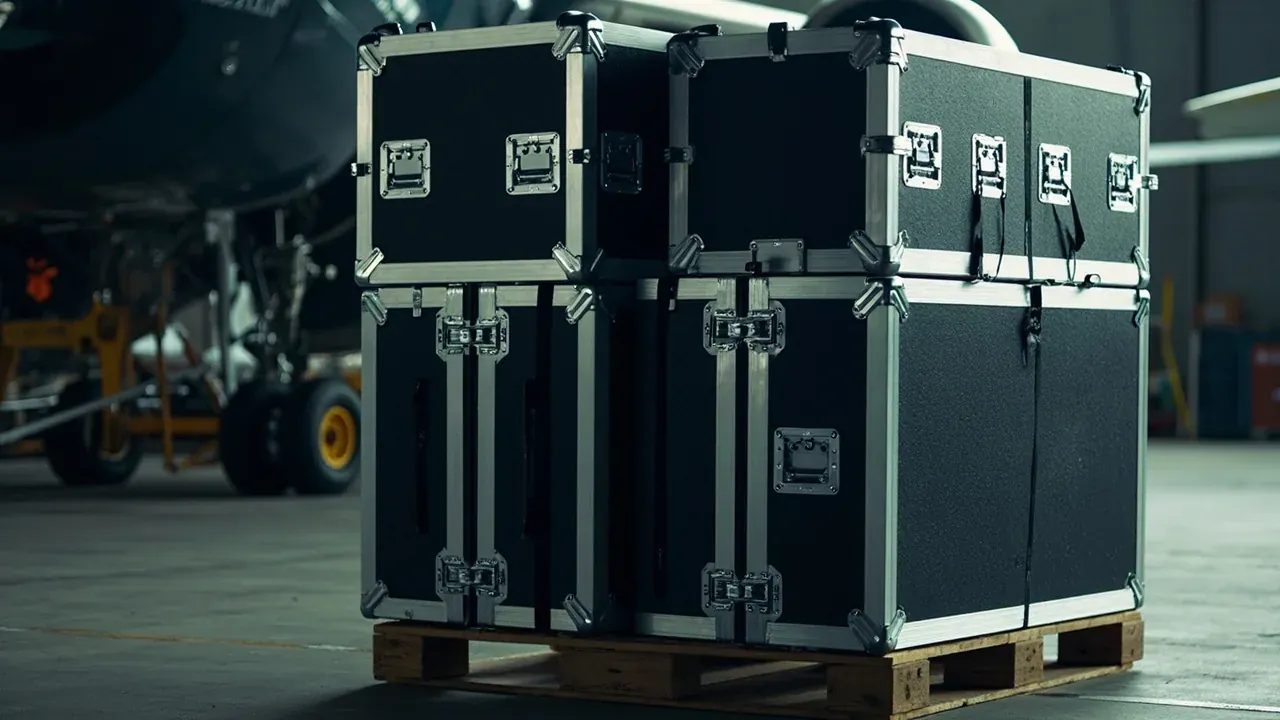
A centre of gravity near the geometric centre keeps a lift level. When locks and hinges sit on one side, two slings tilt the case and it needs more headroom at the door. Four palletised cases pass the upper tier's weight down four frames, not into a lid.
4. Stacking and lashing interfaces
On a military flight case the position of a lashing point matters more than the count. Every point must land on the frame or a corner insert; anything on a lid face, handle or latch fails first. A top face that is not flat concentrates stack load on a few spots.
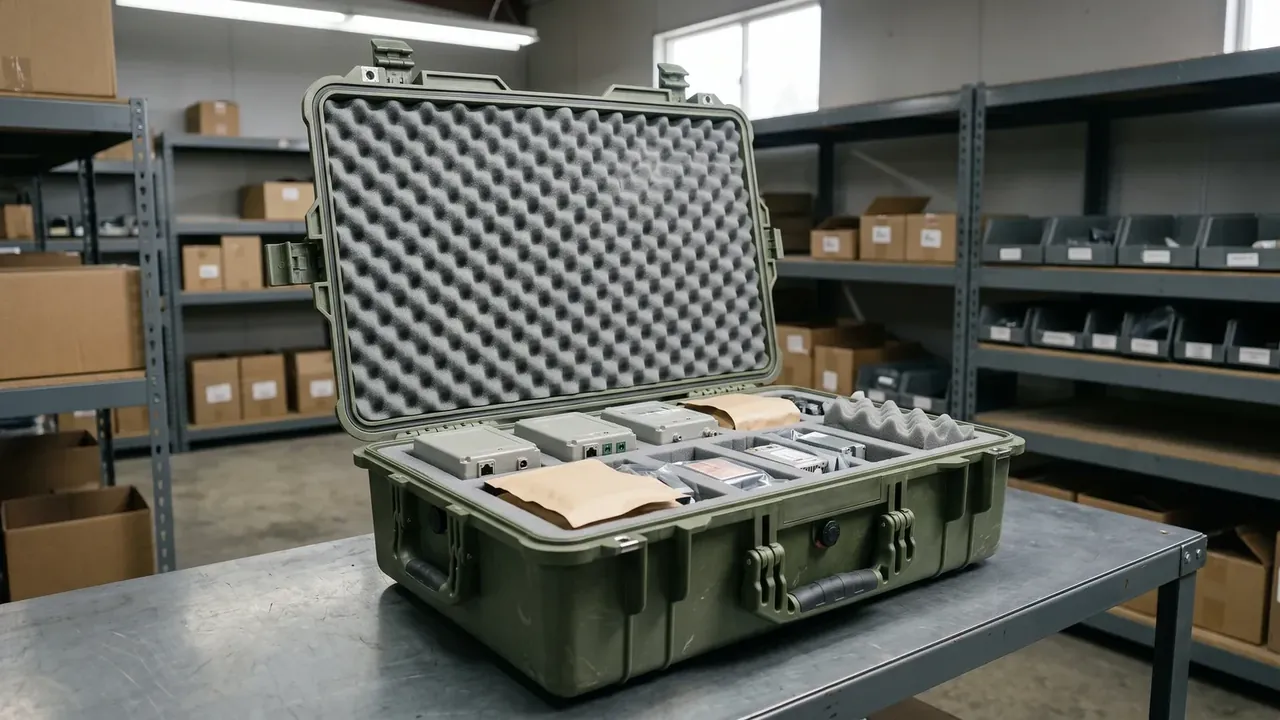
Lashing runs at four or six points, each a through-hole in a corner block aligned with the rail nodes. A shallow strap angle raises the horizontal component and cuts the downward clamp. Handles are for people, never for restraint; the open lid is cushioning, not a load path.
5. Fitting common loading units
Loading units fall into four families: pallets fix the footprint, cargo pallets fix headroom, the cabin floor fixes point load, racks fix tier height. Each constrains a different axis, so a case that suits one can miss another by a few centimetres.
| Unit | Governing | Adjustment |
|---|---|---|
| Standard pallet | Footprint against module | Split into modules, overhang inside corners |
| Air cargo pallet | Door height, clearance | Take height from clearance |
| Cabin floor | Load per area, node pitch | Spread load with a board |
| Storage rack | Tier height, depth, weight | Size to heaviest tier |
When two units conflict, size for the stricter one and adapt the other. A long case on a narrow base can pass on total weight and still exceed load per unit area. A board is cheaper than a new military flight case.
Conclusion
Check in this order: the tightest door section, the floor load per area, the tie-down nodes, then the pallet module and rack height. If a step fails, Military Flight Case dimensions are what should change, not the lashing. A specification listing only cavity size and working load omits the numbers that decide whether it flies.
This article covers container-side specifications and design implications only.
Related Reading
- Structural standards and inspection criteria for military flight cases
- ATA 300: the common reference for air transport cases
- Balancing case weight and strength: wall, ribs and hardware
- Pallet stacking plans: matching case size to pallet modules
Related Products
- 8 Series — Gun Cases; Military Equipment Cases; Camera Equipment Cases; Drone Cases; Watch Cases; Knife Cases; First Aid Cases; Electronics Equipment Cases
- WL8-2812 PP Gun Case — model WL8-2812
- All protective cases and toolboxes: 7 series, 158 models