

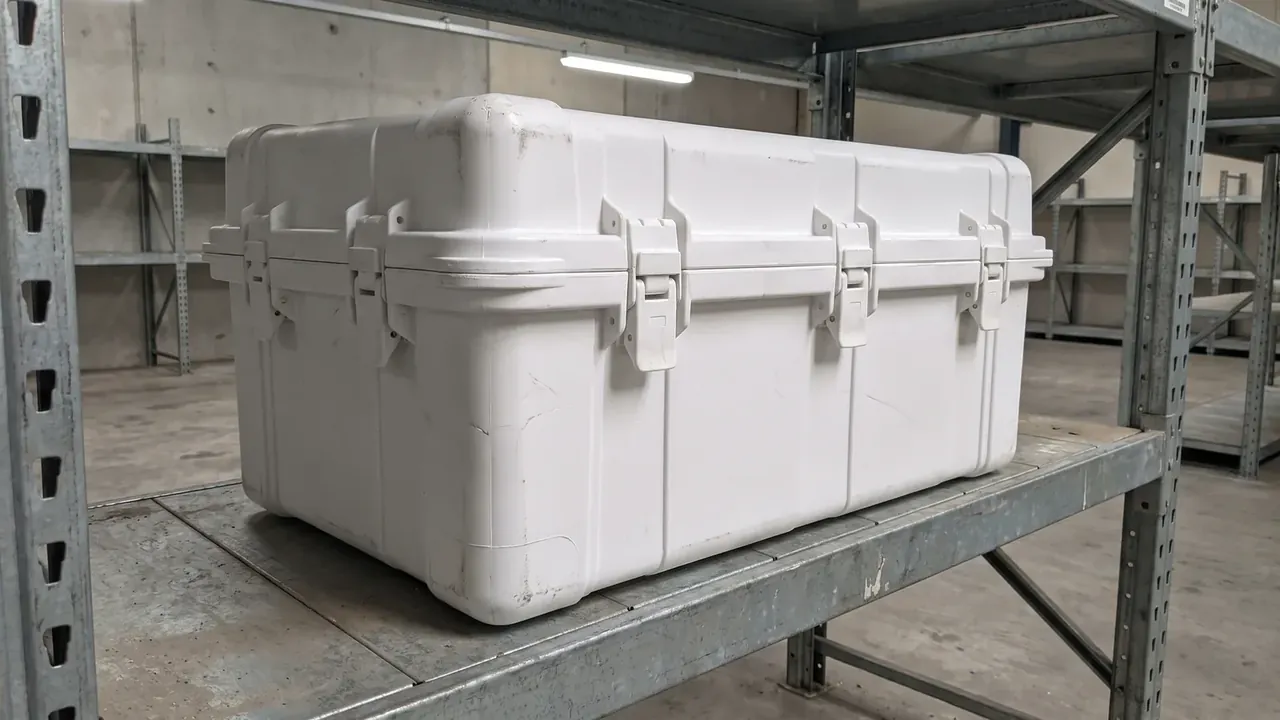
Quick answer: An industrial pressure test pump matching box takes a wet 6 m hose at a 120 mm coil radius in a 180 mm cavity, drained by two φ8 mm ports.
Table of contents
- Wet Storage Inside an Industrial Pressure Test Pump Matching Box
- Coil Radius and the Risk of a Kinked Hose
- Connector Slots and Keeping Pressure Parts Apart
- Where the Release Water Drains
- Gasket Hold in a Damp Working Week
- FAQ
1. Wet Storage Inside an Industrial Pressure Test Pump Matching Box
Pack a pressure test pump away and half a hose of water goes with it. That water does not return to the pump and does not stay in the tube; it runs down the wall and pools at the lowest corner.
An industrial pressure test pump matching box stores items that are all harder than dry ones: 6 m of hose left wet by a 10 min hydrostatic run, connectors with pressure in the threads, a gauge needle that never reaches zero. The method is to lead the water somewhere, not to wipe it.
The cavity is 575×375×250 mm, half for coiling and half for upright connectors. A connector resting on a hose overnight leaves green marks on the tube end, which is why the two halves stay apart.
2. Coil Radius and the Risk of a Kinked Hose
The coil radius on an industrial pressure test pump matching box is 120 mm, fifteen times the 8 mm bore. Hose is normally rated at eight to twelve times its bore, so an 8 mm tube floors between 64 mm and 96 mm, and 120 mm clears that.
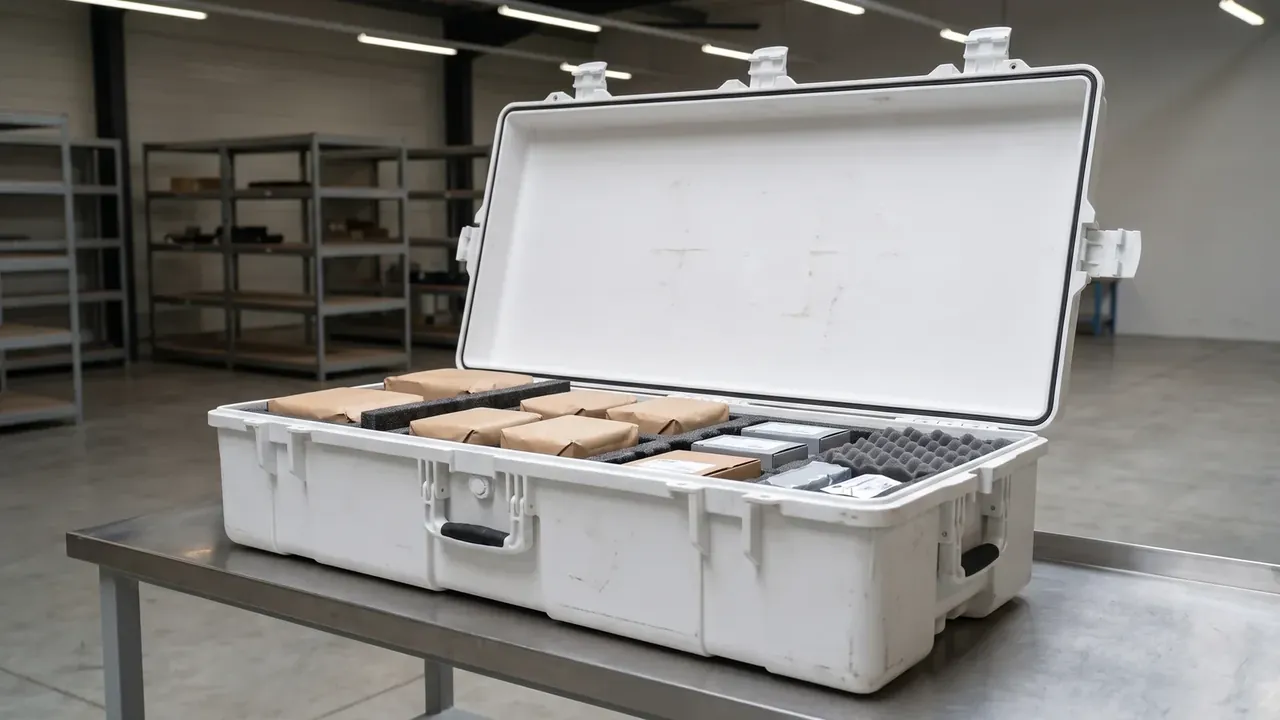
The lid is where it goes wrong. A coil at that radius measures about 240 mm across, the cavity is only 180 mm deep, and the padding travels another 20 mm. The coil flattens into an ellipse, the local radius on the short axis falls under 60 mm, and a crease opens along that side.
| Coil radius | Bore multiple | Kink risk |
|---|---|---|
| 60 mm | 7.5× | Creases overnight |
| 96 mm | 12× | At the floor |
| 120 mm | 15× | Safe unless crushed |
A crease on an industrial pressure test pump matching box is not cosmetic. Once the liner deforms, a 4 MPa test pushes the fold into a blister, and an open blister is a leak.
3. Connector Slots and Keeping Pressure Parts Apart
The industrial pressure test pump matching box carries 6 connector slots across 4 bays, each floored with a φ30 mm counterbore that stands a connector thread-up. Water in the thread then runs down instead of sitting in the tooth root.
Dividers in an industrial pressure test pump matching box are 8 mm PP cut to two thirds of cavity depth, which is 120 mm. They stop short of the floor so water can move between bays toward the drain side; a divider that reaches the floor traps water until it evaporates.
| Connector slot | Dividing scheme | Placement |
|---|---|---|
| 6 upright slots | 4 bays, 120 mm dividers | Thread up |
| Gauge bay separate | 10 mm clearance | Dial inward |
| 2 spare slots | Left open | Caps, tape |
The gauge never shares a connector bay: dial glass cracks under a light side load, so it gets its own bay, unpadded. The divider to the coil area runs full height, or a hose end snakes in and topples a connector.
4. Where the Release Water Drains
On an industrial pressure test pump matching box two φ8 mm ports sit at the ends of the lowest edge, with a 3° fall rolled into the rim. Shallow, but it clears a 2 mm film in ten minutes.
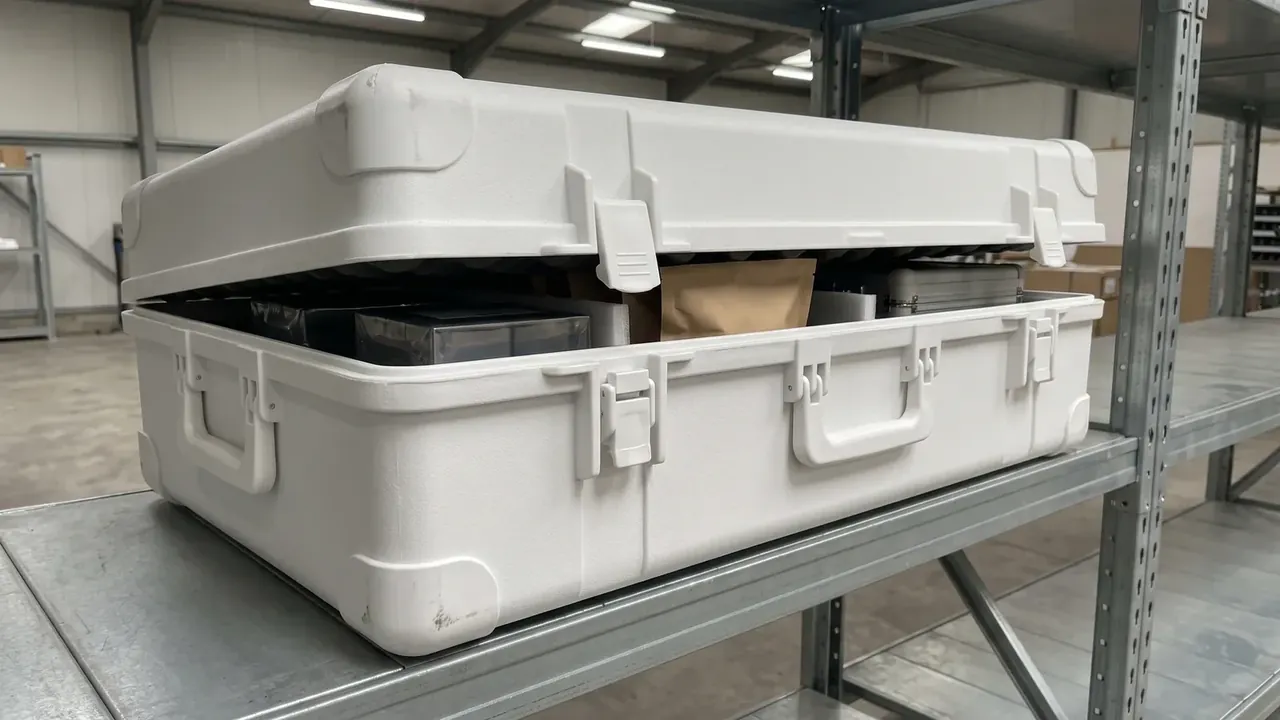
The path must fall one way with no counter-slope. A flat floor is easiest to mould and worst to drain: base ribs bow the panel up, water sits either side of the crown, and an open port achieves nothing.
| Drain path | Slope | Water left |
|---|---|---|
| Both ends out | 3° | Dry in ten minutes |
| One side gathered | 2° | Film hangs |
| Flat floor | 0° | Pools at the crown |
Port size follows flow. A 6 m hose holds about 300 mL and a φ8 mm hole passes near 100 mL/s under 30 mm of head, so a full case empties in seconds. At φ4 mm, surface tension seals the hole shut.
5. Gasket Hold in a Damp Working Week
The lid gasket on an industrial pressure test pump matching box is 8 mm square EPDM at Shore A 65 in a dovetail groove. Compression set to ASTM D395 method B at 70 °C and 25% deflection lands between 20% and 30%, which decides if the strip springs back after six months.
At 25% deflection the strip is squeezed 2 mm. Too little leaks, too much stops recovering, so 4 latches at 400 N along the seam leave roughly 120 N of reaction each and the strip compresses evenly.
The opponent in damp work is vapour moving in and out. A wet hose warms by day and drives vapour up, the lid cools at night and condensation runs into the gasket groove. IP67 covers a metre of immersion for thirty minutes from outside; water made inside leaves through the ports.
The band is 5 °C to +45 °C. Below 5 °C the EPDM hardens and part of the deflection is spent on stiffness; above 45 °C the lid hisses softly when opened, which is pressure equalising.
Conclusion
An industrial pressure test pump matching box is designed backwards: the water route comes first and the coil follows. Two φ8 mm ports on a 3° fall set how the floor is ribbed, the 120 mm radius sets the 180 mm cavity, and an 8 mm gasket under four 400 N latches sets the seam load. Together they hold IP67, stack 3 high and keep a wet hose sealed after a 4 MPa test, if the plugs come out each shift.
Related Reading
Related Products
- 8 Series — Gun Cases; Military Equipment Cases; Camera Equipment Cases; Drone Cases; Watch Cases; Knife Cases; First Aid Cases; Electronics Equipment Cases
- WL8-2812 PP Gun Case — model WL8-2812
- All protective cases and toolboxes: 7 series, 158 models