

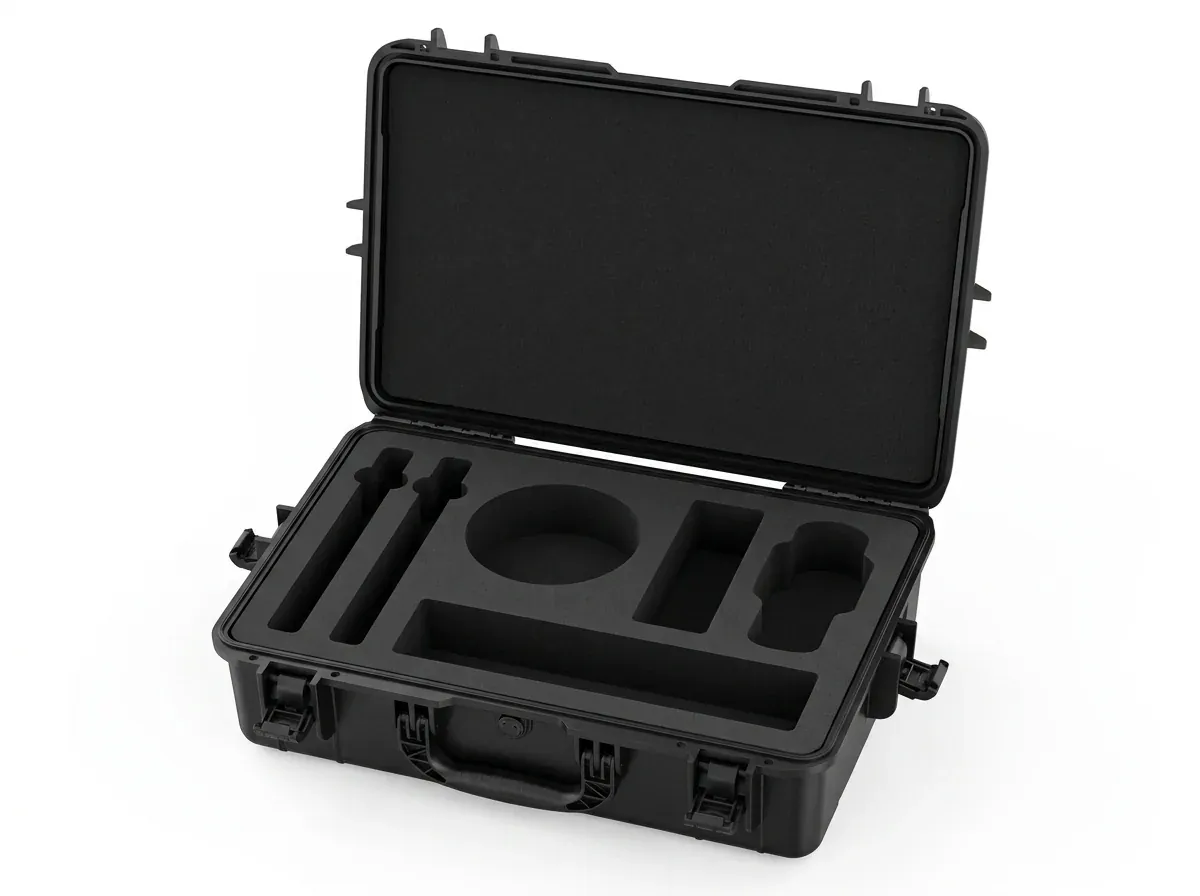
Quick answer: The Industrial Robot Accessories Case is judged by how fast one part comes out: 24 part types in 18 slots, 15 s picks and 20 min changeovers.
This article covers the case side only: slot geometry, insert layout and material choices, not the fitting of parts to a robot.
Table of contents
- Flanges and gearboxes: holding odd shapes
- Routing harnesses and air lines apart
- Slot labels and the pick path
- Keeping grease away from spares
- Reusing inserts across model changes
- FAQ
1. Flanges and gearboxes: holding odd shapes
Whether an accessories case works shows up in how long one part takes to pull out. A flange is round, a gearbox is square with a bolted flange, so the Industrial Robot Accessories Case cuts slots to shape rather than to size; a slot sized by dimensions alone rattles one part and jams the other.
A flange is held at three points: a cradle underneath, a side stop and lid pressure. Standing upright, the outer diameter sits in a half-round cut with finger gaps each side, while foam in the lid presses the end face, so the part neither turns nor lifts. Lying flat, the cradle becomes a shallow bowl about three tenths of the flange thickness deep; shallower slides, deeper will not come out.
Gearboxes hang on their flange holes: shaft up, holes over locating pins that only limit movement, with solid foam under the slot carrying the weight. Mass sits off centre toward the motor, so the slot floor runs down to the case bottom.
The 3 kg per-slot line holds for the Industrial Robot Accessories Case as well. Heavier units go into a sunken pocket on the case floor and are walled in with blocks, because forcing one into a shallow slot pushes compression set past 20% and leaves a widened hole.
| Part type | Retention | Pick motion |
|---|---|---|
| Round flange | Half-round cradle and side stop | Lift by the rim, two hands |
| Flanged gearbox | Locating pins and sunken pocket | Hold the shaft, pull straight up |
| Long linear rail | End clamps | Slide out along the slot |
| Small servo | Square cavity with lid foam | Grip the body, lift out |
2. Routing harnesses and air lines apart
Harnesses and air lines in one slot mean the first thing a hand catches is a fitting. The Industrial Robot Accessories Case splits them: air lines run in shallow channels along both walls, harnesses take the central channel, and the two cross at corners on separate levels.
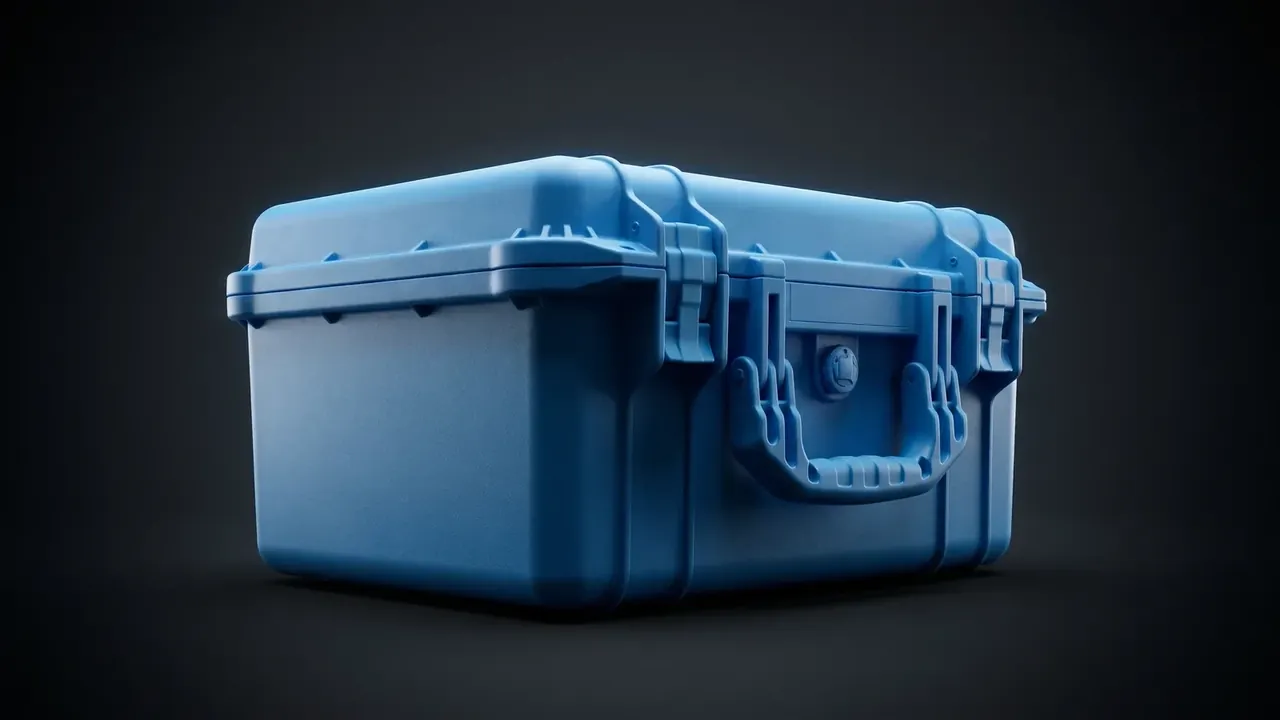
In the Industrial Robot Accessories Case, four air lines are coiled separately, never bundled. Coil radius is kept well beyond the line diameter, because a tighter bend creases the inner wall and the line whistles on its first run. Each line gets a plug pocket at both ends, set into the channel edge.
That central channel is sized to the widest connector rather than the bundle, since a pinched connector fails later. A soft foam pad under the channel takes the hard points out of the transit load.
The gain is measured in pick time: separate routes mean a 15 s pick does not start with unwinding a tangle, while a shared slot forces the bundle out and back. The Industrial Robot Accessories Case is planned around that arithmetic.
3. Slot labels and the pick path
The Industrial Robot Accessories Case labels slots with 3 colour zones: frequent parts, spares and consumables, a code that writes usage frequency onto the case so a hand finds the spot without reading text.
A 15 s pick needs a short path. Frequent flanges and servos sit in the front row on the handle side, spares move back, consumables take the corners. A finger-wide gap separates front from back, since a part that cannot be gripped cannot be picked.
Labels belong on the slot rim, not the floor, where foam hides them the moment a part is pressed down. Rim labels match the slot colour, so parts return to the right place.
The lid takes part in the path too. Lid foam is cut in blocks per slot rather than as one sheet, so opening the case shows the front row outline. With a continuous sheet, the user presses around the foam to learn which slots are empty.
4. Keeping grease away from spares
Two grease types get two slots in the Industrial Robot Accessories Case: lubricating grease and rust preventive oil never share a box. A little grease soaks into foam and the slot carries the smell for good, which then transfers to every electrical part stored beside it.

A grease slot is a separate tray with its own lid. The tray drops into a square cavity and the lid stands slightly proud, so the case lid presses it shut and oil cannot creep sideways; a lip around the cavity stops a spill.
Electrical parts and grease never share a slot. Servo drives, encoder cables and teach pendant batteries stay at least one slot away, with metal parts in between as a barrier.
Rubber spares are the second casualty of oil. Seals, wipers and air lines belong in the dry zone, because rubber swells when it sits in oil and no longer fits the joint.
Any layout where mixed slots leave two or more parts unpickable within 15 s, or where grease shares a slot with electrical parts, has to be re-cut.
5. Reusing inserts across model changes
A 20 min changeover is the target that insert reuse is designed around. The base sheet stays and the top sheet changes: the base is cut to the cavity and holds the 18-slot frame, while a model-specific top sheet follows the parts list.
In the Industrial Robot Accessories Case, top sheets are divided by machine model, not by part size. Within one series, flanges and gearboxes are close enough in outline to share a sheet; across series the flange diameter steps up and the whole top sheet has to change.
Identification travels with the sheet: a model code and a slot colour mark, standing at the case edge once pulled, so two machines' sheets never mix. The usual mistake is fitting similar sheets the wrong way round, which misplaces every slot and stretches a 15 s pick past a minute.
Base and top sheets locate on snap fasteners rather than glue, since a glued base must be torn out at every changeover and the next sheet will not sit flat.
| Changeover | Reused | Replaced |
|---|---|---|
| Same series, new unit | Base sheet, retainer, lid foam | Top sheet |
| Across series | Base sheet, retainer | Top sheet, side blocks |
| Adding one unit | Base sheet, top sheet | Blocks for the new slots |
Related Reading
- How a robot accessories transit case divides its slots
- Shock protection layout for robotic arm parts
- Transport case for a collaborative robot
- Robot controller transport case
JUNZHIJIA
Related Products
- 8 Series — Gun Cases; Military Equipment Cases; Camera Equipment Cases; Drone Cases; Watch Cases; Knife Cases; First Aid Cases; Electronics Equipment Cases
- WL8-2812 PP Gun Case — model WL8-2812
- All protective cases and toolboxes: 7 series, 158 models