


Quick answer: An Industrial Spare Parts Storage Case works by slot, label and count cycle, not by volume; 45% RH and a 5-unit reorder point keep every part traceable.
Table of contents
- Slot Geometry and the Parts Family
- Three Label Tiers and the Board
- Count Cycle and Variance Handling
- Rust Prevention and Humidity
- Issue and Replenishment Loop
- FAQ
1. Slot Geometry and the Parts Family
Slots are not chopped at random. Twelve and twenty-four are the two common layouts on an Industrial Spare Parts Storage Case, and the choice follows how finely the parts family is split rather than how many parts exist. Split by family only, twelve is enough; split down to size and batch, twenty-four is the floor.
A 50 mm pitch is the base unit. Pitch comes from the diagonal of the largest part plus a finger's width, because below 50 mm a gloved hand cannot reach in and the slot becomes decoration. Cavity depth runs 120 to 200 mm, deep for bearings, shallow for O-rings.
The family is traced back from the machine, never listed in purchasing order. Parts for one machine sit in adjacent slots so a breakdown is one reach; sorted by purchase batch, they end up in three corners.
| Slot layout | Net slot size | Typical parts |
|---|---|---|
| 12 slots | 100 × 100 mm | Bearings, flanges, mid-size seals |
| 12 deep | 100 × 150 mm | Hydraulic fittings, sensors, relays |
| 24 slots | 50 × 100 mm | Bolts, washers, fuses, pins |
| 24 mixed | 50 × 100 and 100 × 100 | General line spares |
Case count follows the family: one 24-slot case holds the wear parts of one line, so three lines take three cases marked with the line code.
2. Three Label Tiers and the Board
Labels work in three tiers, each answering one question. The outer tier says which line the case serves, the slot tier says what sits in that slot, and the unit tier says the batch and the stock-in date.

The tiers cannot be merged. An outer list alone means opening it at every pick; slot cards alone go wrong the moment the case changes line; unit labels alone turn a count into a search. An Industrial Spare Parts Storage Case normally carries all three: an A4 sleeve outside, a 50 × 30 mm card on each slot lip, an adhesive label on each bag.
| Label tier | What it says | Where it sits |
|---|---|---|
| Outer list | Line code, slot total, owner | Sleeve inside the lid |
| Slot card | Part name, size, minimum | Card channel on the slot lip |
| Unit label | Batch, stock-in date, supplier | Outer wall of the bag |
The board keeps three lines: quantity on hand, reorder point, date of the last issue. Every extra field slows the update, and a board unchanged for a month has failed. On an Industrial Spare Parts Storage Case the type runs no smaller than 12 point, because small type in poor light is the same as none.
3. Count Cycle and Variance Handling
A 30-day cycle follows issue frequency. Fast movers are touched several times a week, so 30 days exposes drift; slow movers sit for a quarter, and counting them oftener is repeated labour. The count walks slot by slot on an Industrial Spare Parts Storage Case, not part by part, because names repeat and positions do not.
Tolerance is 0.5 percent. A 24-slot case at four units per slot holds about 96 pieces, and 0.5 percent is under half a piece, so books must match reality; at 2 percent two slots can disagree without anyone acting.
Variance falls into three classes. One short is an unrecorded issue, so a slip is written; one over is an unclosed return, so the original is traced; a whole slot out is a mislabelled card.
| Variance | First move | Signs it off |
|---|---|---|
| One short | Write the issue slip, trace the taker | Shift leader |
| One over | Find the return note and reverse it | Store keeper |
| Whole slot out | Reprint the card, check neighbours | Keeper and leader |
Parts ruling: if a slot deviates from its label by more than 2 pieces, or humidity stays above 55% RH for 7 consecutive days, the storage plan must be corrected.
4. Rust Prevention and Humidity
Rust starts with humidity, not with time. Around 45% RH a conductive film forms on steel and corrosion accelerates; below 40% it effectively stops. An Industrial Spare Parts Storage Case holds internal humidity under 45% RH with a gasket and desiccant, not with a dehumidifier.
Desiccant goes in at 100 g per bag, two bags per 24-slot case, changed every 30 days. Indicating silica turns from blue to pink at saturation, and pink means replace now; on the coast the interval drops to 15 days.
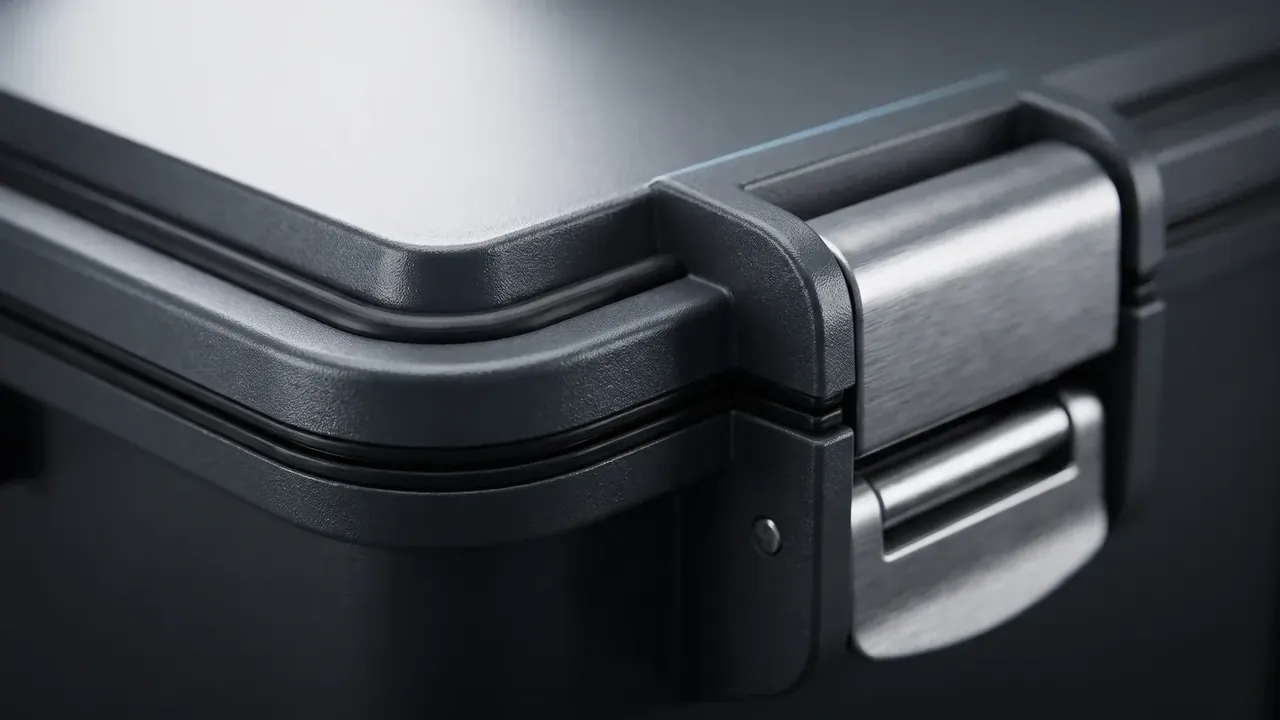
The gasket is the second line. TPE stock runs 50 to 60 Shore A with 25 to 30 percent compression, and a gasket that is not pressed flat leaks air; no desiccant weight compensates for a burr or a warped rim. Shell walls of 2.0 to 3.5 mm keep that rim flat.
Seals and bearings never go in bare. A coat of rust preventive, a bag folded twice at the neck, and copper kept clear of aluminium, because two metals plus moisture make a galvanic cell. This slot is the one most often ignored.
5. Issue and Replenishment Loop
The part number is the spine. Four segments carry it: line code, family, size index and batch, which reads position and identity but never price. Slot cards, unit labels and issue slips on an Industrial Spare Parts Storage Case use the same string, and only when the three agree does the record stand.
Every issue leaves a trace: number, quantity, taker, machine. Skip the machine and nobody knows which unit eats the part. The pad hangs inside the lid, so writing at the pick beats remembering later.
A reorder point of 5 units balances safety stock against tied-up cash. On an Industrial Spare Parts Storage Case, below 5 the line replenishes to 20; too early and parts sit in the case, too late and a machine waits. The point is printed in red on the board.
The loop closes on receipt: number, quantity and whether the batch is current, all three checked before the board changes. An Industrial Spare Parts Storage Case manages traceability; a full case is a by-product.
Conclusion
Slot, label and count are one system: a position, an identity and a record. An Industrial Spare Parts Storage Case compresses all three into one body, so a missing part has nowhere to hide.
This article discusses only the container (case body) side of specifications and design intent, and does not cover any handling, loading or use of the contents.
Related Reading
- Building a standing spare parts list
- Spare parts cases on a production line
- A combine harvester parts case
- Repair work and its spare parts
Related Products
- 8 Series — Gun Cases; Military Equipment Cases; Camera Equipment Cases; Drone Cases; Watch Cases; Knife Cases; First Aid Cases; Electronics Equipment Cases
- WL8-2812 PP Gun Case — model WL8-2812
- All protective cases and toolboxes: 7 series, 158 models