

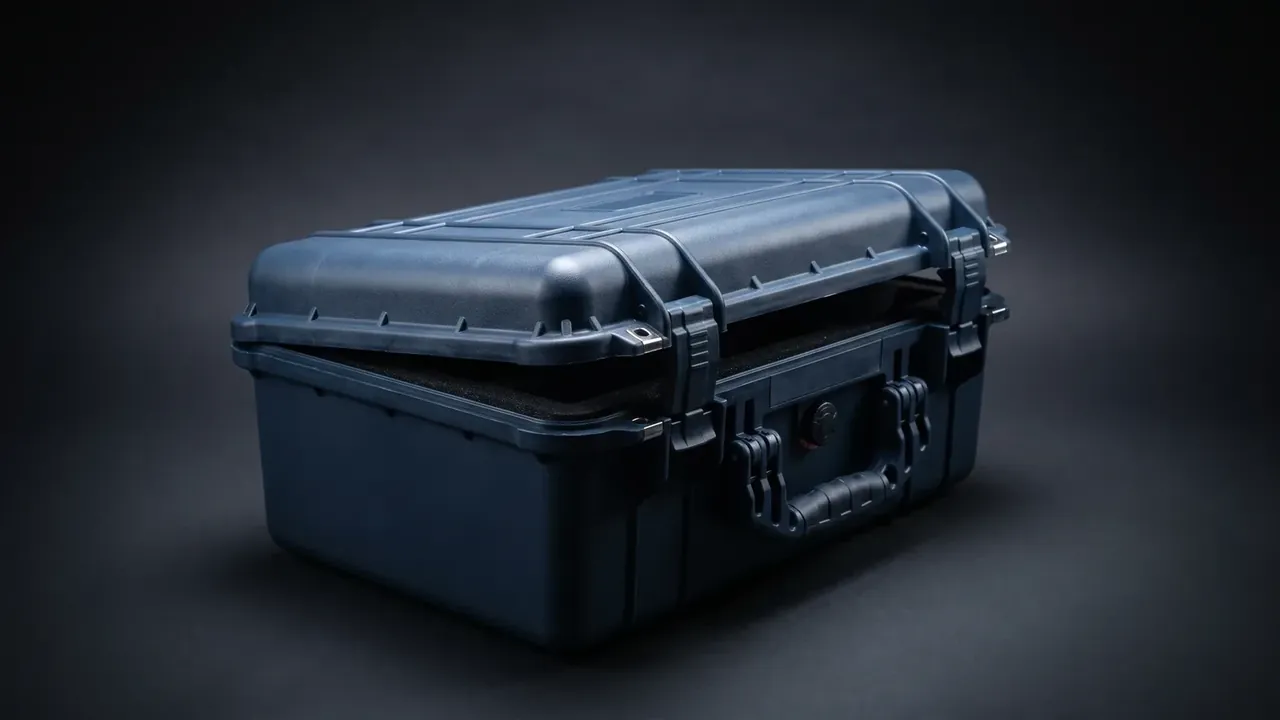
Quick answer: A Production Line Spare Parts Case splits a 580 by 400 mm cavity into 12 cells, each with a batch card, holding 22 kg of three-day stock.
Table of contents
- Dividers and batch numbers in a Production Line Spare Parts Case
- Three days of safety stock at the line
- Wear after forty-five monthly turns
- Label order for a twenty-minute count
- Line-release settings for a spare parts batch
- FAQ
1. Dividers and batch numbers in a Production Line Spare Parts Case
Line-side stock rarely loses time on picking; it loses time proving which batch sits in a cell, and a twenty-minute stop often ends with trays lifted to read a number. A Production Line Spare Parts Case divides a 580 by 400 by 230 mm cavity into three rows of four, twelve cells at 187 by 94 by 215 mm clear, each with a 1.5 mm card in its slot.
The card carries a three-part code: batch, cell and standard quantity. The batch takes two digits for the intake month and two for the run, one batch stays in one cell, and a mixed batch gets its own cell and its own card. Twelve cells hold twelve cards; a card in the wrong slot merges two batch accounts into one.
| Cell code | Parts usually held | Batch prefix |
|---|---|---|
| A1–A4 | Bearings, retaining rings | 2601 |
| B1–B4 | Oil seals, O-rings | 2602 |
| C1–C4 | Fasteners, quick couplings | 2603 |
The third part is a count, not a weight, because a count needs no scale: forty pieces fills a cell and twelve means reorder. An 8 mm blank strip at the foot of each card lets a new label cover the old code without scraping.
2. Three days of safety stock at the line
Three days is derived from daily draw rather than agreed in a meeting. This line consumes 7.3 kg a day, so three days come to 21.9 kg, rounded to 22 kg, exactly the load rating; at 2 kg per cell that fills eleven cells and leaves one for a temporary part; a Production Line Spare Parts Case keeps that cell empty on purpose.
| Daily draw | Three-day quantity | Cells used | Reorder trigger |
|---|---|---|---|
| 5.0 kg | 15 kg | 8 cells | 4 cells empty |
| 7.3 kg | 22 kg | 11 cells | 1 cell empty |
| 9.5 kg | 29 kg | Beyond one case | Two cases side by side |
Too much stock turns the case into a second store: parts sit six months, cards are rewritten three times and the stock is still one batch. Too little stops the line at the first changeover. The 22 kg line keeps the reorder signal inside the case, one empty cell, with no kanban and no system prompt.
A draw of 9.5 kg needs 29 kg over three days, seven kilos above the rating, and forcing it in bows the base dividers by 0.8 mm.
3. Wear after forty-five monthly turns
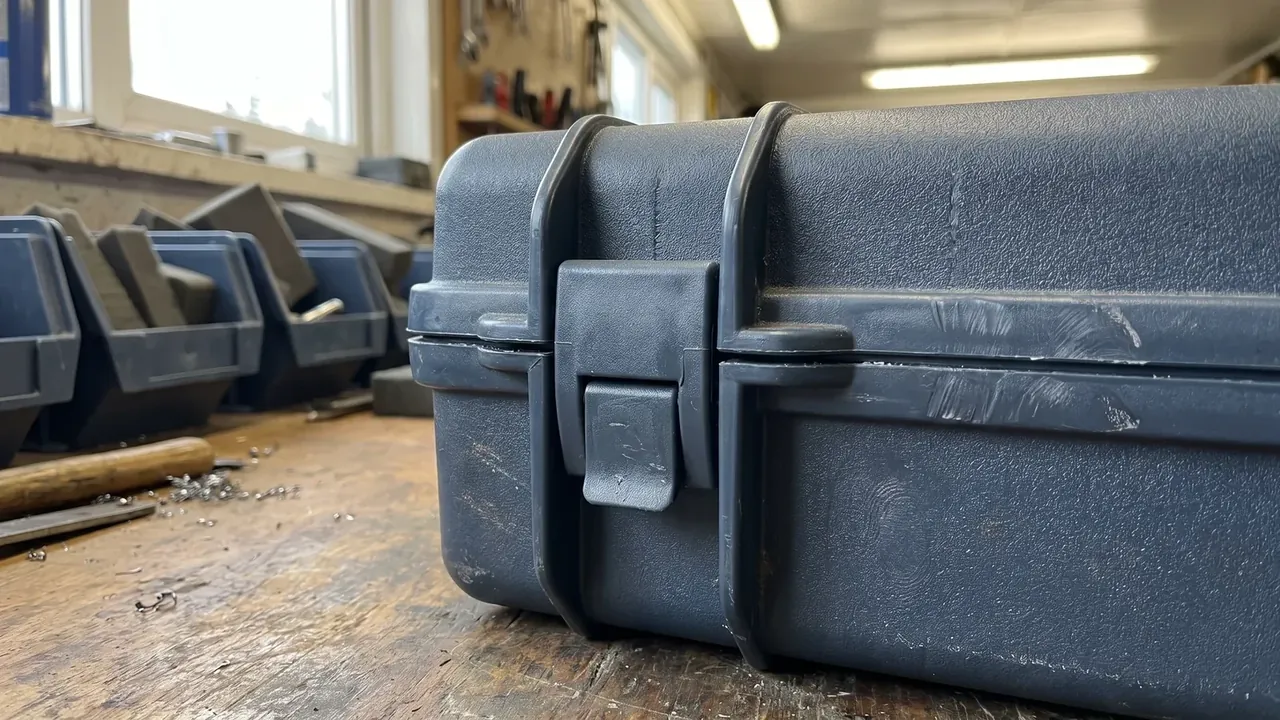
Forty-five turns at three openings each gives 135 openings a month and 1620 a year; against an 11000-cycle design that is about 81 months. On a Production Line Spare Parts Case, wear appears first at the card slot and the gasket face, as a stiff card and a lid that closes too easily.
| Months in service | Openings | Card wear | Latch gap |
|---|---|---|---|
| 12 months | 1620 | 0.3 mm | 0.5 mm |
| 30 months | 4050 | 0.7 mm | 1.0 mm |
| 54 months | 7290 | 1.2 mm | 1.6 mm |
A card is 1.5 mm thick, and at 1.2 mm of wear its edge frays and the slot drags; replacing a card costs far less than replacing a case. At a 1.6 mm latch gap the lid rocks when lifted, gasket compression falls from 22 to 18 percent, and dust enters at the end faces.
Turns are uneven, 70 in a changeover month against 30 in a steady one, so servicing follows the 45 average. Two checks: pull and reinsert all twelve cards, then read the latch gap with a feeler gauge. Both passing, a Production Line Spare Parts Case stays at the line.
4. Label order for a twenty-minute count
Twenty minutes covers twelve cells and three batch checks. The route runs A to C by row, left to right inside a cell, without doubling back; sorting by part type instead adds four crossings and the time runs out.
One misplaced card stops the clock: the label and the parts are not the same batch, and an accurate count still leaves the trace broken. The other eleven cells are checked against that batch number and only the wrong cell is refilled. Two or more misplacements mean worn slots, and the whole case goes for recarding.
The twenty minutes split into eight for counting, six for batch checks and six for sign-off. Only three cells are checked: the oldest intake, the largest quantity and the one changed this month. All three agreeing makes the batch account for the case clean.
5. Line-release settings for a spare parts batch
The release setting is a set of numbers: 6.8 kg empty, 22 kg loaded, twelve cells, twelve cards, 45 turns a month, 11000 openings, three days of stock and a twenty-minute count. All eight go on the batch card, and a line change is checked against the card rather than against memory.
A part change on a Production Line Spare Parts Case starts with layout: keep the cells and swap the cards if the picking route allows. Fifteen cells shrink the clear size to 110 by 94 mm and the card to 60 mm, too narrow for a three-part code, so the count stretches from 20 to 27 minutes.
Above 22 kg the base dividers bow, the opening grows 0.8 mm and cards sit loose; the answer is less load or a divider taken from 1.8 to 2.5 mm, adding 0.7 kg. On a Production Line Spare Parts Case batch card, load and divider thickness are one paired entry.
Conclusion
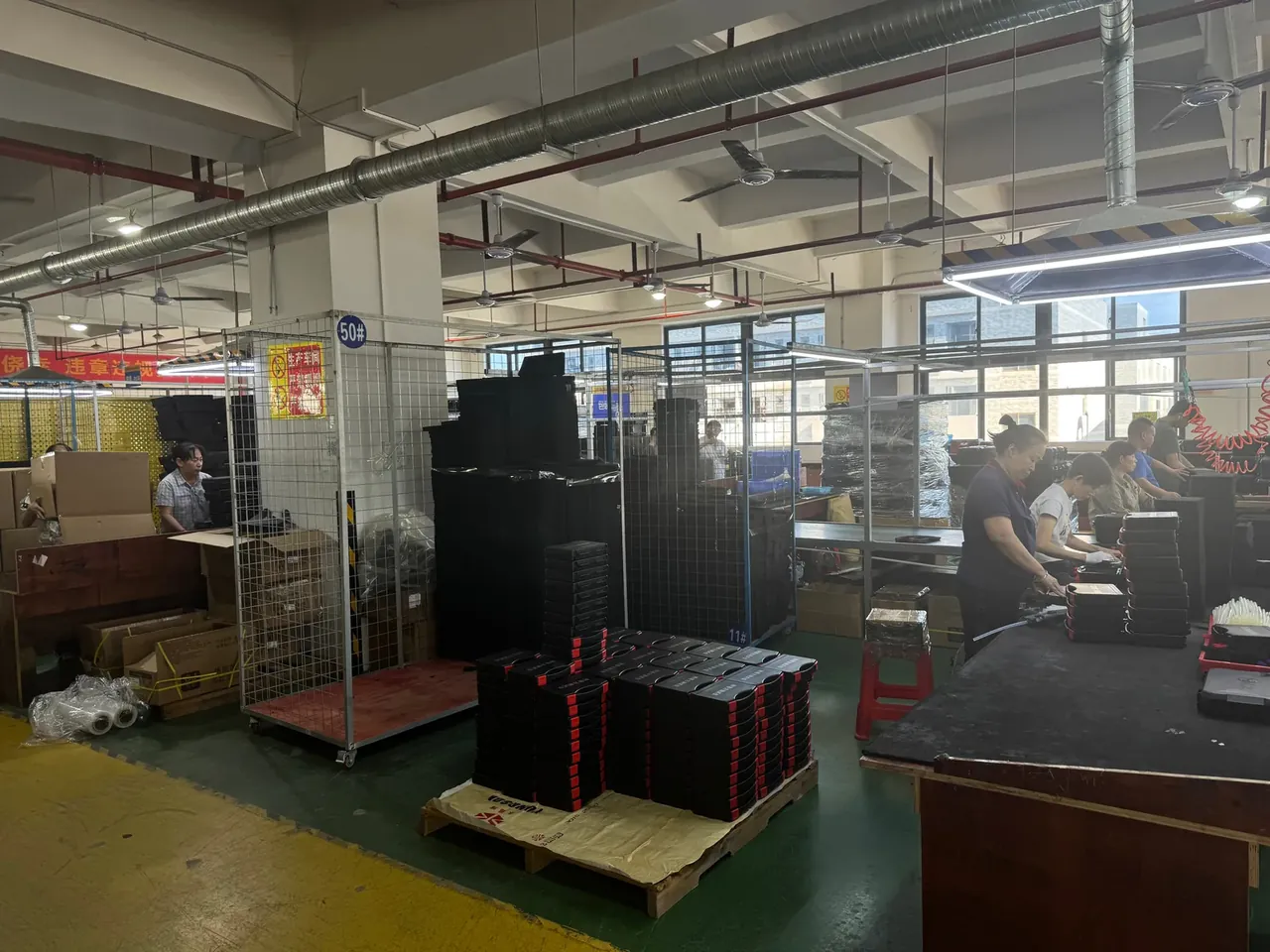
A Production Line Spare Parts Case is judged on three readings: card wear at 1.2 mm, latch gap at 1.6 mm and a twenty-minute count with no misplaced label. Twelve cells with twelve cards, one batch per cell, 22 kg matching three days of stock and 45 turns a month over an 81-month life cover the working range. Cross any one and the case moves to secondary duty. JUNZHIJIA keeps 11000-cycle retest records by spare parts batch, with card drawings issued by Kexin New Materials (Guangdong) Co., Ltd.
Related Reading
- Dividers and on-board tool positions in a combine harvester parts case
- Dust structure and batch marking on agricultural machinery parts cases
- Picking sequence and station layout for assembly line tool carts
- Transport fixing for bearing and gearbox spares
Related Products
- 8 Series — Gun Cases; Military Equipment Cases; Camera Equipment Cases; Drone Cases; Watch Cases; Knife Cases; First Aid Cases; Electronics Equipment Cases
- WL8-2812 PP Gun Case — model WL8-2812
- All protective cases and toolboxes: 7 series, 158 models