

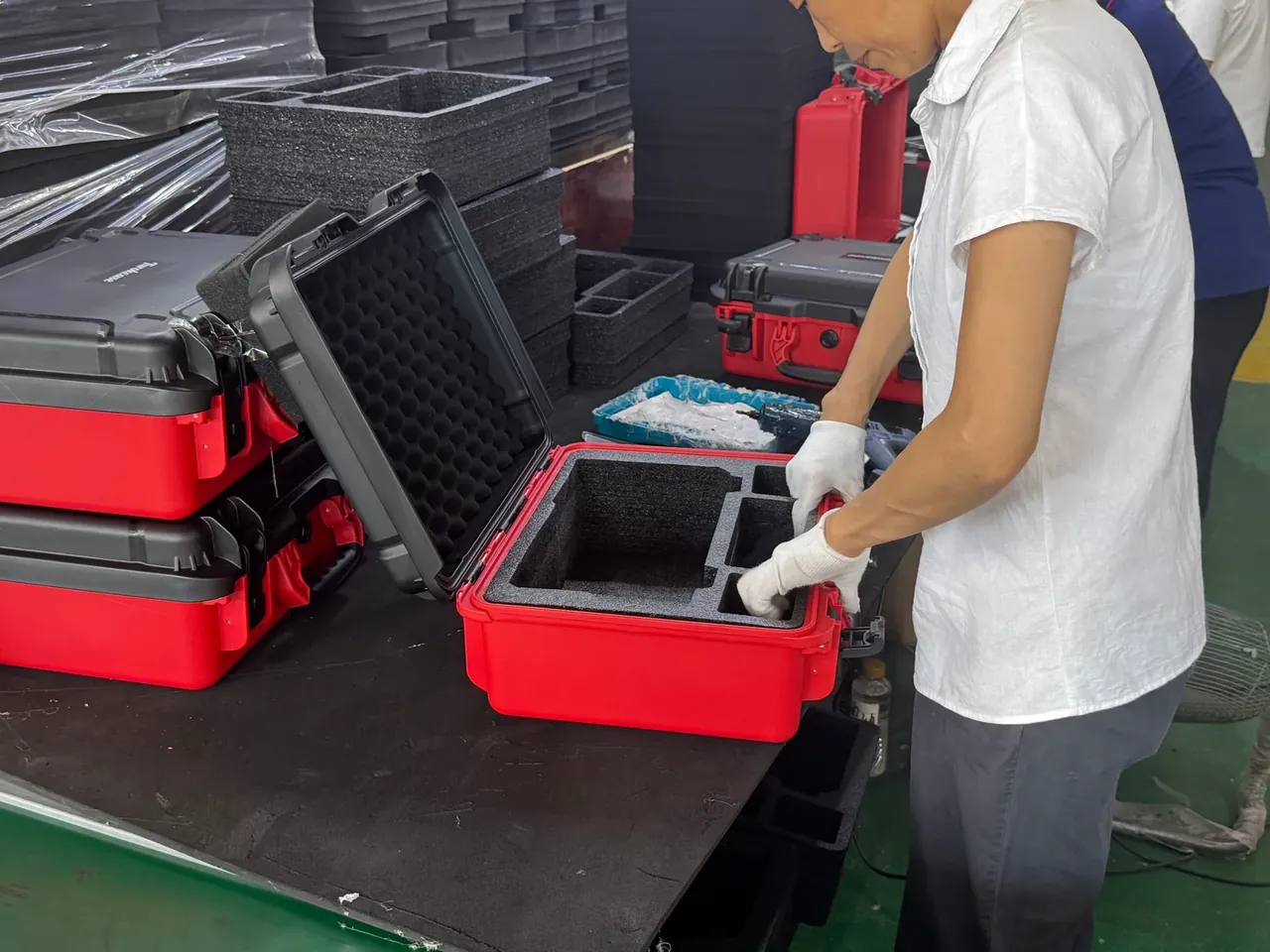
Quick answer: An assembly line case earns its place through 8 s of locking: three points and a 12 mm taper pin hold 0.5 mm repeatability inside a 62 s takt.
Table of contents
- The route: 6 m inside a 62 s takt
- Three lock points and a 12 mm taper pin
- Casters: two fixed, two swivel, two brakes
- 600 x 400 x 220 mm and 0.5 J
- FAQ
1. The route: 6 m inside a 62 s takt
A final assembly line releases a vehicle every 62 s, and stations sit 6 m apart. Walking that gap takes 5 s, or 8 percent of the takt, and a case left behind makes the operator cover it twice.
Across a 480 min shift the case travels 120 times, about once every 4 min, and sits still in between. An assembly line case therefore has two duties: move fast, and stay utterly still when parked.
The second is harder. A 40 N·m pull on an M10 bolt walks a free case 15 mm to 20 mm, enough to misalign the next tool, and 18 kg plus 8 kg of tools must be carried 6 m if it cannot roll.
| Fixing method | Lock and release s | Repeatability mm | Route it suits |
|---|---|---|---|
| Casters braked only | 4 | 8.0 | Fixed station, under 10 moves a shift |
| Single hook plus brakes | 6 | 3.0 | Straight shuttle, 2 corners at most |
| Three points plus 12 mm taper pin | 8 | 0.5 | 62 s takt, 120 moves a shift |
| Floor pallet clamp | 14 | 0.3 | Frequent model changes |
The cheap rows buy a case; the dear rows buy the absence of searching. Two seconds saved inside 62 s returns 15 min a shift.
2. Three lock points and a 12 mm taper pin
The points divide the work. A 12 mm taper pin takes the two freedoms in the floor plane, a front over-centre latch takes rotation, and a braked front caster presses the third point down.
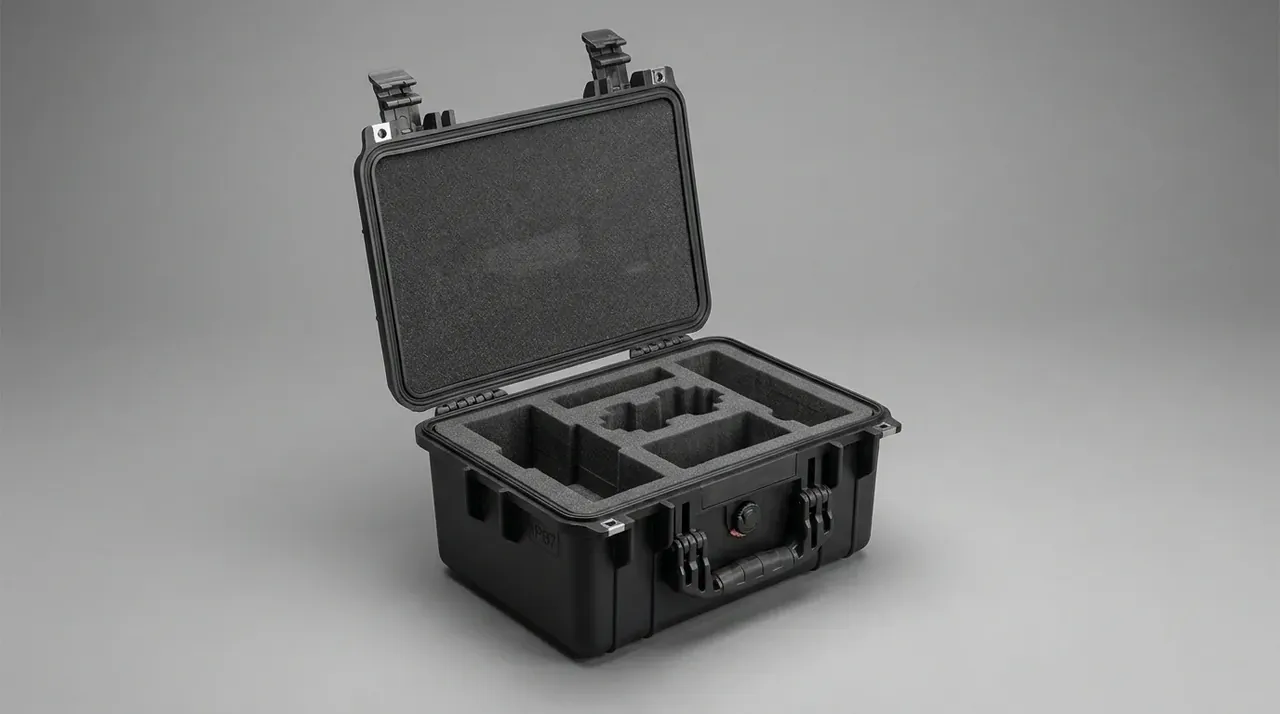
The 1:10 taper settles the argument between insertion force and centring. Each 10 mm of axial travel corrects 1 mm sideways, so landing within plus or minus 5 mm is enough for the cone to close the rest.
The 0.5 mm result adds three clearances: 0.05 mm per side between pin and bush, 0.2 mm of residual offset where the cone seats, and 0.25 mm of pad rebound under the base.
The test sits on the hook rail, where openings are held to plus or minus 1 mm. A 0.5 mm offset still drops a hook in first time; at 2 mm the 1.8 s pick becomes 3.6 s.
| Lock and release s | What the operator does | Share of a 62 s takt | Takt it suits |
|---|---|---|---|
| 4 | Brake, pull, release | 6% | Under 45 s |
| 8 | Insert pin, press latch, confirm | 13% | 62 to 90 s |
| 14 | Align, two pins, four clamps | 23% | Over 90 s |
The difference between the three actions is who aligns: 4 s by hand, 8 s guided by structure, 14 s when two pins must engage together.
3. Casters: two fixed, two swivel, two brakes
The 600 x 400 mm base carries four 75 mm wheels: two fixed at the rear, two swivel at the front, and only the swivel pair braked. Fixed wheels hold a straight line one-handed; swivels let the case slide into a 100 mm gap between rack and column.
Rolling 18 kg from rest on concrete takes 5.4 N, about 0.55 kg at the handle; a 1 percent slope adds 1.8 N. Pushing was never the problem with an assembly line case, stopping is.
Four swivel casters wander: each hunts its own direction, the case drifts 30 mm over 6 m, and the operator steers with both hands. Two fixed wheels cure that, at the cost of a turning radius rising from 0.6 m to 1.1 m.
Only two wheels are braked because the taper pin supplies the third point. Three points define a plane, so one point stops the case whichever edge it tips toward.
| Takt s | Station pitch m | Moves per shift | Lock points |
|---|---|---|---|
| 45 | 4 | 160 | 4 |
| 62 | 6 | 120 | 3 |
| 90 | 8 | 80 | 3 |
A shorter takt wants fewer but surer points: at 45 s only 4 s remains for locking, so every point must be snap-action.
4. 600 x 400 x 220 mm and 0.5 J
The 600 x 400 mm footprint comes from the rack: a 400 mm deep, 600 mm wide line-side shelf with 20 mm of finger room each side.
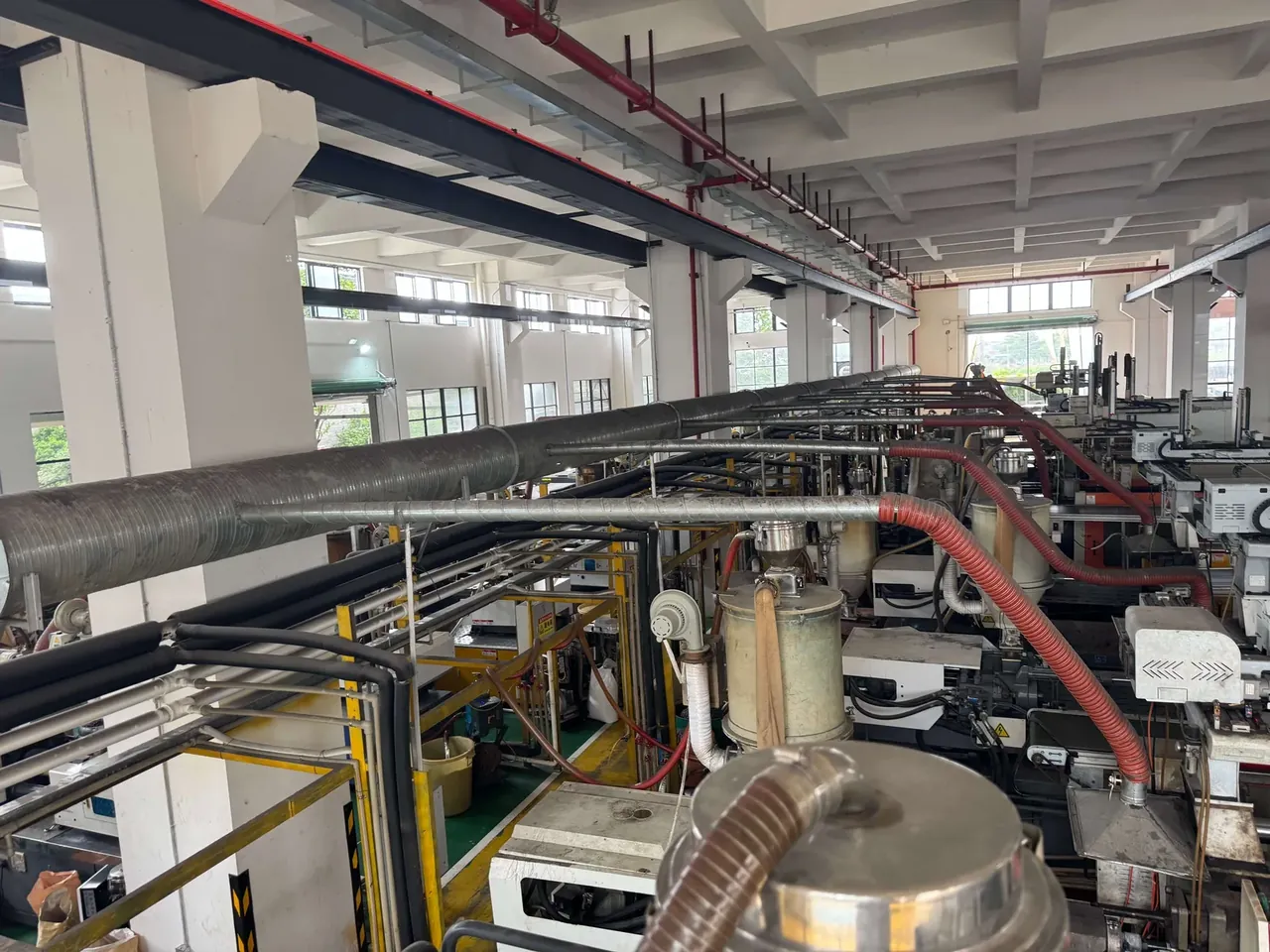
The 220 mm height follows the centre of gravity. Loaded to 18 kg the mass sits 110 mm up, which keeps the lumbar moment 18 percent below a 300 mm case; add 80 mm and the lift becomes a hug.
The 0.5 J figure is the sideways impact budget. An AGV brushing 18 kg at 0.24 m/s delivers 0.52 J; at 0.6 m/s it delivers 3.2 J and dents a 3 mm wall by 4 mm, which 20 mm corner ribs spread over 3000 mm².
The wheels also see the drop: off a 150 mm bench the case lands at 1.7 m/s, and a 2.2 dynamic factor lifts load per wheel from 4.5 kg to 9.9 kg.
Conclusion
Three numbers size an assembly line case: a 62 s takt caps lock and release at 8 s, a 6 m pitch demands casters that track one-handed, and 0.5 mm of repeatability forces three points around a taper pin. When they agree, the case is a bench that follows its operator; when they do not, it eats a slice of every takt.
Related Reading
- How a case assembly line is sequenced
- Matching cases to batch sizes at assembly stations
- Protecting axle assemblies by zone
- Fixtures for brake and clutch assemblies
Related Products
- 8 Series — Gun Cases; Military Equipment Cases; Camera Equipment Cases; Drone Cases; Watch Cases; Knife Cases; First Aid Cases; Electronics Equipment Cases
- WL8-2812 PP Gun Case — model WL8-2812
- All protective cases and toolboxes: 7 series, 158 models