

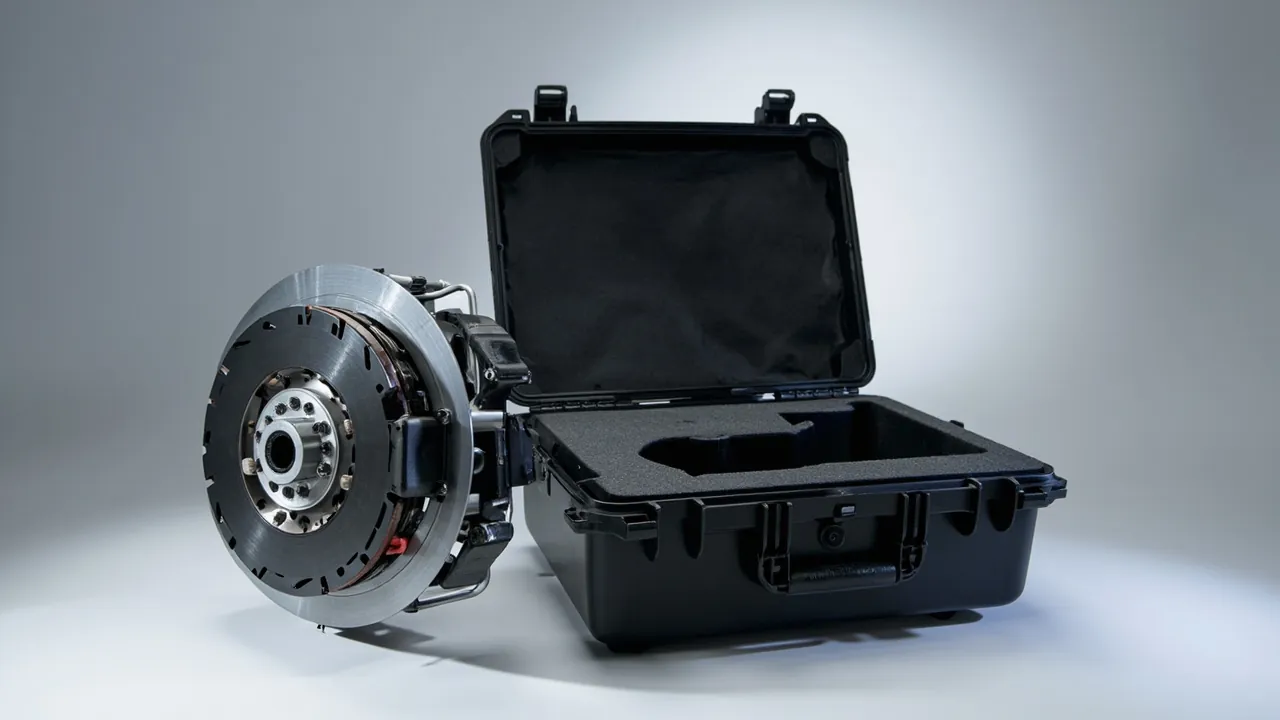
The central problem in protecting brake and clutch assemblies during transport is that their dominant failure agents are not impact but time, moisture, and oil contamination. Friction material is a porous structure, and once it takes up moisture or oil, its coefficient of friction departs permanently from the design value. The rubber diaphragms and seals inside a brake chamber or pneumatic actuator age faster under heat, ozone, and sustained compression, and that aging is irreversible. The packaging proposition for this component family is therefore environmental isolation rather than impact resistance: seal against moisture, isolate from oil, keep non-metallic parts unloaded, and make the storage period traceable.
These failures share one infuriating trait: the part usually looks perfect at unpacking and only reveals the problem after the vehicle or machine has been running for a while. A friction disc that has absorbed moisture shows no visible change, but early braking is weak or judders. A chamber diaphragm that has aged looks intact, but responds sluggishly and resets slowly. By the time the problem surfaces, the batch has usually passed its acceptance window and liability is very hard to assign. That is why packaging records, desiccant records, and humidity indicator cards are not paperwork for its own sake. They are the only objective evidence that can reconstruct transport and storage conditions after the fact.
This article builds on the material characteristics of friction compounds and rubber elastic elements. It works through failure mechanisms, friction disc protection, chamber protection, contamination control, material compatibility, moisture control architecture, environmental windows, and inspection and traceability, giving an actionable design method and pass criteria for brake and clutch assembly cases. It is written for engineers and purchasing staff at brake and clutch manufacturers, automotive and construction machinery parts traders, and equipment builder procurement groups.
Table of Contents
- Why Friction Material and Chamber Failures Correlate Strongly With Time
- Friction Discs: The Triple Threat of Moisture, Oil, and Compression
- Chambers and Pneumatic Actuators: Rubber Aging and Spring Preload Retention
- Sources of Dust and Particulate Contamination and How to Control Them
- Insert and Barrier Materials: Compatibility Screening for Non-Metallic Parts
- Building the Moisture Control System: Desiccant, VCI, and Sealing
- Case Cleanliness and Washdown Compatibility Requirements
- How to Set Transport and Storage Environmental Windows
- Inspection and Testing: What to Measure Beyond Appearance
- Marking, Batch Traceability, and Storage Period Management
- Pre-Installation Inspection and On-Site Exception Handling
- OEM and Volume Supply Program Points
- Frequently Asked Questions
- Conclusion and Related Reading
Why Friction Material and Chamber Failures Correlate Strongly With Time
Transport damage to metal parts is usually a single event: one drop, one impact, damage formed immediately. Brake and clutch assemblies degrade differently. Their damage logic resembles cumulative deterioration, proportional to the duration and intensity of environmental exposure.
| Failure Mode | Dominant Environmental Factor | Time Effect | Reversibility | Early Symptom |
|---|---|---|---|---|
| --- | --- | --- | --- | --- |
| Friction coefficient drift | Moisture uptake, oil uptake | Strong; worsens monotonically with exposure | Essentially irreversible | Weak braking, judder |
| Friction lining corrosion and debonding | High humidity plus metal backing plate | Strong | Irreversible | Lining separation, noise |
| Rubber diaphragm aging | Heat, ozone, compression | Strong; accelerates markedly per temperature step | Irreversible | Slow response, slow return, air leak |
| Seal compression set | Sustained compression | Strong | Irreversible | Air leak, oil weep |
| Spring preload decay | Sustained high stress plus corrosion | Strong | Irreversible | Release clearance change, incomplete return |
| Chamber interior contamination | Particles, oil mist | Moderate | Cleanable | Actuation sticking |
| Bearing and guide surface corrosion | Moisture | Strong | Light cases treatable | Stiff rotation, noise |
One conclusion follows directly from this table: the packaging goal is not to reduce the damage probability to some instantaneous level, but to minimize the integral of exposure time multiplied by exposure intensity. In engineering terms that means two things: hold internal humidity below a threshold, and keep non-metallic parts free of sustained load during transport.
This is also the sharpest difference between this article and general machined parts packaging. The design of a machined parts case revolves around allowable G levels and cushion thickness. The design of a brake and clutch assembly case revolves around humidity thresholds, temperature ceilings, storage periods, and compression state.
Friction Discs: The Triple Threat of Moisture, Oil, and Compression
Friction material is produced by hot-pressing a resin matrix, fiber reinforcement, and friction modifiers. Its defining characteristic is a large internal microporosity. Those pores are part of the friction performance design, used for gas venting, debris clearance, and heat dissipation, but they also make the material a strong adsorbent.
Threat one: moisture uptake. After absorbing moisture, friction material generally loses coefficient of friction, and the magnitude of the loss tracks the moisture content. Worse, moisture uptake causes slight dimensional swelling that changes free clearance. Engineering practice typically characterizes this through equilibrium moisture content, and higher ambient relative humidity with longer exposure makes absorption worse. Holding internal relative humidity low is the first priority for friction disc packaging.
Threat two: oil and grease uptake. Once oil, grease, release agent, or corrosion-preventive oil enters the pores of friction material, it forms a lubricating film. The coefficient of friction drops permanently and cannot be restored by cleaning. This means friction discs must never share a case with greased metal parts or oil-bearing machinery components, and must never be wrapped in contaminated packaging material. This is a very concrete and very easily violated requirement. In many packing areas, greased metal parts and friction discs are placed in the same case to save volume, which produces exactly the worst contamination outcome.
Threat three: compression and bending. Friction discs, particularly disc brake pads and clutch driven plates, are thin plate structures with low bending stiffness. Sustained compression, stacked loading, or tight strapping all produce warping, and after warping the contact area against the mating surface drops, causing uneven wear and judder.
Three hard rules for friction discs follow:
- Separate cavities, no load bearing. The cavity holding friction discs must not carry any stacking load or the weight of other parts. If heavier metal parts are in the same case, provide a structural divider so the load goes into the case walls.
- Zero grease contact. No greased metal parts may be placed in the cavity, and packaging material must be oil-free and never recycled from contaminated stock.
- Controlled humidity. Provide desiccant and a humidity indicator card, with quantity set by transport and storage duration.
For friction discs requiring long storage, use vacuum packaging or an aluminum foil laminate bag with desiccant, and mark the sealing date and recommended use-by period on the outside. With ordinary case packaging, write the storage temperature and humidity limits onto the label and enforce first-in-first-out in warehouse management.
Chambers and Pneumatic Actuators: Rubber Aging and Spring Preload Retention
Spring brake chambers, often called double-diaphragm or spring cylinders, and pneumatic clutch boosters share one thing: they contain rubber diaphragms, O-ring seals, and preloaded springs. All three fear the same thing, namely being held in one condition for a long time in an unfavorable environment.
Aging mechanisms in rubber diaphragms and seals. The dominant factors are temperature, oxygen and ozone, and mechanical stress. The empirical rule is that a certain temperature increase markedly accelerates aging, which is the familiar temperature-life relationship. Transport and storage must therefore avoid high temperature, including the top of a container stack, open yards, and warehouse positions near heat sources. Sustained compression must also be avoided, because seals under long-term compression take a compression set. Once set, they rebound insufficiently, showing up as air leaks or oil weeping.
Retaining spring preload. The internal spring of a spring brake chamber is normally preloaded, which is precisely how it stores energy for parking brake actuation. Additional shock load in transit raises the spring stress level, and over time this can change free length. Chambers should therefore be protected from stacking pressure and sustained squeezing, and located independently in the insert so they never carry the weight of other parts in the case.
Protecting ports and vents. The inlet port, vent, and exhaust port of a chamber are weak points. Foreign matter entering contaminates the interior and jams the piston, while thread damage at a port complicates hose connection on site. Fit dedicated dust plugs and protective caps, and provide clearance recesses in the insert for the ports. Dust plugs deliver a bonus benefit: they prevent the breathing effect caused by vibration-induced piston micro-motion, which would otherwise draw moist air repeatedly into the chamber interior.
Protecting push rods and piston rods. Rod surface roughness directly affects seal life, and any scratch accelerates seal wear. Fit a protective sleeve over the rod and keep it clear of hard components in the insert.
On whether to ship pressurized. Follow the manufacturer's technical requirement. The general principle is to ship vented, so that air pressure cannot impose abnormal load under temperature change or shock. Some designs, however, require a degree of preload to hold internal components in position. In those cases the insert must hold the chamber attitude stable and the requirement must be marked on the case exterior.
Sources of Dust and Particulate Contamination and How to Control Them
For friction pairs and pneumatic components, particulate contamination is a hidden killer. Its harm does not appear immediately; it accelerates wear and causes sticking, eventually showing up after a period of service as performance loss or functional failure.
Four main sources exist:
- Particle shedding from packaging material itself. Low-density foam, talc-containing rubber parts, paper fragments, and corrugated board edges continuously release particles.
- Machining residue on case and insert. Foam cutting debris, sawdust from wooden crates, and paper dust from cartons.
- Particles carried on the parts themselves. Machining chips, casting sand, and blasting residue from coating operations.
- Ingress from the transport environment. Where the case is not sealed, road dust and mud carried by rain enter directly.
The corresponding controls:
- Insert material and cleaning. Specify low-shedding materials, clean after machining by blowing or wiping, and complete packing in a clean area.
- Case sealing. Choose the protection rating based on transport and storage conditions. For sealed cases crossing climate zones, fit a pressure equalization valve so the breathing path runs through the valve rather than the seal faces.
- Clean parts before packing. No loose dust on friction disc surfaces, clean chamber interiors, and no machining chips on metal parts.
- Layer isolation. A barrier layer must separate friction parts from metal parts and from sheddable materials.
- Insert storage. Keep unused inserts sealed against dust, and never reuse an insert that has previously held carbon steel parts and retains chips.
A practical on-site criterion: after packing is complete, wipe the insert surfaces and case floor with a white non-woven cloth. The cloth should show no visible dark particles or oil film. This costs almost nothing and catches most contamination problems.
Insert and Barrier Materials: Compatibility Screening for Non-Metallic Parts
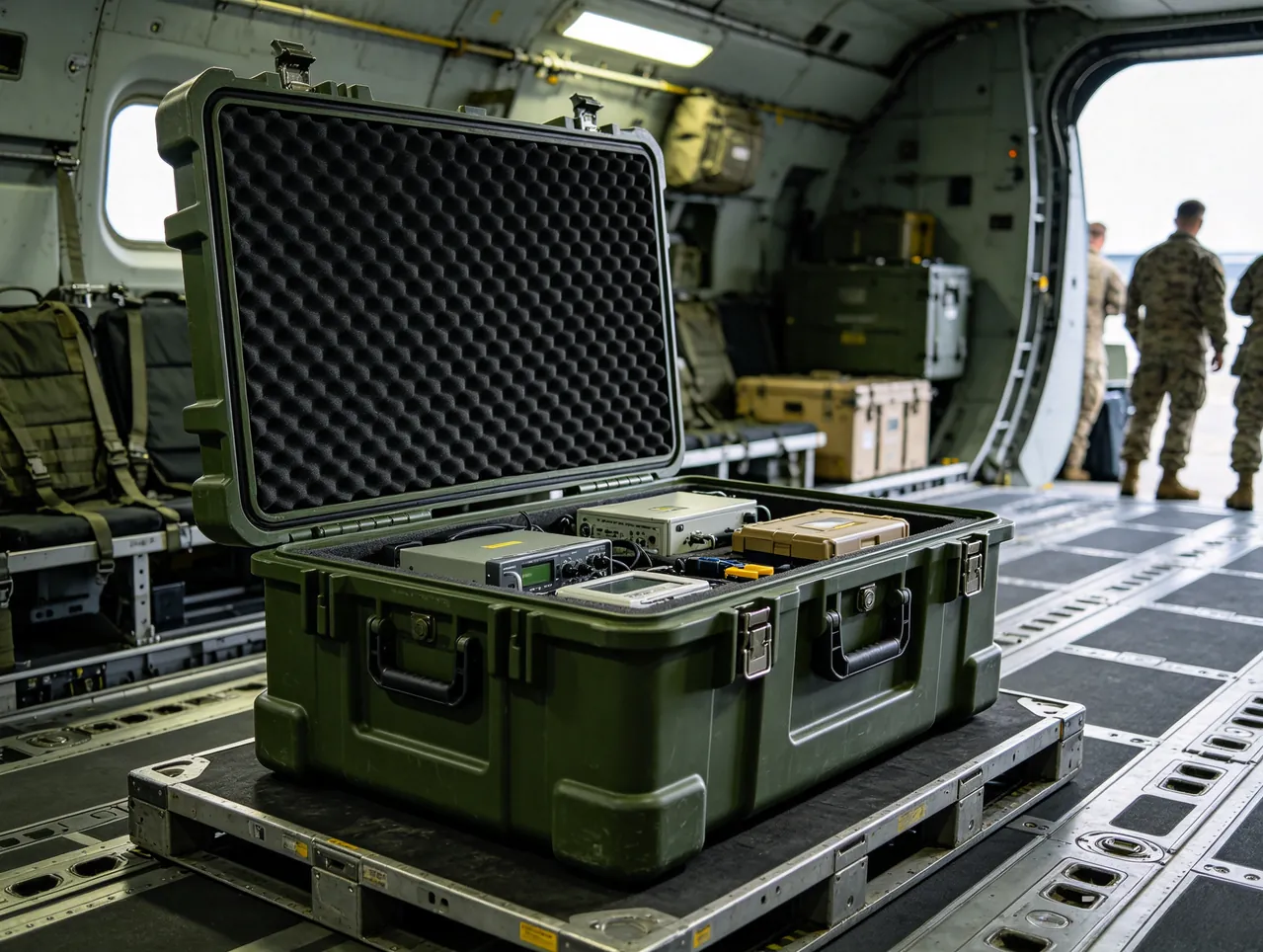
Compatibility between packaging material and product matters far more here than with metal parts, because rubber components, friction material, and some engineering plastics can interact physically or chemically with packaging materials.
| Packaging Material | Compatibility With Rubber | Compatibility With Friction Material | Main Risk | Recommended Use |
|---|---|---|---|---|
| --- | --- | --- | --- | --- |
| Polyethylene (PE) bag | Good | Good | Static attraction of dust | Clean liner, barrier layer |
| Aluminum foil laminate bag | Good | Good | Barrier drops if creased | Long-term sealed storage |
| EVA foam | Good | Good | Low-shedding grades cost more | Load-bearing insert |
| EPE foam | Good | Good | Higher shedding, low stiffness | Outer cushioning |
| Polyurethane (PU) foam | Fair | Fair | Plasticizer migration in some formulations | Use only after migration testing |
| PVC film | Poor | Fair | Plasticizer migration contaminates rubber and friction faces | Not recommended for direct contact |
| Ordinary corrugated board | Fair | Poor | Paper dust, becomes a moisture source when damp | Outer box only, not touching product |
| Sulfur-cured rubber goods | Poor | Fair | Sulfur and accelerators accelerate rubber aging | Prohibited in the same case |
| Greased metal parts | Good | Extremely poor | Grease migration contaminates friction material | Must be separated or cased separately |
Two entries deserve emphasis. First, PVC-type materials should not contact rubber parts or friction faces directly, because plasticizer migration causes rubber swelling or friction surface contamination. Second, sulfur-cured rubber goods such as certain vulcanized rubber pads must not share a case with rubber diaphragms, since sulfur and accelerators accelerate rubber aging. This is an easily overlooked but genuinely grounded compatibility problem.
For any uncertain material combination, run a compatibility verification: place the packaging material and a representative sample together under accelerated conditions for a period, then check the rubber for hardness change, volume change, and appearance, and check the friction disc surface condition. This testing is inexpensive and prevents an entire batch from suffering a hidden failure. Where the customer requires material declarations, such as automotive substance reporting, confirm packaging material compliance at the selection stage to avoid a redesign later.
Building the Moisture Control System: Desiccant, VCI, and Sealing
Moisture control for brake and clutch assemblies is not simply dropping in a desiccant packet. It is a layered system.
Layer one: reduce internal moisture sources. Confirm parts are dry before packing, avoid packing during rain or high-humidity periods, and avoid damp inserts and cartons. This layer is most often skipped and delivers the largest benefit, because packing with moisture inside means any amount of desiccant is only catching up with the initial load.
Layer two: desiccant humidity control. Silica gel or montmorillonite desiccant is standard. Size by free internal volume, using 250 g to 500 g per 100 L as an experience value, with multipliers for transit duration and initial moisture. Free volume means the net space after subtracting product and insert volume. A key point is that desiccant absorbs water vapor already in the case air but cannot stop external moisture from entering continuously, so it must be paired with sealing.
Layer three: vapor-phase corrosion inhibitor. For friction discs with metal backing plates, metal springs, and metal chamber housings, VCI material forms a vapor-phase protective layer on metal surfaces and inhibits corrosion. Note that VCI compatibility with friction material must be confirmed. The usual approach is to place VCI material adjacent to the metal parts but isolated from the friction faces, so the VCI carrier never contacts friction material directly.
Layer four: sealing and pressure differential management. Sealing determines whether external moisture can enter. Among common levels, IP55 suits covered transport, IP65 suits sea freight and general export, and IP67 suits open storage and wet transfer. A fully sealed case develops a pressure differential during transport with large temperature swings, which deforms the gasket and makes the case hard to open, while the differential drives repeated breathing that carries external moisture inside. Fit a pressure equalization valve so the breathing path runs through the valve body with moisture protection on the inner side, as described in the role and selection of pressure equalization valves in protective cases. For seal material selection and moisture vapor transmission, see protective case seal material types and matching scenarios.
Layer five: visual monitoring. The humidity indicator card is the instrument panel of this system. Place it where it represents true internal humidity and is not shielded by foam or desiccant, and make it readable through an external window or a marked location where possible. Set the replacement threshold according to product requirements, schedule desiccant replacement when the threshold is reached, and record each replacement date to build a log.
Case Cleanliness and Washdown Compatibility Requirements
Brake and clutch assemblies serve vehicles, construction machinery, elevators, wind turbines, and mining equipment, where maintenance sites combine dust, oil, and washdown. This places two opposing demands on the case: exclude external contamination, and remain easy to clean for reuse.
Internal cleanliness. No machining chips, paper dust, metal swarf, or oil may be present inside. Clean inserts before use, and never use recycled contaminated foam. For returnable cases, run a cleaning procedure on every return, following the methods and criteria in protective case cleaning methods and precautions.
Exterior cleanability. Case surfaces should use materials and textures that resist dust accumulation and tolerate wiping, avoiding deep recessed patterns that trap dirt. Seal installation grooves should be cleanable and free of dead corners.
Washdown compatibility. Where the site pressure-washes the case exterior, confirm the seal rating and material tolerance. Cases rated IP65 and above tolerate spray, but prolonged direct high-pressure jetting at the gasket should be avoided. Cleaning agents should be neutral formulations that do not swell the seal or case material. Confirm the latches are fully closed and avoid direct jetting at the gasket, which is the key operating habit for extending seal life.
Hinge and latch reliability. Frequently handled cases need captive hinge pins, latches with secondary locking, and gasket compression controlled between 30% and 40%. For the structural forms, see toolbox hinge, latch, and seal structure explained.
How to Set Transport and Storage Environmental Windows
Because friction material and rubber parts degrade in proportion to time, the permitted environmental window must be written down and supplied with the case. This document constrains the logistics provider as much as the customer's warehouse.
| Control Item | Recommended Value (Experience) | Consequence If Exceeded | Monitoring Method |
|---|---|---|---|
| --- | --- | --- | --- |
| Transport temperature upper limit | Not above 40 C | Accelerated rubber aging, grease migration | Temperature recording label |
| Transport temperature lower limit | Not below -20 C | Some rubbers harden at low temperature | Temperature recording label |
| Internal relative humidity | Not above 40%, and not above 30% for friction parts | Reduced friction coefficient, metal corrosion | Humidity indicator card |
| Storage period in sealed original packaging | Use within 12 months is advisable | Natural aging of rubber parts | Label date plus first-in-first-out |
| Stacking layers | Calculated and clearly marked | Insert compression, non-metallic parts under load | Case exterior marking |
| Light exposure | Avoid prolonged direct sunlight | Ozone and UV accelerate aging | Warehouse management |
| Ozone sources | Keep away from motors, welding, ozone disinfection equipment | Rubber cracking | Storage location selection |
On setting the storage period: base it on the manufacturer's aging assessment for rubber parts and friction material combined with the barrier capability of the packaging, rather than filling in an arbitrary number. A sealed original package under normal warehouse conditions is reasonably given a 12-month recommended use period. High-barrier packaging such as an aluminum foil laminate bag with desiccant allows extension, but only with a verification basis.
One easily overlooked scenario is open-air storage during transshipment. Seaports, rail yards, and customer construction sites may all involve open storage. Where the transport chain includes an open-air leg, specify an IP67 class sealed case and mark on the exterior either that prolonged open storage is prohibited or a maximum number of days. Place a temperature recording label inside so the temperature history can be reconstructed afterward.
Spare parts for construction machinery, mining equipment, and wind turbines often sit in remote yard storage for extended periods, making the environmental window especially important. The handling concepts for remote storage and contamination control in mining equipment component transport cases and the long-term storage management experience for large components in wind turbine parts transport case design points translate directly, and both should be reflected in the environmental window supplied with the case.
Inspection and Testing: What to Measure Beyond Appearance
This product family has a particular inspection challenge: passing an appearance check does not mean passing a performance check. The inspection plan must therefore include functional and material-state items.
Incoming and outgoing inspection before packing:
- Friction disc appearance, thickness, and flatness
- Friction material moisture content, measured as equilibrium moisture content where facilities allow
- Rubber part hardness and appearance, with no cracking and no permanent deformation
- Chamber seal integrity by pressure hold test
- Corrosion protection state of metal parts
Post-packing inspection:
- Internal humidity, with the indicator card reading recorded as an initial state
- Desiccant quantity and position matching the plan
- Insert cavities fitting the product with no sustained compression points
- Port dust plugs and protective caps present
- No grease sharing a cavity with friction parts
Transport testing and post-test re-verification:
- Vibration, drop, and compression per the GB/T 4857 series
- After testing, re-measure friction disc flatness, rubber appearance and hardness, and chamber seal integrity
- Check for packaging material migration contamination, including oil stains and plasticizer marks
- Re-read the humidity indicator card
Long-term storage verification by sampling:
For batches intended for long storage, sample per batch and re-inspect at 3, 6, and 12 months, checking friction material condition and rubber hardness change. Accumulated over time, this data is the most reliable basis for setting storage periods and first-in-first-out rules.
Write pass criteria explicitly into the technical agreement and avoid vague wording such as passing on appearance alone. Chamber seal integrity and friction disc flatness should be mandatory checks after testing.
Marking, Batch Traceability, and Storage Period Management
Because failure correlates with time, the marking system must carry time information.
Unit marking where applicable: model and size, batch number, manufacturing date, and friction material grade.
Case exterior marking should include:
- Product name, model, and quantity
- Manufacturing date and recommended use or re-inspection date
- Desiccant sealing date and next replacement prompt
- Storage environment requirements, including temperature and humidity limits, no direct sunlight, and away from ozone sources
- Stacking layer limit
- Keep-dry and sun-protection symbols
- Customer part number and delivery information
- Batch number cross-referenced to internal quality records
The value of batch traceability. When a site reports abnormal braking response from a batch, the batch number allows rapid identification of the friction material grade used, the rubber part supplier lot, the packing environment record, desiccant quantity, transport mode, and elapsed time. This is the only reliable path to separating a manufacturing problem from a transport or storage problem.
Practical storage period management. Use a prominent date label on the case exterior and integrate first-in-first-out into the customer's warehouse process. Product that exceeds the recommended period should be evaluated by the manufacturer for re-inspection rather than automatically scrapped. In most cases the items requiring re-inspection are rubber hardness and friction material moisture content, and a successful re-inspection can justify reasonable extension.
Recommended shipping documents: packing list, factory inspection report, packaging plan description with desiccant quantity and replacement guidance, storage requirement statement, pre-installation checklist, and warranty and technical support contact.
Pre-Installation Inspection and On-Site Exception Handling
The purpose of on-site inspection is to stop problems before installation. Supply the checklist below with the case and require each item to be recorded.
Step one: packaging condition
- Case damage or moisture
- Humidity indicator card above threshold or not
- Temperature excursion indicated by the recording label
- Desiccant sealing date and whether still within validity
Step two: appearance
- Oil, rust, dust shedding, or chipped edges on friction disc surfaces
- Friction disc flatness by surface plate or straight edge
- Rubber diaphragm and seal condition, checking for cracking, hardening, and permanent deformation
- Corrosion on metal backing plates and housings
- Scratches on push rods and piston rods
Step three: function
- Chamber pressure hold test result
- Push rod stroke and return to normal position
- Spring release clearance within specification
- Clutch assembly actuation smooth with no sticking
Step four: installation
- Tighten to specified torque and sequence
- Confirm friction surfaces are clean and oil-free, with no greasy hands contacting friction faces during assembly
- Set and record free clearance
- Run and observe braking response and temperature rise
Principles for handling on-site exceptions:
- Do not declare scrap immediately. Record the packaging state first, including photographs, indicator card reading, and temperature label, since these are the key evidence for liability.
- Separate recoverable from non-recoverable. Surface dust can be cleaned; grease that has penetrated friction material and hardened or cracked rubber parts cannot be restored.
- Retain the packaging material. Do not discard inserts, desiccant, or indicator cards until the conclusion is established.
- Notify the manufacturer and packaging supplier. Conduct failure analysis jointly so the next batch does not repeat the issue.
- Document in writing. File inspection data, conclusions, and actions into the batch traceability record.
OEM and Volume Supply Program Points
For manufacturers and traders, the packaging plan must be managed alongside the product supply system.
Suggested rollout sequence:
- Product grouping. Group by friction part type, including disc pads, drum brake shoes, clutch driven plates, and chamber assemblies, and by size, to define model families that can share packaging.
- Packaging plan release. Specify case type, protection rating, insert structure, barrier layers, desiccant quantity, and humidity indication, and state the separation rules between friction parts and metal parts.
- Trial fitting and testing. Build two to three physical pilot sets per family, run full transport testing on representative sizes, and re-verify function after testing.
- Document freeze. Issue controlled drawings, packing instructions, inspection criteria, and storage requirement statements, and integrate them into the batch management system.
- Spares and consumables management. Supply inserts, gaskets, desiccant, indicator cards, and dust plugs as separate consumables so a stock-out never forces a downgrade of the packaging standard.
- Change control. After any change in friction material grade, rubber part supplier, or case material, reassess compatibility and packaging fit.
For manufacturers serving elevator, hoisting, and construction machinery customers simultaneously, the packaging plan can be platformed: share the case and sealing system, and change insert modules and moisture control intensity by application, reducing the complexity of managing many variants. For packaging emphasis on hoisting machinery components, see hoisting machinery component transport cases.
For brake and clutch assembly programs, JUNZHJIA typically issues a cavity and barrier plan from the customer's friction part type, chamber size, and storage requirements, marking friction part cavities, metal part cavities, barrier layer positions, and load paths; configures desiccant quantity, humidity indication, and pressure equalization according to transport and storage duration; and supports OEM and ODM customization of case appearance, marking, batch label format, and insert structure, with seals, dust plugs, and temperature and humidity monitoring consumables supplied as matched items along with inspection and packaging plan documentation. Brake and clutch case builds are made by Kexin New Materials (Guangdong) Co., Ltd., with wholesale, agency and global supply for powertrain programmes.
Frequently Asked Questions
Q: Why do friction discs fail from moisture uptake, and how is it prevented in packaging?
A: Friction material is a porous composite, hot-pressed from a resin matrix, fiber reinforcement, and friction modifiers, and its internal microporosity is part of the friction performance design, used for gas venting, debris clearance, and heat dissipation. Because those pores exist, the material is a strong adsorbent. At high ambient humidity it absorbs water vapor, which lowers the coefficient of friction, causes slight dimensional swelling, and changes free clearance. In the presence of oil mist or grease it absorbs oil, forming a lubricating film that permanently lowers the coefficient of friction and cannot be restored by cleaning. Prevention runs along two lines. On the moisture line, hold internal relative humidity low using desiccant with a humidity indicator card, apply multipliers for transit duration and cross-climate shipping, and for long storage use an aluminum foil laminate bag or vacuum packaging with the sealing date marked. The oil line matters more and is easier to violate: friction parts must never share a cavity or a case with greased metal parts or oil-bearing machinery components, packaging material must be oil-free and never recycled from contaminated stock, and packing operators must avoid touching friction faces with greasy hands.
Q: What are the main transport risks for the rubber diaphragm inside a brake chamber?
A: Three main risks, all tied to environment and time rather than to impact intensity. The first is temperature-accelerated aging. Rubber is highly temperature sensitive, and as an experience rule a step increase in temperature markedly accelerates aging, so cases must avoid the top of a container stack, open yards, and warehouse positions near heat sources, and a temperature recording label inside the case lets the history be reconstructed. The second is compression set. A chamber diaphragm and its seals are already under some compression in the assembled state, and any stacking load added during transport or storage worsens compression set, so the chamber must be located independently in the insert and must not carry the weight of other parts. The third is ozone and light. Ozone is highly damaging to rubber, so keep chambers away from motors, welding equipment, and ozone disinfection equipment. Ports and vents should also be fitted with dust plugs, which block foreign matter and suppress the breathing effect caused by vibration-induced piston micro-motion, reducing repeated intake of moist air.
Q: How is desiccant quantity determined, and is more always better?
A: No, more is not better. The right quantity matches the internal moisture load and the actual requirement. Size by free internal volume, using 250 g to 500 g of silica gel or montmorillonite per 100 L as an experience value, where free volume means the net space after subtracting product and insert volume rather than the external case volume. Apply multipliers for transit duration: use the low end for trips under two weeks and the high end with possible doubling for one to three months, then add further margin for cross-climate shipping, transit through humid regions, or any open-air storage leg. The reason more is not better has two parts. First, desiccant absorbs water vapor already in the case air but cannot stop external moisture from entering continuously, so with a poor seal even a large quantity only delays the inevitable and the real problem is the seal. Second, excess desiccant has side effects: in a fully sealed case it drives equilibrium humidity very low, which is not necessarily good for the long-term properties of some rubber parts, while cost and replacement labor rise for no benefit. A sounder approach pairs desiccant with a humidity indicator card, so quantity and replacement are based on observed data.
Q: Can friction parts and metal parts travel in the same case?
A: Same-case packing is possible but only under strict separation conditions, and otherwise separate cases are better. Three conditions must all hold. First, structural separation: a solid divider must sit between friction parts and metal parts, and the divider must transfer stacking load into the case walls rather than pressing it onto the friction parts. Second, grease isolation: every metal part coated with corrosion-preventive or lubricating grease must be sealed in its own wrap, with no migration path to the friction material. Third, unified moisture strategy: the humidity requirement for friction parts is usually stricter than for metal parts, so internal humidity must be controlled to the friction part requirement rather than relaxed to suit the metal parts. If any one condition cannot be met, switch to separate cases and pack the friction parts alone in a low-humidity, oil-free package. In practice, nearly all problems arise from packing the two together to save volume, usually with greased metal parts directly touching friction parts, which causes irreversible loss of friction coefficient. Any same-case plan therefore needs an explicit divider design, verification, and a documented illustration in the packing instructions.
Q: Do packaging materials cause compatibility problems with rubber parts?
A: Yes, and this is a frequently overlooked class of hidden failure. Three material groups carry most of the risk. PVC-type films and materials release plasticizers that migrate to adjacent rubber surfaces, causing swelling, softening, or surface property change, so direct contact with rubber diaphragms and seals is not recommended. Sulfur-cured rubber goods, such as certain vulcanized or reclaimed rubber pads, contain sulfur and accelerators that accelerate aging in neighboring rubber parts, a classic case of two components damaging each other in the same case, and they should never share a case. Some polyurethane formulations contain plasticizers or residual additives that can also migrate, so confirm the formulation and run verification before use. Safer options include polyethylene bags, aluminum foil laminate bags, and EVA and EPE foams, with EVA for load-bearing inserts and PE bags for clean isolation forming a sound combination. For any uncertain combination, run a compatibility verification by placing the packaging material and a representative sample together under accelerated conditions, then checking rubber hardness and volume change, appearance for swelling or cracking, and the friction face for contamination marks.
Q: What extra measures apply to sea freight or long-term storage?
A: The core issue with sea freight and long storage is long exposure combined with large temperature and humidity swings and the possibility of open-air storage, so extra measures are needed. For the case, specify an IP67 class sealed structure with a pressure equalization valve, so cross-climate pressure differentials do not deform the gasket or drive moisture-laden breathing. For packaging barrier, use a high-barrier aluminum foil laminate bag with desiccant for friction parts and mark the sealing date on the bag, and isolate rubber parts in PE bags inside the insert. For monitoring, place a humidity indicator card and a temperature recording label inside, and provide an externally viewable humidity window so inspection does not require opening. For marking, state temperature and humidity limits, no direct sunlight, away from ozone sources, and the stacking layer limit. For storage period, a sealed original package under normal warehouse conditions is commonly given a 12-month recommended use period, and product beyond that should be evaluated by the manufacturer, focusing on rubber hardness and friction material moisture content. Where open-air storage appears in the transport chain, state a maximum number of days and write it into the transport agreement.
Q: Which items should be re-verified after transport testing, and is appearance inspection enough?
A: Appearance inspection alone is far from enough, because this product family fails with normal appearance and altered performance. Mandatory post-test items should include friction disc flatness measured by surface plate or straight edge and compared with pre-test data, the friction disc surface checked for oil or foreign material migration, rubber diaphragm and seal appearance and hardness checked for cracking, hardening, and volume change, chamber seal integrity by pressure hold test as the single most important functional item, push rod stroke and return, and spring release clearance. Also inspect the packaging material state, including whether inserts have collapsed or shifted, whether grease has seeped, whether desiccant has saturated, and what the humidity indicator card reads. Only the combined data supports a judgement on whether the packaging design is acceptable. Write the pass criteria into the technical agreement with allowed deviations and nonconformance handling. After several batches, the accumulated data also supports optimizing desiccant quantity and case protection rating so the plan becomes more economical.
Q: Should product exceeding its recommended storage period be scrapped outright?
A: Scrapping outright is not advisable. Evaluate first, because the deciding factor is material state rather than calendar time. Two groups of items need re-inspection. Check rubber part hardness, appearance, and resilience for hardening, cracking, or permanent deformation. Check friction material moisture content and appearance for moisture absorption, corrosion, dust shedding, or delamination. If results fall within the allowed range, the product can usually be used normally or with a shortened service window. If rubber hardness has clearly drifted from the initial value or cracking has appeared, replace the rubber parts before use. If friction material moisture content is high, controlled drying followed by re-inspection is an option, but grease contamination is non-recoverable and the part must be scrapped. Implement this by writing an over-period re-inspection flow into the quality documentation, specifying inspection items, criteria, responsible roles, and records. The most economical way to reduce over-period stock is at the source: use a prominent date label on the case exterior and enforce first-in-first-out in the customer's warehouse.
Conclusion and Related Reading
Designing a brake and clutch assembly case is fundamentally about managing an integral of time multiplied by environment. Three main lines run throughout: isolate friction parts from grease and moisture, keep chambers and rubber parts away from high temperature and sustained compression, and make internal humidity and storage period observable and traceable from start to finish. Meeting these three keeps the large majority of hidden failures out of the warehouse. One operational discipline also deserves repeating: cleanliness at the packing stage determines the pass rate at unpacking, and material compatibility determines whether the product can survive storage at all.
For purchasing and quality staff, three questions expose a supplier's real understanding: does the packaging plan state the separation rules between friction parts and metal parts? Is the desiccant quantity and humidity indication scheme backed by quantified reasoning? And do the shipping documents include the storage environmental window and a pre-installation checklist? Those three reveal an understanding of material behavior rather than just the quality of the box.
Related Reading