

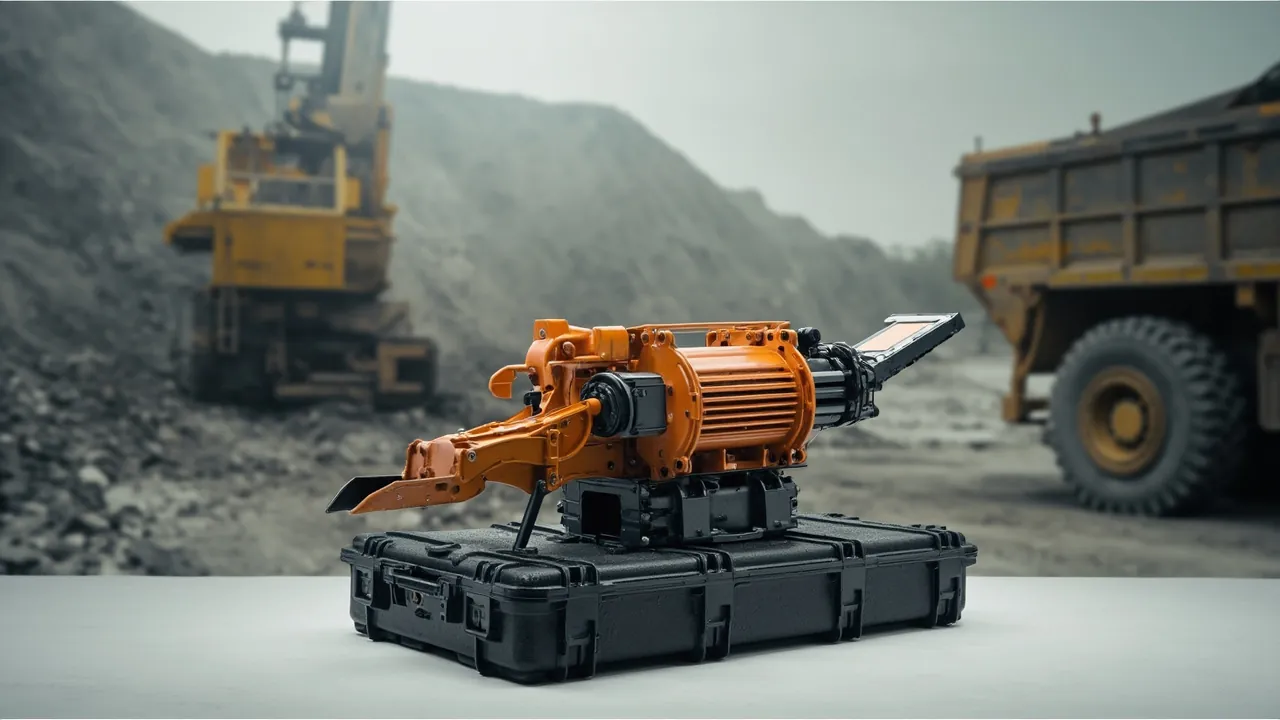
The purpose of a mining equipment parts case is not to hold a spare part, it is to deliver that part with its fit dimensions, cleanliness and assembly performance intact after thousands of kilometres of mine-haul road, rail and ocean freight. Mining spares fail in a very specific way: the goods-in inspection passes, and the failure appears shortly after installation. A crusher liner shows bolt loosening and uneven wear within weeks. An idler develops bearing noise after a few hundred hours. A hydraulic cylinder starts bypassing internally after a handful of cycles. A screen panel tears early because tension was never uniform. In the overwhelming majority of these cases the root cause is not the manufacturing quality of the part. It is latent damage introduced by transport and storage: micro-indentations on mating faces, damaged threads, scored sealing surfaces, and dust or metal swarf that entered the package.
The mining environment imposes packaging requirements that differ fundamentally from those of general industrial spares. First, dust concentration is extreme. Crushers, screens and transfer points generate fine, highly abrasive mineral dust. Once inside a case, that dust becomes a grinding medium, worked back and forth by vibration until precision mating surfaces are destroyed. Second, vibration and impact energy are high. Heavy mining equipment already operates under severe vibration; the haul road leg extends that severity to the packaging. Third, wet and dry thermal cycling is frequent. An open stockyard can swing more than 20 degrees Celsius between day and night, so the air inside a case repeatedly reaches its dew point, accelerating both rust on steel and ageing of elastomers. Fourth, the chain is long and dispersed. Mining spares typically move between the manufacturer, a distributor, a central mine warehouse and a workshop spares cabinet, and every opening, counting and repacking step is another exposure.
This article is written for procurement and logistics engineers at mining equipment manufacturers, mine site materials and equipment departments, mining machinery spare parts traders and exporters, and third-party maintenance service providers. It covers crusher components, screening and feeding components, conveyor belt, idler and pulley components, gearbox and drive components, and hydraulic and lubrication components. It includes failure modes, retention and partition design, dust sealing and humidity control, standards references, selection tables, a packing standard operating procedure and goods-in verification methods. All figures given are industry-typical or empirical ranges; drawings, technical conditions and destination regulations always take precedence. JUNZHJIA provides part-specific partitioned insert design, heavy-part retention structures, sealed dust-control and humidity-control configurations, and OEM/ODM support with inspection documentation for mining spares.
Table of Contents
- 1. Why mining spares cannot use generic wooden crates
- 2. Category map and failure-mode comparison
- 3. Crusher components: jaw plates, cone liners, hammers and rotors
- 4. Screening and feeding components: screens, exciters and support springs
- 5. Conveyor components: belts, splices, idlers and pulleys
- 6. Gearboxes and drive components: gears, shafts and couplings
- 7. Hydraulic and lubrication components: ISO 4406 cleanliness and port capping
- 8. Sealing for high-dust environments: IP6X, IEC 60529 and GB/T 4208
- 9. Heavy-load and impact protection: cradles, retention and lifting
- 10. Corrosion, moisture and condensation control in wet and saline conditions
- 11. Partition inserts and material selection
- 12. Transport test references: ISTA, GB/T 4857, ASTM D4169 and MIL-STD-810H
- 13. Packing standard operating procedure and goods-in verification
- 14. Procurement evaluation and the OEM/ODM customisation path
- Frequently Asked Questions
- Conclusion & Related Reading
1. Why mining spares cannot use generic wooden crates
In many mine sites, spare parts still travel in the classic combination of a wooden crate, straw and wire. For short distances, low-value items and non-precision parts this can be tolerated. Applied to crusher liners, idlers, gearboxes and hydraulic components, it fails quickly and expensively.
The first reason is that the failure is invisible. A large share of mining spare parts damage falls into the category of "looks perfect, no longer performs". Rolling bearings and gear teeth are the classic examples. A single axial impact can leave a micrometre-scale indentation on a raceway or a tooth flank. During packing inspection the part turns smoothly and clearance measures normal; the first hours of operation are also normal. But the indentation concentrates stress locally, and after a period of running it initiates spalling, pitting, and rising noise, vibration and temperature. Alloy liner plates behave the same way at their mounting holes, tapers and keyways: a tiny burr at a hole edge changes the effective tightening torque, and the part loosens in service.
The second reason is that cleanliness loss is irreversible. Mineral dust in mining is dominated by hard minerals such as quartz and feldspar, with Mohs hardness in the 6 to 7 range. Once such a particle enters a hydraulic circuit or a bearing cavity it stops being "contamination" and becomes "abrasive". Hydraulic clearances are measured in micrometres, so a single particle can cause sticking, internal leakage or spool wear. In a bearing cavity, hard particles destroy the raceway within a short operating window. Packing materials that shed fibres or particles, loose fasteners and washers inside the case, and open-air unpacking at the mine site all introduce this contamination directly.
The third reason is weight and centre of gravity. Mining spares are heavy. Jaw plates, cone liners, large gears and pulleys routinely weigh from tens to hundreds of kilograms each. How a heavy part is restrained inside the case determines whether the package succeeds. If it is merely wedged with filler, vibration gradually walks it across the case until it strikes a wall. If it is supported from below but not restrained laterally and vertically, emergency braking or a drop will make it jump and land again, producing a second impact. The heavier the part, the more retention design matters relative to cushioning design.
The fourth reason is transit duration and chain length. A typical mining spare follows this route: factory, road, port, ocean freight of 15 to 45 days, destination port, mine haul road that is often unpaved, open stockyard, workshop spares store. The longer the chain, the greater the accumulated vibration time, the more wet-dry cycles, and the more the packaging materials degrade. In practice, the ocean-freight leg usually causes more real damage to mining spares than any single transport impact.
A field observation worth repeating: among goods-in complaints for mining spares, "cosmetically perfect but failed early in service" is generally more common than "visibly damaged". The design objective should therefore move from damage prevention to performance-degradation prevention, and the acceptance criteria should move from appearance to geometry, cleanliness and function.
Once these four points are understood, it becomes clear why mining spare parts cases need custom inserts, partitions, retention and humidity control. These are not premium options. They are the minimum configuration for this category. The underlying principles are covered in shock-absorbing case design logic and cushion liner and case base plate coordination.
2. Category map and failure-mode comparison
Mining spares span an enormous range, from multi-tonne crusher frames to seals weighing a few grams. The table below maps typical weight class, primary weak points, dominant failure modes and preferred protection measures by category, and can serve as the starting point for a packaging specification.
| Category | Typical weight class | Primary weak points | Dominant failure mode | Preferred protection |
|---|---|---|---|---|
| --- | --- | --- | --- | --- |
| Jaw plates and jaw crusher teeth | Heavy (tens to hundreds of kg) | Tooth faces, mounting holes, backing face | Chipped teeth, hole burrs, backing deformation | Load cradle plus tooth-face isolation plus lifting points |
| Cone crusher mantle and bowl liner | Heavy | Taper face, locating shoulder | Taper scoring, shoulder deformation | Taper protector plus vertical cradle plus retention |
| Hammers and rotor assemblies | Medium to heavy | Striking face, pin holes, rotor journals | Striking-face chipping, pin-hole deformation | Individual compartments plus pin-hole caps plus axial retention |
| Screens and screen panels | Light to medium | Mesh tension, frame flatness | Mesh collapse, frame distortion | Flat stacking, layer dividers, no top loading |
| Exciters and vibrating motors | Medium | Bearings, eccentric weights, terminal box | Bearing micro-indentation, weight displacement | Axial retention plus electrical protection plus humidity control |
| Support springs and rubber springs | Medium | Free height, rubber body | Permanent set, rubber ageing | Vertical storage, away from light and heat |
| Conveyor idlers | Medium | Shell surface, bearing cavity, seals | Shell dents, bearing contamination, seal failure | Individual cradles plus shaft-end caps plus dust exclusion |
| Conveyor pulleys | Heavy | Shell, bearing seats, shaft keyways | Shell dents, bearing-seat scoring | Dedicated cradle plus shaft-end caps plus keyway guards |
| Conveyor belting and splice materials | Heavy (coiled) | Belt surface, steel cord, splice rubber | Surface scoring, cord moisture, expired compound | Mandrel coiling plus moisture barrier plus shelf-life control |
| Gearboxes and gears | Heavy | Tooth flanks, bearing bores, joint faces | Tooth indentation, bore distortion | Load cradle plus joint-face plates plus rust prevention |
| Shafts and couplings | Heavy | Journals, keyways, splines | Scoring, keyway burrs, bending | Journal protectors plus multi-point support plus anti-bend |
| Hydraulic cylinders and pumps | Medium | Rod, bore, ports | Rod scoring, port contamination | Rod sleeve plus port plugs plus clean packaging |
| Hydraulic valves and fittings | Light to medium | Spool and seat, port threads | Sticking, internal leakage, thread damage | Individual compartments plus port capping plus humidity control |
| Lubrication components and filters | Light | Media, sealing face, ports | Media moisture, sealing-face contamination | Sealed packaging, away from light, shelf-life control |
| Fasteners and pins | Light | Threads, mating faces | Thread damage, mixing of part numbers | Compartmented trays plus labelling plus weight verification |
Two rules emerge from this table. The first is that heavy parts are protected by structure while light parts are protected by partitioning. Heavy items such as liners, pulleys, gears and shafts depend mainly on load cradles, retention structures and lifting provisions. Light items such as valves, filters, seals and fasteners depend mainly on individual compartments, clean packaging and part-number control. The second rule is that metal parts are protected by rust prevention while elastomer parts are protected by shelf-life control. The long-term risk for metal parts is corrosion and salt attack; the long-term risk for rubber springs, seals and belt splice compounds is ageing and permanent set. Both must be addressed explicitly rather than being buried under the "anti-vibration" headline.
A note on terminology and specification. In real projects the terms mining equipment case, crusher parts case, conveyor component case, mining spare parts box and mine parts case are used interchangeably, and buyers often simply write "spare parts case" in an enquiry. Yet the structural and protection requirements differ substantially. A crusher parts case for jaw plates and cone liners must be built around a load cradle and taper protection. A conveyor component case for idlers and pulleys must be built around bearing-cavity dust exclusion and shaft-end protection. A mine parts case for hydraulic pumps and valves must be built around cleanliness and port capping. If an enquiry gives only the generic term "spare parts case", the supplier can only quote a generic solution, and the outcome is usually either over-design or under-protection. Buyers should specify category, weight and cleanliness class by part-number family in the enquiry and technical agreement.
3. Crusher components: jaw plates, cone liners, hammers and rotors
Crushers are the first stage of ore processing, and their parts are the heaviest and most frequently replaced in a mine. Different crushing principles demand entirely different protection priorities.
Jaw crusher jaw plates. Jaw plate failure is caused by tooth-face wear, which means the tooth face must never be struck during transit. Once a tooth crest has been flattened, the product size distribution changes immediately and closed-side-setting adjustment loses accuracy. Three packing requirements follow. First, tooth faces must not be stacked directly against one another, because crest-to-crest contact creates localised point loads; use dividers or compliant interlayers. Second, the backing face must stay flat, since any indentation prevents proper seating against the jaw stock and creates local stress concentration. Third, mounting holes need edge protection, because hole-edge burrs distort the effective preload of the fixing bolts. Jaw plates are heavy items and require a load cradle matched to the lifting holes plus separate retention blocks that constrain horizontal movement.
Cone crusher mantles and bowl liners. These are taper-fit components in which the taper and the locating shoulder are the assembly datum. Any taper damage causes eccentricity, which in turn loads the main shaft abnormally and raises oil temperature. The correct approach is to fit a compliant taper protector, to carry the part on a vertical cradle so the taper surface is not load bearing, to protect the shoulder with a ring guard, and to restrain axial movement inside the case. Because a cone liner can weigh several hundred kilograms, the case base plate must be checked for load capacity and lifting points must be clearly marked.
Hammers, blow bars and rotor assemblies for hammer and impact crushers. The striking face is a wear surface, so transit contact does not shorten wear life directly, but it does disturb dynamic balance. For a high-speed rotor, a few grams of eccentricity is enough to produce noticeable vibration. Hammers and blow bars should therefore be compartmentalised in matched sets, weighed for balance and numbered. Rotor journals require protective sleeves, and pin holes should be capped against dust and swarf ingress.
Frames and bearing housings. Crusher frames and bearing housings are large castings or weldments, and the protection focus is the joint face and the bearing bore. Joint-face damage causes oil leakage and reduces structural stiffness after assembly. Bearing-bore scoring changes the fit condition of the bearing outer ring. These items are usually shipped in timber crates with structural supports, but support points must land on structurally rigid areas and must never press on a machined surface.
Insert concepts for crusher spares are described in the custom foam insert design guide and in EVA foam insert custom process, which cover form-taking and partitioning methods.
4. Screening and feeding components: screens, exciters and support springs
Screening and feeding equipment operates in the most vibration-intensive part of a processing plant, and the protection difficulty of its spares is routinely underestimated.
Screens and screen panels. Woven wire screens, polyurethane panels and rubber panels all fail at mesh tension and frame flatness. Once woven mesh has been locally crushed, tension is no longer uniform after installation and early tearing follows. Polyurethane panels that have been heavily compressed distort their apertures and lose screening efficiency. Packing requirements are flat placement, separate layers, interlayer dividers and no top loading. Coiled screen mesh should be wound on a mandrel and kept above the minimum permissible bend radius. Polyurethane and rubber panels must also be kept away from oils and solvents and managed against a shelf-life limit.
Exciters and vibrating motors. Internally, these are precision bearing assemblies, and any transit shock leaves a mark on the raceway. Replacing exciter bearings is extremely expensive. Protection requirements are individual compartments, axial retention, avoidance of radial point contact, and leaving the factory rust-preventive packaging intact. Units with terminal boxes need dust and moisture protection at the box and cable entry. Eccentric weights should be marked and locked so that they cannot shift and change the unbalance moment.
Support springs and rubber springs. Helical steel springs fail through free-height change and permanent set; rubber springs fail through ageing and permanent compression set. Both should be stored vertically, kept free of sustained compressive load, and protected from light and heat. Shelf-life control of rubber items matters more than most buyers expect. A rubber spring that has sat in a warehouse for a year may already show a measurable stiffness shift, so goods-in verification should confirm the production date and enforce first-in-first-out.
Feeder pans and liners. Feeder liner protection follows the same logic as jaw plates: isolate the wear face and protect the mounting holes. Apron feeder chain links and pins are mating components and should be packed and numbered by section so that they can be assembled in sequence on site.
5. Conveyor components: belts, splices, idlers and pulleys
Belt conveyors are the arterial system of a mine, and their spares are numerous, high-turnover and usually the largest single block of site inventory.
Idlers. Idlers are the highest-volume, lowest-unit-cost and most under-appreciated conveyor spare. The core issue is the cleanliness and sealing of the bearing cavity. A dented shell produces a periodic vibration in service that accelerates bearing failure. Dust entering the bearing cavity contaminates the grease and shortens life dramatically. Packing requirements are individual cradles with one recess per idler, protective caps on shaft ends, and no shell-to-shell contact. For high-dust positions such as transfer points, specify idlers with multiple labyrinth seals and add desiccant inside the case.
Pulleys. Pulleys are heavy items, and three features matter: the shell, the bearing seats and the shaft keyway. Shell dents cause belt mistracking and localised belt wear. Bearing-seat scoring changes the fit condition. Keyway burrs make assembly difficult. The correct approach is a dedicated cradle supporting the shaft adjacent to the bearing seats, protective caps on shaft ends, keyway guards, and compliant wrapping of the shell. Heavy pulleys also need wedge-shaped chocks to prevent rolling inside the case.
Conveyor belting and splice materials. Belting is often shipped coiled, and for steel-cord belting moisture reaching the cord layer causes cord corrosion, a particularly insidious failure mode. Coils should be wrapped in a moisture barrier with desiccant added. Splice rubber compounds, uncured splice strips and cements have a defined shelf life and must be kept dark, cool and sealed with clear shelf-life labelling. Vulcanising equipment such as presses and heating platens must be protected at the electrical enclosure and the platen face flatness.
Standards reference for belt conveyors. The general technical requirements for belt conveyors and their components are normally based on the GB/T 10595 series for belt conveyors. Idler sealing and life testing, and pulley static balancing requirements, are specified within that standard family and the standards it references. The packaging specification should align with the machine technical conditions rather than inventing a separate framework. If the standard imposes requirements on idler rotational resistance and sealing performance, the packaging must guarantee that both survive intact on arrival.
6. Gearboxes and drive components: gears, shafts and couplings
Mining gearboxes transmit high power at high ratios, their spares are expensive, and they are extremely sensitive to cleanliness and fit accuracy.
Gears and gear shafts. The tooth flank is the functional surface, and any indentation becomes a pitting initiation site that propagates under alternating load into spalling. Packing requirements: tooth flanks must not contact hard materials directly, must not be stacked in mesh with one another, and must never be secured with wire across the flank. Gear shafts should be supported horizontally at the journals so that unsupported spans cannot bend. Large carburised and hardened gears also need edge protection to prevent corner chipping from metal-to-metal contact.
Gearbox housings. The joint face and bearing bores are assembly datums. Joint-face damage causes oil leakage that is very difficult to repair in the field. Bearing-bore scoring degrades the outer-ring fit. These items must be packed with a joint-face protection plate and with caps over the bores.
Shafts, pins and couplings. Journals and splines are mating surfaces and require protective sleeves. Keyways require guards. Long shafts must be supported at multiple points to prevent bending and flexure during transport. Coupling elastomers such as spider elements and disc packs are deformation-sensitive and should be packed separately.
Rust prevention for drive components. A mining spare may sit in a warehouse for many months or more than a year between manufacture and installation. Gears, shafts and bearing seats therefore need long-term rust prevention, with desiccant and a humidity indicator card inside the case. For how cushioning components should interact with the case structure, see cushion liner and case base plate coordination and case sealing and shock structure design.
7. Hydraulic and lubrication components: ISO 4406 cleanliness and port capping
Hydraulic systems on mining equipment operate at high pressure, high flow and in a heavily contaminated environment, so hydraulic spares have a protection metric that mechanical parts do not have: cleanliness.
Why cleanliness is a hard metric. The International Organization for Standardization defines solid particle contamination classes for hydraulic fluid in ISO 4406, using three code numbers that correspond to concentrations of particles larger than 4 micrometres, larger than 6 micrometres and larger than 14 micrometres respectively. Mining hydraulic systems are normally required to hold working fluid at a relatively strict cleanliness range, with the exact class defined by the equipment manufacturer's technical conditions. The logic is straightforward: if components introduce particles during transport and assembly, even the best filter can only intercept them passively, and the achieved system cleanliness class will be worse than specified. Controlling particle ingress at the packaging stage therefore costs far less than correcting it at the system stage.
Hydraulic cylinders. The three critical features are the piston rod with its plating and surface roughness, the honed cylinder bore, and the ports. Rod scoring destroys the plating and damages the seal, and it is the most common goods-in defect on hydraulic cylinders. Packing requirements are a rod sleeve, port plugs, horizontal support of the body, and no contact with other metal parts. If the cylinder must travel with the rod extended, the sleeve must be stiff enough to prevent both impact and bending.
Hydraulic pumps and motors. Clearances in these units are measured in micrometres and they are highly contamination-sensitive. Requirements: inlet and outlet ports must be plugged, the shaft extension must have a protective sleeve, the housing must not carry load, and the factory packaging should not be opened. Keyways on piston pump and motor shafts also need guards. On variable-displacement pumps, the control mechanism such as a servo valve or stroking cylinder is usually exposed and fragile and should have its own protective cover.
Hydraulic valves, lines and fittings. Spool and seat fits are extremely precise, and a single particle can cause sticking or internal leakage. All ports and connections must be plugged. Tube and hose assemblies must not be bent below their minimum bend radius, and tube ends need protective caps. Threaded connections require thread protection, because a damaged thread under high pressure is a direct leak path.
Lubrication components and filters. Filter media are sensitive to moisture and compression and should be sealed and not stacked under load. Central lubrication system dividers are precision items and need individual compartments. Lubrication pump and drum connections must be capped so that oil cannot escape in transit and contaminate other parts in the same case.
8. Sealing for high-dust environments: IP6X, IEC 60529 and GB/T 4208
Mining presents one of the harshest dust environments in industry. Protection class selection must therefore start from dust exclusion as the first priority rather than defaulting to a waterproof mindset.
Reading an IP code correctly. Ingress protection ratings are defined by IEC 60529, with the corresponding Chinese standard GB/T 4208, the IP code standard for enclosure protection. The first digit indicates protection against solid foreign objects and dust; the second digit indicates protection against water. In a dust environment the first digit is the decisive one.
| IP code | Dust meaning | Suitability for mining spare parts cases |
|---|---|---|
| --- | --- | --- |
| IP5X | Dust protected: dust ingress is not fully prevented but is limited so that it does not interfere with operation | General dust environments, short-haul transport and indoor storage |
| IP6X | Dust tight: no dust ingress | High-concentration mineral dust, long road and ocean freight chains |
| IP65 | Dust tight plus protection against water jets | Standard choice for open mine stockyards and wet loading |
| IP67 | Dust tight plus protection against temporary immersion | Chains involving water crossings, heavy rain or extreme humidity |
The key conclusion for mining applications is that the first digit must be 6, that is IP6X. A rating such as IPX4 or IPX5 with no dust digit carries almost no meaning for mining spares, because the destructive agent is dust, not water.
Three lines of defence for achieving IP6X. The first is the gasket: a continuous full-perimeter foam or solid seal, with corners either moulded or properly butt-joined rather than left open. Gasket compression must be designed within a sensible range, because too little sealing leaks and too much makes the case hard to close and permanently deforms the gasket. The second is pressure equalisation: a fully sealed case develops an internal-to-external pressure differential as temperature changes, which can suck the gasket out of position or even defeat the seal, so a pressure equalisation valve should be fitted to let air exchange through an oleophobic, dust-blocking membrane while particles cannot pass. The third is structural sealing: latch, hinge and handle interfaces should avoid forming a straight-through path into the case interior; the relevant structural details are covered in case hinge, latch and seal systems.
A frequently overlooked detail: the unpacking operation itself. Even a case that genuinely achieves IP6X will lose internal cleanliness if it is opened in an open mine yard. The operating procedure for mining spare parts cases should therefore include an unpacking environment requirement. Wherever conditions allow, opening should be moved into a closed or semi-enclosed spares store, and any part not immediately installed should be returned to the case or covered with a clean drape.
9. Heavy-load and impact protection: cradles, retention and lifting
Heavy components are the hardest case design problem in mining, because weight compresses the available design space for cushioning almost to zero.
Load cradles. The weight of a heavy part must be transferred to the case floor and pallet through structural members, not through cushioning material. The usual approach is a load cradle shaped to the part, made from timber, laminated plywood or engineering polymer, bolted or keyed to the case floor. The cradle provides load carrying and location; the cushioning material provides isolation and damping. The two are not interchangeable.
Retention design. Retention constrains movement in three axes. Horizontally, use blocks or wedges. Vertically, use clamp plates or straps, and straps must pass over rigid features and never across a machined surface. Cylindrical parts such as pulleys, idlers and shafts require anti-roll provisions. Parts with a high centre of gravity should be stabilised either by lowering the centre of gravity or by widening the base footprint.
Lifting and handling. Heavy-part cases must define lifting points and forklift access. Lifting holes or lugs must align with the centre of gravity so the case does not tilt during the lift. Fork pockets should be provided and marked. The case exterior should carry centre-of-gravity, this-way-up and stacking-limit markings. These markings are not decoration; they are a direct means of reducing handling damage.
Stacking and container loading. Stacking loads inside an ocean container are routinely underestimated. In practice, if cases are stacked more than three high, the bottom case can carry several hundred kilograms of static load, and side walls can bulge or collapse. The stacking limit should be stated at the design stage, and stiffening ribs or steel strapping added where necessary.
10. Corrosion, moisture and condensation control in wet and saline conditions
Over a long transport chain, corrosion is the second major risk alongside vibration.
Condensation is the dominant moisture mechanism. When a case moves through a region with a large day-night temperature swing, the air inside reaches its dew point at night and water condenses on metal surfaces. This breathing effect causes more corrosion than direct rain ingress, and it is harder to prevent. Countermeasures include a pressure equalisation valve to reduce moist air exchange, sufficient desiccant inside the case, and a humidity indicator card so that moisture exposure can be assessed on arrival.
Desiccant quantity and replacement. The required quantity depends on case volume, sealing class, transit duration and route climate. The practical method is to estimate from internal volume and expected transit days and then add a safety margin. For ocean chains longer than 30 days, use high-capacity desiccant and arrange it in two layers. If the desiccant is saturated or the indicator card has changed colour on arrival, replace it immediately and inspect the parts for corrosion.
A layered rust-prevention strategy. Rust prevention should be layered: factory oil or film as the first layer, inner packaging such as vapour-phase inhibitor film or paper as the second, and in-case humidity control as the third. No layer should be removed casually. A common site error is opening the rust-preventive packaging for convenience during inspection and then putting it back loosely, which destroys the whole system.
Salt spray protection. Spares exported by sea, or stored in coastal mining regions, must be considered against salt-laden air. ISO 9227 neutral salt spray testing is a useful method for evaluating the corrosion resistance of metal parts and for selecting plating, coating or vapour-phase inhibitor schemes. The packaging itself should also be specified for salt exposure, for example by selecting corrosion-resistant or surface-treated hinges, latches and fasteners.
11. Partition inserts and material selection
The insert is the only interface between the part and the case, and its material selection determines both protection performance and packaging cost.
| Insert material | Density and hardness | Rebound and energy absorption | Processability | Typical application |
|---|---|---|---|---|
| --- | --- | --- | --- | --- |
| EVA | Medium density, wide hardness range | Good rebound, retains properties over repeated impacts | Easy to cut, easy to heat-form, supports complex form-taking | Precision parts, irregular shapes, returnable cases with long service life |
| PE (expanded polyethylene) | Low density, light | Good single-impact absorption, collapses under sustained load | Easy to laminate, low cost | Light-part dividers, surface protection, single-use inserts |
| XPE | Medium-low density, fine cell structure | Reasonable rebound, better weathering than PE | Easy to heat-form | Small and medium part compartments requiring some weather resistance |
| PU foam | Density adjustable, can be poured in place | Excellent energy absorption, fully conforms to irregular shapes | Requires tooling or on-site pouring | High-value irregular parts, close-fitting retention of heavy items |
| Rubber including EPDM | High density, good elasticity | Excellent vibration damping | Limited formability, usually used as pads | Heavy-part cradle padding, damping nodes |
The selection logic reduces to three statements. First, precision and irregular parts favour EVA or PU, because these materials can be formed to the part so that it is fully constrained while still providing good multi-impact rebound. Second, light parts used purely for partitioning favour PE or XPE, which are cheap and quick to process and entirely adequate. Third, heavy parts must not be carried by the insert; the weight belongs to the structural cradle, and the insert only isolates and damps.
Three common insert design errors. The first is "thicker is better". Excessive insert thickness wastes internal volume and, more importantly, fails to constrain the part because compression is insufficient; thickness should follow part weight, weak-point location and expected impact level. The second is full-contact form-taking with no clearance, which makes parts difficult to remove and prone to jamming; a sensible handling clearance is required. Third is ignoring handling convenience. Site staff prioritise speed, and an insert that is awkward to load will be simplified in practice, at which point the protection is nominal only. Material comparison methods are set out in case foam material comparison and removable divider systems.
A note on material fire performance. Mining spares and their packaging are often stored in quantity in underground chambers, shaft stations and closed stores, and these are confined spaces where fire risk cannot be ignored. UL94 is the widely used flammability test method for plastics, and a V-0 rating indicates that in the specified vertical burning test the specimen self-extinguishes within a short time after the ignition source is removed and does not produce dripping material. For insert materials that will be stored and opened in underground chambers or shaft stations, ask the supplier for UL94 test documentation where available, and record the material grade and burning class in the technical agreement so that it can be reconciled with site fire requirements.
12. Transport test references: ISTA, GB/T 4857, ASTM D4169 and MIL-STD-810H
A packaging specification earns credibility from test data, not from descriptive claims. The following test frameworks are commonly used for mining spare parts cases.
ISTA procedures. The International Safe Transit Association publishes a family of procedures covering simulation from single parcels to full vehicle loads. Their distinguishing feature is that they are built around real distribution chains, with procedures graded by transport mode and package weight, which makes them well suited to validating a package on a specific route. Export projects frequently require an ISTA procedure as the baseline packaging validation; see ISTA transport testing procedure explained.
The GB/T 4857 series. These Chinese standards define basic test methods for transport packages, including vibration, impact, drop, stacking and compression. This is the most commonly cited framework for domestic transport packaging validation and is appropriate for domestic routes and domestic project acceptance; see GB/T 4857 transport packaging testing essentials.
ASTM D4169. Published by ASTM International, this standard covers performance testing of shipping containers and systems and organises test sequences by distribution cycle. It emphasises combining tests according to the actual distribution stages and is frequently used for North American projects; see ASTM D4169 distribution cycle testing.
MIL-STD-810H, with an important non-military note. The methods in this standard, particularly vibration, shock, temperature and humidity, mould and salt fog, are widely used by industry as a methodological basis for environmental testing. It must be stated clearly that citing MIL-STD-810H means only that its test methods are adopted; it does not imply any military certification and does not place the product on any military list. For mining spare parts cases, the vibration and temperature-humidity cycle methods are typically borrowed to assess how well packaging retains its performance over a long chain.
Design principles for the test sequence. A single test, such as drop testing alone, is insufficient for mining spares packaging, because real damage is usually the superposition of vibration fatigue, impact and wet-dry cycling. The recommended sequence is: preconditioning at temperature and humidity, random vibration, shock or drop, vibration again, then unpacking inspection and functional verification. Acceptance criteria should cover three layers: packaging integrity, part geometry and appearance, and part function and cleanliness.
Reminder: every test conclusion is bound to a specific packaging configuration, payload weight and set of test parameters. A "passed testing" statement without those parameters has no engineering meaning, which is exactly why test conditions must be recorded in the acceptance file.
13. Packing standard operating procedure and goods-in verification
A recommended packing SOP is as follows:
- Part confirmation: verify part number, quantity, weight and factory packaging condition, and record whether the factory rust-preventive packaging is intact.
- Cleanliness check: confirm the part is free of dust, swarf and moisture; hydraulic ports must remain plugged.
- Weak-point marking: mark tooth faces, tapers, mating surfaces and piston rods as areas that must not carry load, following the drawing or technical conditions.
- Cradle and insert assembly: install and secure the cradle first, then fit the insert, and confirm the recesses match the part.
- Part placement: place from bottom to top, heaviest to lightest; a heavy part must be fully restrained before the next part is added.
- Retention and fixing: constrain all three axes with blocks, clamp plates or straps, and keep straps off machined surfaces.
- Humidity control: add desiccant and a humidity indicator card, and record quantity and location.
- Closing and seal inspection: check gasket continuity and compression, and confirm hinge, latch and pressure equalisation valve condition.
- Marking and records: apply centre-of-gravity, this-way-up, keep-dry and stacking-limit markings, photograph the packed case and complete the packing record sheet.
- Lifting and dispatch: lift from the marked points and confirm the case is secured on the transport unit.
Goods-in verification should follow a three-layer criterion:
- Layer one, the package. Check for case deformation, gasket failure, humidity indicator colour change, desiccant saturation, and any sign of water or contaminant ingress.
- Layer two, appearance and geometry. Check tooth faces, tapers, mating surfaces, piston rods, threads and ports for impact damage, scoring and burrs. Sample-check critical dimensions such as taper roundness or flange flatness.
- Layer three, function and cleanliness. Check bearing rotation by sound, feel and clearance; check port contamination on hydraulic parts; check gear mesh; check elastomer hardness and appearance. Where necessary, apply a sampling plan; methods and acceptance rules are discussed in custom case acceptance and AQL sampling.
Claims and traceability. The packing record sheet should capture part number, packing date, packer, insert reference, desiccant quantity and photograph references. If latent damage is found on arrival, these records are the key evidence for allocating responsibility, and they also help the supplier locate the specific weak point in the packaging scheme.
14. Procurement evaluation and the OEM/ODM customisation path
A recommended procurement scorecard:
| Evaluation dimension | Key questions | Suggested weight |
|---|---|---|
| --- | --- | --- |
| Protection design capability | Can inserts be formed to the part? Has the supplier restrained comparable heavy items before? | High |
| Sealing and dust class | Is IP6X or IP67 stated explicitly? What is the gasket construction and corner treatment? | High |
| Material and structure | Case material, wall thickness, stiffening, load capacity of hinges and latches? | High |
| Humidity control package | Are desiccant sizing, humidity indicator cards and pressure equalisation valves offered? | Medium |
| Standards and documentation | Can IP and vibration test reports be provided? | Medium |
| Delivery and capacity | Lead time, batch consistency, tooling investment? | Medium |
| Service life and spares | Gasket replacement, wear-part supply, expected case service life? | Medium |
The OEM/ODM customisation path. For mining equipment manufacturers or mining groups with a stable spare parts range, the customisation route is recommended: the supplier first proposes a protection scheme and a sample case for a representative part-number family, and volume production follows only after validation. The value of customisation is not cosmetic; it converts packaging from a consumable into a reusable asset. A custom case with replaceable inserts can serve several maintenance cycles, and the total cost is usually lower than continuously consuming single-use timber crates. Factory selection and cost evaluation methods are covered in how to choose a protective case OEM factory and custom case mould cost analysis.
JUNZHJIA capability note. For mining and construction machinery applications, the manufacturer provides three categories of support. First, part-specific insert and cradle design: inserts can be formed from drawings or physical parts, and retention structures can be engineered for heavy items. Second, sealing and humidity-control configuration: gasket systems, pressure equalisation valves, desiccant and humidity indicator cards can be configured to IP6X or IP67 requirements. Third, OEM/ODM and documentation: branding, colour and marking can be customised, with supporting inspection documentation and packing work instructions. Note that the final scheme must follow the part drawing, weight distribution and destination regulations, and providing physical parts or 3D data at the design stage is strongly recommended so that inserts can be formed accurately.
Frequently Asked Questions
Q: Why can mining spares not simply travel in a wooden crate with straw? The equipment itself is robust, so is a dedicated case really necessary?
A: This is the most common misconception in mining spare parts procurement. The machine may be robust, but the acceptance criterion for a spare is not whether it runs, it is whether its fit accuracy and cleanliness survive. The wooden crate and straw approach fails in three ways. First, straw and wood shavings shed particles, and those particles act as hard abrasives once they reach a bearing cavity or a hydraulic circuit, which is far more damaging than ambient dust. Second, straw and timber provide no three-axis retention, so a jaw plate, pulley or liner weighing tens or hundreds of kilograms gradually walks across the case under vibration, eventually striking a wall or jumping and landing during emergency braking. Third, timber has poor moisture resistance, and on an ocean chain longer than 30 days the interior repeatedly condenses, sharply increasing the risk of corrosion at bearing seats and mating faces. The correct approach is a dedicated case with a structural cradle, partitioned inserts and a sealed dust-control and humidity-control configuration, which shifts the objective from damage prevention to performance-degradation prevention.
Q: Mine dust is severe. How should the IP rating be selected? Is it enough to look at the water rating only?
A: No, and in mining applications looking only at water protection is a classic specification error. Ingress protection is defined by IEC 60529, with GB/T 4208 as the corresponding Chinese standard. The first digit covers solid foreign objects and dust, and the second covers water. The real threat to mining spares is mineral dust: hard particles such as quartz reach Mohs hardness 6 to 7 and act as abrasives once inside a mating surface. The first digit must therefore be 6, that is IP6X dust tight. IP65 suits open mine stockyards and wet loading, while IP67 suits chains involving water crossings or extreme humidity. If a supplier quotes only IPX4 or IPX5 with no dust digit, that packaging offers effectively no protection for mining spares. Also note that even a genuinely IP6X case loses internal cleanliness if it is opened outdoors, so the operating procedure must include an unpacking environment requirement.
Q: For heavy castings such as jaw plates and cone liners, what matters more, cushioning or retention?
A: For heavy castings, retention matters far more than cushioning. The reason is straightforward: once a component weighs tens or hundreds of kilograms, the energy that cushioning material can absorb at a practical compression is limited, while the inertia of the part generates displacement forces far beyond cushioning capacity under vibration and braking. If retention is insufficient, the part moves repeatedly and strikes the case wall, and the cushioning layer itself collapses under repeated compression and fails quickly. The correct order is structure first, cushioning second. Step one, use a load cradle matched to the lifting holes so weight transfers to the case floor and pallet. Step two, constrain all three axes with blocks, wedges and clamp plates. Step three, only then add compliant isolation between part and insert, and between insert and case. Straps must pass over rigid features and never across tooth faces, tapers or machined surfaces, because the strap itself then becomes a damage source.
Q: Conveyor idlers look robust. Why do they need individual cradled packing?
A: An idler looks like a simple cylinder, but inside it is a precision bearing assembly with a sealing system, and the overwhelming majority of idler failures come from bearing-cavity contamination and shell out-of-roundness. Individual cradled packing solves three specific problems. First, it prevents shell-to-shell rubbing and denting; once a shell loses roundness it generates periodic vibration in service, and that vibration continuously accelerates bearing damage. Second, it prevents shaft ends from being struck, which would deform the shaft or score the bearing seat. Third, it gives each idler its own local dry environment, so the desiccant in the case works more effectively. Given that idlers are the highest-volume spare in most mine inventories, a reusable custom case with replaceable inserts usually costs less across multiple cycles than single-use packaging, which is why several mining groups are moving in that direction. A practical test is to compare three years of total packaging spend, including disposal and damage-driven downtime, against the one-off cost of a returnable case programme.
Q: What exactly is hydraulic cleanliness, and how can packaging affect it?
A: Hydraulic cleanliness is normally expressed as the solid particle contamination class defined in ISO 4406, which uses three codes corresponding to concentrations of particles larger than 4, 6 and 14 micrometres. Mining hydraulic systems require relatively strict fluid cleanliness, with the exact class set by the equipment manufacturer's technical conditions. Packaging affects cleanliness because particle ingress happens mainly before assembly: dust and swarf inside the case, removed port plugs, scored piston rods and threads, and ambient dust during open-air unpacking all introduce contamination before the part ever reaches the system. Filters can only passively intercept particles that are already in the circuit; they cannot undo contamination introduced during assembly. For cylinders, pumps, motors and valves, the full chain must therefore be maintained: port plugs, rod sleeves, clean inner packaging and clean unpacking. It is also worth recording the cleanliness class actually achieved at goods-in, because that single figure tells you whether the packaging scheme is working or merely present.
Q: A mining spare may sit in storage for more than a year between manufacture and installation. How should the packaging account for that?
A: Long storage shifts the packaging priority from anti-vibration to corrosion prevention, ageing prevention and deformation prevention. Four measures are recommended. First, rust prevention should be layered: factory oil or film as layer one, vapour-phase inhibitor film or paper as layer two, and in-case humidity control as layer three, with no layer removed early. Second, humidity control must be sustainable: fit sufficient desiccant and a humidity indicator card and establish a periodic inspection and replacement regime, because saturated desiccant stops working. Third, elastomers need separate management: support springs, rubber screen panels, seals and belt splice compounds all have ageing or shelf-life limits, so keep them dark, cool and flat, and maintain a shelf-life register with first-in-first-out. Fourth, heavy parts need creep and set prevention: support long shafts horizontally at multiple points, and store rubber springs vertically without sustained compressive load. A simple quarterly walk-round of the store, checking indicator cards and rubber dates, catches most long-storage problems before they reach the maintenance window.
Q: How can a packaging scheme be validated? Is drop testing alone sufficient?
A: No. Real damage is usually the superposition of vibration fatigue, impact and wet-dry cycling, and a single drop test only validates the impact stage. The recommended sequence is preconditioning at temperature and humidity, random vibration, shock or drop, random vibration again, then unpacking inspection and functional verification. Test references include the ISTA procedures, which are built around real distribution chains; the GB/T 4857 series, which defines basic transport package test methods; ASTM D4169, which combines tests by distribution cycle; and the vibration and temperature-humidity methods borrowed from MIL-STD-810H as a methodological basis. It must be stated clearly that citing MIL-STD-810H means only that its methods are used and does not imply any military certification. Acceptance criteria should cover packaging integrity, part geometry and appearance, and part function and cleanliness. Every conclusion is bound to a specific configuration and payload, and a "passed" statement without parameters has no engineering value. The most useful output of a test programme is not a pass certificate but a short list of weak points that the next design revision will fix.
Q: Can mining spare parts cases be reused, and how is that costed?
A: Yes, and for mine sites it is often the more economical option. Single-use timber crates appear cheap per unit, but a fair comparison includes crate purchase, filler material, on-site disposal, which is not inexpensive at a mine, and the cost of spare parts damage and downtime caused by inadequate packaging. A custom case offers several advantages: the case itself serves multiple maintenance cycles, inserts can be replaced or reconfigured by category, and gaskets and hinges are replaceable wear items. Three factors should be assessed. First, the weather resistance of the case material and structure, especially UV and impact resistance during long open-yard storage. Second, repairability, meaning whether gaskets, hinges and latches can be replaced individually. Third, insert reconfigurability, meaning whether one case can carry different part-number families across batches. Service life assessment methods are covered in the site note on protective case service life and wear-part replacement. Buying on replacement-part availability rather than on the initial unit price is usually the decision that pays back.
Q: We buy crusher spares, idlers and hydraulic components together. How can packaging cost be controlled?
A: Control cost with a shared case platform plus category-specific inserts, rather than developing a separate case for every category. Use three tiers. Tier one, heavy parts: a custom case with a structural cradle, where the case size is set by the largest part and the lifting requirement, and cradles and retention blocks are made for specific part numbers. Tier two, small and medium precision parts such as exciters, hydraulic valves and couplings: a standard case platform with replaceable EVA inserts, so that insert form-taking adapts to different part numbers. Tier three, light and small parts such as seals, fasteners and filter elements: compartmented trays in standard returnable boxes, with the emphasis on labelling and quantity verification. All three tiers share the same sealing system, latches and lifting standards, which substantially reduces tooling investment. If an enquiry quotes only the generic term "spare parts case", the supplier can only offer a generic solution, and the result is usually under-protected heavy parts and over-designed light parts. Specify category, weight, cleanliness class and protection class by part-number family in the technical agreement.
Conclusion & Related Reading
Transport protection for mining equipment parts is fundamentally an engineering exercise in moving field failure risk upstream into the packaging stage. Whether a part is restrained, isolated and held in a dry, clean environment inside its case directly determines how long it will work once installed. For crusher liners and cone mantles, the priority is taper and mating-surface protection with heavy-load retention. For idlers and pulleys, it is bearing-cavity dust exclusion and shaft-end protection. For hydraulic and lubrication components, it is end-to-end control of ISO 4406 cleanliness. Across every category, the shared baseline is IP6X dust tightness, a reliable sealing system and sustainable humidity control.
The implementation path has four steps. First, map categories and failure modes by part-number family and separate heavy items from precision items. Second, fix the protection class and humidity-control scheme, specifying IP class, gasket construction and desiccant configuration. Third, validate by testing, using a combination drawn from ISTA, GB/T 4857, ASTM D4169 or MIL-STD-810H methods. Fourth, establish a packing SOP and goods-in acceptance criteria so that the scheme is actually executed on site. JUNZHJIA can support all four steps with part-specific insert and cradle design, sealing and humidity-control configuration, and OEM/ODM supply with inspection documentation.
Related Reading