

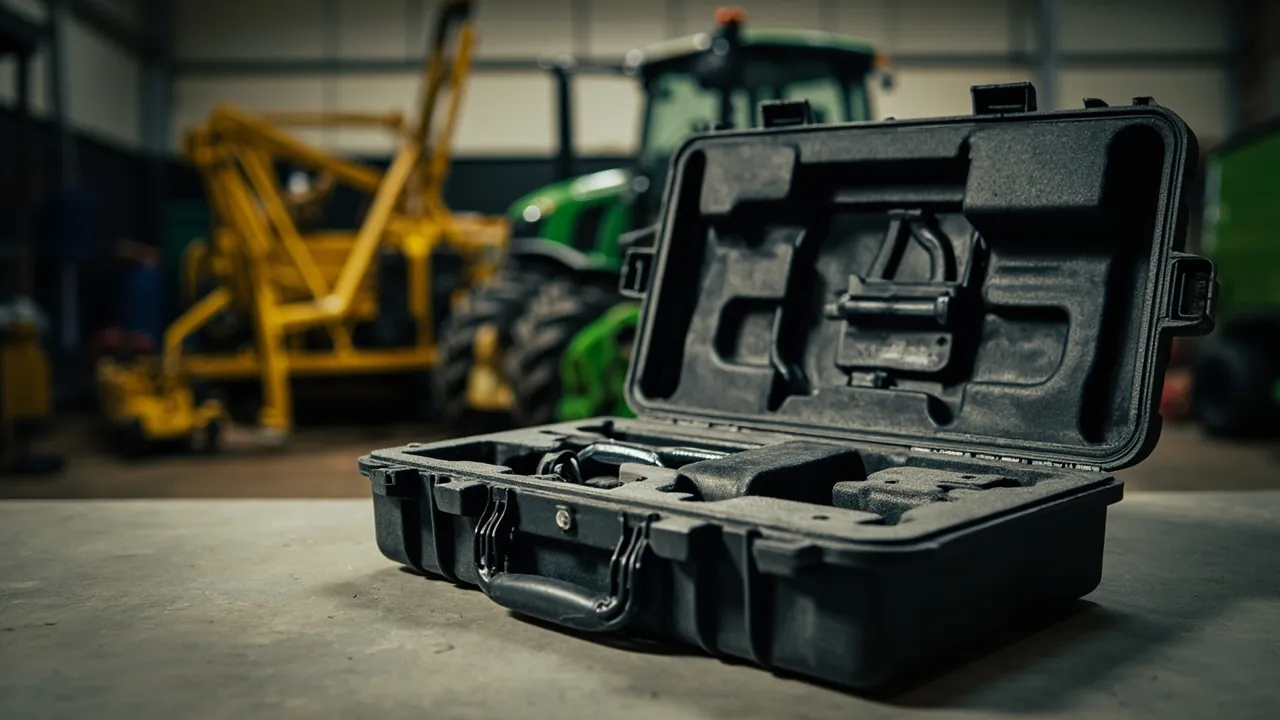
The real job of an agricultural machinery parts case is not to hold components. It is to keep every spare part in an install-ready condition across the entire chain from the central warehouse to the edge of the field. Tillage and harvest spares have two defining characteristics. First, they are mostly metal, closely toleranced, and worthless once corrosion pits or impact deformation set in. Second, they are consumed in remote locations where downtime is expensive, so a service truck is often changing parts in dust, rain, and wide day-night temperature swings. This is why moisture resistance, corrosion resistance, and vibration resistance, plus the on-site efficiency of identifying and retrieving the right part, are the primary performance metrics of an agricultural parts case - not wall thickness.
Many dealerships, cooperatives, and OEM parts departments buy on "how rigid is the box" alone, then discover a season later that a whole batch of bearing races is pitted, hydraulic seals have hardened, or ECU harness pins have oxidized. During harvest, the same team may lose half an hour digging for a single O-ring and burn an irreplaceable working window. This article walks through the engineering logic of agricultural machinery parts cases in the order of part type, failure mechanism, protective structure, standards basis, and selection parameters, and provides specification clauses, a size-class table, and an acceptance checklist you can paste into a purchasing agreement.
Table of Contents
- 1. Protection Goals for Agricultural Parts Cases: The Three Defenses and Install-Ready Condition
- 2. Types of Tillage and Harvest Spares and Their Weak Points
- 3. Case Materials and Structure: Working Backward from Field Conditions
- 4. Sealing and Ingress Protection: Reading IEC 60529 and GB/T 4208 in the Field
- 5. Moisture and Corrosion Control: Desiccants and Barrier Packaging
- 6. Vibration and Impact: Applying ISTA and the GB/T 4857 Series
- 7. Insert Design: Custom EVA and PE Compartments Around Part Geometry
- 8. Hydraulic Components and Seals: Starting from ISO 4413
- 9. Electronics and Sensors: ESD and Shielding Requirements
- 10. Temperature and UV: Accelerated Aging in Outdoor Storage
- 11. Pressure Equalization: The Hidden Risk in Cross-Climate Shipping
- 12. Size Classes and Load Selection: Working Backward from Trucks and Racking
- 13. Marking, Traceability, and Part-Number Integration
- 14. Reliability of Hinges, Latches, and Gaskets
- 15. OEM/ODM Customization and Sample Control
- 16. Acceptance, Inspection, and Life-Cycle Management
- Frequently Asked Questions
- Conclusion and Related Reading
1. Protection Goals for Agricultural Parts Cases: The Three Defenses and Install-Ready Condition
The logistics environment for agricultural spares is nothing like consumer electronics or medical devices. The typical path runs from an OEM or tier-one dealer central warehouse (climate controlled) to a regional depot (partially controlled), to a service truck or a temporary field staging point (fully exposed), and finally to the machine. Conditions degrade at every step, and the last step is the one that matters most, because downtime has already started and every extra hour is a direct operational loss.
Translated into engineering requirements, an agricultural parts case must satisfy four categories at once.
The first is moisture and corrosion control. Steel parts corrode noticeably faster once relative humidity exceeds roughly 60 percent and temperature swings create condensation. Ball bearings, hydraulic spool valves, chains, blade bolts, and springs are all highly sensitive. The countermeasure is a combination of case sealing, desiccant, and vapor corrosion inhibitor (VCI) packaging, not any single measure in isolation.
The second is vibration and impact resistance. Random vibration on field roads concentrates energy in the low-to-mid frequency band and produces sustained fretting wear on stacked parts. Handling drops deliver transient high acceleration that cracks thin-wall castings, aluminum components, and sensor ceramics. The answer is a captive insert with an elastic cushioning layer, not simply packing parts tightly.
The third is dust and splash protection. Dust entering a precision sliding surface causes immediate scoring, and rainwater ingress triggers secondary corrosion. The IP rating system defined by IEC 60529 and GB/T 4208 is the common language for quantifying this capability.
The fourth is operational efficiency. This is the most frequently ignored and the most consequential. Service truck space is limited, so cases must support layered configuration by machine model and work season and must allow visual identification, one-handed opening, and layer-by-layer retrieval. A case with an excellent ingress rating that requires removing three layers to reach a filter is a liability in the field.
Key judgement: a purchasing specification for agricultural parts cases should be written as two separate scenarios - central warehouse storage and service truck carry. The former prioritizes long-term corrosion protection and stacking strength; the latter prioritizes vibration resistance, portability, and fast retrieval.
Within this framework, JUNZHJIA supplies case solutions to the agricultural parts supply chain that treat a replaceable gasket, a custom compartmented insert, and a designated nameplate area as standard rather than optional. The same case can then serve as a storage unit and travel directly on the truck, which eliminates the repeated re-packing that happens when one box has to serve two roles.
2. Types of Tillage and Harvest Spares and Their Weak Points
Protection design has to start with classification. Classifying by failure mechanism rather than by part name is what makes the classification actionable.
Category one: precision rolling and sliding elements. Bearings, bearing housings, oil seals, bushings, guide rails, and injector nozzle assemblies. The dominant mechanisms are corrosion pitting, fretting wear, and particulate contamination. Even a small rust spot propagates into spalling under high-speed rotation. Sealing against ingress and a static protective oil film are the priorities.
Category two: hydraulic and fluid components. Pumps, multi-way valves, cylinder seal kits, quick couplers, filter elements, and hose assemblies. Hydraulic systems demand high cleanliness; the ISO 4406 cleanliness scale is extremely sensitive to particle contamination. A single grain of sand in a spool clearance can cause a stuck valve. Priorities are port capping, internal corrosion protection, and external dust exclusion. ISO 4413 provides the general framework for hydraulic system design and safety.
Category three: cutting and wear parts. Combine blades, guards, reel tines, rotary tiller blades, plough shares, and chains. The mechanism here is edge deformation and chipping - physical damage dominates. Compartmentalization, captive holding, and edge protectors are the answer.
Category four: electronics and sensors. ECUs, harnesses, speed sensors, grain flow sensors, header height sensors, and GNSS or autosteer antennas. Mechanisms are electrostatic discharge (ESD) damage, pin oxidation, and ceramic substrate cracking from shock. Priorities are ESD-safe inserts, moisture control, and low-acceleration restraint.
Category five: rubber and plastic parts. Belts, hoses, O-rings, and plastic covers. Mechanisms are ozone and UV aging, ozone cracking, and compression set. Priorities are shade, thermal separation, and avoiding compression in storage.
Category six: fasteners. Listed separately because they are the most likely to be mixed up and lost. Mechanisms are thread damage and specification cross-contamination. Compartments and specification labeling are the answer.
| Part category | Typical parts | Dominant failure mechanism | Key protective measure | Standards reference |
|---|---|---|---|---|
| --- | --- | --- | --- | --- |
| Precision rolling and sliding | Bearings, oil seals, bushings, nozzle assemblies | Corrosion pitting, fretting, particulate contamination | Sealing, VCI protection, captive insert | GB/T 4208, ISO 4406 (cleanliness context) |
| Hydraulic and fluid | Pumps, multi-way valves, filter elements, couplers | Particle ingress jamming spools, internal rust | Port caps, desiccant, anti-vibration compartments | ISO 4413, IEC 60529 |
| Cutting and wear | Blades, guards, tines, tiller blades | Edge deformation, chipping | Edge protectors, dedicated compartments | GB/T 4857, ISTA series |
| Electronics and sensors | ECUs, harnesses, sensors | ESD damage, pin oxidation, substrate cracking | ESD-safe insert, moisture control, low-acceleration restraint | IEC 61340 (ESD context), IEC 60529 |
| Rubber and plastic | Belts, hoses, O-rings | Ozone and UV aging, compression set | Shade, thermal separation, no compression | UL94 (material flammability context) |
| Fasteners | Bolts, washers, clamps | Thread damage, specification mixing | Compartments, labeling, counting units | GB/T 4857 |
The value of this table is that a single case often needs not one insert concept but a zone-based combination. In a 600 mm class case, the left zone might hold bearings and seals that need sealed corrosion protection, the center might hold hydraulic filter elements that need captive restraint, and the right might hold a fastener compartment tray with counting units. The three zones differ completely in insert density and material.
3. Case Materials and Structure: Working Backward from Field Conditions
Material choice has to satisfy impact resistance, low-temperature toughness, UV resistance, chemical resistance to diesel, hydraulic oil, fertilizer, and cleaning agents, and weight, all at once. The comparison logic follows.
Copolymer polypropylene (PP copolymer) is the most balanced option for agricultural use. Its low-temperature toughness exceeds ABS, so it is less prone to embrittlement below freezing. Chemical resistance is good against diesel, hydraulic oil, and most fertilizer solutions. Weather resistance improves substantially with UV stabilizers. The trade-off is slightly lower rigidity, which is compensated through ribs and wall thickness.
ABS and modified ABS offer better surface quality and rigidity, which suits storage units that need printed labeling and a clean appearance. Low-temperature impact performance requires blending modification; without it, a single drop during winter outdoor handling can crack the case.
Glass-fiber reinforced composites and thermoplastic composites such as glass-filled PP serve applications sensitive to weight, stiffness, and dimensional stability at the same time, for example long-term outdoor storage cabinets that must stack high. Cost is notably higher, so they typically appear at an OEM central warehouse rather than on a service truck.
Metal cases excel at puncture and crush resistance but carry high dead weight, chip easily at corners, and lose sealing once corners deform. On a service truck that loads and unloads frequently, those drawbacks usually outweigh the benefits.
Structure matters as much as material. Five points deserve scrutiny.
- Rib layout. Side walls and the base should carry continuous or cross-braced ribs so that large flat panels do not bulge under differential pressure.
- Lid-to-body interface. A continuous tongue-and-groove feature gives the gasket a defined compression space, rather than relying on latch tension alone.
- Hinge and latch attachment. Self-tapping screws driven directly into plastic should be avoided. Metal inserts, through-shafts, or integrally molded hinge bosses are preferred.
- Feet and stacking features. State the maximum stack height and whether side storage is permitted. Most sealed cases should not be stored on their side long term, because sustained side load takes a permanent set in the gasket.
- Handles and carrying features. Recessed or over-molded handles are preferable; protruding handles tend to be the first thing to fail in a drop.
Engineering note: treating wall thickness as the sole strength metric is a common purchasing error. At equal thickness, rib layout can influence stiffness more than thickness itself. A specification should state both loaded drop height and stacking height as verification requirements.
4. Sealing and Ingress Protection: Reading IEC 60529 and GB/T 4208 in the Field
IEC 60529 and GB/T 4208, the international and Chinese standards for degrees of protection provided by enclosures, are the basis for the IP code. For agricultural parts cases, the common targets are IP54, IP65, and IP67, and the selection logic is not "higher is always better."
IP54 means dust protected, with limited ingress that does not impair operation, plus splash water protection. It suits central warehouse storage, indoor transfer, and short-haul movement. Its advantage is that the case usually needs no pressure compensation, so opening resistance is low and cost is lower.
IP65 means dust tight and protected against water jets. It suits service truck carry, temporary outdoor staging, and washdown cleaning. For agricultural use, this is the most common balance point.
IP67 means dust tight and protected against temporary immersion, typically tested at 1 m depth for 30 minutes at ambient temperature. It suits cross-climate shipping, routes that may encounter flooded ground, or full-case washdown. It is important to note that IP67 usually implies a near-airtight enclosure, which creates a pressure differential across temperature or altitude changes.
| Target rating | Dust capability | Water capability | Typical application | Structural cost |
|---|---|---|---|---|
| --- | --- | --- | --- | --- |
| IP54 | Dust protected, limited ingress | Splash resistant | Central warehouse, indoor transfer, short haul | Low, simple structure |
| IP65 | Dust tight | Water jet resistant | Service truck, outdoor staging, washdown | Medium, continuous gasket required |
| IP67 | Dust tight | Temporary immersion | Cross-climate shipping, flooded routes, full washdown | Higher, pressure equalization usually required |
Sealing performance depends on three elements: a continuous gasket with no breaks, controlled compression, and a sufficiently rigid mating surface. Remove any one and you get a case that meets the rating on paper but leaks in practice. Acceptance should include a full-case mist or immersion test rather than a visual check of the gasket.
JUNZHJIA addresses this stage by supplying replaceable gasket specifications and recommended compression values per case model, and by providing third-party test documentation for sealing and ingress ratings when a project requires it, so that OEMs and dealers can reference it directly in technical agreements. The matching logic between gaskets, hinges, and latches is broken down further in Toolbox Hinge, Latch, and Gasket Selection.
5. Moisture and Corrosion Control: Desiccants and Barrier Packaging
A sealed case is not a dry case. A well-sealed case closed on a humid, rainy day traps that moisture inside and creates a stable high-humidity microclimate, which is one of the most common causes of bearing corrosion.
The correct approach is a three-layer progression.
Layer one: control the closing environment. Packaging should be performed in low-humidity conditions where possible, or with dry-air purge before closing. For high-value spares, record ambient temperature and humidity before sealing as batch documentation.
Layer two: barrier packaging. Precision parts should go into aluminum-laminate or high-barrier PE bags, vacuum or semi-vacuum sealed, combined with VCI paper or film. VCI works by slowly releasing corrosion-inhibiting molecules that adsorb at a molecular level onto metal surfaces; coverage of complex geometries such as bearing cage clearances is typically better than an oil film alone.
Layer three: desiccant sizing. Desiccant quantity can be estimated with a simple empirical method. For silica gel, a design uptake of roughly 15 to 20 percent of its own mass is a reasonable working assumption, subject to the supplier datasheet. A practical estimation sequence is:
- Calculate the free internal volume remaining inside the case.
- Estimate the residual water vapor mass at closing temperature using the saturation moisture content.
- Add the moisture that packaging materials themselves release during storage and transit, since paper, wood, and ordinary plastics all contribute.
- Divide total required uptake by the effective uptake per desiccant unit and multiply by a safety factor, typically 1.5 to 2.0.
One moisture source is routinely overlooked in agricultural settings: insert foam and paper documentation. Cardboard absorbs and releases water as humidity swings and acts as a negative moisture buffer. For precision spares held long term, closed-cell foam inserts should replace paper dividers.
A practical signal: if desiccant packs are visibly swollen or have changed color on opening, the desiccant margin was insufficient or the closing humidity was too high. Treat this as a batch quality signal rather than an isolated occurrence.
6. Vibration and Impact: Applying ISTA and the GB/T 4857 Series
Transport testing for agricultural parts cases can draw on two systems. The ISTA series, from the International Safe Transit Association, focuses on transport packaging test procedures and is widely used for e-commerce and third-party logistics packaging validation. The GB/T 4857 series covers the basic test methods for transport packages in China, including drop, stacking, vibration, and impact. The two are complementary: ISTA maps more closely to parcel and small-consignment distribution chains, while GB/T 4857 is more common in domestic supply-chain tenders and acceptance testing.
For agricultural parts cases, the following test items should be covered at minimum.
Drop testing. Select the worst-case attitude, covering combinations of edges, corners, and faces. Drop height is derived from the loaded mass of the case; heavier cases generally use lower drop heights, a general convention across test procedures. After the drop, inspect the permanent compression set of the gasket and whether latches still close properly.
Random vibration testing. This simulates truck vibration over uneven ground. Agricultural parts cases deserve particular attention to resonance locations. If an internal component has a natural frequency near the dominant transport vibration band, sustained excitation accelerates fastener loosening. Increasing system damping through foam selection is one way to suppress this.
Stacking testing. This simulates warehouse storage. Apply the load corresponding to the actual stack height with margin, and hold it for typically 24 hours or more of static compression. Inspect the bottom case for sidewall bulging and permanent gasket flattening.
Corner and concentrated-load impact. Agricultural spares include many heavy items such as hydraulic pumps and bearing housings that create concentrated impact on case walls during a drop. This is usually solved with local load-bearing structure inside the case rather than by thickening the entire wall.
The full workflow, preconditioning conditions, and acceptance criteria for transport testing are covered in Understanding the ISTA Transport Packaging Test Procedure and GB/T 4857 Transport Packaging Testing and Case Validation. In addition, the environmental test methods in MIL-STD-810H, covering temperature, humidity, vibration, shock, and drop, can serve as a methodological reference when building a test profile, for example a sequence of hot-humid preconditioning followed by random vibration and drop. It should be stated explicitly that this standard is referenced only as an environmental test method basis and does not imply military certification or any military qualification. For export-oriented OEM parts supply chains, referencing the applicable clauses of multiple systems in the technical agreement allows one body of packaging validation data to be reused across markets.
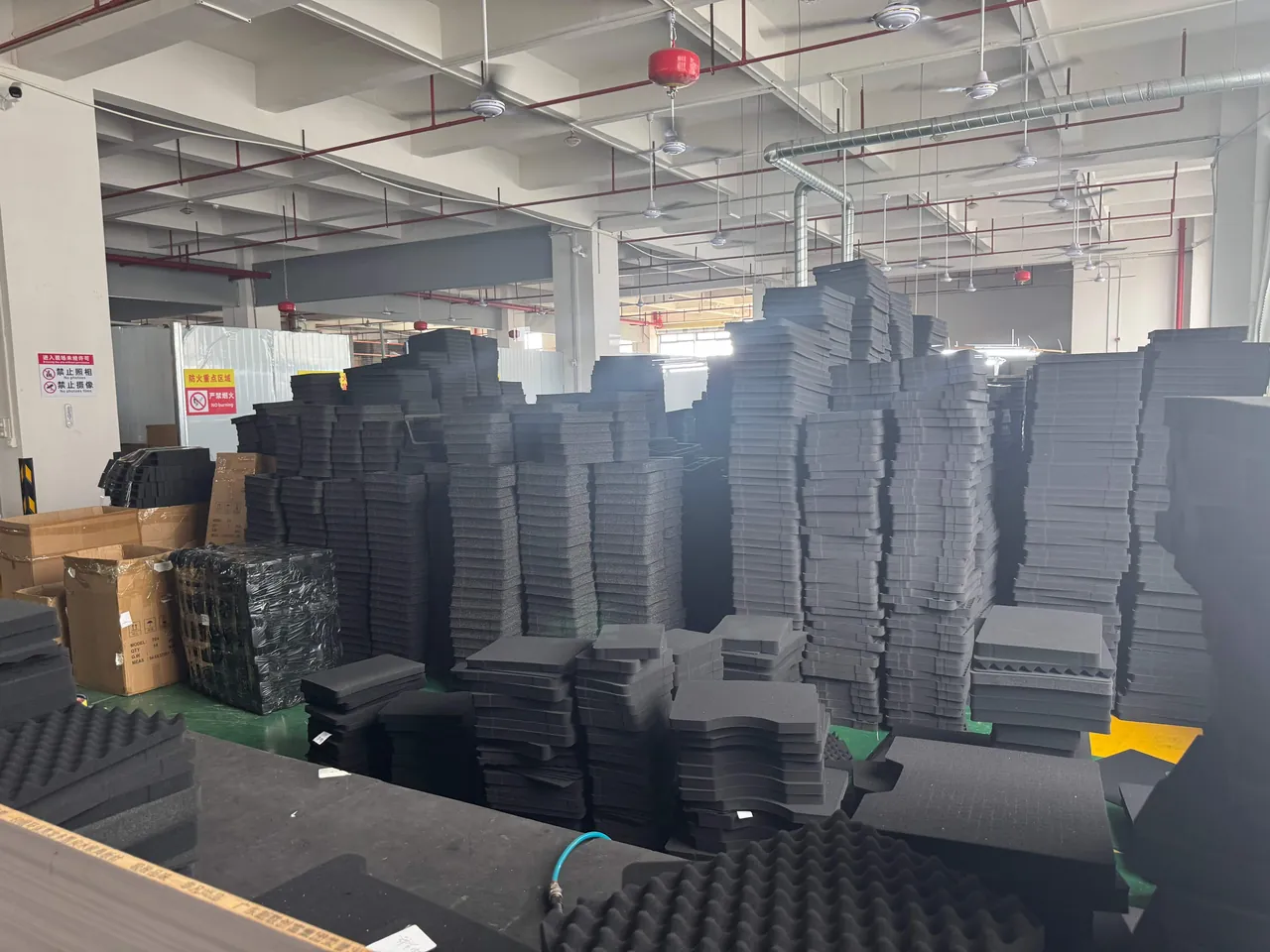
7. Insert Design: Custom EVA and PE Compartments Around Part Geometry
The insert is the highest-return component of an agricultural parts case and the clearest demonstration of a supplier's engineering capability. Its job is not to fill empty space but to lock parts into defined positions while controlling the path of impact energy transfer.
Three material families dominate.
EVA foam is the best all-round option. It has good rebound, cuts to high precision, and conforms to complex part geometry for captive holding, which suits bearings, sensors, and precision castings. The trade-off is possible slight permanent deformation under long-term compression, and higher cost than PE.
PE foam, including XPE and IXPE variants, costs less, resists chemicals well, and has higher compressive strength. It suits heavy and geometrically simple items such as hydraulic valve blocks, flanges, wrenches, and fastener trays. Conformance to complex contours is inferior to EVA.
PU foam at certain densities offers good energy absorption and suits base load-bearing layers under heavy parts. It is more moisture sensitive and may hydrolyze in long-term humid conditions, so it should always be paired with desiccant.
The basic insert design workflow is:
- List the contents and 3D dimensions, including every accessory, harness, manual, and spare.
- Group by center of gravity, placing the heaviest items near the geometric center of the case to avoid imbalance.
- Define part spacing, leaving dividing wall thickness between adjacent parts so they never strike each other under vibration.
- Plan the retrieval path, giving high-frequency items such as filters and seals an upper fast-access position and lower-frequency spares the base layer.
- Leave clearance, since foam cutouts are usually slightly larger than the part envelope; the exact allowance depends on surface sensitivity and foam compression characteristics.
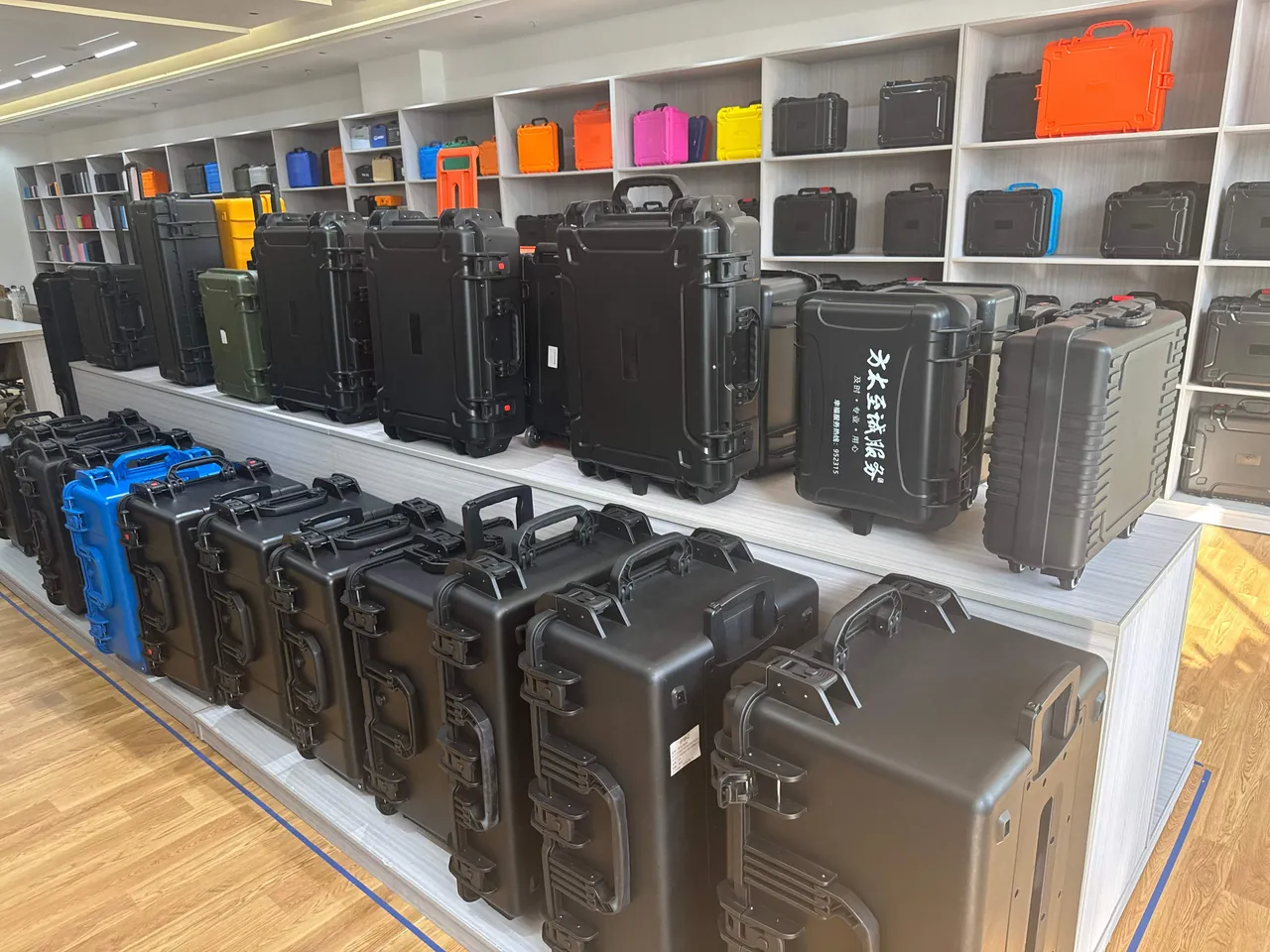
Compartment design also has to support counting and visual identification. For fasteners and small O-rings, use removable sub-compartments or extractable trays so retrieval never becomes a dump-and-search operation. The structural logic behind removable partitioning is covered in Removable Divider Systems for Protective Cases, and the full process from design to sample approval is described in Custom Foam Insert Design Guide and EVA Foam Insert Customization Process.
8. Hydraulic Components and Seals: Starting from ISO 4413
Hydraulic components account for a large share of agricultural spares by both value and unit price, and their failure consequences are severe. ISO 4413, which covers general rules and safety requirements for hydraulic fluid power systems and components, provides a framework whose ideas on cleanliness, sealing, and port protection translate directly into spare-part packaging design.
Port capping is the first rule. Pump, valve, and cylinder ports must be closed with plugs or dust caps during transport and storage. The purpose is not water exclusion but preventing particulate and hygroscopic dust from entering. Caps should be color-coded so that a pre-issue check can confirm all have been removed.
Internal corrosion protection is the second. Machined internal surfaces corrode quickly without an oil film. Components should leave the factory with a protective oil film, and packaging should include VCI material.
Hose storage attitude is the third. Hoses stored in small-radius bends for long periods fatigue their reinforcement layers. Packaging should avoid forced bending, using large-radius coiling or straight storage where needed, and should include support posts to limit movement inside the case.
Compression management for seals and O-rings is the fourth. Rubber seals under sustained compression take a permanent set, which causes leaks after installation. Store rubber seals loosely rather than compressed, away from heat and direct UV. Because FKM and NBR differ substantially in temperature and fluid resistance, they should not share a compartment, which prevents picking the wrong material during a repair.
Dedicated filter compartments are the fifth. Filter media can be torn or creased by contact; a hidden crack can rupture quickly after installation and contaminate the entire hydraulic circuit. Filter elements need individual cylindrical retention and must never share a compartment with metal parts.
Field experience: in hydraulic spare kits, the most common failure is not the case but a missing port cap. Provide a dedicated cap storage position and use color-coded reference marks on the insert.
9. Electronics and Sensors: ESD and Shielding Requirements
As smart farming spreads, ECUs, controllers, sensors, and harnesses make up a growing share of spare parts. Their protection logic differs completely from metal parts, with electrostatic discharge, moisture, and mechanical shock as the primary risks.
Electrostatic discharge. Human and packaging friction during handling can generate several kilovolts of static potential. Against unprotected components, such a discharge can puncture a gate oxide layer or shift parameters. Effective measures include:
- Use conductive or static-dissipative foam rather than ordinary insulating foam for inserts.
- Provide a grounding terminal or conductive strap inside the case for equipotential bonding on a clean bench.
- Seal individual units in ESD shielding bags before placing them in the insert.
- Require operators to wear wrist straps and touch a grounded point before handling.
Moisture. Connector pins and PCB solder joints undergo electrochemical migration in humid conditions, forming dendrite shorts. Protection should be stronger than for mechanical parts, combining desiccant with high-barrier bags. Related design considerations appear in ESD Shielding Case Solutions.
Mechanical shock. Ceramic capacitors and crystals inside ECUs are sensitive to high acceleration. Inserts should use surface contact restraint rather than point contact, which avoids local stress concentration during impact.
Harness bend radius. Harnesses should not be forced into small coils or placed under heavy parts. Reserve a dedicated layer or side zone and secure them to insert posts with ties.
10. Temperature and UV: Accelerated Aging in Outdoor Storage
Agricultural parts cases frequently endure long outdoor storage: dealer yards, the edges of cooperative machine sheds, and exterior racks on service trucks. Two environmental factors then shorten the life of both case and contents.
Thermal cycling. Day-night temperature swings repeatedly expand and contract the air inside the case. In a near-airtight enclosure this cycling produces a breathing effect: gas expands and escapes during the day, and nocturnal contraction draws external moisture back in. The cumulative result is rising internal humidity. This is why airtight cases can be more prone to condensation in outdoor storage, and it is the fundamental reason pressure equalization is needed.
UV aging. UV radiation causes chain scission in polypropylene and ABS surfaces, appearing as chalking, color fading, and reduced impact strength. Countermeasures include UV stabilizers such as hindered amine light stabilizers and UV-resistant masterbatch in the outer surface. For cases stored outdoors long term, specify a UV aging test requirement in the specification.
Heat and rubber components. Elevated temperature accelerates aging and permanent set in rubber gaskets. The interior of a case in summer sun can be substantially hotter than ambient air. Cases storing rubber parts should avoid dark heat-absorbing surfaces and should be kept in shade where possible.
Design considerations for cross-temperature-zone adaptability are covered in Protective Case Design for Extreme Temperatures.
11. Pressure Equalization: The Hidden Risk in Cross-Climate Shipping
The pressure equalization valve is a small component with an outsized role. Its logic is simple: allow gas to pass slowly while blocking liquid water.
Why does an agricultural parts case need one? Consider three typical scenarios.
- Cross-altitude shipping. Moving from a lowland warehouse to a highland work site drops external pressure significantly. In a fully airtight case, internal positive pressure lifts the lid and pushes the gasket aside, sometimes producing a lid pop on opening.
- Air freight and rapid temperature change. Cargo hold pressure and temperature shift quickly, and the resulting differential across a sealed case can be substantial; repeated cycling fatigues the gasket.
- Moving from winter outdoor air into a heated depot. The case surface warms quickly while the interior stays cold, and internal negative pressure draws moisture in.
The working principle and selection criteria for equalization components are covered in How a Case Pressure Equalization Valve Works. A specification for agricultural parts cases should state whether equalization is needed, where the valve is mounted, typically away from direct rain exposure, and whether the valve rating matches the case rating.
12. Size Classes and Load Selection: Working Backward from Trucks and Racking
Selection should not start from "how big a case do I need" but from the downstream handling unit. Agricultural parts cases serve four main handling units: service truck compartment zones, standard pallets, racking shelves, and manual carrying.
Manual handling limits. For a case one person carries frequently, a loaded mass under roughly 25 kg is a reasonable target; two-person carrying allows more, but handle placement matters. Beyond that range, shift to vehicle-mounted cases and stop emphasizing portability.
Pallet and racking fit. For 1200 x 1000 mm or 1200 x 800 mm standard pallets, base dimensions should divide evenly or follow a defined placement pattern so there is no large void and no unstable stacking. Racking fit requires known shelf height and per-level load capacity.
Service truck zoning. Service trucks usually organize by three tiers: high-frequency parts, model-specific parts, and general consumables. Cases should support modular stacking within one size family and should provide a labeling face so contents can be identified without opening.
| Case class | Reference external length | Suggested loaded mass | Suitable parts | Handling unit |
|---|---|---|---|---|
| --- | --- | --- | --- | --- |
| Hand-carried | 300 to 450 mm | 5 to 12 kg | Sensors, O-rings, fasteners, small filters | Manual carry, service truck drawer |
| Portable mid-size | 450 to 650 mm | 12 to 25 kg | Bearings, hydraulic valves, harnesses, mid-size tools | Manual carry, layered truck rack |
| Vehicle-mounted large | 650 to 1000 mm | 25 to 50 kg | Hydraulic pumps, bearing housings, tool sets | Fixed truck position, pallet |
| Storage unit | Above 1000 mm | Per design | Full machine spare kits, turnover stock | Standard pallet, heavy racking |
Size selection also depends on stacking stability. Cases with extreme length-to-width ratios tip easily when stacked, so keep the ratio within a sensible band, and design locating feet or recesses in the base that interlock with the case above.
13. Marking, Traceability, and Part-Number Integration
Agricultural spare parts management is tightly bound to machine models. A tillage machine revised in a later year may not share certain parts with earlier builds. The case is therefore not just a container but a physical anchor in the parts data chain.
Five classes of marking should be designed in.
- Unique case number. For asset management and movement records, applied by laser etching or a durable label.
- Model compatibility marking. State the applicable machine models and configuration range to prevent cross-model misuse.
- Contents QR code. Scanning displays the full contents list, quantities, and storage locations.
- Inspection and re-inspection dates. Especially for gaskets and rubber parts, record the receipt date to support first-in-first-out rotation.
- Ingress rating and handling notes. For example, "do not store on side" and "replace desiccant after opening."
Marking durability matters as much as content. Printed labels peel in warehouse and outdoor environments. Use in-mold labels, laser etching, or high-weathering polyester labels, and validate adhesion and abrasion resistance.
For OEM parts centers managing inventory centrally, case numbers can be tied into enterprise asset systems to create a four-level mapping of case number, storage location, machine model, and batch. JUNZHJIA can customize this in OEM/ODM projects to a customer's numbering rules, including pre-formed nameplate recesses and reserved label faces.
14. Reliability of Hinges, Latches, and Gaskets
These three components determine a case's real protective capability over its life. Their failures are gradual and are often misread as general aging.
Hinges. Agricultural parts case hinges endure repeated opening cycles plus full-load lateral force. Common failure modes are cracked plastic hinge bosses and worn pins. Design guidance: use metal pins, thicken and reinforce the hinge boss, and avoid a pin design that can be driven out from outside.
Latches. Common forms include draw latches, push latches, and cam latches. Agricultural use favors a clear operating force, one-handed operation, and an anti-accidental-opening feature. Latches should also allow tension adjustment, because gaskets take a permanent set under long compression and the latch has to compensate.
Gaskets. The gasket is a consumable and should be designed as replaceable. Selection criteria include material, where EPDM generally outperforms standard NBR in weather resistance, hardness, and cross-section shape, since O-ring, D-profile, and hollow profiles each suit different cases. In cold environments, increased gasket hardness slows recovery and can produce transient leakage, a point that deserves specific validation for cold-region agricultural applications.
Purchasing recommendation: require the supplier to provide gasket replacement specifications and a recommended replacement interval in the technical agreement. This small clause determines whether the case still meets its original ingress rating at year five or year ten.
The matching relationships and common failure modes for hinges, latches, and gaskets are systematically covered in Toolbox Hinge, Latch, and Gasket Selection.
15. OEM/ODM Customization and Sample Control
Customization of agricultural parts cases typically arises from two needs: an OEM wanting a factory spare-parts case for a specific machine, or a dealer needing turnover units that match its own warehouse and logistics system. Depth differs, but the process skeleton is the same.
Step one: requirements and constraints. Define the contents list, use scenario (storage or vehicle), target ingress rating, stacking and load requirements, marking and numbering rules, and volumes with delivery cadence.
Step two: structural concept. Produce case dimensions, material, rib layout, hinge and latch type, sealing approach, and whether a pressure equalization valve and handles are needed.
Step three: insert design and simulation. Build cutout geometry from 3D part data and validate drop and vibration behavior through simulation or physical testing. Physical trial fitting at this stage catches interference and access problems early.
Step four: sampling and first-article approval. Samples must validate appearance and dimensions, opening feel, sealing test results, insert fit and retrieval convenience, and marking legibility. First-article approval should be documented as the baseline for batch acceptance.
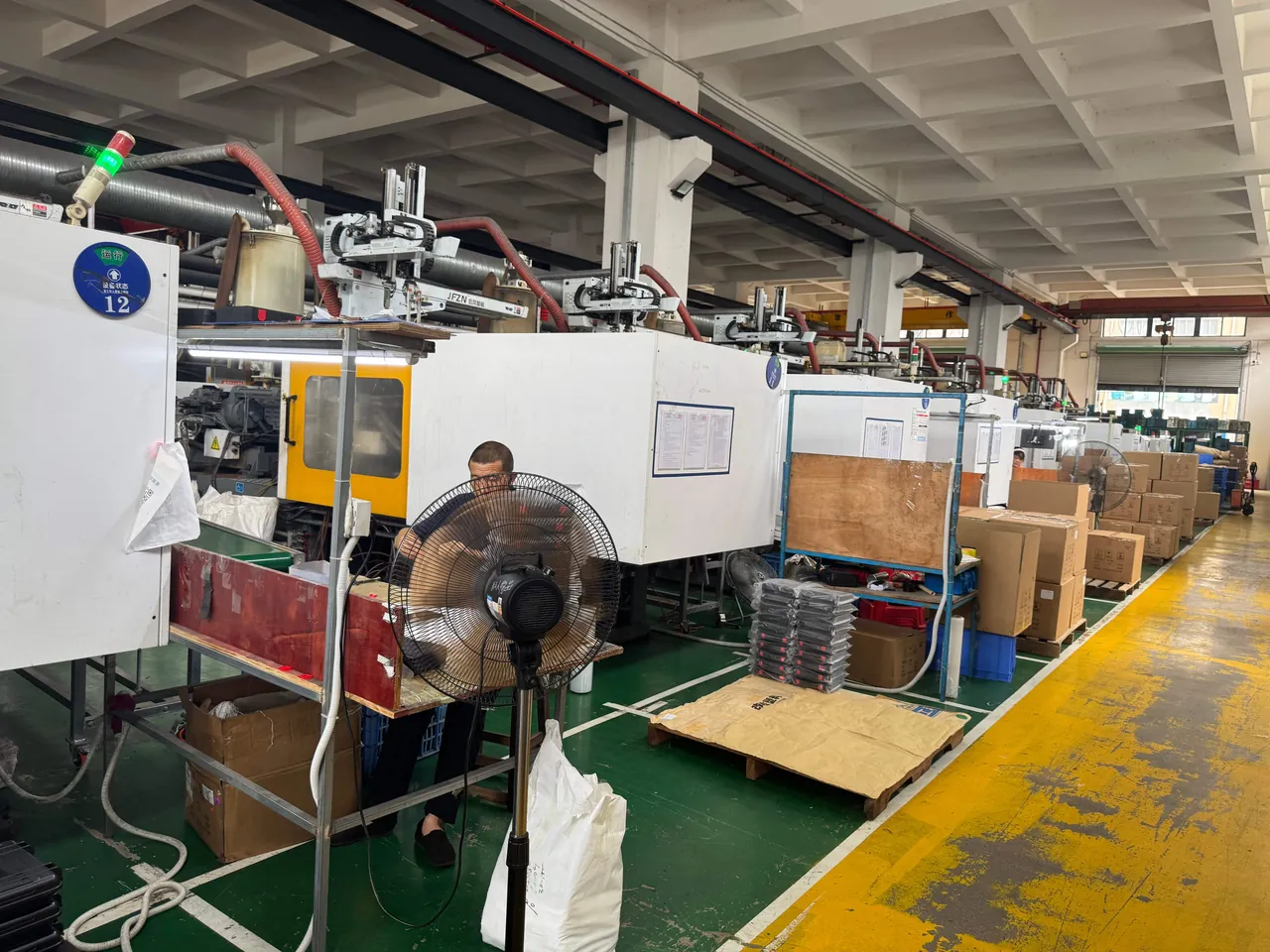
Step five: production and inspection. Apply batch inspection standards, commonly an AQL sampling plan, for appearance, dimensional, and functional checks, with sealing performance sampled at agreed frequency.
Step six: packing, shipment, and documentation. Deliver test documentation, gasket specification sheets, and use and maintenance instructions.
Cost structure and tooling investment logic are covered in Custom Case Mold Cost Analysis, and supplier evaluation criteria in How to Choose a Protective Case OEM Factory.
16. Acceptance, Inspection, and Life-Cycle Management
The value of an agricultural parts case is not decided at delivery. It is consumed across the whole inventory cycle and working season. An inspection regime is what keeps protection at its nominal level.
Inbound acceptance, per case. Check for cracks and deformation, gasket seating, latch closing with a definite detent feel, hinge play, and legible markings. For cases rated IP65 or IP67, sample sealing tests at the agreed frequency.
Quarterly inspection. Check whether the gasket has hardened, cracked, or lost elasticity; whether hinge pins have loosened; desiccant condition; and insert condition for powdering or permanent deformation.
Pre-issue check. Confirm port caps are present; confirm contents match the QR record; confirm retrieval order matches field practice; confirm the load is not offset in the case.
Post-repair reset. After a part is used, refill the vacant position or install a placeholder module so remaining parts cannot migrate inside the cavity and cause secondary impact. This is the step most often skipped and the most frequent cause of downstream damage.
End-of-life assessment. Base retirement decisions on three indicators: sealing performance, structural rigidity, and latch function. The case itself usually outlasts the gasket considerably, so the sensible approach is periodic gasket replacement rather than whole-case scrapping, consistent with the logic in Protective Case Service Life and Retirement Criteria. Cleaning and care methods are covered in How to Clean a Protective Case.
| Management stage | Inspection content | Acceptance criterion | Action |
|---|---|---|---|
| --- | --- | --- | --- |
| Inbound acceptance | Appearance, gasket, latches, hinges, markings | No cracks, gasket seated, latches engage | Reject or batch re-inspect |
| Quarterly check | Gasket elasticity, desiccant state, insert deformation | Good rebound, desiccant not saturated | Replace gasket or desiccant |
| Pre-issue check | Port caps, contents match, load balance | Record matches, no offset | Complete before release |
| Post-repair reset | Vacant positions refilled or padded | No free-moving parts | Refill or add placeholder |
| Retirement review | Sealing, rigidity, latch function | Clear failure in any one | Replace gasket or retire case |
Frequently Asked Questions
Q: Is a heavier, thicker plastic case always the better choice for agricultural spare parts?
A: No, and this is the most common cost misallocation in agricultural parts procurement. Case rigidity addresses only one dimension, impact resistance, while many agricultural spare failures have nothing to do with strength. Bearing pitting comes from condensation, hydraulic valve sticking comes from particle ingress, and rubber seal scrapping comes from long-term compression set and UV aging. Thicker walls do nothing for any of these, and a heavier case reduces on-site efficiency. The right approach allocates protection resources by part category: sealing plus desiccant for corrosion-sensitive items, captive inserts for precision items, dedicated compartments for fasteners and filters, and port caps for hydraulic components. Case strength only needs to satisfy loaded drop and stacking requirements; budget beyond that point belongs in gasket quality, insert precision, and desiccant sizing. JUNZHJIA typically asks agricultural customers to submit the contents list and transport route first, then derives case class and insert zoning from that rather than starting from the box.
Q: Should I choose IP65 or IP67 for an agricultural parts case?
A: It depends on storage and transport conditions, not on budget. IP65 is dust tight plus water jet resistant, matching service truck carry, temporary outdoor staging, and low-pressure washdown of the exterior, which is the most common balance point in agriculture. IP67 is dust tight plus temporary immersion, matching cross-climate long-haul shipping, routes that may cross flooded ground, or full-case washdown. One caution: IP67 usually implies a nearly airtight enclosure, which creates internal and external pressure differentials during altitude changes and rapid temperature shifts. Typical symptoms are a lifted lid, a displaced gasket, or a noticeable pop on opening. Choosing IP67 should therefore come with a check on whether pressure equalization is fitted and whether the valve rating matches the case. Also note that ratings are not permanent. Gaskets age and latch tension decays, so an IP67 case that has run for two or three years without gasket replacement may perform below IP65 in practice. Put the gasket in the technical agreement as a replaceable item with a defined interval.
Q: What typically goes wrong in transit with combine and rotary tiller blade spares?
A: The classic problems are edge deformation and mechanical damage to coatings. Blades are hard, thin-walled parts, and a chipped or rolled edge degrades cut quality and increases power demand even when the blade still bolts on. The second problem is secondary damage from mixed loading. When blades travel loose in the same cavity as bearings and bolts, they act as cutting tools during vibration, scoring adjacent parts while their own edges take impacts. The fix is dedicated compartments, edge protectors, and captive restraint that holds each blade in a defined attitude so it cannot slide. A third issue that is often missed is corrosion protection. Many blade coatings offer limited salt-spray resistance and rust along the edge in outdoor storage, and that rust layer then affects assembly fit. Use VCI material inside the blade compartment and avoid closing cases during humid periods. Finally, count the blades on receipt against the packing list. Because guards and blades differ subtly between model years, a wrong blade discovered in the field mid-harvest is effectively a stock-out, and a mixed compartment is the most common reason it happens.
Q: Should the insert be EVA or PE foam?
A: It depends on the contents. EVA has good rebound and cuts precisely enough to conform to complex contours, which suits bearings, sensors, precision castings, and hydraulic valve blocks. It is the most versatile choice for agricultural parts cases. PE foam, including XPE and IXPE variants, costs less, offers higher compressive strength and better chemical resistance, and suits heavy or geometrically simple items such as flanges, wrench and fastener trays, and base load-bearing layers under heavy parts. Real projects usually combine both: PE for the base and outer load paths, EVA around precision parts for conformance and cushioning, and extractable compartment trays in zones holding high-frequency items. One caution is that PU foam, despite good cushioning, can hydrolyze in long-term humid conditions. If it is used in a case stored outdoors, pair it with desiccant and shorten the inspection interval. A simple decision rule is to ask whether the part has a complex contour that needs conformance and whether that zone will be cleaned often. Complex and dry favors EVA; simple and washed favors PE. Material trade-offs are compared in Case Foam Material Comparison.
Q: With many cases stored in a central warehouse for a full year, how do I keep the spares from rusting?
A: The key is controlling humidity at closing time and sizing desiccant correctly, not simply sealing the case tightly. A well-sealed case closed on a humid day locks moisture inside and creates a stable high-humidity microclimate. A three-layer approach works best. First, close cases in a low-humidity area where possible and record temperature and humidity as batch documentation. Second, bag precision parts in high-barrier film with VCI material, since molecular-level adsorption generally covers complex geometries better than an oil film alone. Third, estimate required uptake from free internal volume, saturation moisture content at the target temperature, and moisture released by packaging materials themselves, then apply a safety factor of 1.5 to 2.0 to determine desiccant quantity. One frequently missed moisture source is paper documentation and cardboard dividers, which absorb and release water as ambient humidity changes. Switch to closed-cell foam inserts for precision parts held long term. Also rotate stock by receipt date, since even perfect packaging has a finite desiccant reserve, and re-inspect any case that has been opened and reclosed during the storage year.
Q: Do agricultural parts cases need drop and vibration testing, and to which standards?
A: Yes, and this is the step that turns protection claims into verifiable contract clauses. Two systems apply. The ISTA series maps more closely to parcel and third-party logistics distribution chains and is widely used for e-commerce and export parts packaging validation. The GB/T 4857 series covers the basic test methods for transport packages in China, including drop, stacking, vibration, and impact, and is more common in domestic tenders and acceptance testing. For agricultural parts cases, cover at least worst-case drop, random vibration simulating uneven roads, stacking at the actual number of levels plus margin, and concentrated-load impact from heavy items. Acceptance criteria should not stop at whether the case cracked. Check gasket permanent compression set, whether latches still close, and whether contents shifted or struck each other. For export projects, reference both systems in the technical agreement so one validation dataset serves multiple markets. Where a machine maker already runs packaging validation for other components, reuse the same fixture and drop heights so results stay comparable across the parts catalogue.
Q: What causes pressure differentials and condensation inside a case stored outdoors?
A: This is a classic behavior of airtight cases in outdoor storage, and the mechanism is a breathing effect. Sunlight warms the internal air by day, it expands and escapes past the seal, and overnight cooling creates negative pressure that draws external air with higher relative humidity back in. Repeated over many cycles, internal moisture accumulates, and when the interior drops below the dew point at night, condensation forms on metal surfaces. Altitude changes and rapid temperature shifts intensify the process. Two remedies apply. First, fit a pressure equalization valve, which lets gas pass slowly while blocking liquid water, eliminating differential pressure without sacrificing water resistance. Second, size desiccant generously and replace it on a schedule, while avoiding opening the case in rain or during humid periods. For agricultural parts cases stored outdoors long term, pressure equalization should be standard, and the valve should sit where direct rain runoff cannot reach it. Note that a valve does not remove moisture already inside; it only prevents the cycling that keeps pulling more in, so the desiccant still has to be managed.
Q: As a dealer, can I ask the factory to customize markings to our parts numbering system?
A: Yes, and this is often the most immediately valuable part of a customization project. Typical content includes laser-etched unique case numbers, machine model compatibility markings, contents QR codes, inspection and re-inspection date fields, and ingress rating plus handling notes. The critical requirement is marking durability, since ordinary printed labels peel in warehouse and outdoor conditions. Use in-mold labels, laser etching, or high-weathering polyester labels and validate adhesion and abrasion resistance. For systems that must integrate with enterprise asset management, a four-level mapping of case number, storage location, machine model, and batch lets a scan pull up the contents list and quantities. JUNZHJIA can pre-form nameplate recesses and reserved label faces to a customer's numbering rules in OEM/ODM projects and support first-article approval so the marking system stays consistent through volume production. Lock the coding rules at the sampling stage rather than at volume release, because changing a numbering convention after tooling exists is far more expensive than deciding it up front.
Conclusion and Related Reading
The value of an agricultural machinery parts case shows up in two field moments. One is during harvest, when a service truck stops at the edge of a field and a technician has to find and pull the correct spare within three minutes. The other is six months later, when a part comes out of the central warehouse and the bearing surface is still bright and the oil seal still elastic. These two moments correspond to insert design for working efficiency and to the three defenses for the case itself. Missing either one turns a protective case into an ordinary plastic box.
Distilled into purchasing principles, the engineering logic reduces to six rules:
- Match protection to part category, not to a single case specification.
- Combine sealing, desiccant, and VCI to actually stop corrosion.
- The insert determines field efficiency, so high-frequency items need upper fast-access positions.
- Hydraulic ports must be capped, and the caps need a dedicated storage position.
- Airtight cases need pressure equalization, or outdoor storage will produce condensation.
- Gaskets are replaceable consumables, and writing that into the agreement is what preserves protection over the full service life.
JUNZHJIA, manufactured by Kexin New Materials (Guangdong) Co., Ltd., supplies protective cases for OEM parts departments, regional dealers, and service providers, offering wholesale, distribution, OEM/ODM, and global supply programs, with model-matched custom inserts and markings, and third-party ingress and environmental test documentation on request for inclusion in purchasing agreements.
Related Reading