

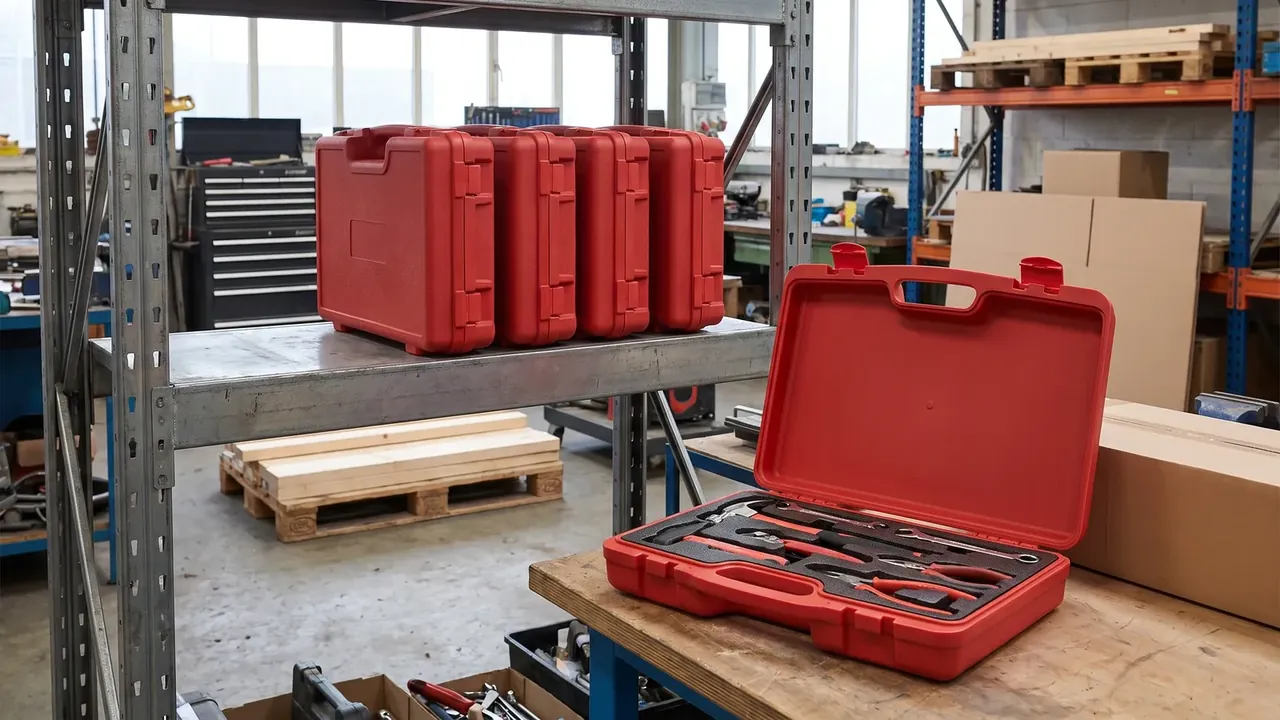
Quick answer: Industrial trolley type plastic heavy duty tool box earns the label by pulling 45 kg over a 25 mm step: a 90 kg axle seat, 400 mm handle and 5.0 mm wall.
Table of contents
- Where an industrial trolley type plastic heavy duty tool box carries its weight
- Pulling 45 kg over a 25 mm step
- The load line between wheel and axle seat
- Keeping a 400 mm, four-stage handle from twisting
- After a drop, check the axle before the wall
- FAQ
1. Where an industrial trolley type plastic heavy duty tool box carries its weight
Industrial trolley type plastic heavy duty tool box has to survive the moment it is pulled while full: an 11.2 kg shell plus 45 kg of load gives 56.2 kg all-up on two wheels and one handle, and a 25 mm step separates a flat floor from a real test. A 5.0 mm wall keeps the shell from twisting but says nothing about a bent axle; the seat must take 90 kg, a four-stage handle must reach 400 mm and a 100 mm wheel must climb the step. Industrial trolley type plastic heavy duty tool box therefore moves the definition from how thick to whether it still rolls when full.
The criterion lands on the axle, not a whitened wall: a bent axle drags the 100 mm wheel and the loaded pull wanders.
Thickness is only one figure among several.
2. Pulling 45 kg over a 25 mm step
On flat ground the two wheels split 56.2 kg evenly. At a 25 mm step the front wheel stops first while the rear hangs, so the whole load shifts onto one axle seat; that condition is rated at 90 kg rather than 56.2 kg, with the margin covering the dynamic kick. A 100 mm wheel must clear the step rather than catch its edge.
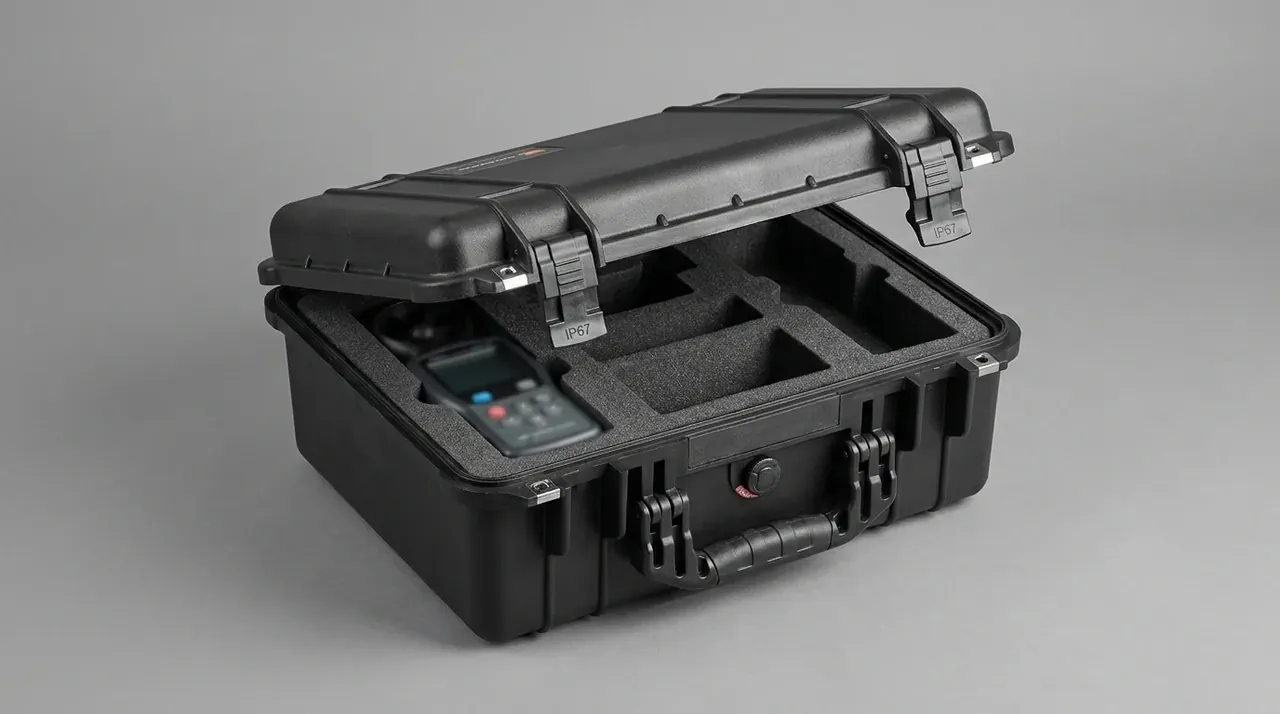
The 45 kg load brings the all-up weight to 56.2 kg and pushes the single seat toward 90 kg on the step. Industrial trolley type plastic heavy duty tool box is sized around that condition.
| Handling condition | Wheel load | Shell response |
|---|---|---|
| Flat pull | 56.2 kg split over two | 5.0 mm wall stays true |
| Over a 25 mm step | One wheel first | Axle seat takes 90 kg |
| 0.8 m drop | Impact on wheel side | Axle stays unwarped |
| Stacked at rest | Wheels unloaded | Three high |
3. The load line between wheel and axle seat
Load travels from floor ribs through seat and axle into the 100 mm wheel. Industrial trolley type plastic heavy duty tool box sets the seat at the crossing of two floor ribs, so 90 kg spreads into the 5.0 mm wall before reaching the axle instead of hanging a flat plate off the shaft.
A 680×480×380 mm outside and a 610×410×320 mm cavity leave the difference to the 5.0 mm wall and seat boss; four latches at 500 N clamp the gasket against IP54. Industrial trolley type plastic heavy duty tool box stacks three high with the wheels unloaded.
| Load-bearing part | Value | Linked condition |
|---|---|---|
| Wheel diameter | 100 mm | Over a 25 mm step |
| Axle seat | 90 kg | Margin on 56.2 kg all-up |
| Handle | Four stages, 400 mm out | Loaded pull |
| Wall | 5.0 mm | Twist resistance |
| Latches | Four at 500 N each | Lid clamping |
The weakest link on that line decides whether heavy duty holds.
4. Keeping a 400 mm, four-stage handle from twisting
A four-stage handle reaching 400 mm tilts the case back, but a longer reach concentrates sideways twist at the wall joint. Industrial trolley type plastic heavy duty tool box resists it with a 5.0 mm wall plus a turned rim around the mouth, which spreads torque over the whole opening rather than two fixing screws.
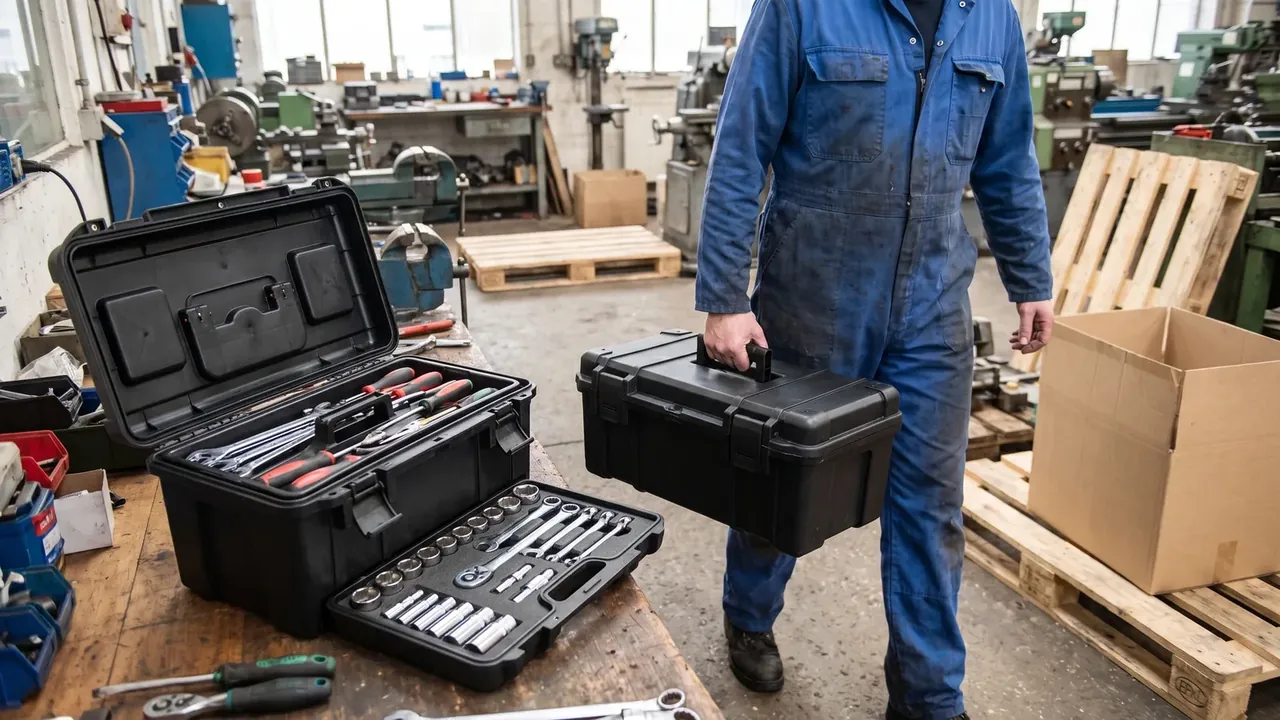
From -20 °C to 60 °C a 5.0 mm wall turns brittle when cold, so the mount carries a larger radius; clearance between stages stops thermal jamming.
| Design value | Condition | Acceptance |
|---|---|---|
| 56.2 kg all-up | 45 kg load plus 11.2 kg shell | Loaded pull |
| 680×480×380 mm outside | 610×410×320 mm cavity | Seat mounting face |
| 0.8 m drop | Wheel side down | Axle stays unwarped |
| -20 °C to 60 °C | Cold pull | Wall does not crack |
| IP54 | Splash and dust | Lid seal |
| Three high | At rest | Bottom layer holds shape |
A handle is a lever arm, not a grip; every extra millimetre asks for more twist resistance.
5. After a drop, check the axle before the wall
A 0.8 m drop lands wheel-side down, so impact reaches the seat through the axle. Industrial trolley type plastic heavy duty tool box makes an unwarped axle the criterion: once bent, the 100 mm wheel runs off-centre and a loaded pull wanders, which no extra wall thickness can correct. The drop check reads the axle first, then the 5.0 mm wall and four 500 N latches.
IP54 is benchmarked against splash and dust at the gasket and four latches; -20 °C to 60 °C is taken up by the turned rim. Industrial trolley type plastic heavy duty tool box logs these apart from the axle because they test different points.
Conclusion
Industrial trolley type plastic heavy duty tool box turns heavy duty from how thick into whether it still rolls when full: 45 kg of load, 56.2 kg all-up and a 25 mm step tie together a 90 kg axle seat, a 100 mm wheel, a four-stage 400 mm handle and a 5.0 mm wall. Watch three points: the seat, wall twist with the handle out, and the axle after a 0.8 m drop. The IP54 benchmark and three-high stacking only set the two ends.
Related Reading
- Load and storage structure of heavy duty tool cases
- Application terms for heavy duty plastic tool boxes
- Batch specifications for industrial hard plastic tool boxes
- Duty grading for industrial grade plastic tool boxes
Related Products
- 8 Series — Gun Cases; Military Equipment Cases; Camera Equipment Cases; Drone Cases; Watch Cases; Knife Cases; First Aid Cases; Electronics Equipment Cases
- WL8-2812 PP Gun Case — model WL8-2812
- All protective cases and toolboxes: 7 series, 158 models