

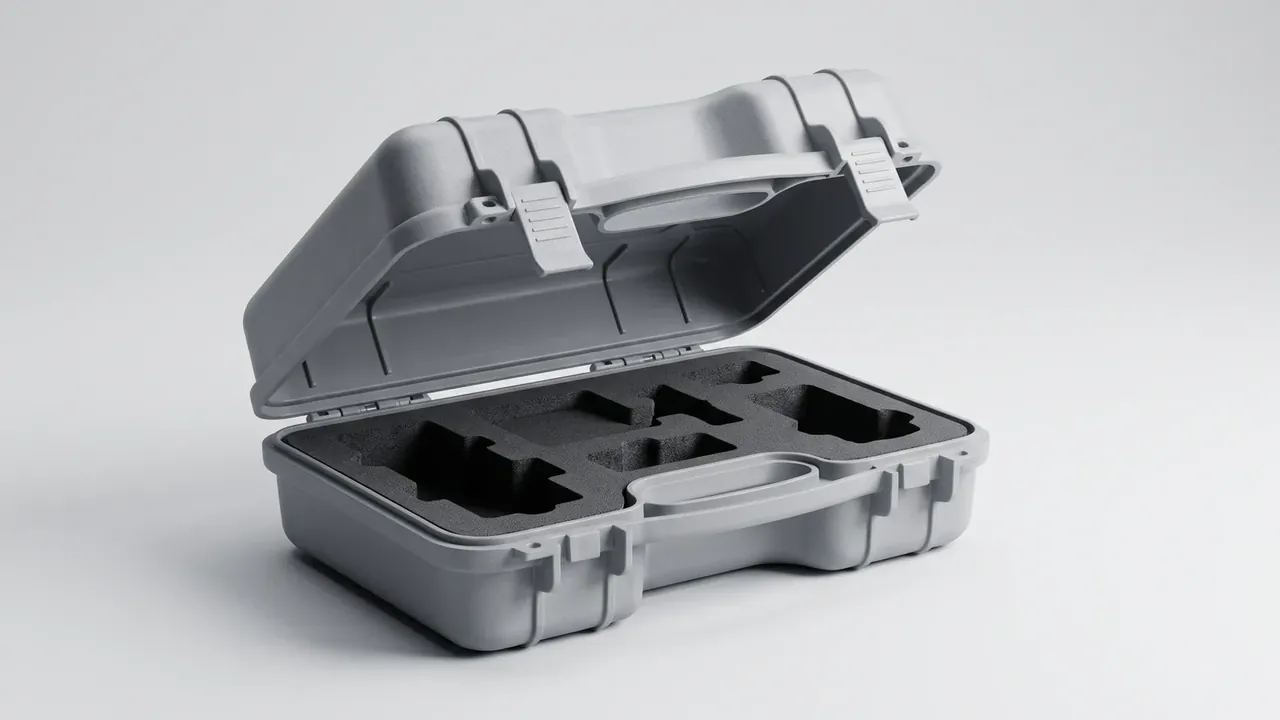
Quick answer: An industrial grade plastic tool box earns its place on a heavy shop floor by surviving three things: ten 1.5 m drops at minus 25 C with latches still closing, four boxes stacked without the bottom shell taking a set, and a salt-air shift without the hardware seizing.
Table of contents
- Six Stations, Six Load Cases
- Drop and Stack Tests, in This Order
- UV and Temperature Swing
- Latches Under Vibration, Lifting Points
- Hardware for Salt Air
- FAQ
1. Six Stations, Six Load Cases
Cases fail fast on a shop floor, and for an industrial grade plastic tool box the cause is usually the wrong station rather than the compound: a line-side position cares how often the lid opens, a seaside platform cares about chloride.
The service cart and outdoor pipeline job are hardest on structure: a cart box rides with the crane eight hours a day, a pipeline box meets dock edges, drops and rain.
| Station | Typical load | Dominant stress | Configuration |
|---|---|---|---|
| Line side | 22 kg | dozens of lid cycles per shift | flat, single layer, latches outward |
| Service cart | 32 kg | crane and road vibration | corner straps, anti-slip mat |
| High rack | 20 kg | stack load | ribs down, four high maximum |
| Seaside platform | 14 kg | salt air and damp | 316 hardware, hinge sleeve |
The welding bay is the one people forget: dust settles on the lid seam and grinds the gasket into a groove within a year, so the shell outlives the seal.
2. Drop and Stack Tests, in This Order
Test an industrial grade plastic tool box loaded: an empty drop proves the shell will not split and says nothing about the latch. Load to 25 kg, condition at minus 25 C for four hours, then run ten drops from 1.5 m within a minute: six faces, three edges, one corner, latch closing one-handed after each.
Order matters: cold then drop tests brittleness, the reverse only room-temperature toughness, and winter docks are where failures happen.
Stack four high with 240 kg on the base for 24 hours, and 2 mm of sink is the limit. At 3.2 mm wall the sidewall bulges 3 to 5 mm, which is elastic; past 6 mm it has yielded.
| Check | Condition | Pass line |
|---|---|---|
| Cold drop | minus 25 C for 4 h, ten drops from 1.5 m | latch closes one-handed, no through crack |
| Stack | four high, 240 kg, 24 h | base sinks 2 mm or less |
| Lid flatness | 300 mm rule on the lid | gap under 1.5 mm |
3. UV and Temperature Swing
An industrial grade plastic tool box for outdoor service spends most of the year in sunlight. After 1,000 hours of xenon arc the colour shift should stay within 3 units and impact strength retain 80 percent, which decides how much UV masterbatch goes in.
A dark shell at midday runs 15 C above ambient, so 45 C air means a 60 C surface, where polypropylene loses modulus and stack capacity derates about 30 percent.
Twenty cycles between minus 25 C and 60 C, two hours of soak at each end, must leave lid warp under 2 mm. Beyond that the gasket stops compressing evenly, water gets in, and the IP rating survives only on paper.
The weak point is rarely the shell: EPDM takes about 25 percent compression set at 60 C against 15 percent for silicone, so hot coastal work wants silicone.
4. Latches Under Vibration, Lifting Points
The latch fails first under vibration. Sweep 10 to 55 Hz and hold two hours: no self-release, holding force above 300 N, which matches the inertia of a 25 kg box under hard braking.
Self-opening starts with a worn hook. Once the gap between hook and keeper passes 0.8 mm, half an hour of vibration walks it back a notch, so measure quarterly rather than waiting for the lid to spring open.
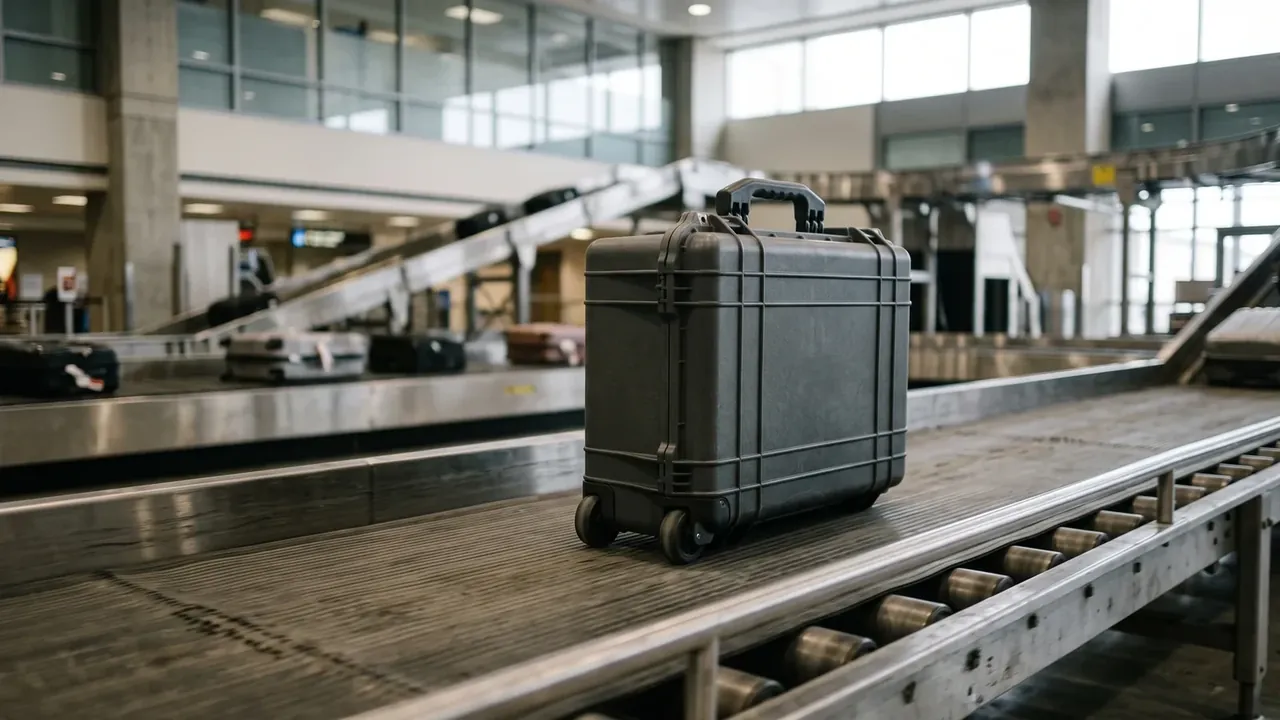
Lifting points get misused most. Two M8 inserts, one per side, 80 kg each; sling a 110 kg box from both and keep the wire angle under 60 degrees, since 90 degrees nearly doubles the load per point.
The carry handle on an industrial grade plastic tool box is not a lifting point. It is sized at 1.5 times the loaded weight for static use, so a sling through it may survive the first lift and split at the root on the third.
5. Hardware for Salt Air
An industrial grade plastic tool box on a seaside platform loses its hardware before its shell. Against 480 hours of neutral salt spray, 304 stainless pits and 316 does not; the price gap is around 30 percent, which one hinge replacement in labour covers.
- Latches and hinges in 316, fasteners 304 or better and passivated
- Gasket in EPDM or silicone, never plain rubber strip
- Hinge pins greased quarterly, every two months in salt water
- Fresh-water rinse for 10 minutes after salt spray, air dry in shade
- Insulating washers between aluminium plates and steel rivets
Material first, maintenance second, records last.
Conclusion
Choosing an industrial grade plastic tool box for heavy shops and field service comes down to four limits: cold drop, four-high stack, temperature cycling and salt-spray hours. Write them into the acceptance sheet, match hardware grade to station, and the box will not fail in its third quarter.
This article discusses only the container (case body) side of specifications and design intent, and does not cover any handling, loading or use of the contents.
Related Reading
- Six differences between industrial and home tool boxes
- How industrial tool boxes are used on lines and in service
- Configuring a tool box for industrial maintenance rounds
- Where aluminium and stainless boxes part company
Related Products
- 8 Series — Gun Cases; Military Equipment Cases; Camera Equipment Cases; Drone Cases; Watch Cases; Knife Cases; First Aid Cases; Electronics Equipment Cases
- WL8-2812 PP Gun Case — model WL8-2812
- All protective cases and toolboxes: 7 series, 158 models