

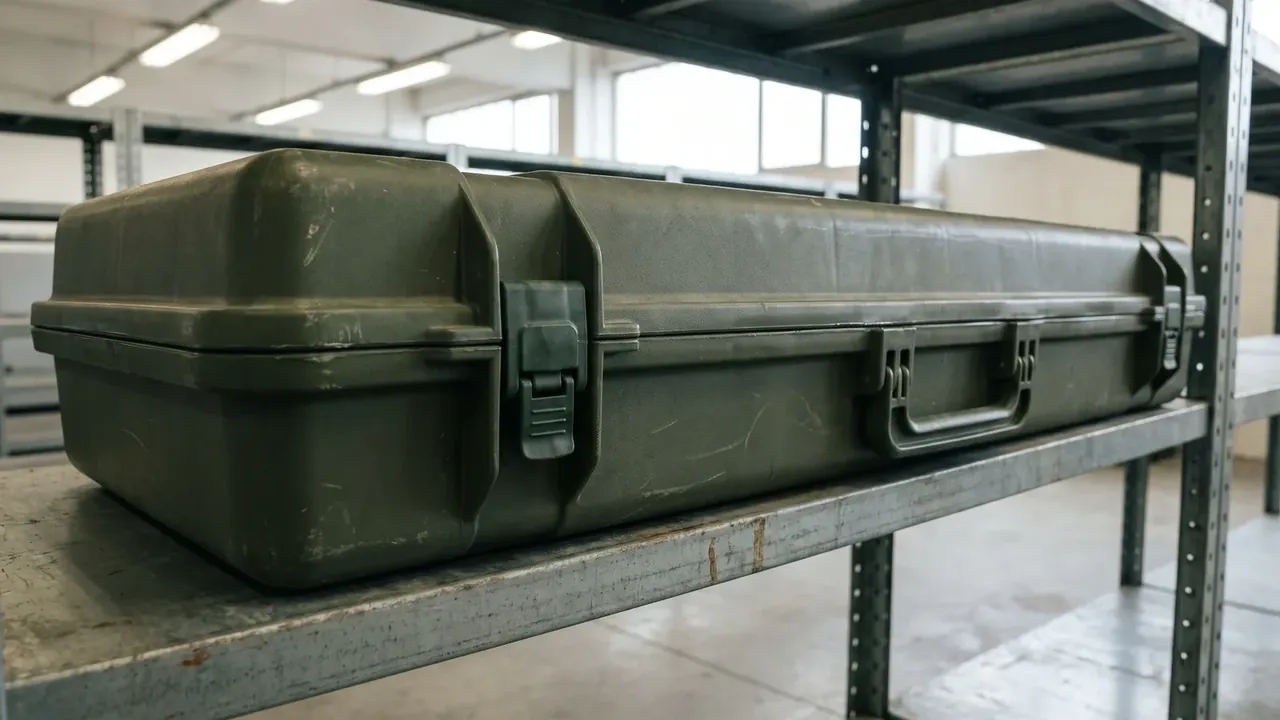
Quick answer: An IP67 dustproof waterproof military transit case fails at the stack: 320 kg over five levels bows the lid 0.5 mm and lifts one side of the 10 mm gasket.
Table of contents
- Sealing fails in a fixed order
- 0.3 mm flatness: shrink and a feeler gauge
- Five levels, 320 kg, three months
- A 10 mm cord at 25%, a valve at 12 kPa
- Salt spray for 96 h, dust at 2 kg/m³
- FAQ
1. Sealing fails in a fixed order
The shell measures 620×450×300 mm, the cavity 560×390×250 mm, the main wall 4.0 mm. Empty, an IP67 dustproof waterproof military transit case weighs 8.6 kg; with 20 kg inside it reaches 28.6 kg, so the shell is 30% of the mass and one 10 mm gasket runs the 2.1 m lid line.
Failure arrives in sequence: the gasket sets, stacking flattens the lid line, dust and salt eat latch retention, and the wall cracks last. A wet check run first hides the three links already loose, so an IP67 dustproof waterproof military transit case is signed off on flatness.
| Sealing link | Failure driver | Control value |
|---|---|---|
| Lid line | shrink, stack bow | 0.3 mm |
| Gasket | compression set | 10 mm cord, 25% |
| Latches | retention loss, dust | 4 units, 450 N each |
| Pressure valve | wall differential | opens at 12 kPa |
| Wall and hardware | impact, salt | 4.0 mm wall, 96 h salt |
2. 0.3 mm flatness: shrink and a feeler gauge
Flatness is read at 12 points: case upside down on a grade 0 plate, 0.3 mm feeler gauge around the perimeter, and any entry fails the case. Four points fall on corners, eight on the sides.
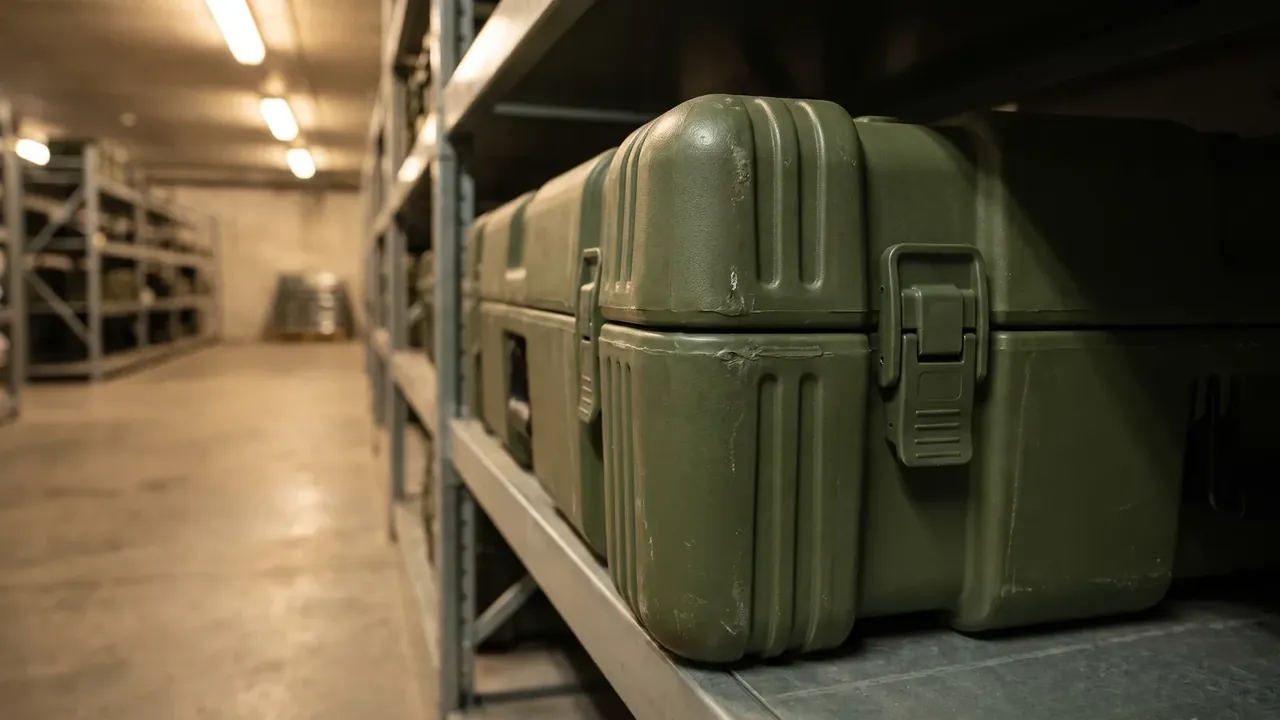
Moulding plants the problem: the cavity is cut 0.5% oversize, 3.1 mm across 620 mm, and a 4 °C split across the cooling circuit lifts the long side 0.4 mm. Holding that split to 2 °C brings warp to 0.2 mm and adds 6 s to the cycle.
Shape matters too: a 2 mm lid lip rolls into waves under load, while a shoulder 6 mm wide and 3 mm high deforms a third as much. On an IP67 dustproof waterproof military transit case a 0.3 mm gap needs 2.5 mm of squeeze; below 20% the rubber cannot follow the wave.
3. Five levels, 320 kg, three months
Stacking on an IP67 dustproof waterproof military transit case is five levels and 320 kg for three months, 90 days. Lid ribs stand 12 mm high at 55 mm pitch and carry mid-span load to the four walls; at 70 mm pitch the same load bows the centre from 0.4 mm to 0.9 mm.
Half a millimetre is the limit, because 300 mm of the 2.1 m lid line opening by 0.5 mm drops squeeze from 25% to 12% and the rubber stops recovering. The progression repeats: 0.2 mm in month one, 0.35 mm in month two, 0.5 mm in month three.
| Failure driver | Where it acts | Value |
|---|---|---|
| Static load | lid mid-span | 320 kg, 5 levels |
| Deflection | lid centre | 0.5 mm |
| Time | storage period | 3 months, 90 days |
| Temperature | lid line, gasket | −30 °C to 65 °C |
| Dust | latch teeth, valve seat | 2 kg/m³ |
Bow is reversible, creep is not: unload, wait 24 h, and 0.1 mm is elastic while 0.3 mm points at the compound.
4. A 10 mm cord at 25%, a valve at 12 kPa
The cord is 10 mm thick in an 8 mm wide, 5 mm deep groove, squeezed 25% or 2.5 mm, with 7.5 mm still proud. More is not better: at 40%, compression set after 24 h at 65 °C rises from 8% to 18%, and the cord never returns after the third opening.
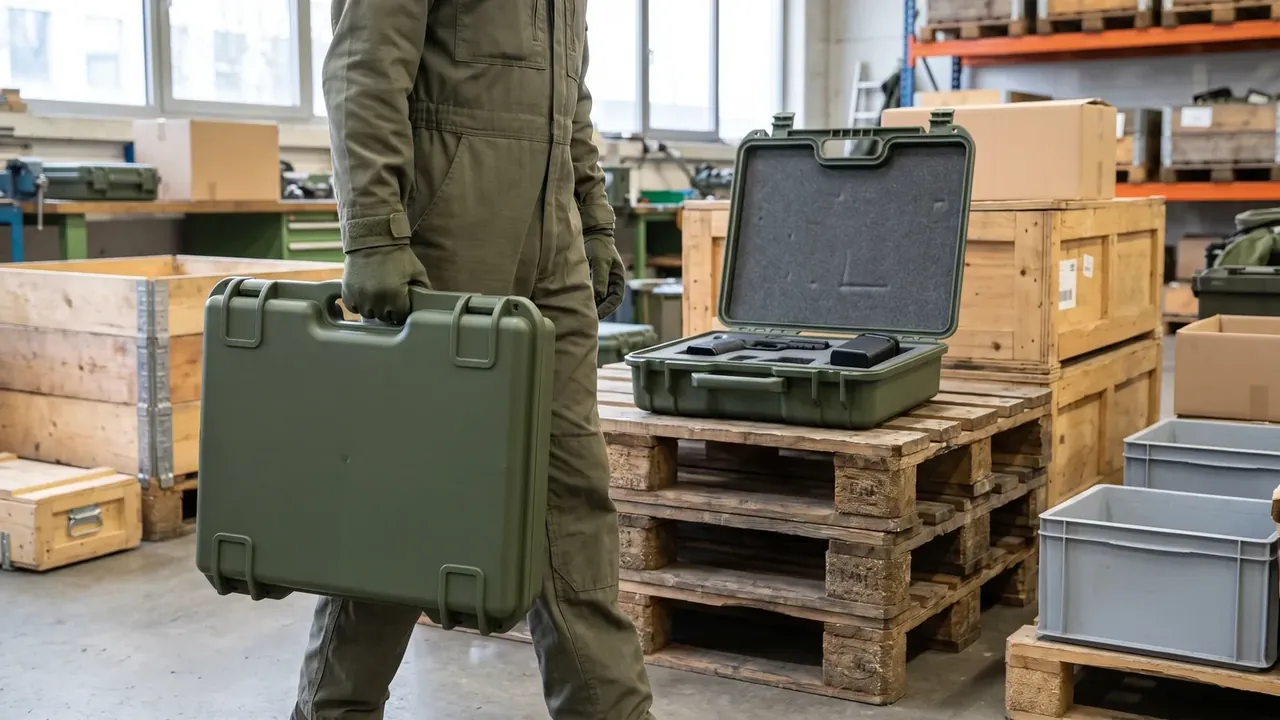
The valve opens at 12 kPa to leave room for temperature. The cavity holds about 54.6 L, and warming from −30 °C to 65 °C raises absolute pressure by 39%, so air vents before the gasket leaves its seat. One metre of water is 9.8 kPa, under the threshold, so the valve stays shut through immersion; that margin is what lets IP67 and pressure equalisation coexist on one IP67 dustproof waterproof military transit case.
| Control value | How it is judged | Past it |
|---|---|---|
| 10 mm at 25% | cord against groove depth | 40% brings 18% set |
| 12 kPa | opening differential | under 9.8 kPa it leaks at 1 m |
| 2.5 mm | effective squeeze | under 2.0 mm it misses 0.3 mm |
| 4 × 450 N | 1800 N total | one latch at 300 N lifts the edge |
| 1.2 m | drop height | a cracked corner shifts the groove |
At −30 °C the silicone hardens and 25% squeeze needs 260 N instead of 220 N, so each latch shares 10 N more; at 65 °C squeeze climbs to 30% by itself.
5. Salt spray for 96 h, dust at 2 kg/m³
Salt spray runs 96 h neutral, aimed not at the shell but at latch springs, hinge pins and the valve disc. Plating is held at 12 μm with no red rust at 96 h; at 6 μm the first spots appear inside the coils at 48 h, rust takes two active coils out, and opening force falls from 65 N to 45 N.
Dust runs 8 h at 2 kg/m³ at latch teeth and the valve seat; about 0.3 g in a tooth groove stops the hook 4 mm short, and dust on the seat drifts the 12 kPa threshold to 20 kPa.
Conclusion
Service life is set by 0.3 mm of flatness, 25% squeeze and a 12 kPa valve, and stacking rewrites all three: five levels at 320 kg for 90 days bows the lid 0.5 mm, enough to leave one side of the cord hanging. Hold flatness at the mould, let the valve breathe and keep 450 N at each latch, and the IP67 dustproof waterproof military transit case meets a condition, not a label.
Related Reading
- IP67 waterproof case: what 1 m for 30 min really means
- Dust and water test items and pass criteria
- Five decision points for military transit cases
- Acceptance standards for IP67 plastic protective cases
Related Products
- 8 Series — Gun Cases; Military Equipment Cases; Camera Equipment Cases; Drone Cases; Watch Cases; Knife Cases; First Aid Cases; Electronics Equipment Cases
- WL8-2812 PP Gun Case — model WL8-2812
- All protective cases and toolboxes: 7 series, 158 models