

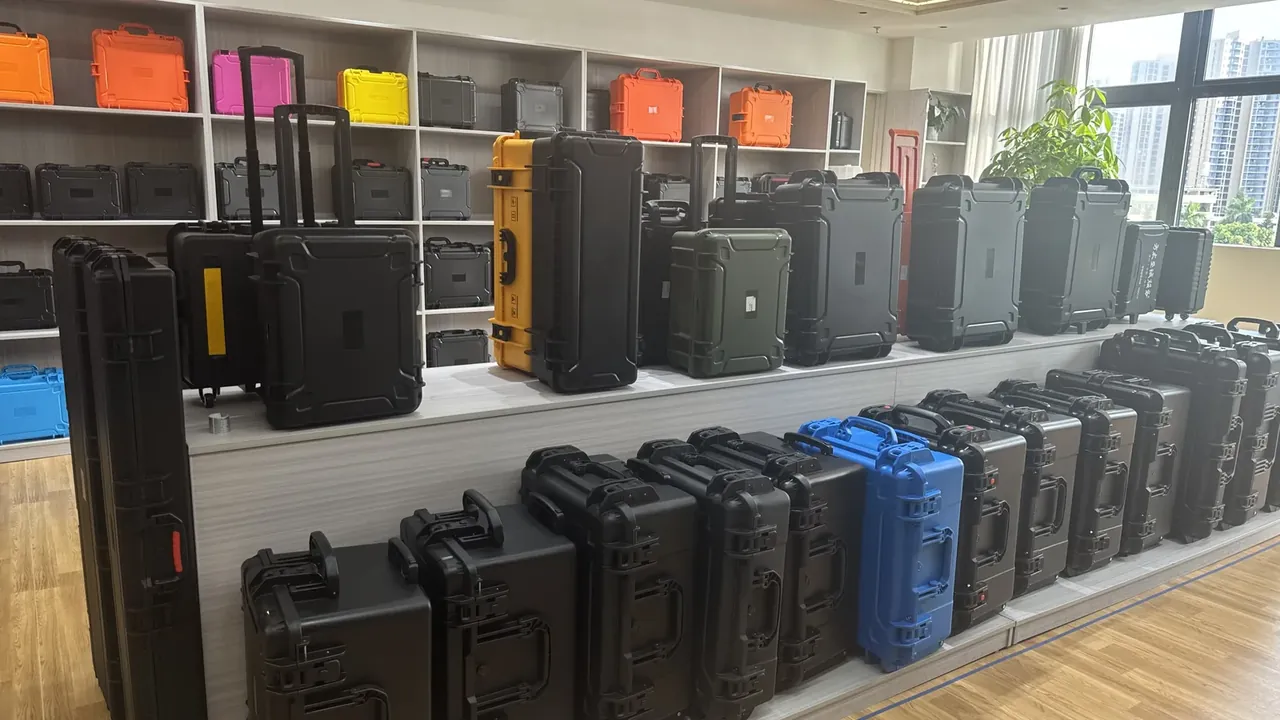
Quick answer: In a jewellery display case the order is window, then lock, then lining: a 4 mm PC window fixes visibility, a 300 N lock fixes security.
Table of contents
- Order of decisions: window, lock, lining
- Setting the 105° display angle
- The 4 mm PC window and 3H hardness
- Cam lock or combination: proving 300 N
- 2 mm flocking and a 15 kg handle
- FAQ
1. Order of decisions: window, lock, lining
Seeing and locking compete for the same rim, so the order cannot be reversed. Fix the window and the rim width follows; fix the lock and you learn how much rim is left; the lining only fills what those two leave.
Reverse it and the lock ends up in a window that shrank by a ring: every 10 mm of rim a lock body takes is 10 mm off the display face.
On a 400 × 300 mm lid, a 320 × 220 mm window leaves a 40 mm rim. That rim has to carry both hinge pockets and latch catches, and two 20 mm stiffening bands are just enough.
| Order | Item | Key figure | What breaks if missed |
|---|---|---|---|
| 1 | Window | 4 mm PC, 70% of lid | Rim too thin for the catch |
| 2 | Lock | 300 N per point | Lock eats the window, rim splits |
| 3 | Lining | 2 mm flock, 12 mm well | Shallow well, pieces slide |
The three items are hard-linked: below a 25 mm rim, the latch screw lands on the window gasket groove, lifting the seal by 1 mm and losing dust and water protection at the same time.
2. Setting the 105° display angle
105° splits the difference between visibility and stability. At 90° the lid stands vertical and the customer has to bend to see the tray; at 120° the lid centre of gravity passes the hinge and a knock on the counter keeps it falling.
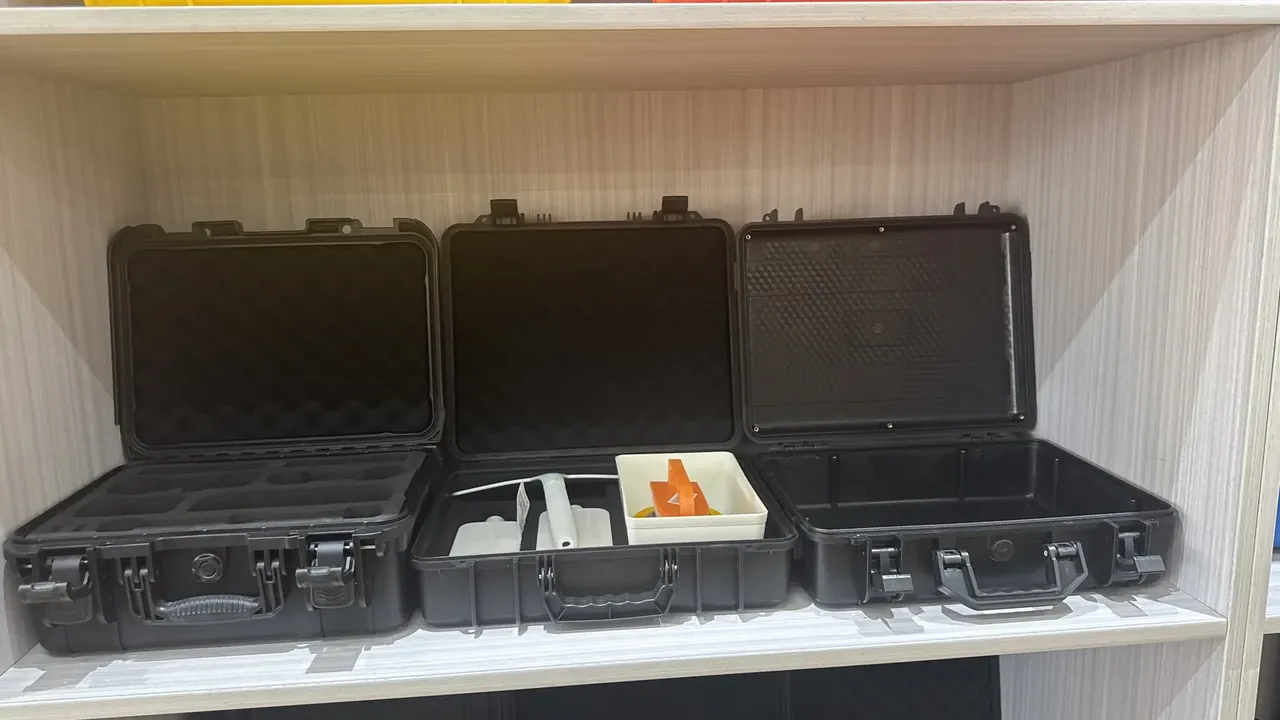
Work the angle from the person: at a 900 mm counter and 1500 mm eye level, a 105° lid puts the tray at 35–55° to the eye, readable without stooping.
The stop belongs inside the hinge, not in a strap. A 3 mm stop block carries the 1.8 kg lid, wears 0.2 mm over 5000 cycles and loses only 2° of angle.
Lighting runs in an 8 × 6 mm channel along the rim, and a 12 V strip at 4 W/m hides behind the window, so no cable shows from the front.
3. The 4 mm PC window and 3H hardness
4 mm is where stiffness and weight part company: over 400 mm, a 3 mm window deflects 2.1 mm under a finger and 4 mm only 0.9 mm, and past 1.5 mm the finger reaches the goods.
3H is measured as pencil hardness. A 3H sheet survives 500 g without marking, and a ring edge leaves a polishable trace; a 2H sheet takes a 0.05 mm scratch that costs 4 min to polish out.
Read transmission and haze together. A 4 mm sheet gives 89% transmission and 2% haze against 91% and 1.5% at 3 mm, which is the price of stiffness; an anti-glare coating lifts haze to 4% and softens the spotlights.
The window seals to the lid on a double-sided tape gasket at 25% compression, so a 320 × 220 mm sheet can be changed in 15 min without stripping the whole lid.
4. Cam lock or combination: proving 300 N
300 N is the pass line. A tensile tester pulls the catch at 10 mm/min and the bolt must stay engaged with no rim split; two lock points flank the window and each carries 150 N.
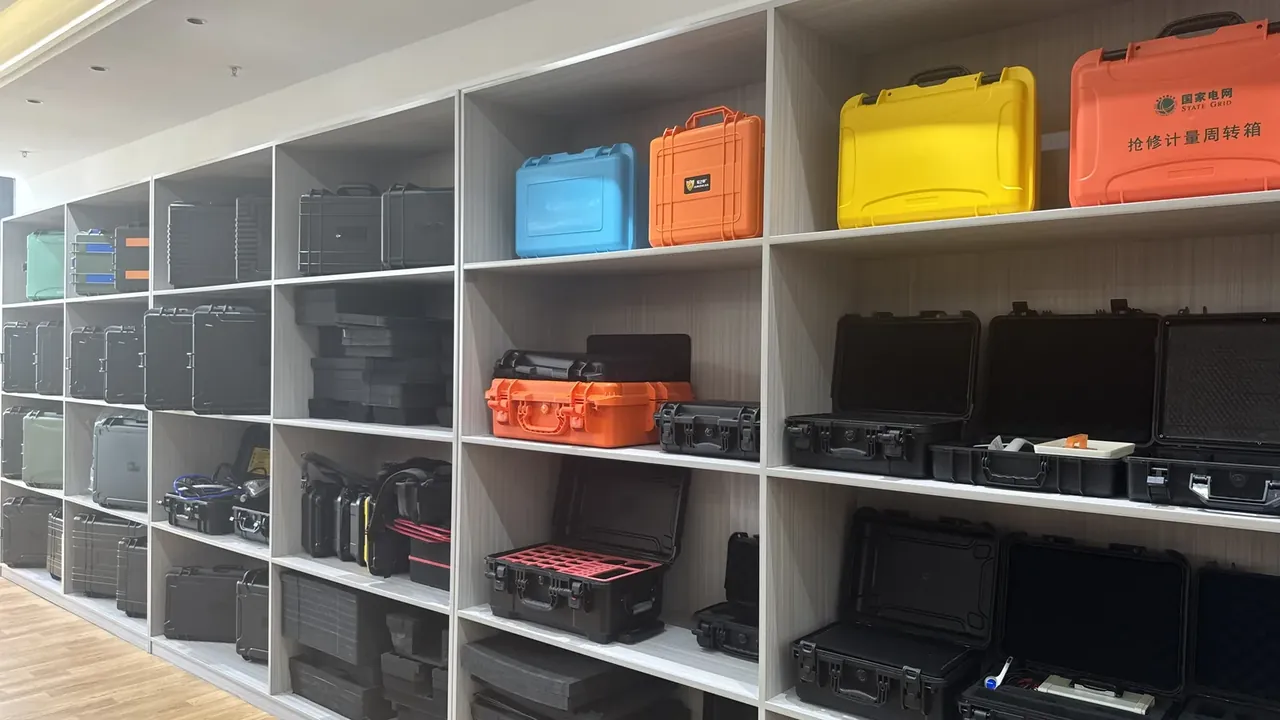
The real difference between a cam lock and a combination lock is opening speed and who carries responsibility. One key opens every case in 3 s; a four-digit code per person removes key handover but locks out for 30 s after three wrong entries.
| Item | Cam lock | Combination |
|---|---|---|
| Pull per point | 300 N | 300 N |
| Opening time | 3 s | 8 s |
| Access control | One key | Four digits per person |
| Best fit | Back-room storage | Counter handover |
Lock position beats lock model: a point 12 mm from the window edge gives the shortest load path, while at 6 mm the rim splits at 260 N with the lock still intact.
Leave 0.5 mm between catch and bolt. The lid expands at 45 ℃ in summer and jams without it, while more than 1 mm rattles and makes staff think the case is unlocked.
5. 2 mm flocking and a 15 kg handle
2 mm flocking balances thickness and wrap. At 1 mm the board edge prints through the fabric; at 3 mm it eats 1 mm of well depth and the tray sits proud.
Well depth follows the piece. Rings take a 12 mm well, necklaces 8 mm, with 2 mm flocking in the bottom and 1.5 mm flocked board for the walls, chamfered 0.5 mm at the lip so chains do not catch.
| Piece | Well depth | Well width | Load per cell |
|---|---|---|---|
| Ring | 12 mm | 25 mm | 0.3 kg |
| Necklace | 8 mm | 180 mm | 0.5 kg |
| Bangle | 15 mm | 90 mm | 0.8 kg |
The handle is rated at 15 kg. The case weighs 6.2 kg empty and 11.8 kg loaded, and the handle holds 15 kg for 1 h without set, on two rivets per side at 60 mm centres.
Set the display height too: a 900 mm counter with a 120 mm case puts the open lid at 1050 mm, 450 mm below eye level, clear of the face.
Conclusion
Display and security split into two lists ticked off on one drawing. Display: window at 70% of the lid, 105° opening, 4 mm PC, 2 mm flocking over 12 mm wells. Security: 300 N per point, points 12 mm from the glass, 0.5 mm catch clearance, rim never under 25 mm. Both lists share one rim, and neither may take more than its share. Do that and the jewellery display case lets a customer read the tray standing up, staff open it in 3 s, and still passes 300 N.
This article discusses container-side specifications and design implications only, and does not cover any handling, loading or use of the contents.
Related Reading
- Jewellery case structure and lining
- Display face design for exhibition cases
- Watchmaking tool case compartments
- Testing flocking wear inside cases
Related Products
- 8 Series — Gun Cases; Military Equipment Cases; Camera Equipment Cases; Drone Cases; Watch Cases; Knife Cases; First Aid Cases; Electronics Equipment Cases
- WL8-2812 PP Gun Case — model WL8-2812
- All protective cases and toolboxes: 7 series, 158 models