

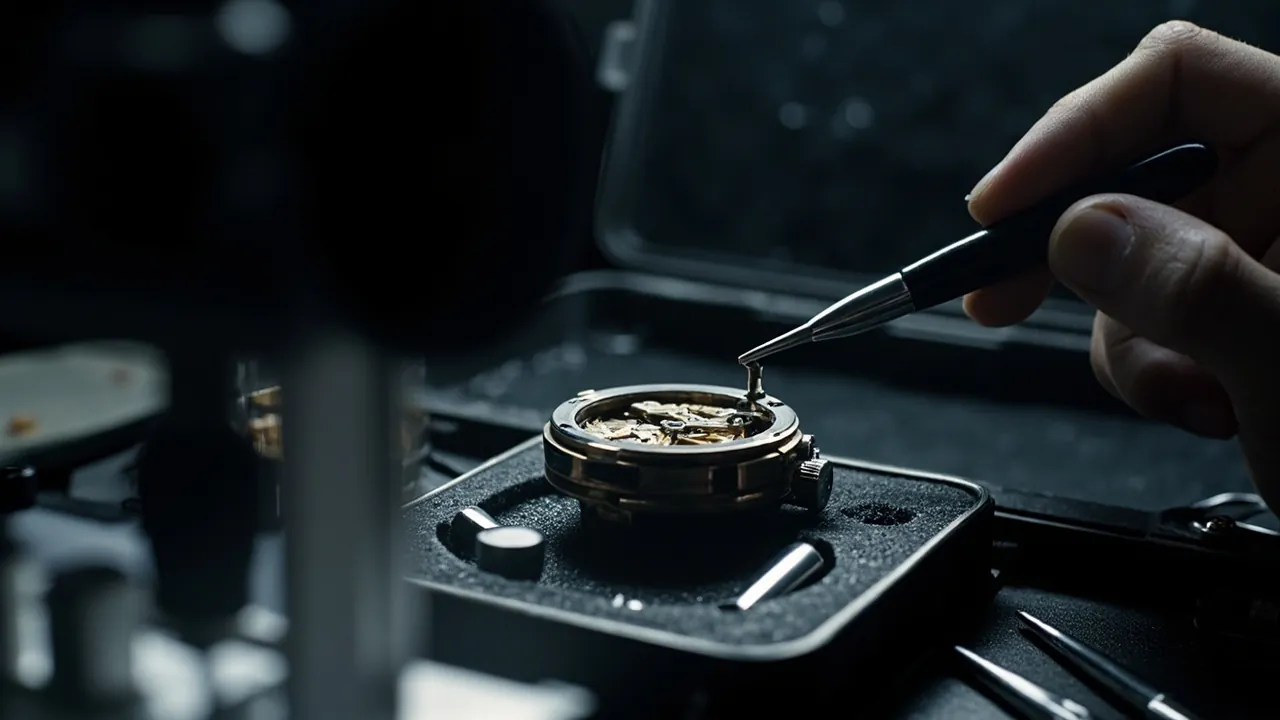
A watchmaking tool case differs from an ordinary tool case in one fundamental way: what it carries is measured in microns. The headline conclusion is that the governing metrics for a watchmaking case are not load capacity but vibration transfer, residual magnetism, humidity, and micro-tool tip protection. A timegrapher that crossed an ocean can look perfect yet drift off zero, and a screwdriver set without individual retention can come back with an edge roll that is invisible to the eye. Both losses are nearly undetectable at goods-in inspection. Meeting IP65 or better under IEC 60529 and GB/T 4208 is only the shell-level threshold. What decides the outcome is the interface precision between liner and parts.
This article is written for purchasing managers at watch repair chains, traders in movements and parts, and case suppliers handling OEM/ODM programs. It works through movements, micro-tools, cleaning equipment and test instruments item by item, and gives liner material comparison tables, a standards reference list and executable acceptance steps. The working values quoted here can be written straight into a procurement technical agreement.
Table of Contents
- 1. The Protection Logic of a Watchmaking Tool Case: How It Differs
- 2. Shipping Movements: The Triple Constraint of Vibration, Magnetism and Humidity
- 3. Hairsprings and Balance Wheels: The Two Most Magnetism-Sensitive Parts
- 4. Micro-Tools: Protecting the Tips and Edges of Tweezers, Screwdrivers and Oilers
- 5. Cleaning Machines and Ultrasonic Baths: Residual Solvent and Safety Boundaries
- 6. Water-Resistance Testers and Timegraphers: Vibration and Humidity for Precision Electronics
- 7. Case Presses, Demagnetizers and Opening Tools: Separating Heavy and Magnetic Items
- 8. Parts Trays and Screw Storage: Preventing Spill and Bounce
- 9. Liners and Dividers: Elastic Pockets, CNC Cut Foam and Magnetic Retention
- 10. Seals, Pressure Equalization and Latches: Matching the Field-Service Use Case
- 11. Standards Cross-Reference: From IEC 60529 to ISO 764 and ISO 22810
- 12. Selection Workflow, Acceptance Points and AQL Sampling
- 13. Volume Supply and OEM/ODM Collaboration Models
- Frequently Asked Questions
- Conclusion & Related Reading
1. The Protection Logic of a Watchmaking Tool Case: How It Differs
An ordinary tool case is designed to hold enough, carry comfortably and survive a drop. A watchmaking case has a completely different objective function, and it must satisfy three conditions that pull against each other.
First, the protected mass is tiny but the failure threshold is extremely low. A movement typically weighs 5 g to 30 g, a hairspring is on the order of 20 to 40 microns thick, and a balance staff pivot is under 0.1 mm in diameter. That makes the mass ratio between case and contents extremely lopsided: a 3 kg empty case holding a 20 g movement barely attenuates vibration transfer at all. The fix is not thicker walls but local mass isolation inside the liner, suspending small, light items in a resilient medium so their response sits outside the resonant band.
Second, magnetic contamination is irreversible. Once a steel part is magnetized it attracts iron debris and disturbs the isochronism of the balance and hairspring system; in severe cases the rate error can reach tens of seconds per day. Magnetization usually happens before packing and is only discovered after unpacking.
Third, micro-tool failure is gradual. A tweezer tip misaligned by 0.05 mm can no longer hold a hairspring. A rolled screwdriver edge slips and chews the screw slot. The tool never "breaks." It simply forces the technician into repeated rework.
Those three conditions explain why professional watchmaking cases use a layered structure with individual compartments and low-rebound liners, rather than simple foam cutouts. See the instrument case selection guide for more on that design approach.
2. Shipping Movements: The Triple Constraint of Vibration, Magnetism and Humidity
The movement is the most valuable and most fragile item in the case. The three constraints rank as follows.
Vibration control comes first. The balance and hairspring system inside a movement is a high-Q mechanical resonator, and external vibration near its natural frequency is amplified. Transport vibration energy concentrates between 3 Hz and 100 Hz, while movement components often resonate anywhere from tens to hundreds of hertz, so coupling is a real risk. The engineering answer is to embed the movement in at least 20 mm of low-rebound material so the system natural frequency drops below the dominant excitation band, and to avoid hard contact entirely: a movement must never sit directly against a rigid part.
Magnetic control comes second. The magnetic sources most often overlooked at packing time include magnetic bases, demagnetizers, speaker-type components, magnetized screwdriver bits and magnetic snap closures on bags. The working practice is to divide the interior into a magnetic zone and a non-magnetic zone with at least 150 mm of separation, and optionally add a high-permeability foil such as mu-metal around the movement cell. Note that shielding adds roughly 5 to 15 percent to case weight.
Humidity control ranks third, but on sea freight it often becomes the first priority. Steel parts in a movement corrode quickly above 60 percent relative humidity with day-night temperature cycling. Inside a sea container the relative humidity sits between 80 and 95 percent for long periods, so place desiccant in individual compartments using a working ratio of 100 g of silica gel per 50 L of internal volume, adjusted for voyage length and season.
The table below gives reference liner parameters for movement-class components.
| Component | Typical weight | Primary risk | Recommended liner | Buffer thickness | Notes |
|---|---|---|---|---|---|
| --- | --- | --- | --- | --- | --- |
| Complete movement in case | 5-30 g | Vibration, residual magnetism, moisture | Anti-static EVA 25D plus PU foam cradle | 20-30 mm | Never in direct contact with rigid parts |
| Bare movement, no case | 3-15 g | Pivot fracture, hairspring distortion | PU 15 kg/m3 individual cell | 25-35 mm | Box it first, then place it in the cell |
| Dials and hands | under 5 g | Scratching, displacement | Non-woven separator plus shallow cell | 10-15 mm | Store dial face up |
| Cases and bracelets | 20-120 g | Scratching, deformation | EVA 30D shallow channel | 10-20 mm | Metal bracelets must not rub together |
| Gaskets and seals | under 5 g | Loss, deformation | Individual small cell or parts box | n/a | Number by specification |
3. Hairsprings and Balance Wheels: The Two Most Magnetism-Sensitive Parts
The hairspring and balance system is unusually sensitive to magnetic fields because the material itself is ferromagnetic. Once a hairspring is magnetized, adjacent coils attract each other, which effectively shortens the active working length of the spring and directly changes the oscillation period of the balance system. The symptom is a sudden gain in rate that varies irregularly with position.
The industry has product standards that frame what magnetic resistance means. ISO 764 defines magnetic resistant watches and their test methods, and its residual magnetism requirements are a useful reference for understanding the magnitude of the effect. ISO 22810 defines water-resistant watches and their test methods, and is a useful reference for judging whether a case seal survived transport. To be clear: both standards address finished watches, not packaging. Citing them in a case context is meant to help a buyer understand why magnetic zoning is necessary, not to claim a case "complies with ISO 764."
Three practical recommendations:
- Demagnetize and measure before packing. Use a gaussmeter to confirm that residual magnetism on the movement and critical steel parts is within an acceptable range, with below 1 mT as a working target, and record the reading. This separates transport-induced magnetization from magnetism present at goods-in.
- Zone the interior. Put magnetic items such as demagnetizers, magnetic bases and magnetized bits in a separate bay from movements, hairsprings and balance wheels, with at least 150 mm of separation. Where space is tight, a 1 mm to 2 mm low-carbon steel plate between the zones acts as a simple flux short circuit.
- Avoid ferrous case hardware. Iron hinges, latches and rivets can become magnetic sources or become magnetized themselves. Specify stainless steel or engineering plastic. See toolbox hinge latch and seal structure.
4. Micro-Tools: Protecting the Tips and Edges of Tweezers, Screwdrivers and Oilers
Micro-tools are the items most often worn out rather than broken. Inside a case they fail in three ways: tips striking each other, tips punching through the liner, and sustained compression deformation.
Tip-to-tip impact is the dominant mode. If a dozen tweezers are tossed loosely into a tray, relative motion during transport causes tips to cross and collide. A 0.05 mm offset is invisible to the eye but makes the tool slip repeatedly when holding a hairspring. The fix is one slot per tweezer, slot width matched to tool width with 0.5 mm to 1 mm clearance, and slot depth of at least 60 percent of tool thickness so the tip sits enclosed rather than exposed.
Tip punching through the liner happens when the buffer layer is too thin or too soft. Contact pressure at a tweezer tip is very high, and low-density material such as PU 15 kg/m3 perforates easily. Add a 3 mm to 5 mm backing plate of high-density EVA or XPE under the slot floor.
Sustained compression deformation comes from the lid-side compression pad. If the pad that suppresses bounce presses too hard, screwdriver shafts and tweezers sit under bending stress for the whole trip. A working rule is to hold pad compression between 10 and 20 percent, providing light restraint rather than hard clamping.
Screwdriver sets have an additional requirement: edge protection. Arrange drivers by tip specification, cradle the shaft in a half-round channel, and leave the tip suspended rather than touching the case floor. Where a set covers more than 20 tip types, use a two-part liner with one piece in the lid and one in the base, the shaft bedding into the lower piece and the tip restrained by soft padding in the upper piece.
Oilers and anti-diffusion fluid are liquid-bearing accessories and must be stored separately, tip up, with absorbent material under the slot. If an oiler leaks in transit, the solvent attacks the EVA surface and leaves a permanent crater.
5. Cleaning Machines and Ultrasonic Baths: Residual Solvent and Safety Boundaries
Cleaning machines and small ultrasonic baths are the most common equipment on a repair bench and the two most likely to cause self-inflicted damage at packing time.
Cleaning machines typically use petroleum ether, isopropanol or a proprietary cleaning fluid. These solvents have low flash points and high volatility, and residual liquid inside a sealed case creates an accumulation of flammable vapor. Two hard boundaries follow. First, the solvent must be fully drained and the machine air-dried before packing. Second, a container with solvent residue must not be placed inside a fully sealed case for long-distance transport. If solvent genuinely must travel with the kit, use the original sealed metal container, fix it separately, and comply with dangerous goods requirements such as the classification and marking rules described in ADR/IMDG hazmat transport case.
Small ultrasonic baths consist of a tank, transducers and a generator. Moisture on transducer lead terminals reduces insulation resistance, and power devices in the generator are sensitive to condensation. Drain the tank, tilt it to stand for at least 30 minutes and confirm no droplets remain, then seal the generator separately in a moisture-barrier bag with desiccant.
Residual liquid control is a boundary question, not a capability question. What a protective case can do is confine liquid locally and prevent it from contaminating other equipment and the liner. It cannot substitute for ventilation, explosion protection or chemical storage requirements. A procurement agreement should state explicitly that the case is not a chemical storage container, which keeps responsibility boundaries clean.
Solvent-bearing equipment also changes the liner material choice. Standard EVA swells and softens with prolonged petroleum ether contact. Switch to PE, which has better solvent resistance, or a surface-treated material, and provide a replaceable absorbent pad at the bottom of each compartment.
6. Water-Resistance Testers and Timegraphers: Vibration and Humidity for Precision Electronics
Modern watch retail and service operations typically run a water-resistance tester, either pneumatic or hydraulic, and a timegrapher. Both are hybrids of precision electronics and precision mechanics.
Timegraphers center on a microphone pickup and a signal-processing circuit. The pickup converts the escapement sound into an electrical signal, which the circuit then analyzes for rate, amplitude and trace. Transport vibration shifts the pickup mounting microscopically, reducing sensitivity. That drift does not show up at goods-in; it shows up later as unstable readings during regulation. Pack the whole timegrapher in a low-rebound liner, and remove the detachable microphone arm and clamps before packing, then fix them separately.
Water-resistance testers split into two types. Pneumatic units contain a precision pressure sensor and an air pump and need their water circuit drained. Hydraulic units need the test chamber and lines fully drained, otherwise residual water seeps during transport and damages the electrical section. Both share the same requirements: cap chamber openings, plug line ports, and use adequate desiccant.
Vibration guidance: buffer thickness of at least 30 mm for these units, plus a dedicated cushion pad under the case floor. If the unit contains a fan or compressor, remove it and fix it separately.
Humidity guidance: target internal relative humidity below 60 percent, achieved passively with desiccant. For routes through humid regions, embed a humidity indicator card in the liner so the receiver can judge at a glance whether limits were exceeded. See extreme temperature case design for supplementary measures in harsh climates.
7. Case Presses, Demagnetizers and Opening Tools: Separating Heavy and Magnetic Items
This group is characterized by high weight, magnetic content, and simple but easily deformed structures.
Case presses are classic eccentric-loading equipment. If packed whole, the joint between the press ram and base takes a bending moment on impact, bending the ram or deforming the base. Remove the ram and pack it separately, fix the base with a CNC-cut PE liner, and add a wooden skid or high-density PE baseplate to spread impact load.
Demagnetizers are strong magnetic sources in their own right and must occupy their own zone, at least 150 mm away from movements, hairsprings and timegraphers. If the coil is an open structure, also prevent metal debris from being attracted into the winding gaps.
Case opening tools, including case knives, opening blocks and case holders, are typically stainless steel with concentrated mass and sharp corners, and they scratch other equipment in transit. Give each item its own compartment, use an XPE backing plate to prevent punch-through, and add a soft pad above the slot so tools cannot jump out.
When heavy and light items share a case, one general principle applies: place heavy items low, near the geometric center, and as close to the hinge side as practical. This keeps the center of gravity stable when carrying and prevents heavy items from falling out when the lid opens. The mechanics are consistent with the analysis in cushion liner case design.
8. Parts Trays and Screw Storage: Preventing Spill and Bounce
Parts generated during watch repair are extremely small. Screws commonly run from 0.6 mm to 1.2 mm in diameter, and shock springs, bridge screws and spring bars are nearly impossible to find once they scatter. Parts storage design directly determines repair efficiency.
The root cause of spill is insufficient constraint combined with vibration coupling. Three design points follow:
- Numbering and fixing. Give every parts tray numbered positions and return parts to their assigned positions. Shallow cells 3 mm to 6 mm deep are more practical than deep wells because they allow visual identification.
- Anti-bounce cover. Add a removable transparent cover over the tray, or use gentle soft padding. The key is suppressing vertical bounce, not simply making cells deeper.
- Removability. The tray should lift out as a unit and serve as a standalone working tray. That requires the liner cell to hold the tray outline within plus or minus 0.3 mm; more clearance and it rattles, less and it is hard to remove.
For screws and similar tiny items, use individual lidded boxes with one specification per box, then nest the boxes in the liner. That way even an inverted case will not mix specifications. See case removable divider system for structural approaches to removable compartments.

9. Liners and Dividers: Elastic Pockets, CNC Cut Foam and Magnetic Retention
There are three mainstream liner approaches for watchmaking cases, each with a clear boundary of use.
| Liner type | Structure | Advantages | Limits | Best fit |
|---|---|---|---|---|
| --- | --- | --- | --- | --- |
| Elastic pocket panel | Elastic fabric sewn to a rigid board | Accepts tools of similar size, fast access | Dimensional accuracy depends on fabric stretch; heavy items sag | Screwdrivers, tweezers, oilers |
| CNC cut foam | One-piece EVA or PE machined cavity | High precision, no seams, easy to clean | Highly tool-specific; changes require a new drawing | Movements, instruments, dedicated fixtures |
| Magnetic retention | Embedded magnetic strip or pads | Convenient access, clear positioning | It is itself a magnetic source and conflicts with magnetic control | Stainless tweezers, non-magnetic assembly fixtures |
| Hybrid | CNC base plus pocket panel plus local magnets | Combines precision and flexibility | Higher structure and cost | Complete field-service kits |
Key trade-off: magnetic retention must be used cautiously in watchmaking. It is convenient, but the magnet strip becomes a field source and directly conflicts with the anti-magnetic requirement for movements and hairsprings. If it must be used, isolate the magnetic zone from the movement zone with a solid divider, keep at least 150 mm of separation, and mark both zones clearly. A mechanical elastic clamp, such as a stainless spring clip or silicone grip, is the safer alternative.
Density selection: EVA 25D to 30D for micro-tool cells, balancing support and cushioning; PU 15 to 20 kg/m3 with anti-static treatment for movements; PE or EVA 40D and above for heavy items. For stronger vibration isolation, add a full 10 mm layer of XPE under the case floor. For a quantitative comparison, see case foam material comparison.
10. Seals, Pressure Equalization and Latches: Matching the Field-Service Use Case
Watchmaking cases serve two very different scenarios: fixed use in a workshop and field service on customer premises. Sealing requirements differ sharply.
Workshop use is mainly about dust and humidity, and IP65 is sufficient. Here the priority is liner precision and access convenience rather than sealing class.
Field service faces rain, road vibration and temporary parking. Specify at least IP65 and IP67 where practical. Field kits also have a special requirement: frequent opening and closing. Latch fatigue life must be long enough, and the latch should be operable one-handed while wearing gloves. See case lock customization options.
A pressure equalization valve is equally necessary in field service. In summer, a vehicle trunk interior can exceed 60 C. Internal air expands, and a fully sealed case with no valve has its lid forced tight and can even roll the gasket outward. For how the valve works and how to select one, see case pressure equalization valve.
Cleaning and maintenance also affect long-term sealing. Dust, polishing paste and solvent residue on a gasket accelerate aging. Wipe the gasket with a damp cloth quarterly and check for uneven compression marks. See how to clean a protective case.
11. Standards Cross-Reference: From IEC 60529 to ISO 764 and ISO 22810
Writing protection requirements into a procurement technical agreement requires citable, auditable standards. The table below maps common standards to watchmaking case requirements.
| Standard | Scope | Application to watchmaking tool cases |
|---|---|---|
| --- | --- | --- |
| IEC 60529 / GB/T 4208 | Enclosure ingress protection, IP code | Defines IP65 and IP67 dust and water ratings and test methods |
| MIL-STD-810H | Environmental test methods, non-military | Used as a methods reference for vibration, shock, temperature and fungus; it is a test-method reference only and does not constitute military certification or military qualification |
| ISTA 2A / 3A | Packaged-product and LTL transport testing | Validates vibration and drop performance for single-case shipments |
| ASTM D4169 | Performance testing of shipping containers | Sets test intensity from distribution cycle and assurance level |
| GB/T 4857 series | Basic tests for transport packages | Drop, stack and vibration basis for domestic routes |
| UL94 | Flammability of plastic materials | Flammability rating for liner and shell materials, commonly HB, V-2 or V-0 |
| ISO 764 | Magnetic resistant watches | Reference for understanding movement-level magnetic requirements only; describes the magnitude of residual magnetism effects |
| ISO 22810 | Water-resistant watches | Reference for understanding case sealing only; used to judge whether a seal survived transport |
| IEC 62262, IK code | Degree of protection against mechanical impact | Expresses external impact resistance |
The boundary around ISO 764 and ISO 22810 must be stated explicitly. They are watch product standards governing the magnetic and water resistance performance of the watch itself, not packaging standards. When cited in a technical agreement, the correct wording is "zoning designed with reference to the residual magnetism requirements of ISO 764." The incorrect wording is "the case complies with ISO 764." That distinction gets probed directly in export compliance review.
The same care applies to how MIL-STD-810H is described. The correct statement is that a case "uses the vibration and shock test methods defined in MIL-STD-810H." The incorrect statement is that a case is "MIL-STD-810H certified." The standard is a collection of test methods and provides no product certification. See MIL-STD-810H case compliance.
12. Selection Workflow, Acceptance Points and AQL Sampling
Six steps for selection:
- Inventory. List every item to be carried: movement count, micro-tool types and quantities, equipment models and weights, and any liquid-bearing accessories.
- Risk ranking. Sort by value multiplied by fragility to set priorities for individual compartments.
- Rating definition. Set IP, IK and flammability ratings from the use case, meaning workshop or field service, and from the transport route.
- Liner plan. Material, density, cell layout, buffer thickness, and whether magnetic zoning is required.
- Test requirements. Drop height, vibration spectrum, stacking load, temperature and humidity cycling.
- Acceptance rules. Appearance, dimensions, sealing, fit tolerance, marking, and sampling ratio.
Most acceptance disputes concentrate on fit tolerance. Define three tolerance bands explicitly: liner cell to tool fit, at plus or minus 0.3 mm for micro-tools; lid pad compression, at 10 to 20 percent; and case external dimension, typically plus or minus 2 mm. These values belong on the drawing rather than in verbal agreement.
Field sealing checks use two qualitative methods: close the empty case and immerse it for 5 minutes watching for continuous bubbles, or pressurize to 20 kPa through the equalization valve and observe the decay rate. Neither replaces laboratory IP testing, but both screen out obvious defects.
For sampling, reference the AQL system: critical defects such as seal failure, latch breakage or failed magnetic zoning take AQL 0.65 or tighter; major defects such as liner fit deviation or cosmetic flaws take AQL 1.5 or 2.5. See custom case acceptance and AQL.
13. Volume Supply and OEM/ODM Collaboration Models
There are generally three procurement models for watchmaking tool cases:
- Standard case plus custom liner. Short lead time and low cost, suited to repair chains whose tool system is already stable. When tools are added, only the liner panel needs rework, not the case tooling.
- Modified case, semi-custom. Adjust latches, hinges, nameplate provisions and color on a standard case size. Suits private-label programs and unified retail identity, and is the most efficient route during chain expansion.
- Full new tooling. For cases with specific brand identity requirements or an unusual tool system. Mold cost and MOQ need separate calculation; see custom case mold cost analysis for the payback logic.
JUNZHJIA, manufactured by Kexin New Materials (Guangdong) Co., Ltd., serves B2B customers with wholesale, distribution, OEM/ODM and global supply. In watchmaking, typical capabilities include reverse-modeling liners from physical tools or drawings, configuring anti-static and magnetically zoned structures on request, matching gaskets and pressure equalization valves to the case model, issuing test reports or third-party inspection documents to a customer-specified standard, and scheduling small-batch repeat orders. For chains that iterate their tool lists continuously, the liner drawing updates alongside the tool list without repeated tooling.
Evaluate suppliers on liner engineering capability, test resources and delivery stability rather than shell price alone. See how to choose a case OEM factory and protective case service life.
Frequently Asked Questions
Q: Why can't a watchmaking case use ordinary sponge with cutouts as a liner? A: There are three main problems. The first is rebound behavior: open-cell sponge loses resilience after repeated compression, so cells collapse and tools loosen within about six months, whereas EVA and XPE have far lower compression set. The second is dust and moisture absorption: open-cell foam takes in dust, oil and humidity and is hard to clean, and debris accumulating in a cell over time can scratch movements and dials. The third is ESD performance: ordinary sponge is an insulator, so friction-generated static attracts tiny parts and can damage the electronics in test instruments. The professional approach is a closed-cell EVA or PE body, CNC cut to the tool outline, with an anti-punch-through backing plate under each cell floor. For ultra-sensitive items such as movements, add a PU foam cradle inside the cell as a secondary buffer. Where budget allows, anti-static modified material is more reliable than a sprayed coating, because coatings wear off with wiping.
Q: How far does anti-magnetic protection need to go when shipping movements? A: There is no universal number, but you can work backward from the mechanism. Once a hairspring is magnetized, adjacent coils attract each other, which effectively shortens the active working length and directly changes the oscillation period, producing a sudden rate deviation that varies irregularly with position. As a working engineering target, keep residual magnetism on movements and critical steel parts below 1 mT before packing, and record the value with a gaussmeter so transport-induced magnetization can be distinguished from magnetism present at goods-in. Structurally, zone the interior: demagnetizers, magnetic bases and magnetized screwdriver bits go in a separate bay from movements, hairsprings and timegraphers, with at least 150 mm of separation. Where space is tight, a 1 mm to 2 mm low-carbon steel plate between zones acts as a flux short circuit. Case hinges, latches and rivets should be stainless steel or engineering plastic so they do not become secondary sources. Note that ISO 764 governs finished magnetic resistant watches, not packaging; citing it only frames the magnitude of the effect.
Q: What pre-packing steps are mandatory for cleaning machines and ultrasonic baths? A: Treat the two separately. Cleaning machines typically use petroleum ether, isopropanol or a proprietary fluid with a low flash point and high volatility, and residual liquid inside a sealed case creates flammable vapor accumulation. Two hard boundaries follow: drain and air-dry fully before packing, and never place a solvent-bearing container inside a fully sealed case for long-distance transport. If solvent must travel with the kit, use the original sealed metal container, fix it separately, and comply with dangerous goods classification and marking requirements. Ultrasonic baths carry risk in the electrical section: moisture on transducer lead terminals lowers insulation resistance and can cause breakdown, and power devices in the generator are sensitive to condensation. So drain the tank, tilt it to stand for at least 30 minutes and confirm no droplets remain, then bag the generator separately with desiccant. As a working ratio, use 100 g of silica gel per 50 L of internal volume, adjusted for voyage length and season. A protective case is not a chemical storage container, and the technical agreement should state that boundary.
Q: What specific measures protect micro-tool tips? A: Micro-tools fail gradually, so protection must target three distinct modes. Against tip-to-tip impact, give every tweezer and screwdriver its own slot, matched in width with 0.5 mm to 1 mm clearance, and slot depth of at least 60 percent of tool thickness so the tip sits enclosed rather than exposed. Against punch-through, add a 3 mm to 5 mm high-density EVA or XPE backing plate under the slot floor, because contact pressure at a tweezer tip is very high and low-density materials such as PU 15 kg/m3 perforate easily. Against sustained compression deformation, hold lid-side pad compression between 10 and 20 percent, providing light restraint rather than hard clamping. Screwdriver sets need one more step: arrange drivers by tip specification, cradle the shaft in a half-round channel, and leave the tip suspended so it never contacts the case floor. Where a set covers more than 20 tip types, use a two-part liner with one piece in the lid and one in the base. Oilers and anti-diffusion fluid must be stored separately, tip up, over absorbent material.
Q: Do timegraphers and water-resistance testers need recalibration after transport? A: A periodic verification check is advisable, but recalibration should not be the default assumption. A timegrapher centers on a microphone pickup and signal-conditioning circuit, and transport vibration can shift the pickup mounting microscopically, changing sensitivity. That shift is usually within the instrument's own allowed drift. The sound approach: remove the detachable microphone arm and clamps before packing and fix them separately, pack the unit in a low-rebound liner with at least 30 mm of buffer thickness, then on arrival compare a reading against a reference or a known watch. If the reading matches the factory or last verification value, continue using it. For water-resistance testers the check focuses on lines and seals: verify the pressure sensor zero and pump sealing on pneumatic units, and check the test chamber and lines for leakage on hydraulic units. One reminder: hydraulic units must be fully drained before transport, otherwise residual water seeps during transit and damages the electrical section. A minimum 30 mm buffer thickness plus a dedicated cushion pad under the case floor is recommended for both.
Q: Do workshop use and field service need very different configurations? A: The differences concentrate in sealing class and opening ergonomics. A workshop case mainly resists dust and humidity, so IP65 is sufficient; here the budget is better spent on liner precision and access convenience, because technicians open the case dozens of times a day and a poorly designed cell layout costs efficiency continuously. Field service faces rain, road vibration, high trunk temperatures and temporary outdoor parking, so specify at least IP65 and go to IP67 where practical. Latches must survive frequent cycling and should be operable one-handed while wearing gloves. Field kits also need one often-overlooked feature: a pressure equalization valve. In summer a vehicle trunk can exceed 60 C, internal air expands, and a fully sealed case without a valve has its lid forced tight or even rolls the gasket outward. Field kits also suit a hybrid liner best, with a CNC base for movement precision and a pocket panel for tool access speed.
Q: What fit tolerances should be specified for the liner cells? A: Define three bands by component type and put them directly on the drawing rather than in verbal agreement. For micro-tool slots, specify plus or minus 0.3 mm. Too much clearance causes rattling and too little makes removal difficult, which matters especially for slender items such as tweezers and screwdrivers. For movement and instrument cells, specify plus or minus 0.5 mm and prioritize floor flatness, because contact between the movement base and the cell floor directly affects cushioning performance. For parts trays and removable trays, specify plus or minus 0.3 mm and require that the tray lifts out smoothly for standalone use as a working tray. Two related parameters belong in the same agreement: lid pad compression between 10 and 20 percent, to suppress vertical bounce without hard clamping, and case external dimension tolerance, typically plus or minus 2 mm, to keep stacking and transport compatibility. Treat these three bands as primary inspection items in the AQL sampling plan.
Q: Is small-batch custom liner work expensive, and who does it suit? A: Not expensive, provided the right path is chosen. Liner customization has two investment models. The first is CNC cutting or die cutting, which requires only a drawing and a program with no steel mold, and suits runs from tens to hundreds of units, especially where the tool list may still change. The second is heat-formed tooling, which carries a mold cost and suits larger volumes, complex geometry and stable long-term models. For most watch repair chains and tool distributors, standard case plus custom liner is the best-value combination: the outer case uses a mature standard size with low amortized cost and short lead time, while the liner is reverse-modeled from the actual tool geometry to hold fit tolerance. The case that genuinely needs cost evaluation is full new tooling, meaning tools or equipment that exceed standard case sizes, or a program with specific brand identity requirements. There, amortize the mold cost over an assumed three-year volume before comparing. JUNZHJIA supports liner modeling from physical tools or drawings, and small-batch repeat orders need no new tooling, which suits chains whose tool lists keep evolving.
Conclusion & Related Reading
The value of a watchmaking tool case ultimately comes down to one thing: it works the moment it is opened. Movement rate accuracy, hairspring magnetic neutrality, tweezer tip alignment and timegrapher zero stability will not improve because the shell is thicker. They improve because slot clearance, buffer thickness, magnetic zoning and compression force were designed deliberately. The practical order of work is: build the tool and accessory list first, rank risk by value and fragility, then set the IP rating and the magnetic zoning plan, and finally write tolerances and acceptance rules into the technical agreement. Doing those four steps properly lowers both the unpacking rework rate and the instrument re-verification rate.
JUNZHJIA, manufactured by Kexin New Materials (Guangdong) Co., Ltd., supplies protective cases, tool cases and equipment cases to B2B customers worldwide through wholesale, distribution and OEM/ODM programs. To have a liner plan and protection rating assessed for a specific tool list or equipment model, send the list and the transport route and we will return structural recommendations with a document checklist.
Related Reading