

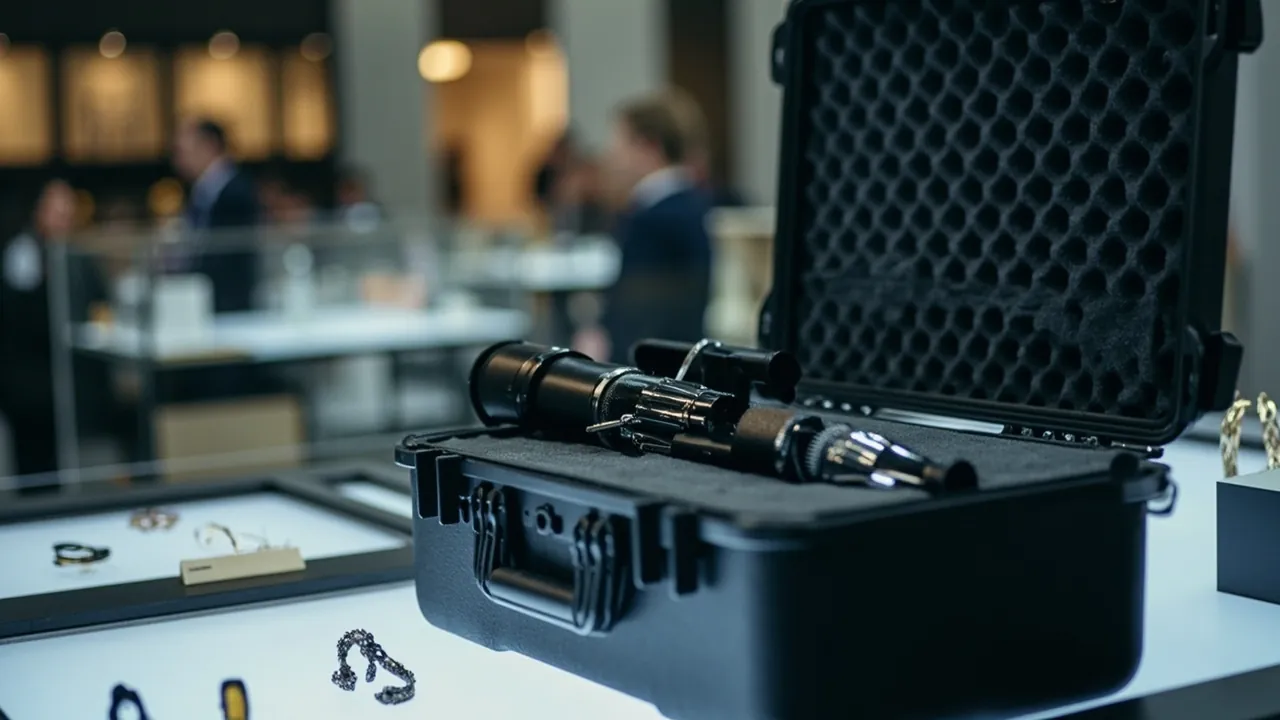
A jewelry display transport case has a dual identity: in transit and storage it must behave as a high-protection container, while on a trade show stand or in a retail store it must behave as a display fixture - opened, it becomes the display; closed, it becomes a secure case. These two identities impose opposing requirements. Transport demands tight retention, zero movement and drop resistance. Display demands fast deployment, adjustable presentation angle, visual transparency and easy access. The case that reconciles both does so through the transport-to-display conversion structure, typically a flippable or withdrawable tray frame combined with a retention system that works in both states. Cases that fail to achieve this produce two familiar failures on site: jewellery damages itself in transit, or deployment takes so long that the stand opens late.
Store turnaround pain points differ from trade shows but share the same root. Stores need a high-frequency loop of stockroom, display cabinet and close-of-day recovery. Individual values may be modest but cumulative value is significant, and the operators are often not security professionals - sales staff and store managers - so the procedure must be simple enough that it cannot be executed incorrectly. Trade shows add further variables: uneven hall floors, long pushing distances, temporary storage on the stand, dense crowds, and tight de-rigging schedules.
This article works through structure and materials, display surfaces and conversion structures, inserts and retention, surface protection, sealing and humidity, locks and seals, store and trade show procedures, handling and tracking, testing and acceptance, and customisation, providing engineering options, parameter tables and checklist-style procedures that can be applied directly.
Table of Contents
- 1. Dual Identity: What One Case Must Satisfy at Once
- 2. Typical Structure and Material Selection
- 3. Display Surfaces: Windows, Flip Structures and Presentation Angle
- 4. Inserts and Partitioning: Trays, Groove Arrays and Single-Item Retention
- 5. Anti-Scratch and Soft Contact: Plating, Gemstones and Chains
- 6. Sealing and Humidity: Store and Exhibition Hall Conditions
- 7. Locks and Seals: Tamper Evidence and Stocktaking Discipline
- 8. Store Turnaround: Handover and Counting from Stockroom to Cabinet
- 9. Trade Show Turnaround: Build-Up, Open Days and De-Rigging
- 10. Transport and Handling: Wheels, Handles, Stacking and Long Pushes
- 11. Tracking and Counting: RFID Bulk Counts and Item-Level Tags
- 12. Environmental Testing: Drop, Vibration, Temperature and IP Basis
- 13. Acceptance, Inspection and Life Management
- 14. Procurement Checklist and OEM/ODM Essentials
- Frequently Asked Questions
- Conclusion and Related Reading
1. Dual Identity: What One Case Must Satisfy at Once
Start with the specific conflicts between the two identities.
| Dimension | Transport state | Display state | Conflict |
|---|---|---|---|
| --- | --- | --- | --- |
| Retention | Zero movement, vibration resistant | Fast access, adjustable | Tighter retention slows access |
| Visibility | Unimportant, concealment acceptable | Critical, transparency needed | Windows weaken structure and sealing |
| Opening frequency | Low | High, several times daily | High cycle count wears hinges and locks |
| Appearance | Wear marks acceptable | Must look clean and attractive | Exterior must be durable and presentable |
| Weight | Lighter is better | Stable, not easily tipped | Weight reduction fights stability |
| Sealing | Rain and dust protection | Dust and fingerprint protection | Sealing at a window is harder |
| Value exposure | Should be discreet | Should attract the eye | Discretion conflicts with display |
Four design principles follow.
Principle one: separate the two states but make conversion fast. The conversion structure should be a single-action transition - the tray withdraws and flips, or the lid becomes a back panel. Any solution requiring parts to be removed and reassembled will be simplified in the field, and retention is lost.
Principle two: the retention system must work in both states. Do not design a solution that uses cable ties in transit and removes them for display. Ties will be omitted on site, and transit risk rises immediately. The cavity itself should continue to locate the item when displayed, so that removal and return both have a unique destination.
Principle three: visible parts must carry structural duty. A window is not a hole with a panel glued over it. The transparent panel should be set into a reinforced frame and form a continuous seal against the case, so that stiffness and ingress protection are not degraded by the opening.
Principle four: design for non-specialist operators. Store staff and temporary exhibition staff are not security professionals. Both structure and procedure should reduce the chance of error: numbered cavities, mistake-proof orientation, clear lock status indication, and a seal position within easy reach.
JUNZHJIA supplies display transport cases for jewelry retail and trade show use with a flippable display tray, numbered retention cavities and a one-way seal channel as the baseline configuration, because these three determine whether "no damage in transit" and "no counting errors" can be achieved simultaneously.
2. Typical Structure and Material Selection
Structural composition. Body shell, lid, optional transparent window, hinge system, locks and seal channel, display tray with retention insert, handles and optional wheels with telescopic handle, and an external marking area.
Four material considerations:
- Balance of stiffness and stability. In the display state the case must be stable and not easily tipped, so the base footprint should be generous and the centre of gravity low. The body material needs enough stiffness that the side wall does not bow when a tray is withdrawn.
- Surface quality and cleanability. Jewelry display demands visual cleanliness. The exterior should resist fingerprints, not attract dust, and tolerate repeated wiping without losing finish.
- Window material. Polycarbonate (PC) and acrylic (PMMA) are common. PC offers better impact resistance; PMMA offers better light transmission and scratch resistance but is more brittle. In exhibition and store environments, scratch resistance and clarity often matter more than impact resistance, because a scratched window directly ruins the display.
- Chemical compatibility of contact materials. Materials in long contact with precious and plated goods must not release sulphur compounds or plasticisers, which cause silver tarnish and plating degradation. The requirement matches that described in high-value security for precious metal and jewelry transport cases.
Material comparison:
| Material | Stiffness | Impact | Surface quality | Suited to |
|---|---|---|---|---|
| --- | --- | --- | --- | --- |
| Copolymer PP | Medium | Excellent | Moderate, can be textured | Main body, daily turnaround |
| Modified ABS | Medium-high | Medium | Excellent, gloss or matt | Cases with strong display requirements |
| Glass-fibre composite | High | Excellent | Medium-high | Large display cases, high stiffness |
| PC window | Medium | Excellent | High clarity | Windows, impact-critical transparent parts |
| PMMA window | Medium-high | Medium | High clarity, better scratch resistance | Windows, display-first applications |
| Aluminium frame profile | High | Medium-high | Excellent | Window frames, demountable structures |
Lid-to-body interface. Use a continuous tongue-and-groove with an elastomeric gasket. For cases with a window, form a continuous sealing ring around the window so rain cannot track along the window edge. If the window is openable, add an extra sealing lip and a limit structure on the opening edge so that long-term deformation does not break the seal.
Hinges and handles. Display cases open far more often than ordinary protective cases, so hinges are the primary fatigue point. Specify a through metal pin with integrally moulded hinge bosses, avoiding self-tapping screws driven into polymer; the handle boss should have sufficient local wall thickness and extend toward the primary load-bearing face. Related failure modes and countermeasures are covered in toolbox hinges, latches and sealing structures.
3. Display Surfaces: Windows, Flip Structures and Presentation Angle
The display surface is what makes this category distinct, and it is also the hardest structural problem.
| Approach | Deployment | Display effect | Structural cost | Suitable for |
|---|---|---|---|---|
| --- | --- | --- | --- | --- |
| Fully transparent lid | Open the lid to display | Moderate, requires looking down | Medium, window carries sealing | Small displays, cabinet supplements |
| Side-hinged transparent door | Side opening | Good, eye-level viewing | Medium-high, needs hinge and seal | Store window displays |
| Lid flips to back panel | Lid stands as a back panel | Good, creates a display elevation | High, needs limits and bracing | Standard trade show stands |
| Withdrawable tray | Tray slides out fully | Excellent, tray can stand alone | Medium, needs slides and limits | Universal for shows and stores |
| Folding tiered | Layers unfold progressively | Excellent, high capacity | High, complex structure | Large shows, many categories |
| Separating body | Lid separates from base | Excellent, flexible | High, two parts to manage | High-end custom display |
Five engineering points for window design:
- The window is a structural part, not decoration. Set it into a reinforced frame that carries stiffness and hinge loads, leaving the window responsible only for sealing and light transmission.
- Continuous sealing. Form a complete sealing ring around the window. If adhesive fixing is used, assess long-term debonding risk; if mechanical clamping is used, distribute the clamping points evenly.
- Scratch resistance and cleaning. Keep the window away from hard items inside the case. Provide a protective film or removable protective panel for the transport state, removed before display. This is a low-cost, high-return design feature.
- Optical quality. Thick acrylic and PC can show edge colour shift and internal reflections. Control thickness and edge polishing angle to avoid distorting gemstone colour.
- Fingerprints and static dust attraction. Window surfaces attract fingerprints and dust. Supply a matched cleaning method and design out recesses and dead corners that are hard to clean.
Adjusting the presentation angle. On a stand, display angle must be adjusted to stand height and visitor sightlines. Provide multi-position detents (slots or toothed features) on the tray or back panel so the angle can be set at defined positions. Compared with continuous friction joints, detented structures last longer and do not slip as friction degrades.
Reliability of the state transition. The conversion structure must meet two conditions: locked in the transport state so it cannot self-deploy during handling, and self-supporting in the display state so a light knock does not tip it. Use a conversion structure with a locking catch, and verify at acceptance with two tests: transport-state vibration without dislocation, and display-state lateral nudge without tipping.
4. Inserts and Partitioning: Trays, Groove Arrays and Single-Item Retention
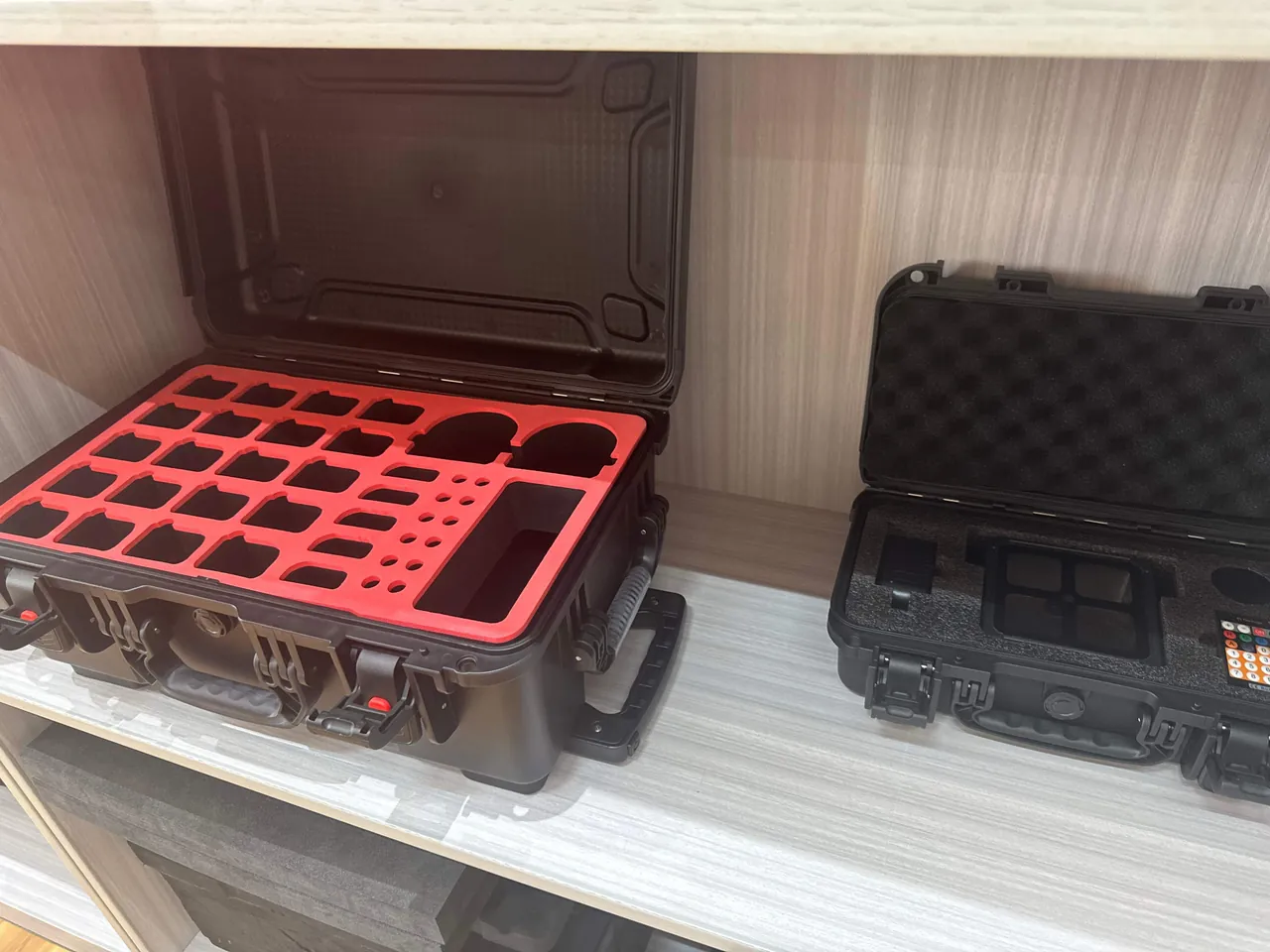
Insert design must balance retention against presentability. The core idea is to make the cavity itself the display position - the orientation of an item in its cavity is the orientation it takes when displayed.
| Partition approach | Retention | Display effect | Counting speed | Suitable categories |
|---|---|---|---|---|
| --- | --- | --- | --- | --- |
| Flat tray with soft pad | Moderate | Good | Moderate | Necklaces, bangles, larger pieces |
| Groove array | Excellent | Good | High | Rings, studs, pendants |
| Small compartment grid | Excellent | Moderate | High | Loose stones, small bulk items |
| Post or hook rack | Excellent | Excellent | Moderate | Necklaces, earrings |
| Adjustable divider system | Moderate | Moderate | Moderate | Frequently changing categories |
| Composite (tray plus dividers) | Excellent | Excellent | High | Mixed categories |
Six key design details:
- One item, one position. Every display piece should have a unique cavity with numbering visible on the tray face. This upgrades counting from counting quantity to verifying position, and makes a missing item immediately visible.
- Finger access. Rings, pendants and small pieces need room for fingers or tweezers. Provide recesses or chamfers at cavity edges. Missing finger access is the single largest cause of operator-damaged inserts.
- Separate chain storage. Necklaces and bracelets must sit in individual cavities or on individual hooks to prevent tangling. Tangling wastes time and deforms links through pulling.
- Ring and stud arrays. Use a groove array with spacing based on common ring sizes, with groove openings slightly narrower than the ring outer diameter for light retention. Note that retention force must not be excessive, or extraction will scratch the metal.
- Inversion resistance. A display case may be inverted in transit. Cavities should retain items from both sides - for example a formed cavity base plus a lid compression feature - so items do not fall out when inverted.
- Label and certificate positions. Provide a separate label strip along the tray edge for price tags, certificate numbers or SKUs, so that display and counting share one identification system.
Using adjustable dividers. Where categories change frequently, such as seasonal store rotation, an adjustable removable divider system allows reconfiguration. Note that adjustable structures generally retain less firmly than moulded cavities, so lid compression features should be used to supplement retention.
Insert material and process strongly affect results. Methodology is in custom foam insert design guide and EVA foam insert custom process; material comparisons are in case foam material comparison.
5. Anti-Scratch and Soft Contact: Plating, Gemstones and Chains
Surface finish is usually a significant part of jewelry value, so scratch prevention is a core specification.
How scratches actually occur. Scratches are rarely caused by direct contact with a hard material. They are usually caused by relative sliding. Even with a soft contact material, if the item micro-moves during transport, abrasive particles - including debris from the material itself and dust - will leave marks. Scratch prevention therefore has two levers: contact material selection and movement suppression.
| Contact material | Softness | Shedding risk | Cleanability | Suited to |
|---|---|---|---|---|
| --- | --- | --- | --- | --- |
| Flocking | High | Low | Moderate, needs specialist cleaning | Polished metal, finished pieces |
| Microfibre | High | Low | High, replaceable | General use |
| Low-density PE foam | Medium-high | Moderate | High | Mid to lower value, large items |
| Acid-free paper | Medium | Low | Low, single use | Silver, tarnish-control scenarios |
| Inert film | High | Low | Moderate | Long-term storage |
| Bare EVA (no soft layer) | Low | Low | High | Not recommended for polished surfaces |
Four means of suppressing movement:
- Fitted cavities. Set cavity dimensions to the item's actual form, with tolerance within about +2 mm.
- Lid compression. Add a foam pad or locating rib on the inside of the lid that lightly presses the item top when closed, eliminating vertical travel.
- Inversion restraint. Items must not leave their cavities when inverted.
- Physical separation. Place a physical divider between adjacent items so they cannot rub against each other.
Special protection for plating and gemstone settings. Plating such as rhodium or gold is thin, and localised pressure can wear through it. Set pieces should be carried by their metal structure with the gemstone suspended, avoiding pressure on the prongs. Fix items with a "lightly suspended plus locally supported" arrangement rather than pressing over the whole surface.
Simulated abrasion verification. At prototype stage, run a simulated transport abrasion test: load representative items (equivalently finished substitutes are acceptable), apply vibration and drop conditions matching the real route, then inspect surfaces under directional light. This is the most convincing form of verification.
| Protected item | Suggested contact material | Avoid |
|---|---|---|
| --- | --- | --- |
| Polished gold surface | Flocking, microfibre | Coarse textile, foam with hard fillers |
| Silver (tarnish control) | Acid-free paper, inert film | Sulphur-bearing rubber, ordinary paper |
| Plated surfaces | Low-density foam, microfibre | Direct hard plastic contact |
| Gemstone settings | Suspension with metal load bearing | Direct pressure on the stone |
| Chains | Individual hook, acid-free paper | Sharing a cavity with other items |
6. Sealing and Humidity: Store and Exhibition Hall Conditions
Sources of environmental risk:
- Exhibition halls: large air volumes, strong air conditioning, dense crowds, floor dust, fluctuating local humidity.
- Stores: window spotlights creating local heat, direct air conditioning, cleaning agents and perfume aerosols, daily wiping.
- Transport and temporary storage: rain during vehicle loading, warehouse humidity, temperature-difference condensation.
| Requirement | Implementation | Note |
|---|---|---|
| --- | --- | --- |
| Continuous tongue-and-groove | Full perimeter at the lid-to-body interface | Also provides dust, splash and pry resistance |
| Elastomeric gasket | Silicone or EPDM with low compression set | Compression ratio 20 to 30 percent |
| Window sealing ring | Complete seal around the window | Prevents water tracking along the window edge |
| Pressure equalisation valve | Removes thermal vacuum, eases opening | Assess permeation risk |
| Desiccant position | Separate mesh bag or cavity | Must not touch display pieces |
Choosing the protection class. Internal store turnaround usually needs only IP54. Trade show build-up and de-rigging involve open-air loading, so IP55 or above is advisable, and IP65 for rainy seasons or long pushing distances. Note that an IP rating does not cover impact, compression or corrosion, so it cannot replace structural strength requirements. For a full reading of the IP code, see IP ratings and waterproof case selection.
Humidity and tarnish control. Silver tarnishing is a common store problem. Sulphur sources include rubber components, poor-quality paper, airborne sulphides and perspiration. Controls include avoiding sulphur-bearing rubber and low-grade paper; preferring acid-free paper, flocking or inert film for contact layers; using desiccant to control internal humidity, since moisture significantly accelerates sulphidation; and avoiding bare-hand contact with silver at the packing stage. The reasoning matches precious metal transport, covered in high-value security for precious metal and jewelry transport cases.
Trading off the pressure equalisation valve. A valve materially improves opening effort and reduces condensation, but it is a permeation path in the case wall. For applications needing long-term sealing, assess the valve's sealing reliability; if used, prefer a breathable, water-tight structure with a hydrophobic membrane, and add the valve to the inspection checklist. See the role of pressure equalisation valves.
7. Locks and Seals: Tamper Evidence and Stocktaking Discipline
Lock selection for store use. Store turnaround involves an extremely high opening frequency, from several to dozens of cycles per day in some settings. Lock selection should prioritise durability and ease of operation rather than maximum pry resistance.
| Lock type | Ease of use | Durability | Suitable scenario | Note |
|---|---|---|---|---|
| --- | --- | --- | --- | --- |
| Mechanical key lock | Moderate | High | Daily store turnaround | Key control must be disciplined; avoid shared keys |
| Mechanical combination | High | Medium-high | Shared counter teams | Combination sharing defeats individual tracing |
| Electronic combination | High | Moderate | Unlock records required | Battery dependent, log replacements |
| Dual locks in series | Low | High | High-value display pieces | Suited to close-of-day recovery |
| Latch plus seal | Moderate | High | Trade shows, inter-store transfers | Seal serial registration |
The role of seals. In store and trade show turnaround, seals protect primarily the unattended interval between close-of-day sealing and next-day opening. Apply a one-time seal at close and register the serial, so that any opening during that interval leaves evidence.
| Seal type | Strength | Suitable scenario | Note |
|---|---|---|---|
| --- | --- | --- | --- |
| Plastic pull-tight seal | Moderate | Daily close-of-day sealing | Low cost, easy serial registration |
| Cable seal | High | Inter-store transfers, show transport | Better tensile resistance |
| Wire lead seal | High | High-value display pieces | Requires cutters |
| Electronic seal | High | Electronic audit required | Can be correlated with unlock records |
| Tamper label | Low | Supplementary | Never the primary protection |
Serial management. Issue seals in numbered blocks and log them; retain voided seals with the reason recorded; have two people transcribe and read back the number at application; photograph the seal serial with the case serial; require the receiving party to verify before cutting; and never cut on site if anything is anomalous. Detail is available in seal materials and case sealing components.
Stocktaking discipline. Much of the value of a display case lies in counting efficiency. Use three counting stages:
- Packing count: verify cavity by cavity at packing against the manifest, with two signatures;
- Display count: after display is arranged, verify once against cavities to confirm the number that should be on display equals the number actually displayed;
- Recovery count: at close of day or de-rigging, verify cavity by cavity, confirm nothing is left behind or misplaced, then seal and register the seal serial.
The key to all three is that the manifest structure matches the cavity numbering. If the manifest says "30 rings" while the tray has numbered positions, counting degrades to manual counting. If the manifest says "positions 1 to 30 map to specific SKUs", both speed and accuracy improve substantially.
For a detailed comparison of lock types and customisation, see case lock customisation options.
8. Store Turnaround: Handover and Counting from Stockroom to Cabinet
The core objective in store turnaround is reduce risk while the case is closed, and shorten exposure while it is open.
| Node | Owner | Key action | Record elements |
|---|---|---|---|
| --- | --- | --- | --- |
| 1 Retrieve from stockroom | Storekeeper | Verify seal serial, inspect exterior | Case serial, seal serial, time |
| 2 Open and prepare | Storekeeper plus manager | Two persons present, verify cavity by cavity | Cavity manifest, two signatures |
| 3 Arrange display | Sales staff | Move whole trays where possible | Confirmed display quantity |
| 4 End of display | Sales staff plus manager | Recover cavity by cavity, log missing items | Recovery manifest, discrepancy record |
| 5 Close-of-day sealing | Manager plus storekeeper | Apply seal, transcribe serial | Seal serial, time, two signatures |
| 6 Return to store | Storekeeper | Verify seal, log receipt | Receipt time, seal serial |
The whole-tray principle. Where possible, move entire trays rather than taking pieces out of a tray and placing them individually into a display cabinet. Whole-tray transfer shortens exposure, reduces drop risk and reduces misplacement. This requires the display cabinet's tray supports to match the tray dimensions - an external constraint to confirm at design stage.
Three priority actions on a discrepancy. When an item is missing: seal the case and stop counting immediately to prevent further on-site confusion; check the previous node's manifest and photographs to locate where the discrepancy arose; escalate under procedure rather than speculating or backfilling records. Avoid the temptation to "fix things first and document later", which destroys the evidentiary value of the records.
Managing the close-to-open window. This is the highest-risk window in a store. Seal the case and place it in a monitored locked area; register the seal serial separately in the close-of-day and next-day records; verify the seal before opening. If the seal is anomalous, transfer the whole case and preserve the scene.
9. Trade Show Turnaround: Build-Up, Open Days and De-Rigging
Trade shows have more variables than stores, so split the procedure into four defined nodes.
Node one: packing and dispatch (before departure). Verify cavity by cavity against the display manifest, and photograph each tray in its packed state as the baseline for de-rigging. Seal the case and register the serial, photographing the seal serial with the case serial.
Node two: build-up (on arrival, before opening). Verify the seal, then cut it and retain the cut seal until de-rigging. During build-up, pieces move from trays to the stand, so designate a temporary storage area with a named owner. Manage that temporary area at tray level where possible, rather than leaving loose items.
Node three: open days. The main risks are accidental knocks and theft in dense crowds. The transport case's role during the show is as the recovery container at close of day, so run a fixed sequence each evening: recovery, cavity-by-cavity verification, sealing, and seal serial registration. If daily sealing is not feasible on the stand, move pieces to the venue's security storage or a monitored enclosed space.
Node four: de-rigging. De-rigging schedules are usually tight, which makes this the highest-error phase. Repack against the packed-state photographs cavity by cavity, verify the total once more, then seal and register the seal serial. The de-rigging seal serial should be recorded alongside the seal serial cut at build-up, forming a complete seal chain.
Three common trade show errors:
- Temporary staff operating the case. Procedures must be simplified into a readable manifest, numbered positions and photographic baselines. Complex forms will not be completed on site.
- Floors and pushing conditions. Hall floors may have carpet, cable trunks and steps. Undersized wheels jam repeatedly, so choose a larger wheel diameter with good obstacle crossing, and assess handle stiffness under full load.
- Stand space constraints. Stands are cramped, and the case must be stored temporarily without obstructing the display. Choose a case with a lid that can close into the display state or a stackable structure, and confirm the stand plan against case dimensions in advance.
10. Transport and Handling: Wheels, Handles, Stacking and Long Pushes
Wheel selection points:
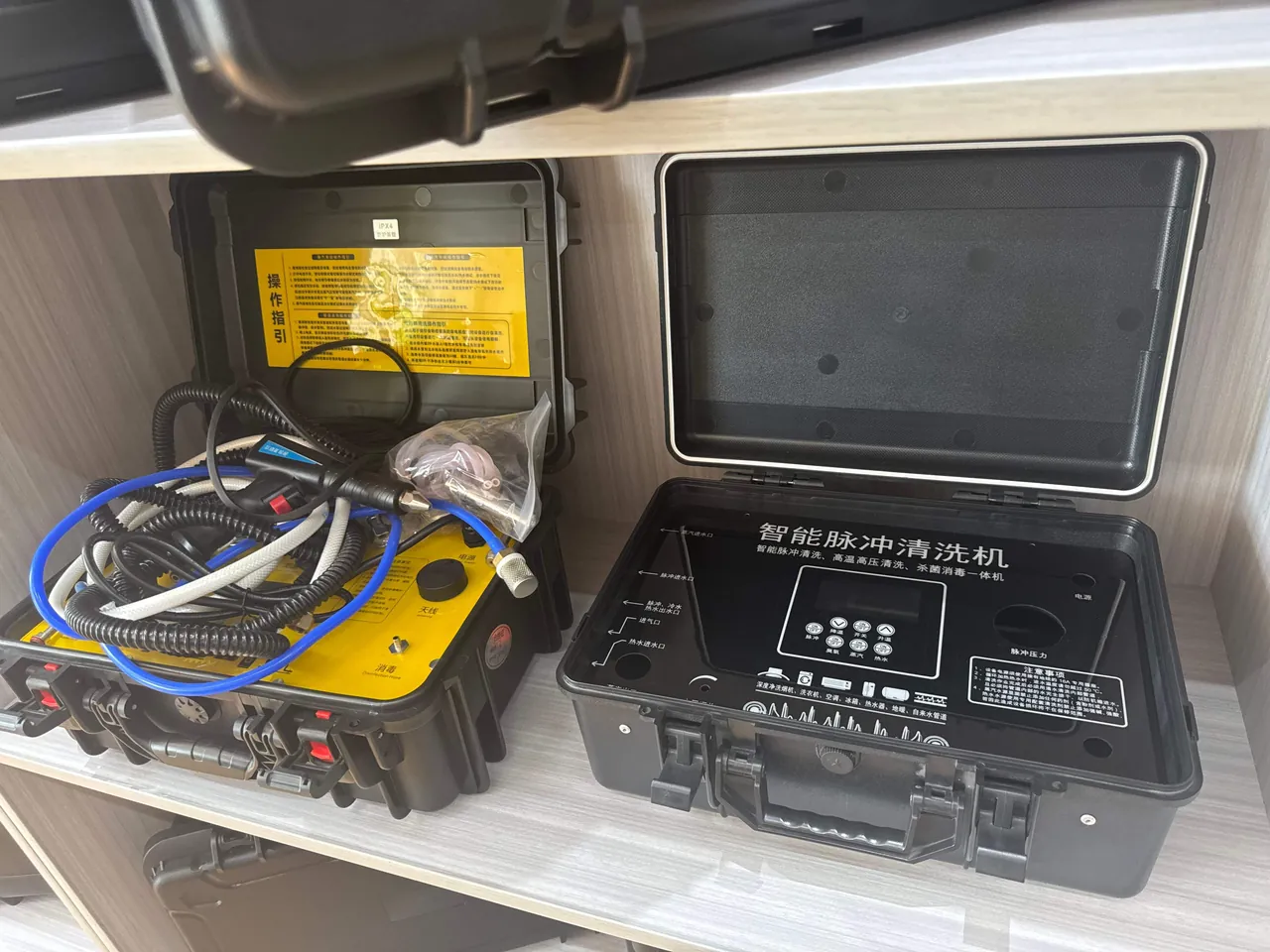
- Diameter: determines threshold and cable trunk crossing ability. Exhibition halls and stores have thresholds, carpet edges and cable trunks, so a larger wheel set is advisable.
- Material: soft wheels such as thermoplastic rubber are floor-friendly and quiet, suited to indoor use; hard wheels wear better but transmit more vibration.
- Layout: two fixed plus two swivel wheels is a common combination, balancing straight-line stability with manoeuvrability.
- Mounting strength: the wheel mount is a load concentration point and needs local reinforcement to avoid long-term cracking.
Handle selection points. Use a metal inner tube with multi-position locking; the stowed handle must not significantly increase overall height, otherwise rack and stand storage are compromised; reinforce the handle-to-case connection so a fully loaded case does not wobble when pushed.
Stacking design. Display cases are often stacked in storage and transport. Provide a stacking location feature on the base that mates with the lid top, so slight misalignment does not cause sliding. Also assess whether stacking load reaches the insert cavities - the correct path is upper case, lower case lid reinforcement, side wall, base, floor. Load must not pass through display pieces.
Handle design. With high opening frequency and potentially long carrying distances, the handle should be wide enough to distribute hand pressure. Consider both side handles and a top handle to suit different carrying postures.
Full selection logic for wheels and handles is in case wheels and trolley handles.
11. Tracking and Counting: RFID Bulk Counts and Item-Level Tags
Three-level identity design. For display scenarios, use case level, tray level and item level identification:
| Level | Identification | Function | Note |
|---|---|---|---|
| --- | --- | --- | --- |
| Case | Laser-engraved unique serial plus label | Case identity, handover verification | Serial must not be removable |
| Tray | Tray number label | Tray-to-manifest mapping | Tray number used together with case serial |
| Item | Barcode, QR or RFID tag | Item-by-item counting, certificate matching | Tag must not affect wearability or appearance |
RFID suitability in jewelry settings. RFID substantially improves counting speed, but note that metal and liquid environments degrade RF reads. Metal jewelry generates eddy current interference, so use metal-tolerant tags and pay attention to the spacing between tag and metal surface. For tray-level bulk counting, use a gate-style read tunnel or a handheld reader.
Trade-offs on item-level tags. Item-level RFID enables second-scale counting, but the tag itself affects wearability and appearance. A common compromise is to use item-level tags only during stock and turnaround, placing them on the tray cavity or packaging rather than on the piece, and removing visible tags for display. This requires the tag to be bound to the cavity number, so that the cavity tag represents the item in that cavity.
Combining data with procedure. The value of tracking depends on how well it is integrated with procedure. Use tracking data for three actions: packing verification (automatic comparison of manifest against actual), missing item alerts (automatically listing empty positions at count), and handover evidence (a timestamp and responsible person at each node). Tracking data that is not wired into procedure is just a passive record.
Important: tracking does not replace seals and stocktaking discipline. Tracking tells you where items are. The seal tells you whether the case was disturbed. Stocktaking tells you whether anything is missing. All three are complementary.
12. Environmental Testing: Drop, Vibration, Temperature and IP Basis
(1) Drop test. Load to 100 percent of rated mass and drop from 1.0 to 1.2 m onto nine attitudes covering three corners, three edges and three faces. For display cases the pass criteria must additionally cover display structure: whether the window cracks, whether the flip structure still converts, whether tray detents have failed, whether insert cavities fracture, and whether items (equivalent substitutes) leave their cavities.
(2) Vibration test. Reference the random vibration methods of the ISTA series or the GB/T 4857 series, with duration set to the longest single-leg transit time plus at least 50 percent margin. Focus judgement on inserts not collapsing, items not undergoing relative displacement (the key anti-scratch criterion), seal channel not worn, locks not loosened, and conversion structures not self-deploying. Method selection logic is in ISTA transport testing procedures explained and GB/T 4857 transport package testing; full distribution cycle verification is in ASTM D4169 distribution cycle testing.
(3) Stacking test. Convert actual stacking tiers into load, hold for 24 to 72 hours, and check body deformation, latch engagement and whether insert cavities have been compressed.
(4) Temperature and damp heat test. Store window spotlights and closed vehicle bodies both create local heat. Perform high-temperature storage, low-temperature storage, thermal cycling and damp heat tests, referencing the corresponding MIL-STD-810H methods. Note that the standard is an environmental test method standard, not a military certification; correct wording is "tested in accordance with the relevant MIL-STD-810H methods". Judge window deformation or yellowing, gasket compression set, contact layer ageing and label adhesion. See MIL-STD-810H environmental testing explained.
(5) Ingress protection verification. Execute under the relevant IEC 60529 / GB/T 4208 conditions. For cases with a window, focus on sealing around the window, and after testing check for moisture or water marks on the inside of the window.
| Test category | Suggested basis | Key judgement |
|---|---|---|
| --- | --- | --- |
| Drop | GB/T 4857 series / ISTA | No cracks, window intact, conversion structure functional |
| Stacking | GB/T 4857 series | Acceptable deformation, cavities not compressed |
| Vibration | ISTA random vibration spectrum | No relative movement of items, conversion structure not dislocated |
| Temperature and damp heat | Relevant MIL-STD-810H methods (environmental basis) | Window not deformed or yellowed, gasket not permanently deformed |
| Water and dust | IEC 60529 / GB/T 4208 | Target IP achieved, no moisture inside the window |
13. Acceptance, Inspection and Life Management
Incoming acceptance points:
| Check item | Method | Judgement |
|---|---|---|
| --- | --- | --- |
| Cavities and numbering | Check each cavity | Correct count, clear numbering, matches manifest structure |
| Contact layer | Visual and by hand | No shedding, no hard spots, no contamination |
| Window | Visual and light transmission check | No scratches, no bubbles, continuous sealing perimeter |
| Conversion structure | Repeated conversion test | Single-action conversion smooth, transport lock reliable |
| Appearance and structure | Visual, whole case | No cracks, sink marks or burrs |
| Case serial | Cross-check | Unique plate, matches order, securely fixed |
| Locks | Operate each one | Smooth, no binding, clear status indication |
| Sealing | Visual joint plus sampled water test | Joint continuous, target IP achieved |
| Seal channel | Insert each seal | Inserts freely, resists reverse pull |
| Wheels and handle | Loaded push test | No jamming, no abnormal wobble |
Daily inspection (before and after each use): new cracks; hinges loose or noisy; locks operating smoothly and keys unworn; gasket detached or hardened; new window scratches or loosening; conversion structure binding; insert cavities deformed or numbering illegible; contact layer soiled or worn; wheels jamming; seal channel blocked.
Periodic maintenance (monthly or quarterly): clean the window using a suitable method that avoids solvent damage; clean the gasket and check elasticity; clean or replace the contact layer; tighten hinge and lock fasteners; check wheels and handle; replace and log desiccant; isolate faulty cases, tag them and route to repair or scrap. Cleaning methods are in how to clean a protective case, service life assessment in protective case service life assessment, and counterfeit identification in identifying genuine versus counterfeit cases.
Suggested scrap criteria. Through-cracks or large structural deformation; a badly scratched or cracked window that cannot be replaced; conversion structure failure that will not lock in the transport state; joint wear preventing sealing; hinge boss pulled out or cracked; lock mounting damaged beyond repair; seal channel worn until a seal can be freely removed; or insert cavities deformed enough to allow free movement of display pieces. Any of these warrants scrap or repair.
14. Procurement Checklist and OEM/ODM Essentials
A ready-to-use procurement requirement list:
Functional requirements - display method (window, flip, withdrawable, folding), number of tray tiers, maximum item size and mass, total case mass, whether dual control is required, seal type, counting method including whether RFID is used.
Structure and materials - body material and colour, wall thickness and reinforcement, window material and thickness, hinge type (specify through metal pin), handle configuration including side handles, top handle, wheels and telescopic handle.
Display structure - window sealing method, tray or panel limit method, number of display angle detents, transport-state locking mechanism.
Sealing and protection - target IP rating and test basis, whether a pressure equalisation valve is required, gasket material, desiccant position.
Insert - cavity type and count, contact layer material, tolerance, cavity numbering rule, label and certificate positions.
Identity and tracking - case numbering rule and engraving method, tray numbering rule, label type and position, seal serial registration area.
Verification documents - drop, stacking, vibration, temperature and humidity, and water test requirements and reports, plus sampling scheme.
Delivery and service - first-article approval, packaging and shipping, warranty and spare parts, consistency assurance for repeat orders through retained sample control.
Seven-step customisation process:
- Requirement capture: display method, category list, dimensions and masses, site constraints including stand plan, display cabinet tray dimensions, lift and doorway limits;
- Design proposal: structural concept, window and conversion structure, insert layout and cavity numbering, lock and seal positions;
- Functional prototype: build a fully functional prototype including window sealing, conversion mechanism, formed insert and contact layer, not a visual model;
- Functional verification: loaded drop, stacking, vibration, repeated conversion cycles, and simulated abrasion testing;
- Field trial: at least one complete store or trade show turnaround in live use;
- Corrective action and design freeze: record changes, produce drawings and a retained sample;
- Volume delivery and first-article approval: inspect the first batch against a sampling scheme.
The five most common prototyping problems:
- Window sealing: water appears inside the window during sampled water testing, usually because the sealing ring is discontinuous or clamping force is uneven;
- Conversion structure: insufficient transport locking allows dislocation under vibration, or insufficient display bracing allows tipping from a light knock;
- Insert tolerance: CNC insert tolerance stacking against moulded case tolerance makes some cavities too tight or too loose;
- Contact layer fixing: poor bonding between contact layer and skeleton causes detachment or wrinkling after a few uses;
- Wheel and handle stiffness: noticeable handle wobble under full load, or frequent wheel jamming on thresholds.
JUNZHJIA, the brand of Kexin New Materials (Guangdong) Co., Ltd., provides integrated capability from structural design and tooling development through insert forming. For jewelry brands, retail chains and trade show service providers, the company supplies customised display transport cases including flippable display trays, numbered locating cavities, soft contact layers, transparent windows with a continuous sealing ring, dual lock positions and one-way seal channels, and supports prototyping, functional verification and volume supply with inspection and test documentation as required. Tooling investment and amortisation logic is in custom case mould cost analysis; supplier evaluation criteria in how to choose a case OEM factory; and acceptance sampling in protective case acceptance sampling.
Frequently Asked Questions
Q: What is the difference between a jewelry display transport case and an ordinary jewelry transport case?
A: The core difference is whether the case also serves as a display fixture once it reaches the venue. An ordinary jewelry transport case is designed to arrive safely and leave safely, with priorities on retention, seals and tracking. A display transport case must additionally satisfy display requirements, so it adds a transparent window, a flippable or withdrawable display tray, and display angle detents, and those structures must be reliably locked in the transport state. The trade-offs point in different directions: an ordinary transport case can sacrifice appearance entirely for strength, while a display case must balance protection against presentation - for example, the window must be set into a reinforced frame so that overall stiffness and sealing do not drop. Selection should therefore start from the use case. If the case only travels between stockroom and transport and never participates in display, an ordinary jewelry transport case is the better choice. If it must open into a display on a stand or in a store, choose a display type.
Q: Does a transparent window reduce the case's protection?
A: Yes, unless the window is designed as a structural component. A common error is to cut an opening in the lid and bond a transparent panel over it, which weakens both stiffness and sealing: reduced stiffness lets the window crack in a drop and the lid deform, while sealing failure lets water track along the window edge. The correct approach sets the window into a reinforced frame that carries stiffness and hinge loads, leaving the window responsible only for sealing and light transmission, with a continuous sealing ring around the perimeter. Scratch resistance also matters, because a scratched window directly ruins the display. Provide a removable protective panel for the transport state, removed before display. At acceptance, focus on sealing around the window, and check for moisture or water marks on the inside of the window after water testing.
Q: Do I really need seals for daily store turnaround?
A: Use seals during the unattended time window, meaning the interval between close-of-day sealing and next-day opening, which is the highest-risk period in a store. A seal makes any opening during that interval a matter of record. Do not use seals during the display day, when the case is opened frequently; the burden would be excessive and the step would be skipped. The practical pattern: at close, recover pieces cavity by cavity, seal the case with a one-time seal and register the serial; on opening, verify the seal before opening; if the seal is anomalous, transfer the whole case and preserve the scene. The seal serial should be registered by different people in the close-of-day and next-day records, creating cross-verification. Note that the seal itself does not prevent tampering; the correspondence between seal serial and record does. Registration and verification therefore matter more than the seal itself.
Q: Chains and necklaces always tangle in transit. How can that be solved?
A: Tangling originates from multiple chains sharing one space. Any arrangement that looks tidy will fail once vibration and jolting are applied. The effective solution is to give each chain its own space: individual cavities, individual hooks or individual pouches. Hook racks suit longer necklaces, while cavities suit bracelets and shorter chains. Also keep chains away from hard items in the same cavity, to prevent rubbing and pulling that deforms links. Heavier chains should not hang under load for long periods, because sustained tension can deform links, so provide support beneath the hook or use a flat cavity. Where categories change frequently, an adjustable divider system allows reconfiguration, with lid compression features supplementing retention.
Q: How can the flip or sliding structure of a display case be made reliable?
A: Two conditions must be met simultaneously. It must be locked in the transport state. The conversion structure should have a defined locking mechanism such as a catch, verified by a vibration test confirming no dislocation under transport conditions. Designs that rely on friction alone tend to self-deploy after jolting. It must be self-supporting in the display state. Use detented positions, slots or toothed features, rather than a continuous friction joint, because friction decays with use and the display angle will drift or even tip. Multi-position detents are recommended, verified at acceptance by a lateral nudge test for tipping. The moving parts of the conversion structure are wear points, so design them as replaceable or in wear-resistant material, and add them to the inspection checklist.
Q: What water protection class does a jewelry display case need?
A: Internal store turnaround usually needs only IP54, chiefly for dust and splash. Trade show build-up and de-rigging involve open-air loading, so IP55 or above is advisable, and IP65 for rainy-season operation or long pushing distances. Three cautions apply. First, an IP rating covers only ingress of solid objects and water; it does not cover impact, compression or corrosion, so it cannot replace structural strength requirements. Second, for cases with a window, the sealing challenge concentrates around the window perimeter, which acceptance testing should verify specifically. Third, a higher sealing class makes the lid harder to open, and display cases open far more often than ordinary protective cases, so an unnecessarily high class can push operators into levering the lid and damaging the joint. Choose a class matched to the real scenario and add a pressure equalisation valve to keep opening effort consistent.
Q: How can counting efficiency be improved?
A: The key is to make the manifest structure match the cavity structure. If the manifest says "30 rings" while the tray has numbered positions, counting can only be manual. If the manifest says "positions 1 to 30 map to specific SKUs", counting becomes position-by-position verification, which is both faster and able to reveal misplaced or missing items. Three enhancements build on that: cavity numbers visible on the tray face so no searching is needed; tray-level and case-level numbers used together so multiple trays can be verified in parallel; and RFID or barcode counting for bulk reading, bearing in mind that metal jewelry causes RF interference so metal-tolerant tags are required. Note that technology only accelerates counting. Reliability comes from the counting discipline itself: three counting stages, a defined discrepancy path, and two signatures.
Q: How often should display cases be replaced?
A: There is no universal interval; use condition-based judgement as the primary criterion. What is specific to display cases is the extremely high opening frequency, so hinges, locks and conversion structures wear faster than in ordinary protective cases, and the replacement interval is usually shorter. Define criteria for repair or scrap: through-cracks or large deformation; a badly scratched or cracked window that cannot be replaced; conversion structure failure that will not lock in the transport state; joint wear preventing sealing; hinge boss pulled out or cracked; lock mounting damaged beyond repair; seal channel worn until a seal can be freely removed; or insert cavities deformed enough to allow display pieces to move freely. Maintain an inspection log recording every repair and part replacement, use that data to derive a sensible service interval for the batch, and rotate high-frequency units on a scheduled basis.
Conclusion and Related Reading
The design challenge of a jewelry display transport case is fundamentally about reconciling retention with presentation. Retention demands zero movement, drop resistance and sealability. Presentation demands fast deployment, adjustable angle and visual transparency. The reconciliation does not come from materials but from the conversion structure: locked in the transport state, self-supporting in the display state, and convertible in a single action. Any solution requiring parts to be removed or extra tools will be simplified in the field, losing reliability in both states at once.
Four practical rules summarise the approach. Select by scenario: pure transport cases should not pay for display structures, while display cases must treat the window as a structural component. Set the insert by category, one item per position, and make the manifest structure match the cavity structure, which is the fundamental source of counting efficiency. Use seals by time window, concentrating effort in the unattended interval rather than adding daily burden. Set maintenance by cycle count, because opening frequency determines the life curve, and an inspection log is more reliable than a uniform replacement interval.
JUNZHJIA supplies jewelry display transport cases to jewelry brands, retail chains and trade show service providers, supporting flippable display trays, numbered locating cavities, soft contact layers, transparent windows with a continuous sealing ring, dual lock positions and one-way seal channels, wheels with telescopic handles and stacking location features, with test and inspection documentation and OEM/ODM service available.
Related Reading