

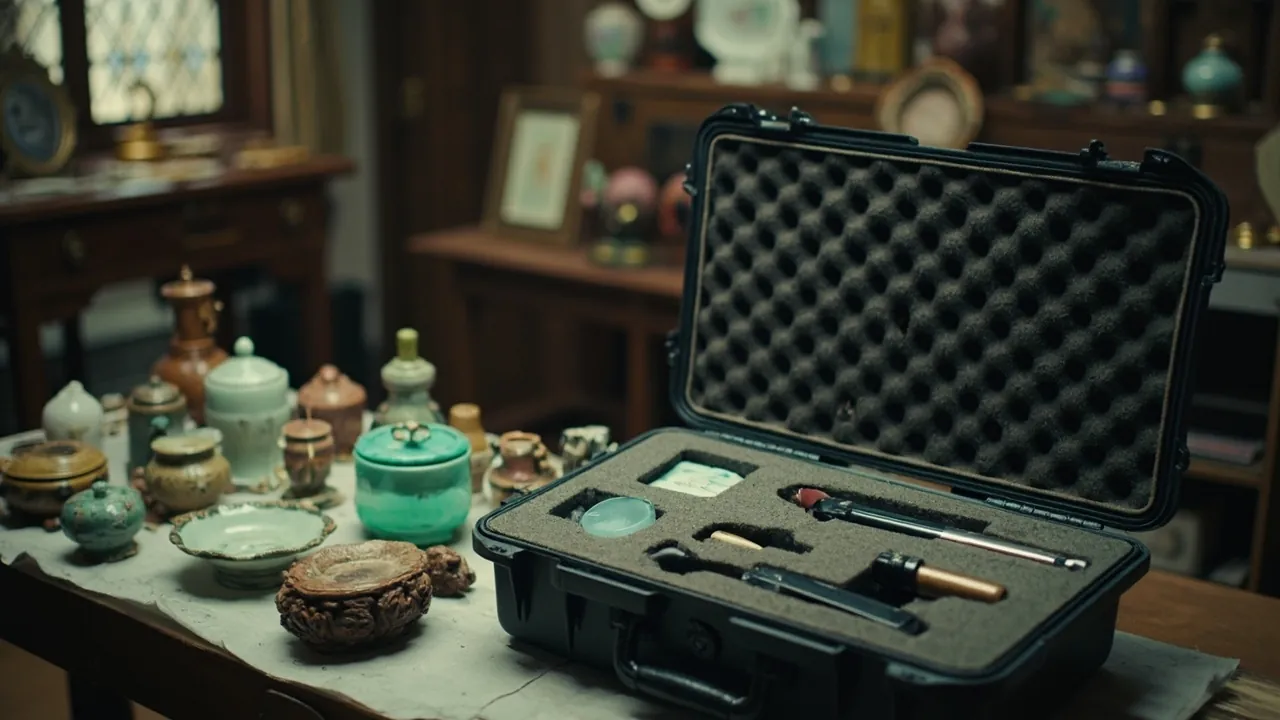
Protecting porcelain and jade in transit is fundamentally a matter of managing energy rather than opposing hardness with hardness. Porcelain is a classic brittle material: high compressive strength, low tensile strength — typically an order of magnitude lower — and almost no plastic deformation stage. It does not bend and then break; it cracks the instant stress reaches a critical value. Jade is tougher than ordinary ceramics, because its interlocking crystal structure resists fracture notably better, but once a natural fissure or a residual fabrication stress is present, it becomes a brittle body with a pre-existing defect, and vibration in transit propagates that fissure until it suddenly separates during an otherwise unremarkable impact. The engineering objective for an antique case therefore reduces to three statements: apply no point loads (avoid stress concentration), allow no relative motion between object and any interface (avoid micro-abrasion and fatigue), and hold impact energy below the object's fragility threshold (cushioning design with a basis).
Antique transport carries one extra constraint: many objects are irreplaceable. A chip, a hairline crack or a lost corner affects value and often cannot be reversed, because restoration itself alters original condition and, in some collecting systems, amounts to a downgrade. Specifications for an antique case must therefore target zero damage rather than acceptable damage. This guide works through material mechanisms, damage classes, cushioning design, suspension packing, acid-free material systems, temperature, humidity and light control, shell selection, test evidence, chain of custody, and acceptance and cost, with parameters that can be written into procurement specifications and shipping instructions.
Table of Contents
- 1. Material Behavior and Failure Mechanisms in Porcelain and Jade
- 2. Ten Damage Classes in Transit
- 3. Cushioning Design: Fragility, Drop Height and Cushion Curves
- 4. Suspension (Floating) Packing: The Museum Standard Practice
- 5. Point Loads and Line Loads: Why "Packing It Tight" Is the Most Dangerous Approach
- 6. Porcelain Specifics: Rims, Handles, Thin Walls and Glaze
- 7. Jade Specifics: Fissures, Toughness, Thermal Shock and Carved Detail
- 8. Insert Material Systems: Acid-Free, Plasticizer-Free, Lignin-Free
- 9. Humidity and Temperature: Trading Off Across Mixed Materials
- 10. Light and Ultraviolet: Overglaze Enamels, Pigments and Organic Adhesives
- 11. Shell Structure and Ingress Protection Selection
- 12. Environmental and Transport Test Evidence
- 13. Large Objects, Sets and Display Mounts
- 14. Tamper Evidence, Condition Records and Chain of Custody
- 15. Cleaning, Maintenance and Long-Term Storage
- 16. Customization Flow, Acceptance and Cost Structure
- Frequently Asked Questions
- Conclusion and Further Reading
1. Material Behavior and Failure Mechanisms in Porcelain and Jade
Before choosing a protective scheme, the differences between the two materials must be explicit.
| Material | Mechanical characteristics | Dominant failure mechanism | Implication for design |
|---|---|---|---|
| --- | --- | --- | --- |
| Ceramics (porcelain, earthenware) | High compressive, low tensile, almost no plasticity | Cracking once tensile stress exceeds the threshold; notch sensitive | No point loads; must control peak acceleration |
| Glaze | Hard, thin, expansion coefficient differs from body | Spalling, crazing, scratching | Avoid friction and rapid temperature change |
| Jade (nephrite and jadeite) | Reasonably tough, but contains natural fissures and cleavage | Fracture propagating along existing fissures; edge chipping | Must avoid accumulated vibration and local impact |
| Old restorations | Include adhesives and fill materials | Restoration layer aging, mismatched expansion | Avoid heat, high humidity, solvents and strong vibration |
| Wooden stands, brocade boxes, paper labels | Organic materials | Moisture swelling, acidification, insect damage | Require acid-free materials and stable humidity |
Three conclusions drive design directly.
First, porcelain fears tensile stress, not compression. An object under uniform compression is usually safe, but when it is point-supported or gripped by sharp clamps, tensile stress concentrates near the contact points and can easily exceed the fracture strength. The larger the contact area and the more distributed the contact points, the safer the arrangement.
Second, brittle materials exhibit fatigue. Under cyclic stress below the fracture strength, micro-cracks still propagate progressively, much like fatigue crack growth in metals. Transport vibration is exactly this kind of low-amplitude, high-cycle loading, and a single long lane can impose hundreds of thousands of cycles. This explains a familiar experience: nothing obviously damaged on arrival, then a hairline crack discovered months later. Controlling vibration transmissibility and avoiding stress concentration is more effective than simply adding thicker foam.
Third, aged and restored objects hide their own weaknesses. Old adhesives, fill materials and the object itself have different thermal expansion coefficients, so temperature swings generate interfacial stress that eventually cracks or detaches the restoration. For restored objects, stable temperature matters more than humidity control.
Museum practice for fragile objects converges on four principles worth borrowing: increase the number of restraint points, reduce load per point, avoid rigid contact, and stabilize the environment. These transfer directly to commercial transport case design. For the broader logic of impact-resistant structures, see sealed and shock-resistant case structures.
2. Ten Damage Classes in Transit
| Damage class | Typical manifestation | Primary cause | Countermeasure |
|---|---|---|---|
| --- | --- | --- | --- |
| Fracture (full or partial) | Object split, piece broken off | Peak acceleration above fragility, point load | Suspension cushioning, limit peak acceleration |
| Hairline cracks and internal fissures | Sub-glaze cracks, dulled ring | Cyclic vibration fatigue, thermal stress | Vibration isolation, temperature control, avoid concentration |
| Chipped corners and rim losses | Corner chips, rim spalling | Point contact, collision with hard parts | Full soft wrap, dedicated rim relief |
| Broken handles, ears and spouts | Cantilever features snap at the root | Bending of cantilever structures, no independent support | Dedicated cantilever cradles |
| Glaze scratching and spalling | Surface scratches, lifted glaze | Relative friction, thermal and moisture cycling | Zero displacement, acid-free soft barrier, temperature control |
| Restoration cracking | Cracks at fills, whitened adhesive | Thermal expansion mismatch, solvents, vibration | Temperature stability, no solvents |
| Jade fissure propagation | Existing fissures lengthen, translucency changes | Vibration fatigue, local impact | Vibration isolation, distributed support, no point loads |
| Mold and staining | Surface mold spots, yellowed labels | Sustained RH above 65%, paper as moisture source | Sealing, humidity control, acid-free materials |
| Surface contamination and fingerprints | Oil marks, prints, salt corrosion | Bare-hand contact, insert material outgassing | Gloved handling, low-outgassing materials |
| Missing and mismatched parts | Lost lids, stands, labels, fittings | No compartments, no manifest | Zoned numbering plus in-case manifest |
Among these ten, hairline cracks, glaze spalling and restoration cracking are delayed-onset. The object may look entirely normal on unpacking day, with the defect appearing weeks or months later. Condition assessment for antiques therefore cannot rely on visual inspection at unpacking alone; it must combine a pre-packing condition record, transport environment records and post-unpack verification into a traceable evidence chain. That is why an antique case should ship with a condition record card and environmental logging.
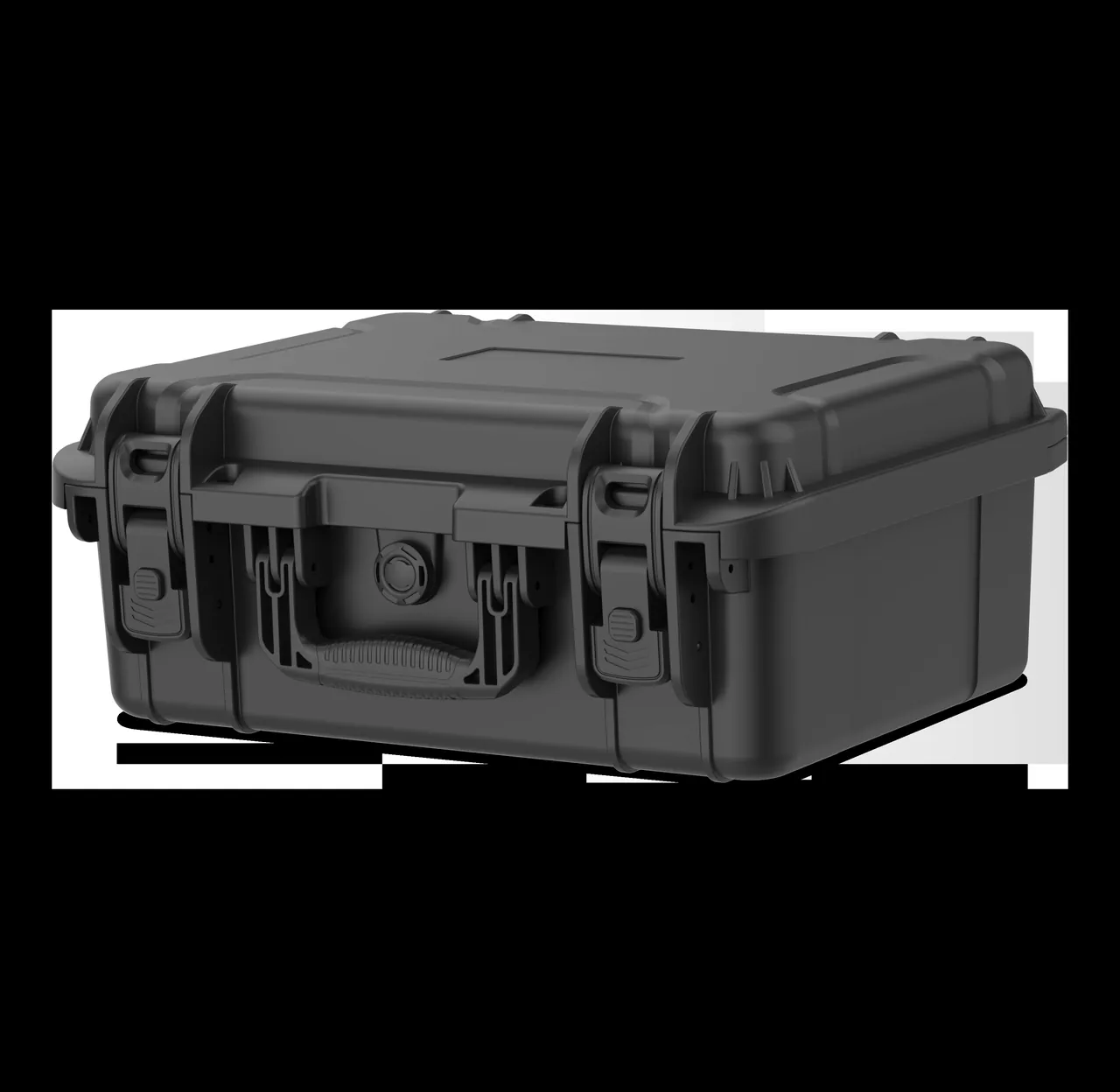
3. Cushioning Design: Fragility, Drop Height and Cushion Curves
Cushioning is not "thicker is better." It is an engineering process with a calculable basis.
Three basic inputs.
- Fragility factor (G level): the maximum acceleration multiple the object can survive. Experience bands for ceramics run roughly 40 to 85 G; thin-walled, large-span, handled objects, or pieces with existing hairline cracks may sit as low as 25 to 40 G; jade varies enormously with fissure condition. These are experience reference bands, and production specifications should be confirmed by physical testing.
- Drop height: determined by lane and package weight. As an experience guide, single-item manual handling lanes use 600 to 900 mm, mechanized sortation lanes use 800 to 1200 mm, and heavier packages take the lower end of the range.
- Bearing area: determines the static stress in the cushion material, which directly drives cushioning efficiency.
What a cushion curve means. Every foam material has a relationship between static stress and peak acceleration, and there is a static stress band in which cushioning efficiency is highest — peak acceleration lowest. Outside that band, whether softer or stiffer, cushioning degrades. This explains a counterintuitive fact: packing an object extremely tight, producing very high static stress, and leaving it loose in an oversized box, producing very low static stress, are both unsafe. The former transmits impact; the latter lets the object accelerate and strike the box.
Design flow (operational steps).
- Determine object weight and the most fragile features.
- Fix drop height and target fragility from the lane.
- Calculate required bearing area and static stress band.
- Select cushion material density and thickness from the material's cushion curve.
- Verify cushion thickness is sufficient so the layer does not bottom out within the compression stroke of the maximum drop.
- Validate by drop testing and adjust material or geometry as needed.
Bottoming out is a failure mode that must be designed out. If a cushion layer is fully densified during impact, energy transfers straight into the object and peak acceleration can rise by a factor of several. Cushion thickness must match expected impact energy and must allow margin for long-term compression creep.
A note on creep. Beyond drops, stacking load also passes through the cushion. Long-term stacking causes foam creep, a permanent set that reduces support force and increases displacement on the next shipment. For long-term storage, reduce or eliminate stacking, or use materials with better creep resistance.
For overall cushion liner structural forms, see cushion liner case structure.
4. Suspension (Floating) Packing: The Museum Standard Practice
For high-value, fragile or unusually shaped objects, museums and fine art logistics operations overwhelmingly use suspension packing, also called floating packing: the object is wrapped and then held on a suspended film or elastic support inside the case, touching no rigid surface of the case.
Principle. Suspension packing shifts cushioning from compression of a material to elastic extension. On impact, elastic deformation of the suspension film absorbs energy, and peak acceleration is governed by film stiffness and travel. Because the object has clearance on all sides, impact is cushioned in every direction and no rigid contact point exists.
Typical construction.
- Inner layer: acid-free tissue or soft cotton paper wrapped around the object for isolation, not for cushioning.
- Middle layer: acid-free foam or polyethylene foam wrapping that forms a soft envelope and eliminates point contact.
- Outer layer: suspension film, commonly polyethylene, stretching the wrapped object to the case interior with 40 to 100 mm of free travel on all sides, sized by object dimensions and weight.
- Stops: positive stops between the suspension structure and the case walls to prevent excessive excursion and wall contact in transit.
Where it fits and where it does not. Suspension packing suits irregularly shaped objects that resist cavity machining, objects with cantilever features such as handles, ears and spouts, and extremely fragile or restored objects. It does not suit very heavy objects, where film capacity and travel are constrained; objects with sharp protrusions that could puncture the film without a prior soft wrap; or high-frequency turnaround, where assembly time becomes a burden.
Vacuum sealing versus suspension. Some workflows use the object plus soft wrap plus evacuated film, gaining excellent retention and moisture isolation. The risk is that vacuum pressure applies sustained stress to the object, which is unsuitable for porcelain with hairline cracks or thin walls, and that sudden film failure causes an abrupt loss of support. The conclusion: vacuum suits robust pieces, not fragile ones.
5. Point Loads and Line Loads: Why "Packing It Tight" Is the Most Dangerous Approach
Packing tight is the most common and most dangerous habit in antique packing, for three reasons.
First, tight packing means high static stress. When an object is compressed in place, the cushion material enters a highly compressed state and its stiffness rises steeply, so shock transmissibility climbs. The result: soft foam behaves like a nearly rigid spring, and impact reaches the object almost undamped.
Second, tight packing concentrates load on whichever point touches first. Object surfaces are rarely flat — rims, footrings and raised decoration all create high spots. Under compression, pressure concentrates at a few contact points, producing stress concentration, and in brittle materials the tensile stress at a concentration can reach several times the average.
Third, tight packing applies sustained load during long storage. Continuous pressure on foam accelerates micro-crack growth through stress-corrosion and creep paths and can leave impressions on glaze.
Correct alternatives.
- Area contact instead of point contact: use conformable or semi-conformable soft materials that follow the object's shape and maximize contact area.
- Distributed points instead of a single restraint: at least three directional restraint points, each in light contact.
- Keep elastic margin: the purpose of restraint is to limit movement, not to crush the object. Total permitted displacement should be small, but the object should carry no obvious sustained pressure.
- Independent support for cantilevers: handles, ears and spouts get their own cradles so load never travels through the body.
A practical criterion. If shaking the closed case produces a perceptible 1 to 3 mm of internal movement, restraint is usually well tuned. If there is no clearance at all and shaking produces no sound, static stress is likely too high and the arrangement should be reworked.
6. Porcelain Specifics: Rims, Handles, Thin Walls and Glaze
Four vulnerable zones in porcelain need targeted detailing.
Rim. Rims on vases, jars and bowls are the thinnest and most exposed features and often carry a finished lip. Requirements: the rim must not touch any hard surface; provide a soft ring support inside and outside the rim so load spreads around the circumference rather than onto individual points; and where an object is inverted, such as certain bowls, use a ring collar to carry the rim rather than resting the rim directly on a flat surface.
Handles, ears and spouts. These are cantilever structures with maximum bending moment at the root. Requirements: give each handle its own cradle so it carries neither its own weight nor vibration inertia; fill the gap between handle and body with soft material to stop swinging; and where two handles are symmetrical, keep supports symmetrical to avoid torsion.
Thin walls and large spans. Flat bases or thin walls on large plates, bowls and jars can exhibit plate-like bending modes under whole-case vibration. Requirements: use area support at the base to spread load, add one compliant support at the center to shift the bending mode, and avoid supporting only at the outer ring, which leaves the center unsupported.
Glaze. Glaze and body have different expansion coefficients, so rapid temperature change causes crazing and even spalling, while relative friction leaves scratches. Requirements: use acid-free, plasticizer-free soft contact layers; avoid sudden temperature change and keep the rate of environmental change gradual; and never place ordinary foam plastic in direct contact with a high-gloss glaze.
Lidded objects and matched pieces. The lid-to-body interface is a stress concentration zone, and relative motion wears or even chips the interface. Recommended practice: pack lid and body separately in their own cavities, or fill the interface with soft material to immobilize it; and relieve the finial so it carries no load. For compartment structures, see case removable divider system.
7. Jade Specifics: Fissures, Toughness, Thermal Shock and Carved Detail
Jade protection differs from porcelain: it is more impact-tolerant, but it fears cracking more.
Toughness advantage, fissure disadvantage. Jade, both nephrite and jadeite, has an interlocking fibrous or granular crystal structure that resists fracture far better than ordinary ceramics, so at equal size it tolerates higher impact. But jade almost always contains natural fissures, cleavage planes or locked-in fabrication stress, and those defects are the starting points for crack growth. Repeated low-amplitude vibration in transit extends cracks from those origins until, at some point, an ordinary impact causes sudden separation. For jade, reducing vibration transmissibility ranks above adding cushion thickness.
Edges, corners and carved detail. Edges, corners and openwork carving are where chipping occurs first. Requirements: openwork areas must touch no material at all and should sit in relief cavities; edges and corners receive soft wrapping; and sharp hard elements such as metal latches or hard plastic corner protectors must never come near the object.
Thermal shock. Jade is relatively sensitive to rapid temperature change, which can develop internal stress and drive fissure propagation. Therefore: avoid packing in a hot environment and immediately moving into cold transport, or the reverse; pack at 18 to 24 degrees Celsius after temperature equilibration; and prevent localized heating from direct sunlight in transit.
Translucency and light. Some jade has a translucent quality. Prolonged intense light will not fade it the way organic materials fade, but it accelerates evaporation and degradation of surface wax and conditioning oils, changing surface appearance. Light-excluded storage remains the recommendation, especially for long-term storage.
Cords, pendants and metal mounts. Suspension cords, tassels and metal mounts are mixed materials: organic cords absorb moisture and age, metal parts oxidize. Requirements: cords coiled and restrained without compression; metal mounts protected with vapor-phase corrosion inhibitor paper; and no direct rubbing between metal and jade.
8. Insert Material Systems: Acid-Free, Plasticizer-Free, Lignin-Free
Antique insert material selection is far stricter than for ordinary goods, because the materials touch the object plus wooden stands, paper labels and brocade boxes.
| Material | Advantages | Risks | Typical position |
|---|---|---|---|
| --- | --- | --- | --- |
| Polyethylene foam (PE) | Chemically inert, plasticizer-free, closed-cell and non-hygroscopic | Limited stiffness options, moderate creep resistance | Primary cushioning and support layers |
| Ethylene-vinyl acetate (EVA) | Precisely machinable, good resilience | Some formulations contain additives that need verification | Moulded cavities, divider structures |
| Acid-free tissue | Acid-free, wrap-capable, low cost | No cushioning capacity | Direct object wrap |
| Acid-free cotton paper or soft cotton cloth | Soft, low friction | Needs dust management, can absorb moisture | High-gloss glaze, jade surfaces |
| Corrugated plastic sheet (PP or PE twin-wall) | Inert, rigid, load bearing | Edges must be chamfered to prevent scratching | Layer dividers, load-bearing boards |
| Wood | Machinable, inexpensive | Releases organic acids, harmful in long contact | Not recommended as a contact layer |
| Standard PVC film | Soft, cheap | Contains plasticizers that migrate and bond | Never used in contact zones |
| Rubber and elastomeric foams | Good elasticity | Contain sulfides that can corrode metal parts | Avoid where metal parts are present |
Three hard principles.
- Materials in direct contact with objects must be acid-free, plasticizer-free and low-outgassing. Newsprint, standard corrugated board, PVC film and some rubber products are all disqualified.
- Wood components must be isolated. Wood releases organic acids, especially in humid conditions, so wooden crates, stands and supports must have an inert barrier between them and the object.
- Materials need composition declarations. For high-value objects, require suppliers to provide composition and outgassing documentation and run a small-scale compatibility test before volume use, placing the object and material together under controlled temperature and humidity and comparing surface condition.
A note on display boxes. Many objects come with a brocade or wooden box. These original boxes have collectible value, but their protective capability is usually limited: brocade boxes typically contain ordinary foam and fabric that can dull glaze or corrode metal parts in long contact. The correct arrangement is to protect the original box separately while the object's protection is carried by a purpose-built transport case, with the two zoned apart inside the case. For material comparisons, see case foam material comparison; for process detail, custom foam insert design flow and EVA foam insert custom process.
9. Humidity and Temperature: Trading Off Across Mixed Materials
Antiques are rarely a single material, so the humidity window must be negotiated between several.
Recommended window.
- Relative humidity 45% to 55%: satisfies ceramics, which are themselves not moisture sensitive, alongside jade, metal parts requiring oxidation control, and paper labels and wooden stands that must neither swell nor dry out, while suppressing mold.
- Temperature 18 to 24 degrees Celsius: covers the safe range for restoration adhesives and fill materials and avoids thermal shock to jade.
- Stability first: the rate of change often matters more than the absolute value. Rapid change generates interfacial stress in multi-layer assemblies and is especially dangerous for restorations and glaze.
Why not "drier is better." Below 40% relative humidity, paper labels, wooden stands and brocade boxes lose moisture and shrink or crack, and restoration layers can crack from expansion mismatch. Very low humidity may be harmless for a single ceramic piece but is harmful for a group that includes organic components.
Condensation and the warm-box effect. Across climate zones, a case moving from a cold environment into warm humid air can condense on its exterior, and a highly airtight case with a cold interior can precipitate moisture on inner walls. Measures: fit a pressure equalization valve that passes air but not water, balancing differential pressure while preserving the IP rating, and avoid sealing a case in extreme conditions. See pressure equalization valve design.
Desiccant sizing. Estimate from both free air volume and organic material mass: a baseline of 20 to 30 g of high-performance desiccant per 20 liters of free air, plus 10 to 20 g for each kilogram of organic material such as wooden stands, brocade boxes, paper and textiles, multiplied by a lane factor of 1.2 to 1.8. These are typical experience values; fix production specifications only after lane validation. Place a humidity indicator card and a data logger inside the case so decisions rest on data.
Emergency handling principle. If a case has been exposed to extreme temperatures in transit, do not open it immediately. Let it stand in the target environment for 12 to 24 hours to equilibrate before opening. Opening abruptly exposes the object to a thermal step that can crack glaze or a restoration layer.
10. Light and Ultraviolet: Overglaze Enamels, Pigments and Organic Adhesives
Light causes limited direct damage to inorganic materials, but it affects the antique as an assembly.
What is affected. Overglaze enamels and low-temperature painted decoration, scrolls and paper labels, brocade textiles, lacquered wooden stands, and some organic components such as aged restoration materials and wax layers are all light sensitive. Museum practice for sensitive materials is to cap illuminance and limit ultraviolet content: for most organic and painted materials, illuminance is typically held at low levels, commonly in the 50 to 200 lux range, with ultraviolet content kept low, often with a control target below 75 microwatts of ultraviolet power per lumen.
Three-layer blocking strategy.
- Opaque liner: use opaque or dark liner materials so the object sits free of direct light.
- Shell blocking: specify sheet with UV stabilizers; where a window is used, the window layer must include a UV absorber and be identified as such.
- Storage and display lighting management: hold illuminance at or below about 200 lux for long-term storage as an experience guideline, avoid prolonged direct exposure from high-color-temperature spotlights in display, and consider timed lighting.
An easily missed point: whether the insert is actually opaque. Many insert materials are white and semi-transparent and do not block light over long storage. Where the shell itself is clear, such as a PC case, add an opaque inner cover or bag. This is another reason transport cases and display cases should be separate designs.
11. Shell Structure and Ingress Protection Selection
| Option | Strengths | Limitations | Suitable scenarios |
|---|---|---|---|
| --- | --- | --- | --- |
| Injection-moulded ABS case with custom insert | Good stiffness, sealable, reusable, lockable | Tooling investment, higher self-weight | Mid and high-value objects, cross-region transport, repeated turnaround |
| Aluminum-frame flight case | Very high strength and stiffness, stackable | Heavy, costly, requires internal cushioning design | Large objects, touring exhibitions, intercontinental freight |
| PP twin-wall case | Light, low cost, collapsible | Moderate stiffness, low sealing | Short haul, lower value, internal turnaround |
| PC case | High impact resistance, visible contents | Requires light exclusion, higher cost | Scenarios needing visual inspection |
| Wooden crate (outer) | Custom sizing, carries heavy loads | Releases organic acids, needs barrier layers, poor sealing | Outer crate for large objects, with internal inert barrier |
Selection criteria. First, object value and irreplaceability: high-value or irreplaceable items should use a sealable, lockable, traceable option. Second, lane: intercontinental freight favors aluminum frame or reinforced injection-moulded structure with IP67. Third, turnover count: frequent touring favors structures with replaceable parts. Fourth, number of custody transfers: multi-party handover requires numbering and seal systems.
Ingress protection, defined by IEC 60529 and its national equivalents such as GB/T 4208.
| Rating | Meaning | Value for antiques | Recommended scenarios |
|---|---|---|---|
| --- | --- | --- | --- |
| IP54 | Dust protected plus splash resistant | Basic dust control | In-museum turnaround, short haul |
| IP65 | Dust tight plus water jet resistant | The workhorse rating | Parcel, LTL, trade shows |
| IP67 | Dust tight plus short-term immersion | Sea freight, rainy regions, severe weather | Full-container ocean, intercontinental lanes |
| IP68 | Dust tight plus continuous immersion | Specialized lanes | Requires stated test conditions |
Why dust tightness matters. For antiques, dust is not merely a cosmetic issue: it causes secondary scratching during unpacking and cleaning, especially on high-gloss glaze and jade surfaces. The value of an IP6X dust-tight rating often exceeds the specific water digit. Moving to IP67 is mainly justified by sea freight and open-air handling in high-rainfall regions. Remember that an IP rating is a system-level outcome: gasket material, groove geometry, latch clamping force and shell stiffness must all match. See IP67 case sealing structure, waterproof case IP ratings and seal materials and case seal material selection.
12. Environmental and Transport Test Evidence
Specifications should rest on reproducible evidence.
| Reference | Scope | Relevance to antique cases |
|---|---|---|
| --- | --- | --- |
| GB/T 4857 series | Stacking, vibration, impact, drop | Establishes strength baseline and stacking limits |
| ISTA 1/2/3 series | Transport package performance procedures | Combines test intensity by lane |
| ASTM D4169 | Distribution cycle performance testing | Simulates a complete distribution cycle |
| MIL-STD-810H | Environmental test methods | Used as a method reference only; not a military certification |
| IEC 60529 / GB/T 4208 | Enclosure ingress protection | Defines and verifies IP rating |
| UL94 | Flammability classification for plastics | Flammability requirement for inserts and windows |
| ISO 9706 / ISO 18916 | Permanent paper and enclosure compatibility | Reference logic for acid-free contact materials |
On MIL-STD-810H. It is a test method standard defining conditions and procedures. Testing according to its methods confers no military certification or approved-status designation, and documentation and marketing must strictly separate the two. For antique cases its practical value is a reproducible vibration, shock and temperature-humidity procedure, well suited to validating vibration isolation and cushioning schemes.
Recommended validation sets by lane.
- Local and short haul (in-museum, auction house internal): drop testing at a rated height for the package weight, plus stacking and seal inspection.
- Domestic trunk lanes (parcel, LTL): ISTA 3A or ASTM D4169 plus vibration, drop and IP65 verification.
- Intercontinental sea and air: the above plus high-temperature high-humidity exposure, long-duration stacking, IP67 verification and a pressure equalization function test.
- Fragile or restored objects: the above plus acceleration monitoring, with accelerometers placed near the object to record actual lane peaks, followed by post-unpack condition verification.
In practice, JUNZHJIA combines test items according to the customer's lane: drop and vibration pre-tests to calibrate the cushioning scheme, then in-lane validation with acceleration loggers, and finally a comparison of measured peaks against the object's experience-band fragility. All testing can be routed to third-party laboratories with reports archived. See ISTA transport testing procedure selection and ASTM D4169 distribution cycle testing.
13. Large Objects, Sets and Display Mounts
For large objects such as tall vases, jars, screens and stone carvings, and for sets such as dinner services, matched ornaments and objects with display mounts, the focus shifts from unit protection to system protection.
Center of gravity and overturning. Large objects have a high center of gravity and lateral acceleration in transit can tip them. Measures: enlarge the base support area; use straps as secondary restraint where necessary, but straps must spread pressure through pads and must never bear directly on the object body; and apply non-slip treatment between case base and vehicle floor.
Relative positions within a set. The value of a matched set usually depends on completeness, so relative positions must be fixed and no two pieces may touch. The approach is one cavity per piece plus rigid dividers plus a numbered manifest, with no contact path between any two pieces.
Shipping display mounts. Mounts in wood, metal or acrylic create three problems: they can release organic acids or create rigid contact; they move relative to the object under vibration; and they can deform themselves. Recommendation: ship mounts in a separate case, or in a separate compartment of the same case with an inert barrier between; and never let a metal or wooden mount surface touch glaze directly.
Long and flat objects. Scrolls, screens and long forms need continuous longitudinal support, since supporting only the ends lets the middle sag. Use curved cradles or continuous channels and limit bending deflection.
Assembled structures. For objects reassembled on site, such as multi-tier displays, include an assembly sequence note and component numbering in the manifest and give each core component a unique number.
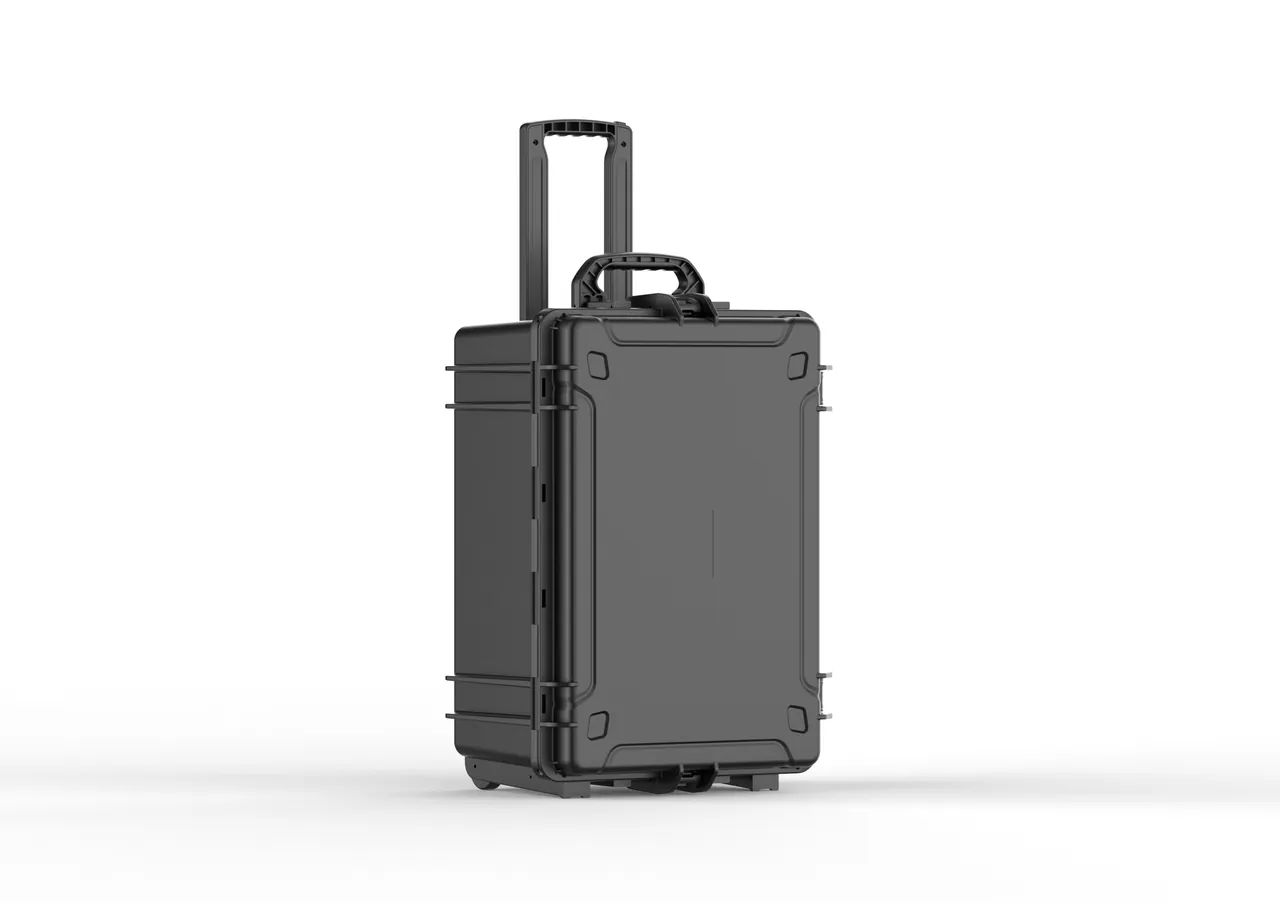
For oversized or heavy items, consider handling aids. See case wheels and trolley handle configuration and portable transport case structure.
14. Tamper Evidence, Condition Records and Chain of Custody
Antique transport involves multiple parties — collectors, logistics providers, auction houses, museums, insurers — so the evidence chain is part of the protection system.
Pre-packing condition record. It should include multi-angle high-resolution photography, with consistent lighting for both overall and detail shots; dimensions and weight; annotation of known defects and restored areas, located by label or measurement; pre-packing temperature and humidity; and the packer, date and case number.
Handover documentation. Use three-way numbering:
- Unique case number, bound to the waybill.
- In-case manifest numbering, with every object numbered and condition notes attached.
- Single-use seal number, unrecoverable once broken and matching the other two.
Any anomalous opening surfaces during reconciliation. For very high-value objects, add a temperature and humidity logger plus a shock indicator label that records threshold exceedance, making transport conditions traceable evidence. For tamper-evident and lock configurations, see case hinge, latch and seal selection and case lock customization options.
Unpacking verification. Follow a fixed procedure: allow the case to equilibrate first; wear gloves; check items against the manifest one by one under consistent lighting; compare against pre-packing photographs; and record and file the result. If an anomaly is found, photograph the seal and case exterior before opening so that responsibility can later be determined.
A compliance reminder for cross-border movement. Certain categories, such as objects with cultural property status, items containing ivory or other endangered-species materials, and specific metals or chemicals, may be subject to dedicated cultural property or endangered species regulations, permits and declarations. Requirements vary substantially between jurisdictions and may include provenance documentation, permits or expert opinions. Before arranging cross-border transport, confirm the applicable regulations, permits and documentation with a qualified professional. This article does not constitute compliance or legal advice. Also confirm carrier category restrictions and insurance terms, and check whether packaging must meet carrier requirements such as phytosanitary treatment for wooden packaging.
15. Cleaning, Maintenance and Long-Term Storage
Object cleaning. Apply minimal intervention. Routine work is dust removal only, using a soft brush, an air bulb or low-suction vacuum. Avoid organic solvents, abrasives and household cleaners. Glaze and jade surfaces should not be wiped frequently, since this wears surface wax or leaves fine scratches. Any intervention that qualifies as restoration belongs with a professional conservator.
Case and insert maintenance. Wipe shells with mild detergent and a soft cloth and keep solvents away from windows. Wipe gaskets with water or mild detergent and air dry; never apply grease-based conditioners. Clean inserts by soft brushing and vacuum extraction, never by soaking. Polyurethane-class foams are consumables: replace them when powdering, shedding, hardening or permanent compression set appears, because powder particles contaminate object surfaces. Replace gaskets with the same material and cross-section when hardening or cracking appears.
Long-term storage points.
- Temperature and humidity: 45% to 55% RH and 18 to 24 degrees Celsius, held as stable as practical.
- Light: exclude it; where lighting is needed, hold illuminance at or below about 200 lux as an experience guideline and limit ultraviolet.
- Support: avoid long-term stacking that crushes foam into creep; inspect insert support every 6 to 12 months.
- Inspection interval: open and inspect every three to six months, focusing on new crazing, changes in jade fissures, distortion of wooden stands and labels, oxidation of metal parts, and desiccant replacement.
See cleaning and maintaining protective cases and protective case service life assessment.
16. Customization Flow, Acceptance and Cost Structure
Customization flow (seven steps, one more than typical categories because of the condition baseline).
- Object inventory and condition baseline: record dimensions, weight, defect locations, materials and restorability for each object to form a condition record.
- Risk assessment and lane definition: determine lane type, drop height assumption, target fragility and whether acceleration monitoring is required.
- Cushioning and structural design: select cushion material and thickness, suspension or cavity architecture, contact layer materials and zoning.
- Prototyping and live fit: build insert prototypes, fit the actual objects, and check contact point count and static stress level.
- Test validation: drop, vibration, stacking and sealing tests by lane, with in-lane acceleration monitoring where required.
- Acceptance freeze: appearance and dimensions, function covering opening, sealing, locking and pressure equalization, material declarations, and the manifest and seal system.
- Production and delivery: manufacture to batch with inspection records and material documentation; per-case inspection records can be provided for high-value projects.
Cost structure.
| Cost item | Nature | Drivers | Optimization direction |
|---|---|---|---|
| --- | --- | --- | --- |
| Shell tooling | One-time | Size, structure, surface finish | Reuse size families |
| Insert forming and machining | Semi-one-time | Cavity count, suspension complexity | Modular cavities, universal cradles |
| Shell material | Recurring | Material type, thickness, flammability and sealing requirements | Choose by lane |
| Acid-free and inert consumables | Recurring | Acid-free paper, PE foam, barrier layers, gloves | Tier usage by object value |
| Seals and hardware | Recurring | Gasket material, latch and lock grade | Standardize wear parts |
| Testing and documentation | Per batch | Item count, whether in-lane monitoring is used, laboratory accreditation | Combine the minimum necessary items |
| Assembly labor | Recurring | Cavity count, condition record complexity | Numbering and poka-yoke design |
Acceptance points. Build acceptance at three levels: appearance and dimensions including tolerances; function covering opening, sealing, locking, pressure equalization, cavity fit and suspension travel; and documentation and materials covering the condition record, manifest, seals, material composition declarations and test reports. Sampling plans can follow AQL methods; see custom case acceptance and AQL sampling. For supplier selection, see how to choose a protective case OEM factory; for tooling economics, custom case mold cost analysis. For high-value or irreplaceable objects, inspect every case rather than sampling.
Frequently Asked Questions
Q: Porcelain can be repaired, so why invest heavily in a transport case?
A: Because repaired and undamaged are not the same value. Once a piece is broken, even a good restoration leaves visible seams, fills and color differences, and within collecting and auction systems this is generally treated as a downgrade whose price effect far exceeds the case cost. For a piece that already has hairline cracks, a single shipment can turn a repairable object into an unrepairable one through multiple fractures and lost fragments. In addition, three antique damage classes are delayed-onset: hairline cracks, glaze spalling and restoration cracking may be entirely invisible on unpacking day and appear weeks or months later, at which point determining responsibility is extremely difficult. Investment in a transport case therefore buys avoidance of one irreversible value loss plus reduced handover dispute cost. For mid to high-value or irreplaceable objects, the return is usually unambiguous. Starting with a dated condition record is the cheapest part of the whole programme, and it is the part that most often decides who pays when something goes wrong.
Q: Why is packing an object tight the most dangerous approach?
A: For three reasons. First, high static stress raises transmissibility: once foam is compressed to densification, its stiffness rises steeply and it behaves like a nearly rigid spring, so impact reaches the object almost undamped and the cushioning design fails. Second, load concentrates at the first contact point: object surfaces are rarely flat, with rims, footrings and raised decoration acting as high spots, so tight packing concentrates pressure on a few points, and in brittle materials tensile stress at a concentration can be several times the average. Third, sustained load accelerates damage: long compression creeps the foam, leaves impressions on the object surface and promotes micro-crack growth. The correct alternatives are area contact instead of point contact, distributed points instead of a single restraint, and retained elastic margin. Check with a simple criterion: if shaking the case externally produces a perceptible 1 to 3 mm of internal movement, restraint is usually well tuned; if there is no clearance at all and shaking produces no sound, static stress is likely too high and the arrangement should be reworked. Where an object has any existing damage, photograph the contact arrangement before closing the case, so later questions about support points can be answered from evidence rather than memory.
Q: How thick should cushion foam be? Is thicker better?
A: No, thickness should follow calculation and testing. The correct sequence is to determine object weight and the most fragile features; fix drop height and target fragility from the lane, with experience bands for ceramics around 40 to 85 G and as low as 25 to 40 G for thin-walled or hairline-cracked pieces; calculate required bearing area and static stress band; select material density and thickness from the cushion curve; and verify that the cushion layer does not bottom out within the compression stroke of the maximum drop. Bottoming out is a failure mode that must be designed out, because once a cushion layer is fully densified energy passes straight into the object and peak acceleration can rise by a factor of several. Also allow margin for long-term compression creep, since foam takes a permanent set under prolonged stacking, reducing support force and increasing displacement on the next shipment. All values are experience reference bands, and production specifications should be confirmed by drop testing. Record the chosen material and thickness in the case documentation so a replacement insert is built to the same specification rather than to a visual approximation.
Q: Does suspension packing suit every object?
A: No. Suspension packing converts cushioning from material compression to elastic extension, gives the object free travel on all sides and eliminates rigid contact points, which makes it ideal for three cases: irregularly shaped objects that resist cavity machining; objects with cantilever features such as handles, ears and spouts; and extremely fragile or restored objects. It is unsuitable for very heavy objects, where film capacity and travel are constrained; for objects with sharp protrusions that could puncture the film without a prior soft wrap; and for high-frequency turnaround, where assembly time becomes a burden. Also distinguish suspension from vacuum sealing: vacuum sealing gives excellent retention and moisture isolation, but vacuum pressure applies sustained stress to the object, which is unsuitable for porcelain with hairline cracks or thin walls, and film failure causes abrupt loss of support. Vacuum suits robust pieces, not fragile ones. Where an object combines suspension with substantial mass, consider a hybrid arrangement in which the base carries load while the upper body floats, keeping the film within its working range while still removing rigid contact points.
Q: Why do antique cases require acid-free materials? Are ordinary foam and cartons not acceptable?
A: Because antiques are usually mixed-material assemblies that include wooden stands, brocade boxes, paper labels, metal parts and restoration materials alongside ceramic and jade. Standard corrugated board, kraft paper and some foams release acids or lignin degradation products, and wood components release organic acids especially in humid conditions. Over long contact this yellows and embrittles paper labels, discolors wooden stands, corrodes metal parts and can leave irreversible traces on glaze. International standards exist for permanent paper, such as ISO 9706, and for enclosure compatibility, such as ISO 18916, the photographic activity test, and the logic transfers directly: materials in direct contact with objects must be acid-free, plasticizer-free and low-outgassing; wood components must have an inert barrier; and standard PVC film and sulfide-containing rubber must stay out of contact zones. For high-value objects, require composition declarations and run a compatibility test. Where provenance matters as much as the object itself, keep the original box in the same case but in its own inert-lined compartment, so packaging history travels with the piece without its materials touching the object.
Q: What temperature and humidity range is right, and why does stability matter more than the exact value?
A: For mixed-material antiques containing ceramic, jade, metal parts, wooden stands and paper labels, hold 45% to 55% relative humidity and 18 to 24 degrees Celsius, and keep both as stable as practical. Stability matters more than the exact value because an antique is a multi-layer assembly whose materials have different thermal and moisture expansion coefficients. Rapid change generates interfacial stress, which is especially dangerous for restored objects and glaze and can directly crack a restoration layer or spall glaze. Separately, below 40% relative humidity paper labels, wooden stands and brocade boxes lose moisture, shrink and crack, while above 65% sustained for more than 48 hours activates mold and accelerates metal corrosion. One further principle is important: if a case has experienced extreme temperature exposure in transit, do not open it immediately. Let it stand in the target environment for 12 to 24 hours to equilibrate first, because opening abruptly exposes the object to a thermal step. Recording the logger trace for each shipment turns the storage window from a target into a verified fact, and it also shows whether a case sat too long on a loading dock before departure.
Q: What should be considered when moving antiques across borders?
A: The core rule is to confirm the applicable regulations and documentation requirements before arranging packaging and transport. Certain categories — objects with cultural property status, items containing ivory or other endangered-species materials, and specific metals or chemicals — may be subject to dedicated cultural property or endangered species regulations, permits and declarations. Requirements differ substantially between jurisdictions and may include provenance documentation, permits or expert opinions. Also confirm carrier category restrictions and insurance terms, whether a third-party appraisal or customs broker is needed, and whether the packaging meets carrier requirements such as phytosanitary treatment for wooden packaging. Compliance determinations must follow current regulations and rely on the opinion of qualified professionals such as customs brokers, legal counsel and appraisers; this article does not constitute compliance or legal advice. At the engineering level, provide a fixed document pocket in the case and record chain-of-custody information with the shipment. Keeping copies of permits, appraisals and the condition record together with the shipping documents prevents delays at exactly the point where they are most expensive.
Q: Antique case acceptance is harder than for ordinary cases. What should be checked?
A: Use three levels plus physical testing. The first is appearance and dimensions, including tolerances and surface finish. The second is function: whether opening is smooth, whether gasket compression is correct, whether locks and the pressure equalization valve work, and whether cavities actually fit the objects. Cavity checks must be done by trial fitting with the real objects or an accurate replica, never from drawings alone. The third is documentation and materials: whether the condition record is complete, whether manifest lines correspond one to one with cavity numbers, whether seal numbers match across all three records, whether materials carry composition declarations, and whether test reports cover the agreed items. For high-value or irreplaceable objects, inspect every case rather than sampling, and retain the acceptance records. Finally, run a physical drop or vibration pre-test and then re-open and compare against the condition record, confirming no new scratches, chips or fissure changes. That is more persuasive than any paper specification. For repeat shipments of the same object, comparing each new acceptance record against the previous one often reveals slow drift, such as a gasket taking a set, before it produces an actual failure.
Conclusion and Further Reading
The technical core of an antique transport case is treating irreversible damage as the only acceptable failure criterion. The essentials compress into five statements: no point loads (area contact, distributed points, independent support for cantilevers); no rigid contact (suspension or full soft wrap, with an inert layer always between the object and any hard surface); cushioning with a basis (a three-part calculation across fragility, drop height and cushion curves, avoiding bottoming out and static stress outside the efficient band); a stable environment (45% to 55% RH at 18 to 24 degrees Celsius, stability ahead of absolute values, with light excluded and ultraviolet limited); and a traceable process (condition records, three-way numbering, environmental and shock records). Meet these five and "still intact on opening" becomes a specification rather than a hope.
The recommended sequence is: build the object inventory and condition baseline, design cushioning and structure by lane, validate with drop and vibration testing including in-lane acceleration monitoring where required, then freeze acceptance through per-case inspection. JUNZHJIA can supply suspension and cavity-type custom inserts by object list, acid-free inert contact layer configurations, cushion material selection with thickness calculation, matched seals and locks, and reserved numbering and seal systems, and can route third-party testing and per-case inspection documentation according to the customer lane, supporting wholesale, distribution and OEM/ODM supply.
Further Reading