

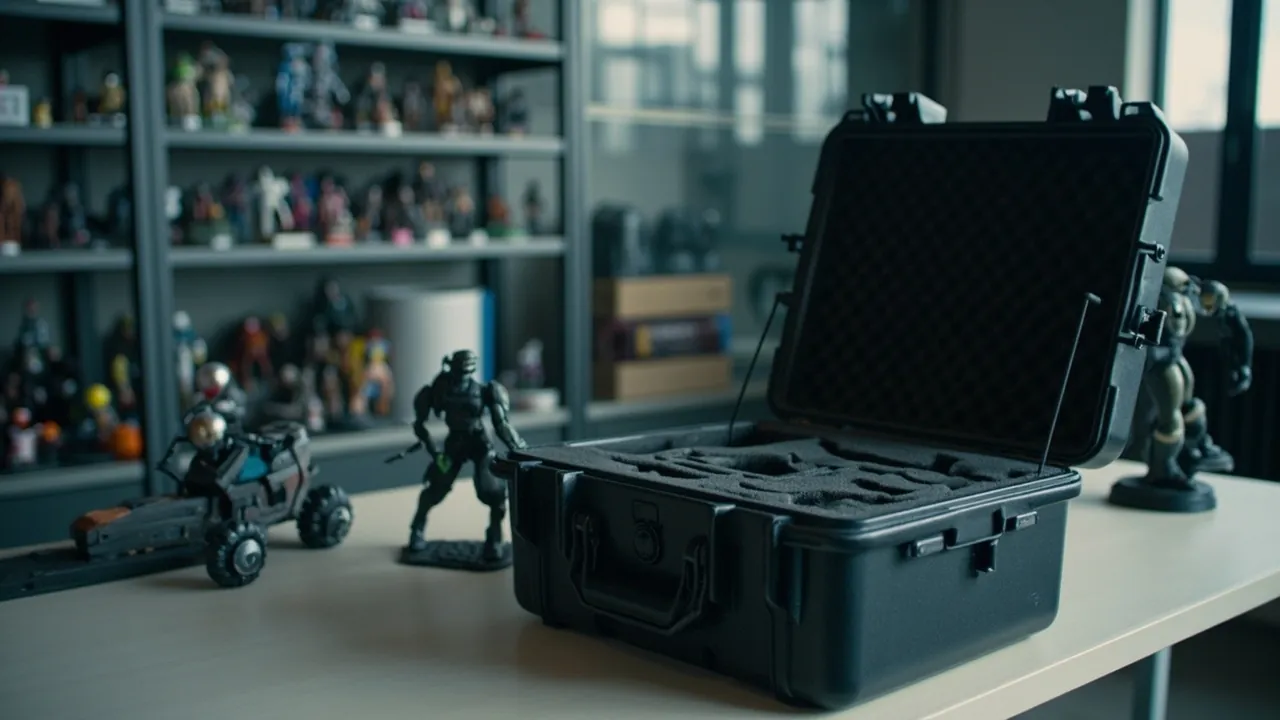
Protecting collector-grade toys and figures during transport means locking a graded asset into an environment of zero movement, low humidity and zero light exposure, so that the case structure absorbs stacking and impact loads instead of the model. This is not the same problem as ordinary toy logistics. For mass-market toys the success criterion is "arrives usable." For collectibles the criterion is "arrives still gradeable." The same limited-run figure, in flawless condition with its original box, can trade at three to ten times the price of a copy with dents, mold spots or yellowing, and that gap does not narrow as the item changes hands again. It widens.
Three mistakes dominate collector transport. Using the art box as the package (cardboard is a moisture source and a mold substrate). Using bubble wrap as cushioning (bubble wrap absorbs impact but does not constrain displacement, so the model still rattles inside the carton). And treating "not broken" as "not damaged" (yellowing, mold, micro-cracking of paint and loosened joints typically appear two to eight weeks after receipt, not on day one). This guide works through six threads — damage mechanisms, insert geometry, humidity and light control, ingress protection ratings, test evidence, and turnaround management — and provides parameters, tables and acceptance methods that can be written directly into a purchasing specification.
Table of Contents
- 1. Why Collector-Grade Toys and Figures Need a Dedicated Case
- 2. Condition Grading and the Economics of Damage
- 3. Eight Damage Classes in Toy and Figure Transport
- 4. Insert Design: Cavities, Soft Contact and Zero-Displacement Constraint
- 5. Dust, Static and Surface Protection
- 6. Moisture and Temperature: The RH Window and Mold Mechanics
- 7. Ultraviolet Light: Yellowing, Fading and Aging
- 8. Art Box Protection: The Case-in-Case Architecture
- 9. Shell Materials and Structural Options
- 10. Ingress Protection: Choosing Between IP65 and IP67
- 11. Environmental and Transport Test Evidence
- 12. Packing Density, Size Families and Combination Schemes
- 13. Trade Shows, Relocation and Resale Turnaround
- 14. Hinges, Seals, Locks and Tamper Evidence
- 15. Cleaning, Maintenance and Service Life
- 16. Customization Flow, Acceptance and Cost Structure
- Frequently Asked Questions
- Conclusion and Further Reading
1. Why Collector-Grade Toys and Figures Need a Dedicated Case
Traditional collectible logistics relies on a three-layer model: art box, bubble wrap, shipping carton. That combination is workable for single items on short domestic hops under constant supervision. It fails structurally in three ways once you move to batch shipping, cross-climate transport or repeated unpack-and-inspect cycles.
Flaw one: the art box has almost no compression resistance. Its job is presentation and identification, not load bearing. The flat crush strength of typical corrugated board sits in the hundreds of kilopascals range. Once the stacked weight above exceeds the critical value, the box top deflects and presses into the model itself. Antennae, hair tips, weapon accessories and cape edges are the first structures to deform, and they have no recovery: once a plastic part yields plastically, elastic springback is zero.
Flaw two: the art box is a continuous moisture source inside the case. Paper products absorb moisture persistently above roughly 70% relative humidity. Once moisture content climbs past roughly 12%, the fibers themselves become a substrate for mold spores. In full-container ocean freight or during a humid monsoon storage season, the "art box plus bubble wrap" configuration is a high-incidence mold combination, and mold usually starts at box corners and liner paper where it is invisible until it has already contaminated the model surface.
Flaw three: disposable packaging cannot carry condition-management requirements. Collectibles need tracked item numbers, limited-edition numbers, colorway, scale, serial numbers and unboxing status, plus protection against substitution and mis-shipment. A single-use carton cannot provide reusable fixed positions or a checkable manifest, so returns, authentication and resale all generate avoidable coordination cost.
The decision rule fits in one sentence: the value of a figure case equals the markdown avoided, plus authentication disputes avoided, plus packing and inventory efficiency gained, minus the purchase and amortization cost of the case. For limited figures priced in the hundreds of dollars or more, the first three terms usually dwarf the last.
For toy and collectible programs, JUNZHJIA typically defines specifications along three axes: category (PVC figure, resin statue, die-cast painted model, clear-part model, soft vinyl), which sets cavity geometry and contact materials; size band (lid heights of roughly 150 mm, 250 mm, 400 mm and 600 mm), which sets the shell size family and insert partitioning; and lane (brand direct-ship, trade-show round trip, relocation, cross-region ocean freight), which sets shell strength, ingress protection and UV configuration.
2. Condition Grading and the Economics of Damage
Collector markets price condition rigidly. Specific scales differ between third-party grading services and platform-specific standards, but the underlying dimensions converge: box integrity, model integrity, paint condition, accessory completeness and factory-seal status. The table below summarizes typical markdown ranges by damage type (industry experience bands, intended for prioritization only and not a statement of any grader's outcome).
| Condition dimension | Acceptable state | Common degradation | Typical markdown band (experience) |
|---|---|---|---|
| --- | --- | --- | --- |
| Art box | No dents, no foxing, sharp corners | Top deflection, frayed corners, yellowed faces | 10% to 40% |
| Model body | No cracks, no missing parts, seams closed | Broken hair tips, detached accessories, split joints | 20% to 60% |
| Paint | Even tone, no dust nibs, no scuffs | Rubbed paint, uneven matte, fingerprints | 10% to 35% |
| Clear parts | Transparent, no haze | Haze, hairline cracks, scratches | 15% to 50% |
| Metal parts | No oxidation, no rust spotting | Dulled plating, flaking | 10% to 30% |
| Factory seal | Seal intact | Evidence of resealing | 30% to 70% |
Two conclusions follow immediately. First, paint and clear-part damage carries the steepest markdown and is the hardest to reverse, because both are surface processes and any sanding or touch-up leaves an identifiable trace. Second, box condition is not a minor term — many buyers purchase box and figure together, so box state feeds directly into price negotiation, which is why art box protection must be specified to the same standard as model protection rather than improvised. That is the reason Section 8 is devoted entirely to case-in-case architecture.
3. Eight Damage Classes in Toy and Figure Transport
Decomposing figure and collectible toy failure into eight classes makes it possible to target spending. Without this decomposition, budgets tend to go to configurations that look professional and deliver little.
| Damage class | Typical manifestation | Primary cause | Effective countermeasure |
|---|---|---|---|
| --- | --- | --- | --- |
| Protrusion fracture | Broken hair tips, weapons, antennae, capes | No cavity constraint, free displacement, point contact | Full-wrap cavity, soft contact points, eliminate single-point loading |
| Denting and creep | Collapsed box, permanent flat spots on model | Stacking load, insufficient shell stiffness | Load-bearing top board, stacking limit, grid-reinforced insert |
| Joint loosening and cracking | Loose articulation, broken pegs | Repeated vibration, in-case resonance, opening shock | Support at joints, whole-body constraint, limit unsupported spans |
| Paint and coating damage | Rubbed paint, chipped coating, uneven matte | Relative surface friction, plasticizer migration | Zero-displacement retention, plasticizer-free barrier film |
| Clear part haze and cracking | Whitened acrylic, hairline cracks | Solvent residue, stress cracking, compression | Isolated cavity, avoid direct contact, control assembly stress |
| Mold and odor | White or green spots, musty smell, foxed paper | Sustained RH above 65%, condensation | Sealing, desiccant bay, pre-pack drying |
| Yellowing and fading | White parts yellow, colors desaturate | UV exposure, oxidation, elevated temperature | Opaque liner, UV-blocking window, temperature control |
| Accessory loss and mismatch | Missing pieces, swapped hands, wrong base | No dedicated compartments, no manifest | Numbered compartments, in-case manifest, seal verification |
Within these eight, paint damage, mold and yellowing are delayed-onset failures. Every unit can pass visual inspection on dispatch day and still degrade over the following weeks. Condition judgment therefore cannot rest on receiving inspection alone; it requires process data — moisture content at packing, desiccant quantity, and the temperature and humidity curve in transit. That is the engineering reason a figure case should ship with a humidity indicator card, not the reason to add a free gift.
For the broader framework of package performance testing, see transport packaging basic tests and strength design.
4. Insert Design: Cavities, Soft Contact and Zero-Displacement Constraint
The insert is the real technical core of a figure case. Its engineering objective is a single sentence: the model must not be able to move in any direction inside the case, and every contact point must occur between a soft material and a structurally strong part of the model.
Four insert routes are practical.
Route one: full moulded cavity. The cavity is machined to the model silhouette in EVA or PE foam, walls matching the model's perimeter, floor supporting the base, with the contact surface faced in soft fabric or an acid-free layer. This is the default route for limited figures and resin statues. It delivers the strongest shape retention at the cost of tooling time and packing density.
Route two: partial cavity plus restraint strap. The lower half provides a cavity, and the upper half presses on key structures with an elastic strap or soft pad. This suits statues whose geometry resists complete machining. The critical rule is that pressure points must land on high-strength regions such as the base or torso, never on hair tips or weapons.
Route three: suspension. The model hangs on a film or woven sleeve without touching the case floor, so impact loads are absorbed elastically by the suspension membrane. This suits slender structures such as scale-model airframes or long accessories. Its limitation is weaker lateral restraint, so it must be paired with limiting walls.
Route four: layered tray. Models lie on rigid trays separated by dividers that carry the load. Packing density is highest, which suits thin boxed figures and card products.
| Route | Suitable categories | Units per case | Shape retention | Structural complexity |
|---|---|---|---|---|
| --- | --- | --- | --- | --- |
| Full moulded cavity | Limited figures, resin statues | Low to medium | Very strong | High |
| Partial cavity plus strap | Complex statues, long accessories | Medium | Strong | Medium |
| Suspension | Slender models, long accessories | Low | Medium to strong | High |
| Layered tray | Thin boxed items, cards | High | Medium | Low |
Insert material selection drives long-term safety. EVA (ethylene-vinyl acetate) offers the best resilience and machining precision and tolerates repeated compression without collapse, which makes it the most common primary material. PE foam is inexpensive and water resistant but softens under load and takes a permanent set after long compression, so it suits short cycles and light items. PU foam feels soft and conforms to complex curvature, but some formulations hydrolyze and outgas, so formulation stability and material documentation must be confirmed. Acid-free foam and acid-free paper are used as the layer in direct contact with the model, preventing acid migration that degrades coatings and paper components.
For cavity tolerances, corner radii and layering methods, see custom foam insert design flow and EVA foam insert custom process.
5. Dust, Static and Surface Protection
Surface condition is the price of a collectible. Dust is rarely a cosmetic issue in isolation; it binds to static charge and forms stubborn adhesion, and the cleaning process itself causes secondary scratches.
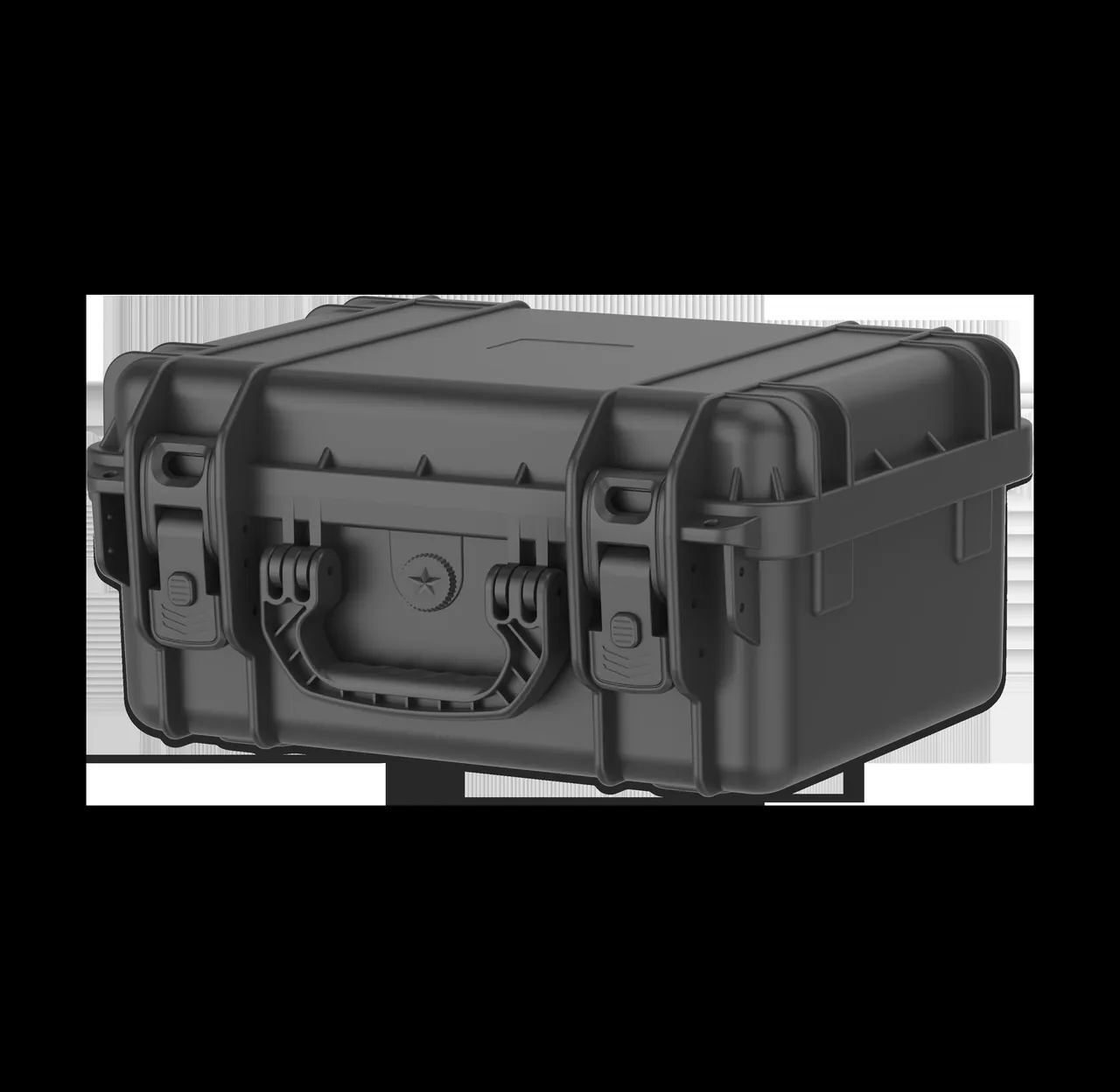
Sources of static and how to suppress them. Plastic shells, foam inserts and bubble wrap all generate static through friction and separation. When in-case relative humidity drops below roughly 35% — northern winters, long-haul air cargo holds — charge cannot bleed off and the amount of dust and fiber adhering to the model rises sharply. For collectible toys with electronics or light-and-sound modules, static also damages function. There are three suppression paths: use static-dissipative insert formulations or laminated conductive fabric layers; apply antistatic treatment to the shell surface; and hold in-case RH in the 45% to 55% band so charge bleeds off naturally.
It is worth stating that static control and moisture control reinforce rather than conflict with each other. Slightly higher humidity helps charge bleed; too much humidity drives mold. The 45% to 55% RH band is the overlap where both requirements are satisfied simultaneously, which is why this guide returns to it repeatedly.
Contact layer selection. Materials in direct contact with the model must meet four requirements: no plasticizer migration, no acid release, low outgassing and a low friction coefficient. A practical configuration is three layers — acid-free tissue (wrap), acid-free foam or soft fabric (conform), EVA cavity (retain). Avoid newsprint, ordinary corrugated board and plasticized PVC film as direct contact layers; these can leave irreversible traces within three to twelve months.
For toys with circuits, batteries or sensors, see ESD shielding case design.
Window materials. Where a viewing window is required, as is common for trade shows and retail turnaround, choose PMMA (acrylic) or PC. PMMA transmits light excellently but is brittle and prone to stress cracking; PC is highly impact resistant but scratches easily and needs a hard coat. Both should satisfy UL94 flammability requirements, with V-0 or V-2 selected according to the application, backed by material documentation. The window is also the main entry path for UV, so the window layer should incorporate UV absorbers that reduce energy below about 380 nm to a low level.
6. Moisture and Temperature: The RH Window and Mold Mechanics
Humidity is the quietest killer of collectibles. It leaves almost no evidence on delivery day and then produces mold, foxed paper, dulled coatings and oxidized metal over the following weeks.
Recommended humidity window. For most PVC, ABS, resin and paper-based collectibles, in-case relative humidity of 45% to 55% RH is the long-term safe zone. Below 40%, paper components and some soft-vinyl materials lose moisture and become brittle, and adhesives tend to crack. Above 65% sustained for more than 48 hours, mold spores become active and art boxes and liner paper are affected first.
Temperature window. A long-term storage range of about 15 to 25 degrees Celsius is appropriate. Temperature itself does limited direct harm to most plastics; the real risk is condensation driven by temperature cycling. When the case surface falls below the dew point of the air inside, liquid water forms on the inner wall. The day-hot, night-cool cycle of an ocean freight container is a high-incidence condition.
Estimating desiccant quantity. Desiccant consumption — typically silica gel or mineral desiccant — should be estimated from both the free air volume inside the case and the mass of hygroscopic material, not from case volume alone. A practical approach: start with roughly 20 to 30 g of high-performance desiccant per 20 liters of free air, add 10 to 20 g for each kilogram of paper components such as art boxes, leaflets and liner paper, then multiply by a factor of 1.2 to 1.8 according to lane length, using the upper end for intercontinental routes. All values here are typical experience figures; production specifications should be fixed only after validation on the actual lane.
Pressure equalization. A fully sealed case experiences pressure differentials during air freight and high-altitude road transport, producing a lid-suction effect on opening and accelerated seal wear. The correct solution is a pressure equalization valve that passes air but not water, releasing differential pressure while preserving the IP rating. See pressure equalization valve design.
Pre-pack drying. Packing should take place at 45% to 55% RH and 20 to 25 degrees Celsius. Art boxes brought in from a humid environment should not be sealed immediately; allow 12 to 24 hours to equilibrate, otherwise you seal water vapor inside.
7. Ultraviolet Light: Yellowing, Fading and Aging
Yellowed white PVC parts, desaturated painted surfaces and hazed clear parts all trace back to light and oxidation.
UV mechanism. Ultraviolet energy in the 295 to 400 nm band carries enough energy to break polymer chains and initiate free-radical reactions, which appear as surface yellowing, embrittlement and loss of gloss. Ordinary cartons and bubble wrap provide almost no UV blocking, which explains why a collectible stored in a carton near a window comes out yellowed a year later.
Blocking strategy. The first layer is an opaque liner, so the model sits in an environment free of direct light. The second is shell material blocking, using plastic sheet or composite structures with UV stabilizers; where a clear window is used, the window layer should carry a UV absorber. The third is storage lighting management, keeping illuminance in long-term storage below roughly 200 lux as an experience guideline and avoiding prolonged direct exposure from high-color-temperature spotlights.
Oxidation and plasticizer migration. Plasticizers in PVC articles migrate to the surface over time, creating a tacky layer that captures dust and bonds to adjacent materials. Controls include preventing direct model-to-model contact, using plasticizer-free barrier film, holding temperature below 25 degrees Celsius and avoiding prolonged sealed storage in a hot environment without buffering.
One point deserves emphasis: yellowing and fading are irreversible. This is not surface dirt that can be wiped away; the material bulk and the coating structure have changed. Every light and UV measure is therefore preventive, and no equivalent remediation exists. That property is why cost compromises should not be made in the light-blocking configuration of a figure case.
8. Art Box Protection: The Case-in-Case Architecture
The art box contributes independently to value, so the correct architecture is case-in-case: the outer case carries stacking and impact loads while the inner original box keeps its factory geometry untouched.
Sizing allowance. A cushioning gap should be maintained between inner box and outer shell wall. A practical approach: 10 to 20 mm lateral gap filled with cushioning, 15 to 25 mm at the top with a load-bearing board, and 10 to 20 mm at the bottom. The overall envelope ratio of outer case to inner box typically falls between 1.05 and 1.12 depending on inner box strength and stacking layers.
Corner protection. The eight corners are the most vulnerable features of an art box. Acid-free corner protectors or moulded corner pads of 3 to 8 mm thickness are recommended, and the corner material must be free of acids and plasticizers.
Insert-to-box relationship. The inner box should sit in a dedicated cavity whose walls follow all four faces, preventing lateral slide. Where the art box carries UV varnish or foil stamping, add acid-free barrier tissue at the contact surface so varnish does not bond to foam.
Unboxing experience. Collectors are sensitive to the unboxing process, and any design that requires cutting with a blade introduces scratch risk. A lift-off lid with a hinge stop that holds the lid open at an angle allows one-handed access.
9. Shell Materials and Structural Options
| Option | Typical construction | Strengths | Limitations | Best-fit applications |
|---|---|---|---|---|
| --- | --- | --- | --- | --- |
| PP twin-wall case | Twin-wall sheet, edge trim, plastic latches | Light, low cost, collapsible | Moderate stiffness, low sealing class | Short haul, light items, internal turnaround |
| Injection-moulded ABS case | One-piece lid and base with gasket | High stiffness, good sealing, tooling-friendly | Tooling investment, heavier unit | Brand direct ship, repeated long-term use |
| PC case | Clear or tinted polycarbonate sheet | Highest impact resistance, good visibility | Higher cost, scratch-prone surface | High-value single items, display turnaround |
| EVA composite case | EVA shell with integrated insert | Light, good cushioning, soft appearance | Weak puncture resistance, compression set | Light collectibles, relocation |
| Aluminum-frame flight case | Aluminum frame, panels, hard insert | Very high strength and stiffness | Heavy, costly | Touring exhibitions, intercontinental freight |
Several quantifiable criteria guide selection. Stacking layers determine top-load requirements. Unit value determines whether tooling is justified. Turnover count determines whether an injection-moulded structure with replaceable gasket and hinges is warranted. Transport mode — parcel, LTL, full-container ocean, air — determines the ingress protection class and pressure equalization configuration. For the fundamentals of sheet selection and case construction, see plastic protective box selection and structure.
For collector brands, the most underestimated factor is turnover count. A single-use carton looks cheap, but if a display piece is unpacked and repacked six times a year, the labor and attrition cost rapidly exceeds the purchase price of a reusable case.
10. Ingress Protection: Choosing Between IP65 and IP67
Ingress protection ratings are defined by IEC 60529 and its national equivalents such as GB/T 4208. The format is IP followed by two digits: the first covers solid particle protection from 0 to 6, the second liquid protection from 0 to 9K.
| Rating | Solid protection | Liquid protection | Practical meaning for collectibles |
|---|---|---|---|
| --- | --- | --- | --- |
| IP54 | Dust protected (limited ingress) | Splash resistant | Retail internal turnaround, dust control |
| IP65 | Dust tight | Water jet resistant | General transport, rain during handling, washdown |
| IP67 | Dust tight | Short-term immersion at stated conditions | Ocean freight, flooded routes, severe weather |
| IP68 | Dust tight | Continuous immersion at manufacturer-stated conditions | Specialized lanes where test conditions are specified |
Selection logic. For roughly 95% of collectible transport scenarios, IP65 is sufficient. IP65 means dust tight plus protection against water jets, which covers normal transport, rain during loading and case washdown. Only three lane types justify IP67: full-container ocean freight with prolonged high humidity and condensation risk, open-air handling in high-rainfall regions, and lanes where immersion or severe standing water is genuinely possible. Note the side effects of over-specifying: higher ratings mean greater gasket compression, more opening resistance and a stronger case for a pressure equalization valve, and operators are more likely to scratch contents through excessive force when opening.
Equally important, an IP rating is a system-level outcome, not a property of a gasket alone. Gasket material, compression ratio, groove geometry, latch clamping force and shell stiffness must all match; if any one falls short, measured performance will be below the claimed rating. Purchasing specifications should therefore require verification records against IEC 60529 or GB/T 4208. See IP67 case sealing structure and waterproof case IP ratings and seal materials.
11. Environmental and Transport Test Evidence
Figure case specifications should rest on reproducible test evidence rather than a subjective sense of sturdiness.
| Reference | Scope | Relevance to collectible cases |
|---|---|---|
| --- | --- | --- |
| GB/T 4857 series | Stacking, vibration, impact and drop tests for transport packages | Establishes baseline strength and stacking limits |
| ISTA 1, 2 and 3 series | Transport package performance test procedures | Non-simulation, simulation and combined lane testing |
| ASTM D4169 | Performance testing of shipping containers and systems | Combines test intensity according to the distribution cycle |
| MIL-STD-810H | Environmental test methods (vibration, shock, temperature, humidity, salt fog) | Used as a test-method reference only; not a military certification |
| IEC 60529 / GB/T 4208 | Enclosure ingress protection | Defines IP class and verification method |
| UL94 | Flammability classification for plastic materials | Flammability requirement for windows and inserts |
Regarding MIL-STD-810H, one clarification is mandatory: it is a test method standard that defines conditions and procedures. Testing a product according to its methods does not confer any military certification, qualification or approved-status designation. Procurement documents, marketing materials and labels must strictly distinguish "tested according to its methods" from "military certified."
In practice, JUNZHJIA combines test items according to the customer lane. A parcel-plus-rainy-region lane typically uses an ISTA 3A or ASTM D4169 distribution cycle as the primary program with IP65 seal verification and low-temperature drop as supplements. A full-container ocean lane adds high-temperature high-humidity exposure and long-duration stacking. Programs can be routed to third-party laboratories on request, with reports archived for the customer. See ISTA transport testing procedure selection and ASTM D4169 distribution cycle testing.
12. Packing Density, Size Families and Combination Schemes
Packing density is the visible cost in collectible logistics. Every 10% gain reduces unit freight and storage cost, but protection falls as clearance shrinks, so the trade-off must be quantified.
Density estimate (experience formula).
Packing density = total packaged model volume divided by case internal volume
For figure cases using full moulded cavities, typical packing density lands between 35% and 55%. Layered trays for thin boxed items can reach 60% to 75%. If a scheme falls below 30%, either the cavity design or the size family is mismatched and should be re-derived.
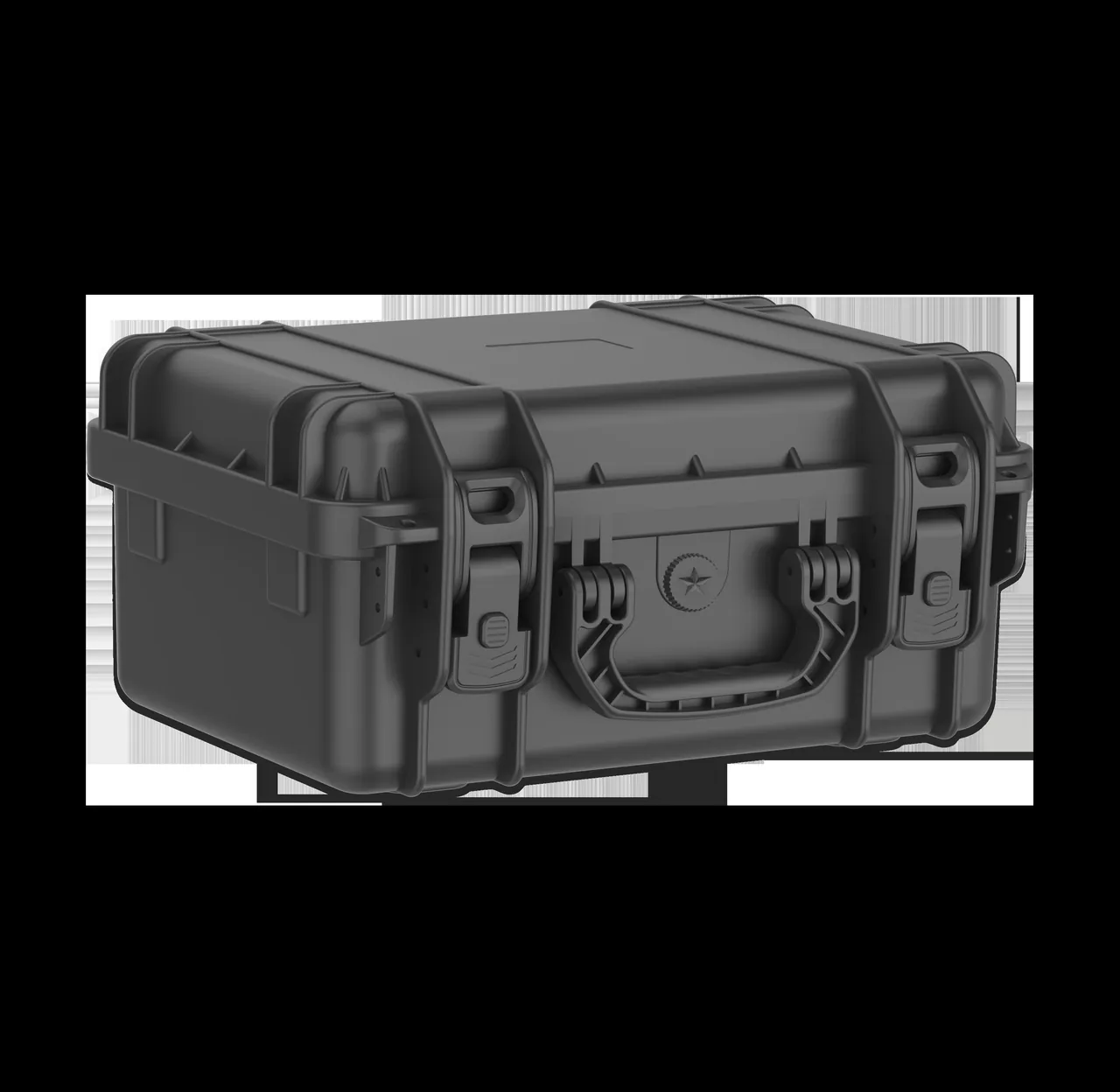
Size family recommendation. Establish four to six fixed outer dimensions, for example by internal height bands of 150, 250, 400 and 600 mm, and modularize inserts by category. This covers most categories without new shell tooling and substantially reduces customization cost.
Weight and handling limits. Total case weight is a frequently overlooked design constraint. As an experience reference, keep single-person frequent handling under about 15 kg and two-person or cart-assisted handling under about 30 kg. Beyond that, add a telescopic handle and casters; see case wheels and trolley handle configuration and portable transport case structure.
Mixed loading cautions. When items of different materials share a case, such as soft-vinyl and clear parts together, hard items must not rub against soft surfaces. Give each item its own compartment, or add an acid-free barrier at contact surfaces. The acceptance criterion for any mixed-load scheme is that no two items touch each other directly.
13. Trade Shows, Relocation and Resale Turnaround
Three turnaround scenarios dominate, each with different engineering priorities.
Trade shows and pop-up retail. Characteristics are high-frequency opening, heavy foot traffic and limited booth space. Design priorities: a lid that holds position for one-handed access; compartment layout matching the display sequence to cut search time on site; external labeling and numbering to prevent mix-ups. IP65 with reinforced corner protection is usually appropriate.
Relocation and personal moves. Characteristics are a sudden increase in volume, long single lanes and non-specialist handling. Priorities: packing density and lightweight construction first; layered trays with compartments; optionally collapsible structures for return-trip storage; a manifest label per case with case number and content summary. The largest loss source in relocation is not dropping the case but items striking each other in mixed loads, which is why compartment design outranks shell thickness.
Resale and consignment. Characteristics are single-item shipping, highly condition-sensitive buyers and a need for evidence. Priorities: art box protection first via case-in-case; an in-case state record card with space for unboxing photos; and single-use tamper-evident labels or seals to avoid return disputes. For high-value limited items, add a temperature and humidity recording label so transport conditions become traceable evidence.
14. Hinges, Seals, Locks and Tamper Evidence
The opening system determines long-term reliability. Collectible cases may be opened tens to hundreds of times a year, and poorly specified hinges and latches produce lids that will not seat, gaskets that will not compress properly and latches that loosen — each of which degrades the IP rating directly.
| Component | Common options | Key metrics | Common failures |
|---|---|---|---|
| --- | --- | --- | --- |
| Hinge | Internal hinge, living hinge, metal bearing hinge | Cycle life, lid stop angle, axial play | Stiff operation, stop failure, lid sag |
| Latch | Cam latch, snap latch, spring latch | Clamping force, fatigue life, one-hand operation | Clamping force decay, latch fracture |
| Gasket | EPDM, silicone, sponge rubber | Compression ratio, resilience, weatherability | Hardening, permanent set, cracking |
| Lock | Padlock eyelet, combination lock, key lock | Security level, resistance to bypass | Pried eyelet, altered combination |
| Tamper evidence | Single-use label, seal, serialized tape | Single-use, verifiable | Reuse, numbering errors |
Gasket maintenance. Gaskets are consumables. Inspect visually for hardened impressions and cracks after each long-duration shipment, and replace them at intervals matched to turnover frequency. Replacements must match material and cross-section, since a different profile shifts the compression ratio away from design value. For combined selection of hinges, latches and gaskets, see case hinge, latch and seal selection.
Tamper-evident design. High-value collectibles benefit from three-way numbering: a serialized seal, a numbered in-case manifest and a unique case number. A broken seal is unrecoverable, the manifest numbers each item and the case number is bound to the shipping document, so any anomalous opening surfaces during reconciliation. For lock configurations, see case lock customization options.
15. Cleaning, Maintenance and Service Life
Cases need maintenance, otherwise protective capability decays invisibly.
Cleaning method. Wipe shells with a mild detergent and a soft cloth. Keep organic solvents such as alcohol, acetone and thinner away from PC and PMMA windows, and avoid abrasive brushes or polish. Wipe gaskets with water or mild detergent and air dry; do not apply grease-based conditioners, which attract dust and degrade rubber. EVA inserts must not be soaked; use a soft brush and vacuum extraction.
Insert replacement criteria. Replace the insert when any of the following occurs: permanent compression set in cavity walls, surface powdering or shedding, mold spots (which cannot be fully removed by wiping), or hardening and cracking. Replacing an insert costs far less than a markdown on a model.
Service life. Injection-moulded cases often last five to ten years or more, but gaskets, inserts and latches have shorter lives and behave as periodic wear items. Planning assets as a long-life shell plus regularly replaced wear parts is more economical than replacing the whole case. See cleaning and maintaining protective cases and protective case service life assessment.
16. Customization Flow, Acceptance and Cost Structure
Standard customization flow (six steps).
- Requirement definition: category list, unit dimensions and weights, lane (parcel, LTL, ocean, air), turnover count, and whether a window or lock is needed.
- Solution design: shell size family, shell material, ingress protection class, insert route, and humidity and light control configuration.
- Prototype build: insert prototypes and trial-pack units assembled with real models for verification.
- Test validation: stacking, vibration, drop and sealing verification against the selected references (ISTA, GB/T 4857, ASTM D4169, IEC 60529).
- Acceptance freeze: define appearance, dimensional, assembly, sealing and packing acceptance criteria with a sampling plan.
- Production and delivery: manufacture to batch, with inspection records and material documentation supplied per batch.
Cost structure. The following items make up the cost of a custom figure case. Tooling and cavity machining dominate the upfront investment, while shells and seals drive recurring cost.
| Cost item | Nature | Drivers | Optimization direction |
|---|---|---|---|
| --- | --- | --- | --- |
| Tooling | One-time | Shell dimensions, structural complexity, surface finish | Reuse size families, minimize dedicated tools |
| Cavity machining | Semi-one-time | Cavity count, complexity, material | Modular inserts, shared cavity design |
| Shell material and molding | Recurring | Material type, thickness, flammability requirement | Choose by lane, avoid over-specification |
| Seals and hardware | Recurring | Gasket material, hinge and latch grade | Standardize wear parts for easy replacement |
| Testing and documentation | One-time or per batch | Test item count, laboratory accreditation | Combine the minimum necessary items per lane |
| Assembly and packing labor | Recurring | Compartment count, manifest complexity | Numbered compartments, poka-yoke assembly |
Acceptance points. Build acceptance at three levels: appearance and dimensions including tolerances; function covering opening, sealing, locking and pressure equalization; and packing and documentation covering manifest, numbering, seals and material certificates. Sampling plans can follow AQL methods; see custom case acceptance and AQL sampling. For supplier selection, see how to choose a protective case OEM factory, and for tooling economics, custom case mold cost analysis.
Frequently Asked Questions
Q: Is a standard carton with bubble wrap really inadequate? Why invest in a purpose-built figure case?
A: It depends on three variables: unit value, turnover count and lane. A carton with bubble wrap absorbs a portion of impact but has two structural gaps. First, it does not constrain displacement, so the model between bubble layers still strikes the walls repeatedly under vibration, and protruding structures such as hair tips, weapons and antennae fatigue and fracture after many small impacts. Second, it neither controls humidity nor blocks light: cardboard is a moisture source and bubble wrap does not stop ultraviolet energy, so mold and yellowing emerge weeks later. If a collectible is worth several hundred dollars or more, will be opened multiple times within a year, or crosses climate zones, a dedicated case pays for itself at the first markdown event it prevents. For low-value, short-haul, single-use scenarios, the carton approach remains acceptable. The point is to select by lane rather than applying one rule everywhere. As a rough decision rule, if a purpose-built case and its insert cost less than about five percent of the value of one full load, the economics almost always favor the purpose-built option, because a single prevented markdown event covers the investment.
Q: Should collectibles be sealed or ventilated? Does sealing trap moisture inside?
A: Sealing is the right direction, but it only works with two companions. First, the packing environment must be dry — pack at 45% to 55% RH and 20 to 25 degrees Celsius, and let art boxes from humid environments equilibrate for 12 to 24 hours, otherwise you seal water vapor inside. Second, desiccant is mandatory, sized from both free air volume and paper mass, with a multiplier for long lanes. Sealing buys you a barrier against external moisture and contaminants; whether the interior stays dry depends on packing state and desiccant sizing. A fully sealed case should also carry a pressure equalization valve, or air freight and high-altitude road transport will create a lid-suction effect and accelerate gasket wear. The correct framing is not "sealed or ventilated" but "sealed plus desiccant plus pressure equalization." A sequence that works reliably is: equilibrate the contents, pack them dry, add sized desiccant, close the case, and confirm the equalization valve suits the lane. Verify with a data logger on the first shipment of any new lane, then freeze the desiccant quantity as a standard.
Q: Why do you keep emphasizing 45% to 55% RH? What is the basis for that band?
A: The band is where several constraints overlap. Looking upward, sustained relative humidity above 65% for more than 48 hours activates mold spores, with art boxes and liner paper affected first before the model surface is contaminated. Looking downward, below 40% paper components and some soft-vinyl materials lose moisture and embrittle, and adhesives and paper layers tend to crack. In addition, static dissipation efficiency drops sharply in low humidity, which worsens dust adhesion. The 45% to 55% band simultaneously satisfies mold suppression, avoidance of desiccation embrittlement and adequate static dissipation, which is why it is a general long-term storage window. It is an engineering experience window, not a mandatory value from a single standard. Collectibles with unusual materials such as natural fiber or leather components should have their optimal band confirmed through small-scale sample testing. A practical way to lock the window in place is to record logger traces from the first three shipments of a lane and compare them against the design band; if the trace drifts outside it, adjust desiccant quantity, gasket condition or packing procedure before changing the target value itself.
Q: Should a figure case be IP65 or IP67?
A: For roughly 95% of collectible lanes, IP65 is sufficient. IP65 means dust tight plus resistance to water jets, which covers normal transport, rain during loading and unloading, and case washdown. Only three lane types justify IP67: full-container ocean freight with prolonged high humidity and condensation risk, open-air handling in high-rainfall regions, and lanes where immersion or extreme standing water is genuinely possible. Note the side effects of over-specifying. Higher ratings mean greater gasket compression, more opening resistance and a stronger case for a pressure equalization valve, and operators are more likely to scratch contents through excessive force when opening. Also remember that an IP rating is a system-level outcome: gasket material, groove geometry, latch clamping force and shell stiffness must all match, otherwise measured performance falls below the claimed rating. Require verification records against IEC 60529 or GB/T 4208 at purchase. One operational point is easy to forget: gasket compression is what actually delivers the rating, so inspect gasket condition at every long-turnaround interval. A hardened or permanently set gasket can drop a case from IP67 to roughly IP54 performance with no visible external damage at all.
Q: Why would a case claim to be "based on MIL-STD-810H"? Is that a military certification?
A: No. MIL-STD-810H is an environmental test method standard that defines conditions and procedures for vibration, shock, temperature and humidity, salt fog and related exposures. Testing a product according to its methods only means the test procedure followed that standard's protocol. It does not confer any military certification, qualification or approved-status designation. Procurement documents, marketing materials and labels must strictly distinguish "tested according to its methods" from "military certified" to avoid compliance risk. For collectible cases, the practical value of citing the standard lies in obtaining a reproducible, comparable environmental test procedure. Where the customer lane is primarily commercial distribution, the more relevant references are ISTA and ASTM D4169 distribution cycle testing, with MIL-STD-810H as a supplement. Keep the wording consistent across every document in the chain as well: the test report, the case label, the datasheet and the sales sheet should all state the same thing, because inconsistent phrasing is the most common source of compliance questions in audits and tenders.
Q: Should the insert be EVA, PE or PU? How do I choose safely?
A: Each material involves trade-offs. EVA has the best resilience and machining precision, tolerates repeated compression without collapsing and is the most common primary material for moulded cavities. PE foam is inexpensive and water resistant, but softens under load and takes a permanent set after long compression, so it suits short cycles and light items. PU foam feels soft and conforms to complex curvature, but some formulations hydrolyze and outgas, so formulation stability and material documentation must be confirmed. One additional principle is frequently overlooked: regardless of the primary material, the layer in direct contact with the model must be acid-free and plasticizer-free — acid-free tissue, acid-free foam or soft fabric. Otherwise you may see dulled coatings, blocking and yellowing within three to twelve months. During insert approval, run a small-scale compatibility test by placing the model and insert material together under controlled temperature and humidity for a period and comparing before and after. Where budget is tight, a hybrid stack works well: EVA for the load-bearing cavity and a thin acid-free contact layer, which captures most of the protection at a fraction of an all-acid-free construction.
Q: Should the original art box be protected too, or is protecting the model enough?
A: Protect both, because the art box participates in pricing. Many collectors purchase box and figure together, and box condition feeds straight into negotiation, with top deflection, frayed corners and yellowed faces carrying markdowns in the 10% to 40% experience band. The correct architecture is case-in-case: the outer case carries stacking and impact loads while the inner original box sits in a dedicated cavity and keeps its factory geometry, with 10 to 20 mm of lateral cushioning, a load-bearing top board and acid-free corner protectors on all eight corners. Where the art box carries UV varnish or foil stamping, add acid-free barrier tissue at contact surfaces so varnish does not bond to foam. Only when the original box has no residual value — for example when it is already badly collapsed — is model-only cavity protection justified. It is also worth photographing the art box before packing: a dated photo set turns a later dispute about pre-existing dents into a factual comparison rather than a negotiation, and it costs almost nothing to produce.
Q: How do trade-show round trips and relocation differ in configuration priority?
A: The differences are significant. Trade-show round trips involve high-frequency opening, on-site operators working under time and space pressure, and a need for fast access. Priorities are a lid that holds position for one-handed use, compartment layout matching display sequence, external numbering and labeling, and reinforced corner protection with IP65 recommended. Relocation involves a sudden volume increase, long lanes, non-specialist handling and a need for return-trip storage. Priorities are packing density and lightweight construction, layered trays with compartments, optionally collapsible cases, and a manifest label per case showing case number and content summary. Note that the largest loss source in relocation is not dropping a case but items colliding in mixed loads, which is why compartment design outranks shell thickness. A further practical measure for both scenarios is a packing list fixed inside the lid, so repacking at the destination follows the same layout. Rebuilding a case from memory is where most repacking damage happens, particularly when several models share one case and the compartments are not obviously numbered.
Q: How long do the case and its wear parts last, and when should they be replaced?
A: Judge by component. The shell of an injection-moulded case often lasts five to ten years or more, provided it is cleaned properly and not exposed to prolonged sunlight or solvents. Gaskets are consumables with a distinctly shorter life; replace them as soon as hardening, permanent set or cracking appears, and use the same material and cross-section. Inserts should be replaced when permanent compression set, surface powdering, mold spots or cracking appear; mold cannot be fully removed by wiping and requires full replacement. Latches and hinges are evaluated by cycle count, and should be serviced when clamping force decays or operation becomes stiff. Planning assets as a long-life shell plus regularly replaced wear parts is usually more economical than scrapping whole cases, and it is far easier to defend in acceptance and audit. For planning purposes, assume gaskets and inserts will be replaced at least once during the life of a shell and budget them as consumables, and record replacement dates on the case label so an overdue unit is visible at a glance.
Conclusion and Further Reading
Transport protection for collector-grade toys and figures is an engineering discipline whose purpose is to reduce condition uncertainty to an acceptable level. The core is not thicker walls but four quantifiable constraints holding simultaneously: zero displacement (inserts lock every item into its own cavity), low humidity (a 45% to 55% RH window with desiccant and pressure equalization), light exclusion (UV blocking and illuminance management) and traceability (numbering, manifests, seals and humidity records). From that base, choose IP65 or IP67 by lane, select shell material by turnover count and decide on tooling by unit value, and "arrives as it left the factory" becomes a specification rather than a hope.
The most practical sequence for buyers is: fix the specification using the damage tables and packing density formula in this guide, validate it with an ISTA, GB/T 4857 or ASTM D4169 test path, then freeze acceptance with AQL sampling. JUNZHJIA can supply custom inserts, matched sealing components, pressure equalization and static-dissipative configurations by category and size band, and can route third-party testing and batch inspection documentation according to the customer lane, supporting wholesale, distribution and OEM/ODM supply.
Further Reading