

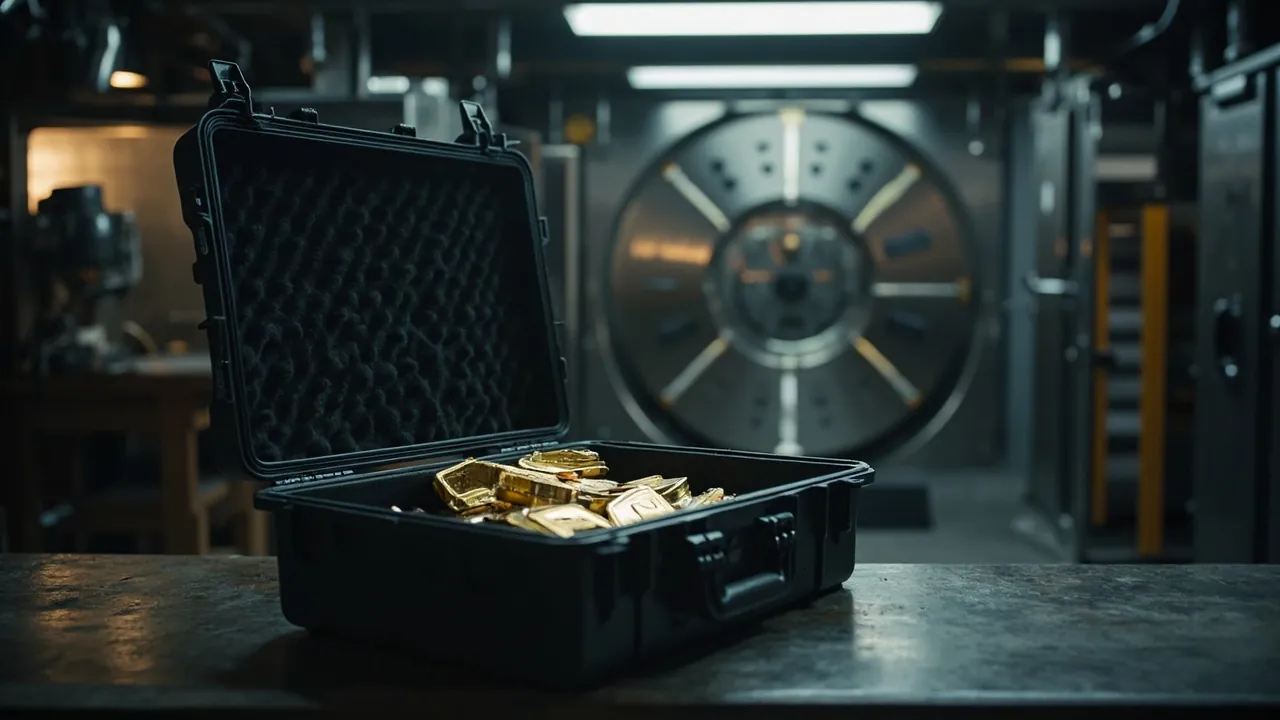
The design objective of a precious metal and jewelry transport case can be reduced to one engineering statement: within a finite volume and weight budget, give dense, high-value, easily marked and easily substituted items four simultaneous guarantees across the whole transport chain - they must not move, must not touch, must not be opened, and must be traceable. The difference from an ordinary protective case is fundamental. An ordinary protective case is concerned with "the contents must not break". A precious metal transport case must also solve structural failure caused by concentrated weight, micron-level protection of surface finish, and opening control plus evidence chain in a high-value setting. Missing any one of these shifts risk from a manageable loss to an irreversible one.
Three pain points dominate. First, the weight and volume paradox: gold has a density of roughly 19.3 g/cm3, so a modest case can weigh tens of kilograms, and the base, handle and hinges carry concentrated loads far beyond normal design assumptions. Second, surface damage is hard to reverse: fingerprints and scratches on bullion, sulphide tarnish on silver, chipped edges on loose stones, plating abrasion on finished pieces - once it happens, repolishing may be required or the damage may be permanent, and the loss includes brand and customer trust, not only rework cost. Third, substitution is hard to detect: precious items are small and visually similar, so quantity verification alone cannot reveal that an item was removed and replaced. A precious metal transport case must therefore be treated as a combined protection, evidence and tracking vessel.
This article covers materials and structure, inserts and partitioning, seals and locks, humidity control, anti-static and surface protection, tracking integration, test basis, scenario differences and insurance documentation, and provides engineering parameters and tables that can be used directly for procurement and acceptance.
Table of Contents
- 1. Risk Structure and the Three-Layer Protection Logic
- 2. Typical Structure and Material Selection
- 3. The Weight and Volume Paradox: Design Under Dense Loads
- 4. Inserts and Trays: Bullion, Jewelry, Loose Stones and Finished Pieces
- 5. Tamper-Evidence and Seals: Serial Numbers, Lead Seals and One-Time Seals
- 6. Locks and Dual Control: Opening Discipline in High-Value Settings
- 7. Sealing and Humidity Control: Silver Tarnish and Plating Oxidation
- 8. Anti-Static and Anti-Scratch: Fine Detail Protection
- 9. Tracking and In-Transit Monitoring: Positioning, RFID and Electronic Seals
- 10. Structural Attack Resistance: Prying, Cutting and Dropping
- 11. Environmental Testing: Drop, Vibration, Temperature and IP Basis
- 12. Scenario Differences: Trade Shows, Vaults and Cross-Border Movement
- 13. Acceptance, Inspection and Insurance Documentation
- 14. Procurement and Customisation: OEM/ODM and Cost Structure
- Frequently Asked Questions
- Conclusion and Related Reading
1. Risk Structure and the Three-Layer Protection Logic
High-value transport risk breaks into five categories, each requiring a different layer of defence.
Risk one: violent seizure. This occurs at known high-exposure points. Mitigation depends mainly on route and procedure - shortening dwell time, avoiding predictable patterns, using armed escort. The case contributes by denying an attacker an additional grip point and keeping contents intact even if the case is abandoned.
Risk two: internal substitution and skimming. This is the most covert and most persistent risk in high-value transport. Methods include removing some bullion and restoring the appearance, substituting visually similar lower-value items, and swapping an entire case. The first two are countered by seals and dual control. The third is countered by unique identity bound to tracking.
Risk three: surface and structural damage. Symptoms are scratches, chipped edges, deformation and plating abrasion. The financial value may be modest, but the damage to brand and customer trust is significant, and it is often discovered only after delivery, making responsibility hard to assign. Protection depends on insert fit accuracy and partitioning.
Risk four: environmental degradation. Silver tarnishes, copper alloys oxidise, gemstones lose lustre in damp conditions, leather fittings mould. This damage is slow but irreversible. Protection depends on sealing, humidity control and material compatibility.
Risk five: shell rupture after a drop. A dense load applies far greater impact to the case than a low-density load of the same volume. Protection depends on structural strength, cushioning layer design, and the load capacity of handles and hinges.
The resulting three-layer logic:
| Layer | Objective | Means | Consequence of failure |
|---|---|---|---|
| --- | --- | --- | --- |
| Layer one: physical | Contents undamaged | Structure, cushioning, insert fit | Surface and structural damage, value loss |
| Layer two: evidential | Opening detectable | Seals, serials, dual locks, photo records | Substitution untraceable, responsibility undefined |
| Layer three: tracking | Location known | Positioning, RFID, electronic seals, route comparison | Deviation and loss not detected in time |
The layers are complementary, not substitutable. Physical protection cannot detect internal substitution. Evidential protection cannot stop violent seizure. Tracking cannot prove the contents were not replaced.
JUNZHJIA supplies cases for precious metal and jewelry transport with partitioned per-item inserts, a serial plate and a one-way seal channel as the baseline configuration, because these three correspond to the three non-negotiable requirements: no damage, traceability, and verifiability.
2. Typical Structure and Material Selection
Six subsystems. Body shell, lid, hinge system, locks and seal channel, inserts and trays, external identity and tracking area.
Four constraints on material selection:
- Stiffness takes priority over toughness (unlike a standard protective case). Dense loads require the case to resist deformation under stacking and handling so that insert location is not lost.
- Impact resistance is still required for drops and violent impact.
- The material must not become a contamination source. Certain sulphur-bearing additives, plasticisers or recycled content can affect silver and plated surfaces over long contact periods, so suppliers should be asked to address material compatibility and migration risk.
- Surface texture and cleanability. The exterior should be easy to clean and not prone to trapping dust, so that contaminants are not carried into the insert area.
Material comparison:
| Material | Stiffness | Impact | Temperature behaviour | Weight | Suited to |
|---|---|---|---|---|---|
| --- | --- | --- | --- | --- | --- |
| Copolymer PP | Medium | Excellent | Good low-temperature toughness | Medium | Medium to large, high load |
| Modified ABS | Medium-high | Medium | Low-temperature embrittlement to assess | Medium | Small to medium, appearance-critical |
| Glass-fibre composite | High | Excellent | Stable | Medium-high | High stiffness, large format |
| Aluminium frame with composite panels | High | Medium-high | Stable | Medium | High pry resistance, easy to lock |
| Metal-lined reinforced body | Very high | Medium | Stable | High | Extremely high value, short haul |
On aluminium and metal reinforcement. Metal bodies have clear advantages in pry and cut resistance, but at the cost of weight and price, and metal-to-metal lock interfaces introduce galvanic corrosion considerations plus rigid load transfer that can crack polymer components. The common engineering compromise is a composite structure: a polymer body for toughness, with metal inserts or reinforcement plates at critical load points such as lock positions, hinges and corners. This follows the same load-path reasoning as toolbox hinges, latches and sealing structures.
Lid-to-body interface. Use a continuous tongue-and-groove with an elastomeric gasket. Beyond sealing, the tongue-and-groove contributes directly to pry resistance: the recessed geometry makes it hard for a pry bar to gain an effective fulcrum. For high-value applications, consider a double tongue-and-groove (inner and outer) to raise insertion difficulty further.
3. The Weight and Volume Paradox: Design Under Dense Loads
This is the most commonly underestimated engineering problem in precious metal cases.
Three consequences of density:
Consequence one: concentrated load on the base. At equal volume, gold weighs roughly six to ten times more than typical electronic equipment. Base pressure per unit area therefore rises sharply, and a case built with the wall thickness and base ribbing of a standard protective case will develop base sag and insert support failure over time.
Consequence two: failure of the handle and hinge load path. Lifting a case of tens of kilograms with one hand applies not only vertical tension but also an overturning moment at the handle boss. If the boss is mounted on a thin wall, the wall will flex outward under full load. The countermeasure is to extend the handle boss toward the primary load-bearing face and use a metal pin or reinforced bushing.
Consequence three: much greater drop impact energy. Impact energy scales with mass. For the same drop height, a dense load imposes far greater impact on the case than a light load, and can crack the base or fracture the insert.
Design countermeasure list:
- Base reinforcement. Add a reinforcement rib network and a base plate so that load is distributed into the side walls rather than concentrated on the base panel.
- Raised insert corner columns. Elevate the four corners of each cavity so that stacking load passes down through the columns into the base reinforcement, instead of pressing directly on bullion or trays.
- Defined handle and hinge load path. State the path explicitly: handle, metal pin or bushing, main load-bearing side wall, body frame. The path must not be interrupted in a thin-wall zone.
- Split loading strategy. For overweight loads, split across two cases rather than building one overweight case. An overweight case sharply increases drop and snatch risk, and concentrates loss if it falls.
- Wheels and telescopic handles. For heavy cases, specify wear-resistant wheels and a metal inner-tube telescopic handle to reduce manual carrying distance. Selection guidance is in case wheels and trolley handles.
Experience-based load and size mapping:
| Target load per case | Suggested external format | Suggested structural reinforcement | Suggested handling |
|---|---|---|---|
| --- | --- | --- | --- |
| Light | Small, hand-carried | Standard base ribbing | Hand-carried |
| Medium | Medium | Base ribs plus insert corner columns | Hand or shoulder strap |
| Heavy | Medium to large | Reinforced base, metal inserts, double joint | Wheels and telescopic handle |
| Very heavy | Large | Split loading preferred | Wheels, handle and pallet |
4. Inserts and Trays: Bullion, Jewelry, Loose Stones and Finished Pieces
The insert is the most technically demanding component, because it must balance retention against surface protection.
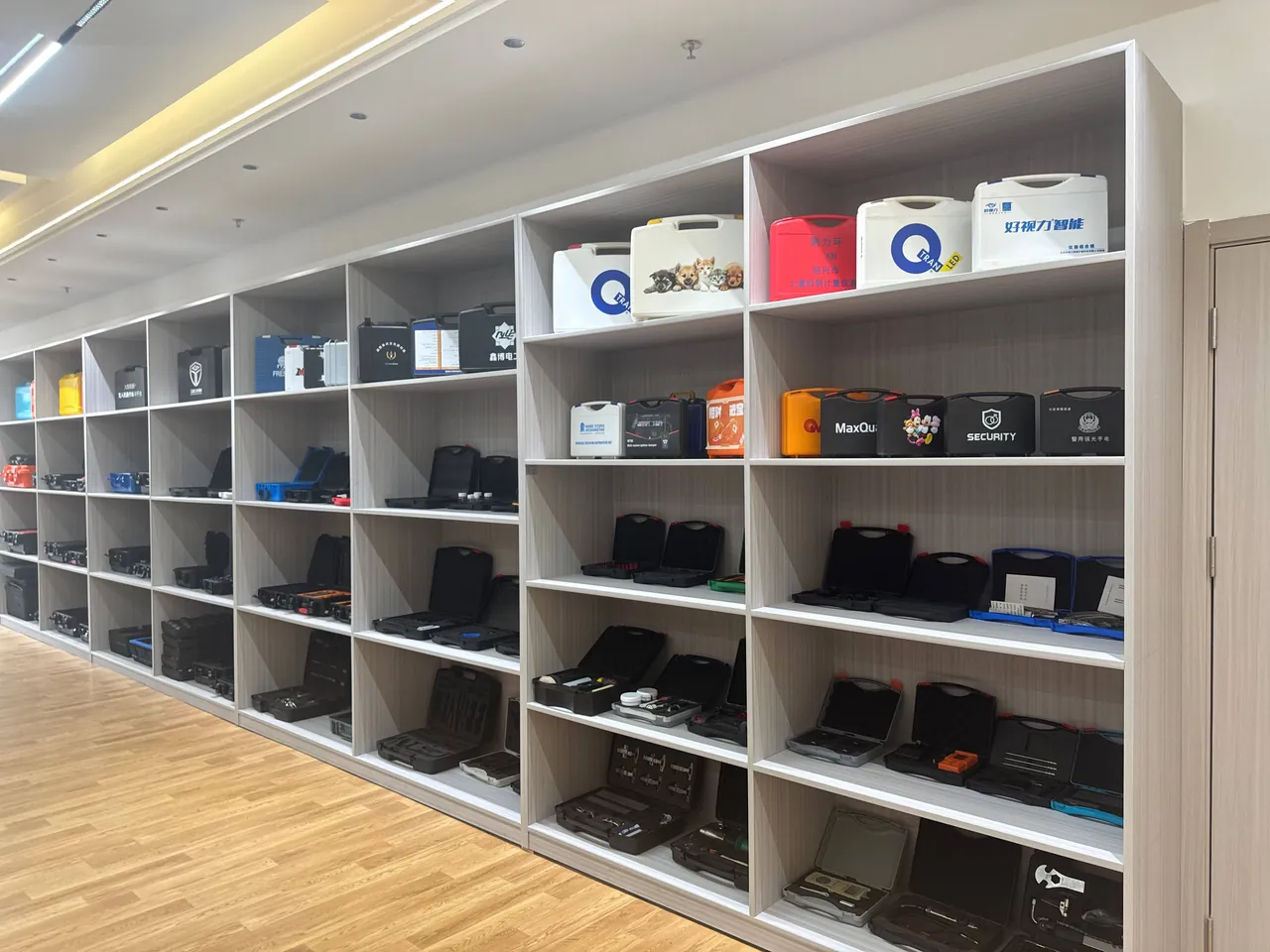
The core conflict. Retention requires the insert to fit the item closely, even with slight interference; surface protection requires that no hard contact or relative movement occurs against a polished surface. The engineering resolution is a soft contact face on a rigid locating skeleton: dimensional accuracy comes from a firmer material such as EVA, while the contact surface is provided by a soft layer such as flocking, brushed fabric, microfibre or low-density foam.
Partitioning principles:
| Item type | Main risk | Insert approach | Key control |
|---|---|---|---|
| --- | --- | --- | --- |
| Bullion bars | Impact, scratches, galvanic discolouration | EVA skeleton plus flocked contact layer, individual cavity per bar | One item per cavity, no mutual contact |
| Finished jewelry | Deformation, snagging, chain tangling | Compartmented tray with soft pad, separate chain cavity | Chains stored separately |
| Loose stones | Chipped edges, loss, mixing | Individual cell with clear cover and numbered label | One stone per cell, label matched to certificate |
| Set pieces | Loose stones, distorted prongs | Fitted cradle with top clearance | No load on the stone or prongs |
| Certificates and documents | Creasing, mixing | Separate document layer | Separated from goods to avoid disturbance |
| Tools and accessories | Scratching goods | Separate tool cavity | Physically isolated from the goods zone |
Key engineering details:
- One item, one position. Bullion and loose stones must be individually located. This is not only for impact protection but also for substitution detection: when every item has a unique cavity, an empty cavity is immediately visible at count.
- Cavity numbering. Mark cavity edges with numbers that remain visible with the lid open, and map them to the manifest and certificate numbers.
- Top clearance. For set pieces, cavity depth should leave the stone suspended so load is carried by the metal, not the gemstone.
- Handling cues. Provide finger recesses at cavity sides and plan space for tweezers or dedicated tools.
- Colour choice. A light contact layer reveals soiling and debris; a dark layer hides ageing. A common compromise is a light contact face with a dark shell.
Insert material and process strongly affect the final result. Related detail is in custom foam insert design guide and case foam material comparison. For impact-critical applications, see cushion liner structure design and shock-resistant sealed case designs. Where partitioning must be reconfigured between shipments, consider an adjustable removable divider system.
5. Tamper-Evidence and Seals: Serial Numbers, Lead Seals and One-Time Seals
Seal regimes for high-value shipments are stricter than in ordinary cash transport, because the substitution incentive is stronger and the methods more refined.
| Seal type | Strength | Reuse difficulty | Suitable scenario | Note |
|---|---|---|---|---|
| --- | --- | --- | --- | --- |
| Plastic pull-tight seal | Moderate | Moderate | Internal rotation, short haul | Retain the cut seal as evidence |
| Wire lead seal | High | High | Vault transfers, escort | Crimp quality directly affects reliability |
| Cable seal | High | High | Cross-district transfers | Record cable diameter and length |
| Bolt seal | Very high | Very high | Cross-border, large value | Requires hydraulic cutter at unloading point |
| Electronic seal | High | High | Electronic audit required | Depends on battery and connectivity |
| Tamper label | Low | Low | Supplementary only | Never the primary protection |
Serial management. The same discipline applies as in cash transport: issue seals in numbered blocks and log them; retain voided seals with the reason recorded; have two people transcribe and read back the number at application; photograph the seal serial with the case serial; require the receiving party to verify in a fixed order before cutting; and if anything is anomalous, do not cut on site. See anti-tamper and handover management for cash-in-transit cases; the two regimes are highly consistent.
Three additional requirements for high-value shipments:
- Multiple seals at multiple positions. Apply seals at more than one point - main lock position, both lid sides, and optionally a base position - so that if one point is bypassed, others still provide evidence. Register each seal serial separately.
- Combined uniqueness of case and seal. Record the "case serial plus seal serial" combination in the handover document and keep historical records so that repeated anomalous combinations become visible.
- Documented de-sealing. For high-value shipments, cut the seal under surveillance and photograph the cut seal together with the handover form. Retain the physical seal until that consignment has completed counting and confirmation.
Further analysis of seal materials, crimping and failure mechanisms is in seal materials and case sealing components.
6. Locks and Dual Control: Opening Discipline in High-Value Settings
| Lock type | Reliability | Traceability | Suitable scenario | Limitation |
|---|---|---|---|---|
| --- | --- | --- | --- | --- |
| Mechanical key lock | High | Low | Fixed routes, fixed staff | Duplication and loss risk |
| Mechanical combination | Medium-high | Low | Few cases, stable staff | Combination sharing defeats individual tracing |
| Electronic combination | High | Medium | Unlock records required | Battery dependent, moisture sensitive |
| Electronic lock with platform | High | High | High value, many users | Higher cost, system integration needed |
| Dual mechanical locks in series | High | Medium | Standard dual control solution | Requires procedural support |
Implementing dual control. Effective dual control is not "two locks engaged" but two independent accountable parties:
- Provide two independent lock positions in series logic - the lid cannot be lifted unless both are released. If designed so that each lock secures one side and releasing one allows partial opening, dual locks fail in control terms.
- Two keys carried by people in different roles, never in the same cabinet and never held on another's behalf.
- Handover records state which lock was opened by whom, not a generic "case opened".
- On staff changes, rekey or adjust which cases those staff can access.
- Use dual locks together with seals: locks prevent unauthorised opening, seals make authorised opening a matter of record.
Additional control for high-value shipments. Consider a three-person rule at critical nodes such as opening for counting, loading and sealing: two custodians plus one supervisor or recorder, where the recorder handles photography and registration and does not operate. This materially improves record quality, because operators' attention is normally on the goods themselves.
For a detailed comparison of lock types, pry-resistance levels and customisation, see case lock customisation options.
7. Sealing and Humidity Control: Silver Tarnish and Plating Oxidation
The precious metals themselves are chemically stable, but silver, copper alloys and some plating systems are sensitive to humidity and sulphur-bearing environments, and gemstones, leather fittings and paper certificates are also humidity sensitive.
Three sources of humidity risk:
- External moisture ingress through rain, splash and high-humidity ambient air.
- Internal condensation when temperature changes, for example moving from an air-conditioned vehicle into a hot humid dock, causing moisture to condense on cooler metal surfaces.
- Contaminant migration from packaging materials, cartons, leather goods and rubber components releasing sulphur compounds and plasticisers.
Control measures:
| Measure | Function | Implementation |
|---|---|---|
| --- | --- | --- |
| Sealing structure | Blocks external moisture | Continuous joint with elastomeric gasket; IP54 or above recommended |
| Pressure equalisation valve | Reduces condensation and opening vacuum | Breathable but water-tight; assess valve reliability and contamination risk |
| Desiccant | Absorbs residual moisture | Use indicating type, define replacement interval and log it |
| Material compatibility screening | Reduces contaminant migration | Ask suppliers for material declarations; avoid sulphur-bearing additives |
| Temperature-controlled transport | Reduces thermal differential | Avoid uncontrolled long-haul exposure for high-value loads |
| Barrier wrapping | Isolates contact | PE foam, acid-free paper or inert film selected by item type |
Choosing an IP rating. High-value applications generally warrant at least IP54 to IP55 for rain and splash, and IP65 or above for rainy-season routes or frequent open-air loading. Note that an IP rating does not cover impact, compression or corrosion, so it cannot replace structural strength requirements. For a full reading of the IP code, see IP ratings and waterproof case selection.
Trading off the pressure equalisation valve. A valve materially improves opening effort and reduces condensation, but it is also a potential permeation path in the case wall. For long-term high-value storage, assess the sealing reliability of the valve; if used, prefer a breathable, water-tight structure with a hydrophobic membrane, and add the valve to the inspection checklist. The principle is explained in the role of pressure equalisation valves.
Desiccant management. Use indicating desiccant and define both replacement interval and record method. Desiccant should not contact goods directly; place it in a separate mesh bag or cavity to avoid abrasion and dust contamination.
8. Anti-Static and Anti-Scratch: Fine Detail Protection
Three levels of anti-scratch protection:
- Contact material selection. The contact layer must be soft and non-shedding. Common choices are flocking, microfibre, low-density PE foam and acid-free paper. Avoid coarse textiles and foams containing hard fillers.
- Suppression of relative movement. Scratches are often caused not by hard materials but by relative sliding. Insert fit accuracy and lid compression features are therefore equally important: goods must not micro-move in transit.
- Foreign particle isolation. No sand, metal swarf or packaging debris inside the case. Provide an inspection step at the packing station and design inserts without debris-trapping internal corners.
When anti-static matters. Most finished jewelry is not damaged by static, but static control is relevant when:
- The case also carries precision electronic tags, sensors or inspection equipment;
- The transport environment itself is static-sensitive, for example when electronic components travel together;
- The case carries an electronic seal or positioning module whose circuitry must be protected.
For these needs, use conductive or dissipative insert materials and establish a grounding path. Design thinking is available in anti-static shield case designs.
How to verify anti-scratch performance. At prototype stage, run a simulated transport abrasion test: load representative items (equivalently finished substitutes are acceptable), subject the case to vibration and drop conditions matching the real route, then inspect surfaces under directional light. This is far more convincing than inspecting the insert visually.
| Protected item | Suggested contact material | Avoid |
|---|---|---|
| --- | --- | --- |
| Polished gold surface | Flocking, microfibre | Coarse textile, foam with hard fillers |
| Silver (tarnish control) | Acid-free paper, inert film | Sulphur-bearing rubber, ordinary paper |
| Loose stones | Soft individual cells | Mutual contact, shared large cells |
| Plated surfaces | Low-density foam, acid-free paper | Direct hard plastic contact |
| Electronic tag modules | Dissipative material | Standard foam (triboelectric charging) |
9. Tracking and In-Transit Monitoring: Positioning, RFID and Electronic Seals
| Technology | Read method | Environmental tolerance | Power | Suitable use |
|---|---|---|---|---|
| --- | --- | --- | --- | --- |
| Laser-engraved serial | Visual | Very high | None | Permanent case identity |
| Barcode or QR | Optical scan | Moderate | None | Document binding, stocktaking |
| Passive RFID | RF bulk read | Moderate to high | None | Batch verification |
| Active RFID or BLE | Active broadcast | Moderate | Battery | In-transit visibility |
| GNSS positioning | Satellite | Moderate | Battery | Route monitoring, deviation alerts |
| Electronic seal | Digital ID plus timestamp | High | Battery | Opening event records |
Integration points:
- Dedicated reinforced module bay. Positioning and communication modules must sit in a dedicated reinforced bay so daily drops do not damage them or eject the battery. They must also be not directly removable by anyone opening the case, otherwise tracking fails at the critical moment.
- Antenna and metal shielding. Metal-bodied cases and metal linings shield signals. Place antennas in non-metal zones or provide an external antenna port.
- Battery life and replacement procedure. Define battery life, replacement interval and replacement log, so you do not end up with modules fitted but long since flat.
- Event and video correlation. Electronic seal opening events should be aligned with handover documents and surveillance timestamps to form a cross-verifiable evidence chain.
- Data boundaries. Positioning data is sensitive. Define access rights, retention period and permitted uses, and comply with applicable data protection requirements.
Important: tracking does not replace seals and dual control. Tracking tells you where the case is. The seal tells you whether it was disturbed. Dual control tells you who disturbed it and when. All three are complementary.
10. Structural Attack Resistance: Prying, Cutting and Dropping
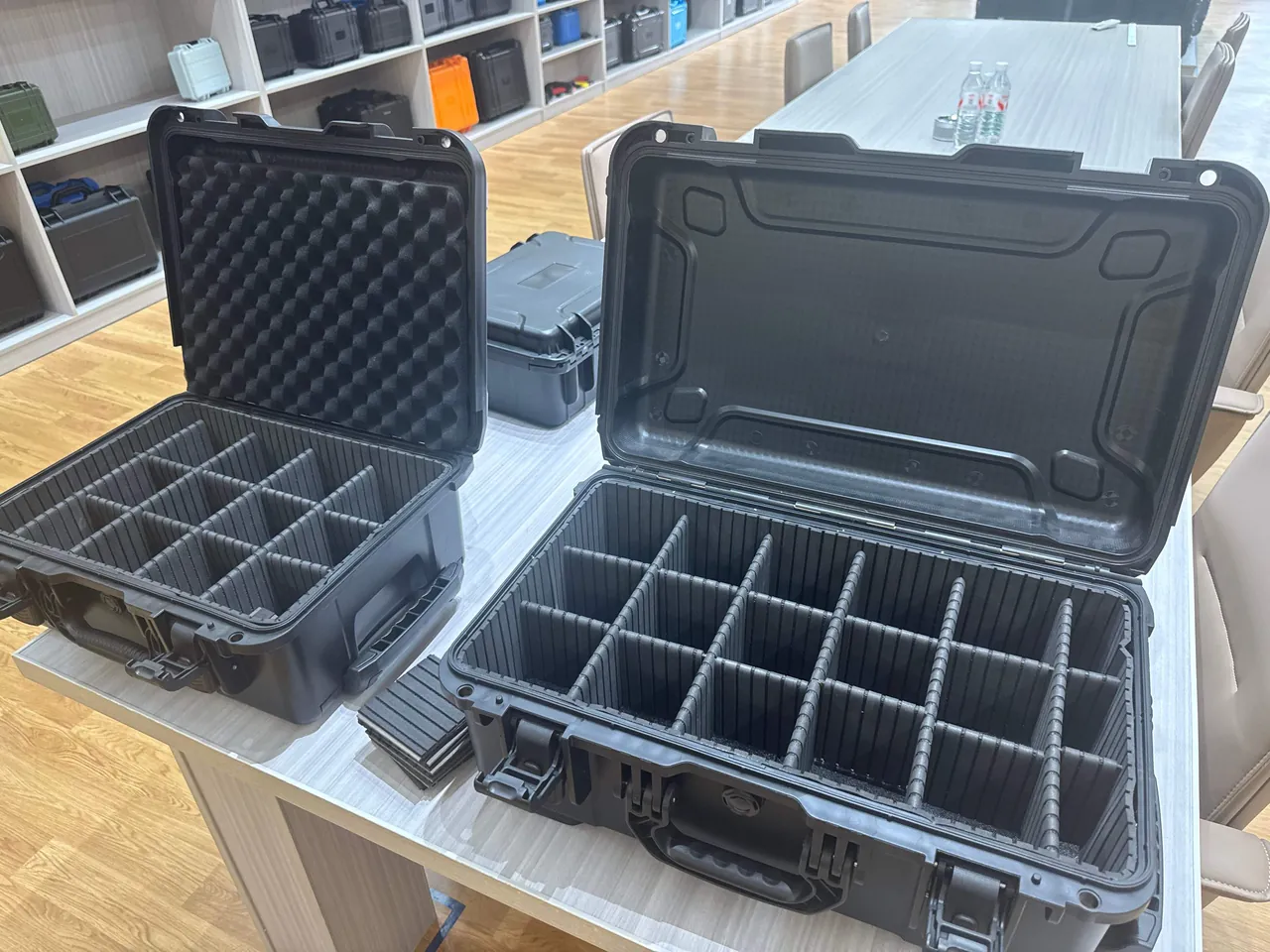
Pry resistance. Prying depends on three conditions: an insertable gap, a usable fulcrum, and transmissible torque. The design responses are:
- A continuous tongue-and-groove to eliminate the insertion gap, optionally doubled;
- No external steps that could serve as a fulcrum;
- Local reinforcement around locks, so that prying torque is distributed by the body structure before reaching the lock cylinder.
Cut resistance. No polymer can fully resist cutting tools, but the threshold can be raised: thicker walls and denser ribbing increase cutting time; metal mesh or plate inserts in critical areas force repeated repositioning; a layered composite structure requires multiple approach angles. It must be stated plainly: no case can resist cutting given sufficient time and tools in a static environment. The practical value of cut resistance is therefore extending attack time to create a response window.
Drop resistance. Drops with dense loads are a real threat. Key points:
- Base reinforcement working together with insert corner columns, so impact does not reach goods directly;
- Dedicated corner cushioning (corner blocks or thickened corners), because most drops land on a corner;
- A continuous handle and hinge load path that is never interrupted in a thin-wall zone;
- Through metal pin hinges with integrally moulded bosses, avoiding self-tapping screws driven into polymer.
Layering of structural protection:
| Attack or risk | Primary countermeasure | What it cannot solve |
|---|---|---|
| --- | --- | --- |
| Prying | Continuous joint, no steps, reinforced lock area | Sustained attack over time |
| Cutting | Wall thickness, ribs, metal inserts | Complete resistance; only time extension |
| Dropping | Corner cushioning, base reinforcement, load path | Risk under extreme load |
| High or low temperature | Material and seal selection | Direct flame |
| Whole-case seizure | Route and procedure management | Not solvable by the case itself |
11. Environmental Testing: Drop, Vibration, Temperature and IP Basis
(1) Drop test. Load to 100 percent of rated mass with weights simulating the real mass distribution, and drop from 1.0 to 1.2 m onto nine attitudes: three corners, three edges, three faces. For dense loads, also check whether insert cavities fracture, whether items (equivalent substitutes) move, and whether the base sags. Pass criteria should cover structure, insert and function (locks operable, seal threadable). Empty-case drop testing has no reference value.
(2) Stacking test. Convert actual stacking tiers and per-case mass into load, hold for 24 to 72 hours, and check deformation and latch engagement. Under dense loads this test matters especially, because bottom-case deformation transfers directly to the goods.
(3) Vibration test. Reference the random vibration methods of the ISTA series or the GB/T 4857 series, with duration set to the longest single-leg transit time plus at least 50 percent margin. Focus judgement on inserts not collapsing, goods not undergoing relative displacement (the key anti-scratch criterion), seal channel not worn, and locks not loosened. Method selection logic is in ISTA transport testing procedures explained and GB/T 4857 transport package testing; full distribution cycle verification is in ASTM D4169 distribution cycle testing.
(4) Temperature and damp heat test. Perform high-temperature storage, low-temperature storage, thermal cycling and damp heat tests. In high-value settings, the significance of thermal cycling is not only material strength but condensation risk: moving from an air-conditioned environment into hot humid conditions can condense moisture on cooler metal surfaces inside the case. Judge polymer embrittlement, gasket compression set, insert dimensional stability and label adhesion. The corresponding MIL-STD-810H methods can be referenced; note that the standard is an environmental test method standard, not a military certification, and the correct wording is "tested in accordance with the relevant MIL-STD-810H methods". See MIL-STD-810H environmental testing explained.
(5) Ingress protection verification. Execute under the relevant IEC 60529 / GB/T 4208 conditions, then allow the case to stand and check whether water has collected inside lock mechanisms, hinges and the equalisation valve.
(6) Extreme temperature scenarios. Where transport involves extreme cold or heat, such as winter open-air loading in northern regions or summer vehicle-interior heat, assess impact toughness at that temperature separately. Related approaches are in protective cases for extreme temperatures.
| Test category | Suggested basis | Key judgement |
|---|---|---|
| --- | --- | --- |
| Drop | GB/T 4857 series / ISTA | No cracks, insert intact, goods not displaced |
| Stacking | GB/T 4857 series | Acceptable deformation, latch engagement normal |
| Vibration | ISTA random vibration spectrum | Inserts intact, no relative movement of goods |
| Temperature and damp heat | Relevant MIL-STD-810H methods (environmental basis) | No embrittlement, no residual condensation, gasket not permanently deformed |
| Water and dust | IEC 60529 / GB/T 4208 | Target IP achieved, no internal standing water |
12. Scenario Differences: Trade Shows, Vaults and Cross-Border Movement
(1) Trade shows and travelling exhibitions. Characteristics: high shipping frequency, frequent opening, complex on-site conditions such as exhibition hall floors, dense crowds and poor temporary storage. Configuration priorities: inserts that load and unload quickly, a clean exterior since rapid access is often required on the stand, efficient seal application, and wheels with a telescopic handle for long pushing distances inside the hall. Also provide a lockable, stackable temporary storage solution for the return leg.
(2) Vault and inter-vault transfers. Characteristics: short distance, heavy load, concentrated value. Priorities: structural strength and stacking stability, dual control locks, lead or bolt seals, pallet and rack compatibility, and case numbering bound to vault locations. Prefer pallets and wheels over manual carrying.
(3) Cross-border movement. Characteristics: long flow, many handing parties, strict documentation. Beyond the case itself, pay attention to seal type and destination requirements (some routes require specific seal types with recorded serials), separate storage for documents and certificates, and availability of the tracking module on cross-border networks. Cross-border movement usually involves multiple transfers and customs inspection, so the procedure should include a resealing and re-registration step after inspection to prevent a break in the seal serial chain.
(4) Store-to-store transfers. Characteristics: short haul, high frequency, lower per-shipment value but many batches. Priorities: light weight, fast opening, a simplified seal procedure and clear batch marking.
| Scenario | Core risk | Configuration priority | Typical IP class |
|---|---|---|---|
| --- | --- | --- | --- |
| Trade shows | High frequency, complex site | Fast access, wheels, lockable temporary storage | IP54 to IP55 |
| Vault transfers | Heavy load, concentrated value | Structural reinforcement, dual locks, lead seal, pallet fit | IP54 or above |
| Cross-border | Long flow, many handovers | Seal compliance, separate document storage, tracking availability | IP55 to IP65 |
| Store transfers | High frequency, many batches | Light, fast opening, batch marking | IP54 |
| Long-term storage | Humidity, oxidation | Sealing plus desiccant plus humidity records | IP55 or above |
13. Acceptance, Inspection and Insurance Documentation
Incoming acceptance points:
| Check item | Method | Judgement |
|---|---|---|
| --- | --- | --- |
| Insert cavities | Check each cavity | Correct count, clear numbering, goods fit on trial |
| Contact layer | Visual and by hand | No shedding, no hard spots, no contamination |
| Appearance and structure | Visual, whole case | No cracks, sink marks or burrs |
| Case serial | Cross-check | Unique plate, matches order, securely fixed |
| Locks | Operate each one | Smooth, no binding, series logic effective |
| Sealing | Visual joint plus sampled water test | Joint continuous, target IP achieved |
| Seal channel | Insert each seal | Inserts freely, resists reverse pull |
| Handle and hinges | Loaded pull test | No pull-out, no cracks, pin not extractable |
| Equalisation valve | Function check | Breathable but water-tight, no noise |
| Documents | Checklist | Complete inspection and test files |
Daily inspection: new cracks or dents; hinges loose or noisy; locks operating smoothly; gasket detached or hardened; insert cavities deformed or contact layer worn or soiled; serial plate legible; seal channel free of debris with no enlarged wear; equalisation valve not blocked; desiccant due for replacement.
Periodic maintenance: clean the gasket and check elasticity; clean the insert contact layer without shedding and without solvent residue; tighten hinge and lock fasteners; check handle bosses and wheels; verify tracking modules and electronic seals with logged replacements; replace desiccant and log it; isolate faulty cases, tag them and route to repair or scrap. Cleaning methods are in how to clean a protective case, service life assessment in protective case service life assessment, and counterfeit identification in identifying genuine versus counterfeit cases.
Insurance and compliance documentation. High-value transport usually involves insurance terms, so prepare the following at procurement stage to avoid reduced settlement through lack of evidence:
- Case technical specification covering material, dimensions, structure, locks and seal specification;
- Test reports for drop, stacking, vibration, temperature and water, citing the standards applied;
- First-article inspection records and the sampling scheme (see protective case acceptance sampling);
- Inspection and maintenance log templates;
- Handover form template including case serial, seal serial, slot-to-item mapping, time and signatures;
- Exception handling procedure covering anomalous seals, quantity discrepancy, damaged cases and suspected substitution, with named responsibility.
Note that insurance terms generally require evidence of reasonable care. A complete inspection log and handover record often influence settlement more than the absolute strength of the case.
14. Procurement and Customisation: OEM/ODM and Cost Structure
Seven-step customisation process:
- Requirement capture: item list and types, individual dimensions and masses, maximum total load per case, external dimension limits, handling method, IP requirement, seal and lock requirements, tracking requirements;
- Design proposal: structural concept, insert layout and partition drawing, contact layer materials, lock and seal positions, identity and tracking areas;
- Functional prototype: build a fully functional prototype including locks, seal channel, formed insert and contact layer;
- Functional verification: loaded drop, stacking, handle pull, open-close cycles, and simulated abrasion testing;
- Field trial: at least one full transport cycle including packing, transit, unpacking and return loading;
- Corrective action and design freeze: record changes, produce drawings and a retained sample;
- Volume delivery and first-article approval.
Cost structure breakdown:
| Cost element | Drivers | Optimisation headroom |
|---|---|---|
| --- | --- | --- |
| Case moulding | Material, size, tooling complexity | Standardise and series-develop sizes |
| Structural reinforcement | Ribbing, metal inserts, double joint | Grade the configuration by real load |
| Insert forming | Cavity count, material, process | Standardise partitions, reduce irregular cavities |
| Contact layer | Material grade, processing | Select by item grade |
| Locks and seal channels | Lock type, channel count | Grade by scenario |
| Tracking module | Technology route, platform integration | Design for replaceable modules |
| Certification and testing | Number of test items | Select by target market necessity |
Three common cost misjudgements:
Misjudgement one: specifying the highest grade for every case. High-specification cases cost materially more, and most shipments in practice do not carry the same value or risk. Grade the configuration by batch value and concentrate high-specification resources on the highest-risk routes.
Misjudgement two: substituting a generic insert for a custom one. A generic insert is the option most likely to produce long-term loss: goods move, surfaces are damaged, damage is discovered only after delivery, responsibility is hard to establish, and brand damage cannot be quantified. Amortised over volume, custom insert tooling normally costs far less than a single damage incident.
Misjudgement three: overlooking quality differences in the contact layer. Contact layer material is a modest share of total cost but strongly affects surface protection. Run simulated abrasion testing at prototype stage rather than comparing material names.
JUNZHJIA, the brand of Kexin New Materials (Guangdong) Co., Ltd., provides integrated capability from structural design and tooling development through insert forming. For precious metal refiners, jewelry wholesalers and retailers, vaults and professional escort organisations, the company supplies customised high-value transport cases including partitioned per-item inserts, soft contact layers, dual lock positions in series, one-way seal channels, unique case serial plates and tracking module bays, and supports prototyping, functional verification and volume supply with inspection and test documentation as required. Supplier evaluation criteria are in how to choose a case OEM factory, and tooling investment assessment in custom case mould cost analysis.
Frequently Asked Questions
Q: Why can an ordinary protective case not be used for precious metal transport?
A: Three requirements cannot be substituted. First, structural margin under dense loads: gold has a density of about 19.3 g/cm3, so at equal volume it weighs far more than ordinary equipment. A standard protective case is designed for normal loads and will develop base sag and insert support failure over time. Second, micron-level surface protection: polished bullion, plated silver and cut stone edges are all sensitive to contact material and relative movement, and a generic foam insert neither locates items individually nor provides a dedicated soft contact layer. Third, evidence chain requirements: high-value settings need a unique serial plate, multiple seal channels and dual locks in series so that "was this opened, and by whom" can be verified, and an ordinary protective case offers none of these evidence positions. A case with a higher IP rating therefore still cannot be used directly for precious metal transport.
Q: Should the insert use hard or soft material?
A: The correct answer is both, in combination, not one or the other. Locating and retention need some stiffness, otherwise goods develop relative movement under vibration, and relative sliding is the primary cause of scratches. But material that touches a polished surface must be soft and non-shedding, otherwise it leaves abrasion marks and contamination. The standard engineering resolution is a soft contact face on a rigid locating skeleton: a firmer material such as EVA forms the skeleton to control dimensional accuracy and positional stability, while flocking, microfibre, low-density PE foam or acid-free paper forms the contact layer that protects the surface. Chemical compatibility also matters: silver should not contact sulphur-bearing rubber or ordinary paper, because tarnishing can occur even without mechanical damage.
Q: What water protection class does a precious metal transport case need?
A: At least IP54 to IP55 is usually appropriate for rain and ground splash during loading. For rainy-season operation or frequent open-air loading, IP65 or above is preferable. For long-term storage or humid regions, consider IP65 together with desiccant and humidity management. Three cautions apply. First, an IP rating covers only ingress of solid objects and water; it does not cover impact, compression or corrosion, so it cannot replace structural strength requirements. Second, high-value goods are also sensitive to condensation, which arises from temperature differentials as well as external water, so controlling temperature swing or using desiccant is needed in addition to sealing. Third, a higher sealing class makes the lid harder to open and can push operators into levering it and damaging the joint, so balance protection against handling effort, using a pressure equalisation valve where necessary.
Q: How can I prevent items being removed and substituted inside the case?
A: Three layers must work together. Layer one is physical isolation: bullion and loose stones should be individually located, one item per position, so that an empty cavity is immediately visible at count. Cavities should be numbered and mapped to the manifest and certificate numbers. Layer two is the seal and serial regime: unique seal serials, issue in numbered blocks with a log, two people transcribing and reading back the number at application, the seal serial photographed with the case serial, receiving-party verification in a fixed order before cutting, and no on-site cutting if anything is anomalous - the whole case goes to security. High-value shipments should use seals at multiple positions, each registered separately, so that bypassing one point still leaves evidence. Layer three is dual control: dual lock positions in series with keys held by people in different roles, and handover records stating who opened which lock. Remove any layer and substitution becomes effectively undetectable.
Q: What special requirements does a dense load place on case design?
A: Three main areas. Concentrated load: at equal volume, mass rises sharply, so base pressure per unit area increases significantly. A base reinforcement rib network and plate are needed to distribute load into the side walls and prevent base panel sag. Load path: handles and hinges experience overturning moments, not only vertical tension, so the handle boss must extend toward the primary load-bearing face and use a metal pin or reinforced bushing to prevent thin-wall flexing. Drop impact energy: impact energy scales with mass, so for the same drop height a dense load imposes far greater impact than a light load. Corner cushioning and raised insert corner columns are needed so impact does not reach goods directly. For overweight loads, split the load across two cases rather than building one overweight case, because an overweight case sharply increases drop and snatch risk.
Q: Why does silver turn black, and can a transport case prevent it?
A: Silver discolouration is normally sulphidation rather than oxidation: silver reacts with sulphur-bearing substances to form silver sulphide. Sulphur sources include rubber components, certain papers and packaging materials, airborne sulphides and perspiration. A transport case can help in three ways. First, block the external environment with a continuous tongue-and-groove joint and an elastomeric gasket to reduce ingress of sulphur-bearing gases and moisture. Second, control internal material compatibility by avoiding sulphur-bearing rubber parts, poor-quality paper and polymer materials with sulphur additives, preferring acid-free paper, flocking or inert film for the contact layer. Third, control humidity, since moisture significantly accelerates sulphidation, which can be managed with desiccant and sealing. Also avoid bare-hand contact with silver at the packing station and define an insert cleaning interval.
Q: How should a tracking module be installed to be reliable?
A: Four points. First, a dedicated reinforced bay: the module should sit in a reinforced bay so daily drops do not damage it or eject the battery. Second, not be removable at will: anyone opening the case should not be able to simply remove it, otherwise it will be stripped at the critical moment and tracking will fail exactly when it matters. Third, antenna and metal shielding: metal-bodied cases and metal linings shield signals, so place the antenna in a non-metal zone or provide an external antenna port. Fourth, battery life and replacement procedure: define battery life, replacement interval and replacement logging to avoid modules fitted but long since flat. Also define access rights, retention period and permitted uses for the data. Tracking answers only "where is the case" and does not replace seals and dual control; the three are complementary.
Q: How much cut resistance can a transport case realistically provide?
A: It must be stated objectively: no polymer case can resist cutting given sufficient time and tools in a static environment. The practical value of cut resistance is therefore not invulnerability but extending attack time to create a response and alarm window. Measures include increasing wall thickness and rib density to raise cutting time; adding metal mesh or plate inserts in critical areas such as around locks and at the lid-to-body joint; and using a layered composite structure that forces repeated changes of approach angle. These must be combined with procedural measures: shorten high-risk dwell times, avoid route predictability, and use tracking plus electronic seals for deviation alerting. When evaluating, ask suppliers for structural detail rather than accepting a "cut resistant" claim.
Q: What documentation should be prepared for insurance and audit of high-value transport?
A: Six categories are advisable at procurement stage. One, the case technical specification, covering material, dimensions, structure, locks and seals. Two, test reports covering drop, stacking, vibration, temperature and water, citing standards applied such as GB/T 4857, ISTA, IEC 60529 / GB/T 4208 and the relevant MIL-STD-810H methods. Three, first-article inspection records and the sampling scheme. Four, inspection and maintenance log templates recording every repair and part replacement. Five, a handover form template with case serial, seal serial, slot-to-item mapping, time and signatures. Six, an exception handling procedure defining the path and responsible person for anomalous seals, quantity discrepancy, damaged cases and suspected substitution. Insurance terms generally require evidence of reasonable care, and a complete inspection log plus handover record often influences settlement more than the absolute strength of the case.
Conclusion and Related Reading
The essence of a precious metal and jewelry transport case is putting "no damage" and "no deniability" into the same container. No damage depends on insert fit accuracy, soft contact layers, load paths and cushioning. No deniability depends on unique serials, multi-point seals, dual locks in series and handover records. Both tracks must advance together; strengthening one alone does not cover the risk handled by the other.
Four practical rules summarise the approach. Partition by item type, one item per position with numbers, and link those numbers to the manifest. Set structure by load class, and split overweight loads rather than adding thickness. Set protection class and seal combination by scenario, with high specification on high-risk routes. Grade resources by batch value and concentrate them on the real risk points. In addition, manage inspection logs, handover forms and test reports as standard deliverables alongside the cases - in high-value transport their practical worth is often no less than that of the case itself.
JUNZHJIA supplies high-value transport cases to precious metal refiners and fabricators, jewelry wholesalers and retailers, vaults and professional escort organisations, supporting partitioned per-item inserts, soft contact layers, dual lock positions in series, one-way seal channels, unique serial plates, reinforced tracking module bays and desiccant management, with test and inspection documentation and OEM/ODM service available.
Related Reading