

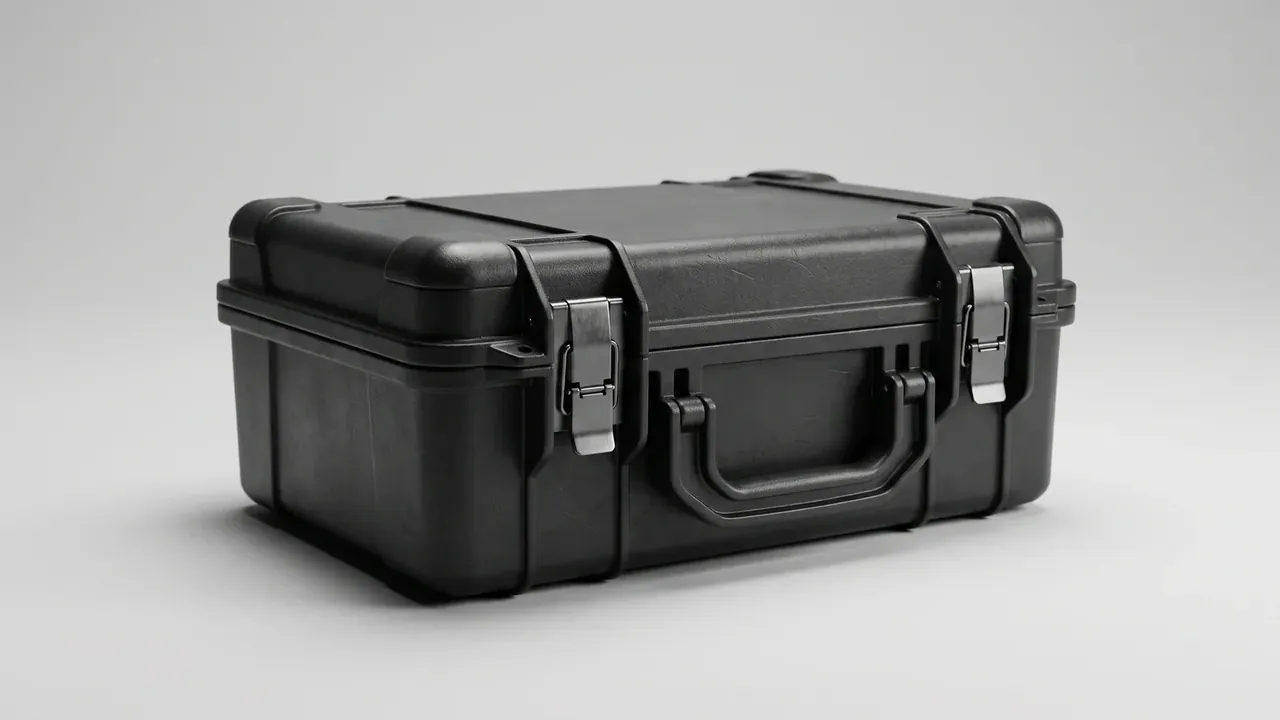
Quick answer: A Kids Tool Box is sized backwards from the tool list, not forwards from a shell. Measure the longest tool and the loaded weight, set the cavity, lay out compartments, then back-calculate wall thickness from handle load and drop energy. Radii and latches come last, because thickness constrains them.
Table of contents
- A Sampled Batch and the Cavity It Had to Fit
- Compartment Layout and Partition Thickness
- Wall Thickness Back-Calculated from Load and Drop
- Corner Radii and the Lid Interface
- FAQ
1. A Sampled Batch and the Cavity It Had to Fit
Last autumn a 12-piece Kids Tool Box went to tooling with the shell fixed first at 420 × 300 × 95 mm. The cavity came out 386 × 264 × 74 mm, and the longest item, a 205 mm screwdriver, had to go in diagonally. The lid closed onto the handle and stopped.
The order that works starts with the list. Twelve tools were traced flat on paper: longest 205 mm, widest 88 mm, stacked height 62 mm, loaded 1.9 kg. Cavity length is the longest tool plus 15 mm, width two items side by side plus a partition, depth the stack plus finger room.
Draft and texture sit between trace and drawing: across a 385 mm cavity a 1.5 degree draft eats 2 mm per side and 0.6 mm texture takes 1.2 mm.
| Input | Measured | Rule applied | Value on drawing |
|---|---|---|---|
| Longest tool | 205 mm | plus 15 mm | cavity 220 mm |
| Two side by side | 88 and 62 mm | plus partition | cavity 162 mm |
| Stacked height | 62 mm | plus 10 mm | cavity 72 mm |
| Loaded weight | 1.9 kg | checked at 3x | 250 N static |
| Texture, draft | 0.6 mm, 1.5 deg | deducted | shell plus 4 mm |
The last two rows are the ones people skip: weight sets thickness, and thickness eats back into the cavity.
2. Compartment Layout and Partition Thickness
Only after the cavity is fixed does the grid matter. Twelve tools split into three bands: three long across the rear, five medium upright, four small in a shallow front row, a pocket under the handle.
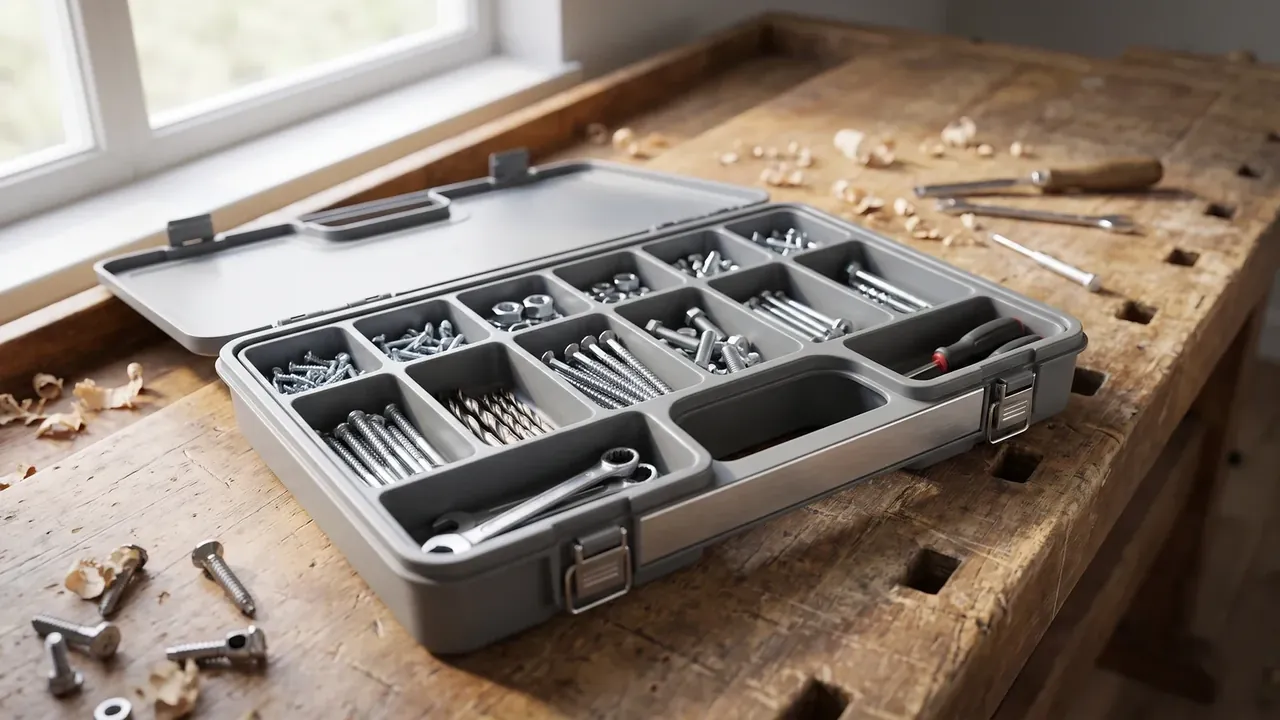
Thicker partitions are not automatically better. At 2.2 mm a partition deflects 0.4 mm under 1.9 kg; at 3 mm it improves to 0.3 mm and adds 11 percent weight. So the wall stays at 2.2 mm and stiffness comes from height: a 6 mm top flange returns deflection to 0.2 mm. Floor ribs run at 45 mm pitch, 6 mm tall, R1 root.
- Long bay: 215 mm clear, two through ribs
- Medium bay: 24 mm clear, 1 degree draft
- Small bay: 28 mm deep, R2 floor
- Under the handle: 30 mm pocket
- Edge bay: 1.5 mm gap
A twelve-bay grid weighs 45 g more than an eight-bay one at the same thickness, which is the budget a later thinning pass counts on.
3. Wall Thickness Back-Calculated from Load and Drop
Handle load is three times the loaded weight, about 56 N, rounded up to 250 N held one minute, with no white marks at the root.
Drop is 1.2 m onto concrete, six faces, three edges and one corner, ten drops. Impact lands on the corners, where energy is densest, so corner walls run thicker: 2.6 mm sides, 3.0 mm corners, 3.2 mm floor.
Three variants were shot against each other. The 2.2 mm set cracked on the second corner drop, an 18 mm crack starting opposite the gate. The 2.6 mm set survived all ten but showed a 0.5 mm dish on the lid. The 3.0 mm set stayed flat and jumped from 780 g to 940 g, which the buyer rejected. The release used 2.6 mm with local 3.0 mm corner pads at 815 g. Adding 6 percent mass at the corners lifts impact absorption by a fifth, while thinning the flats pays for the grams. Ultrasonic gauging waits 24 hours, because trapped stress reads 0.1 mm high.
| Area | Thickness | Driver | Result |
|---|---|---|---|
| Floor | 3.2 mm | drop, stacking | stable three high |
| Side wall | 2.6 mm | lateral squeeze | 0.3 mm flex |
| Corners | 3.0 mm | corner drop | no crack in ten |
| Partition | 2.2 mm | bay side load | 0.2 mm flex |
| Lid panel | 2.4 mm | top load | 0.5 mm dish |
The lid was the only row that failed. Two cross ribs cut the dish to 0.15 mm, at the cost of two shallow grooves outside.
4. Corner Radii and the Lid Interface
Radii come last because thickness constrains them. Outside R3 against inside R1.5 leaves 1.5 mm, half the wall, the ratio that keeps sink marks off a moulded face. Drop the inside radius below half the wall and the thick section cools late and pulls the surface in.
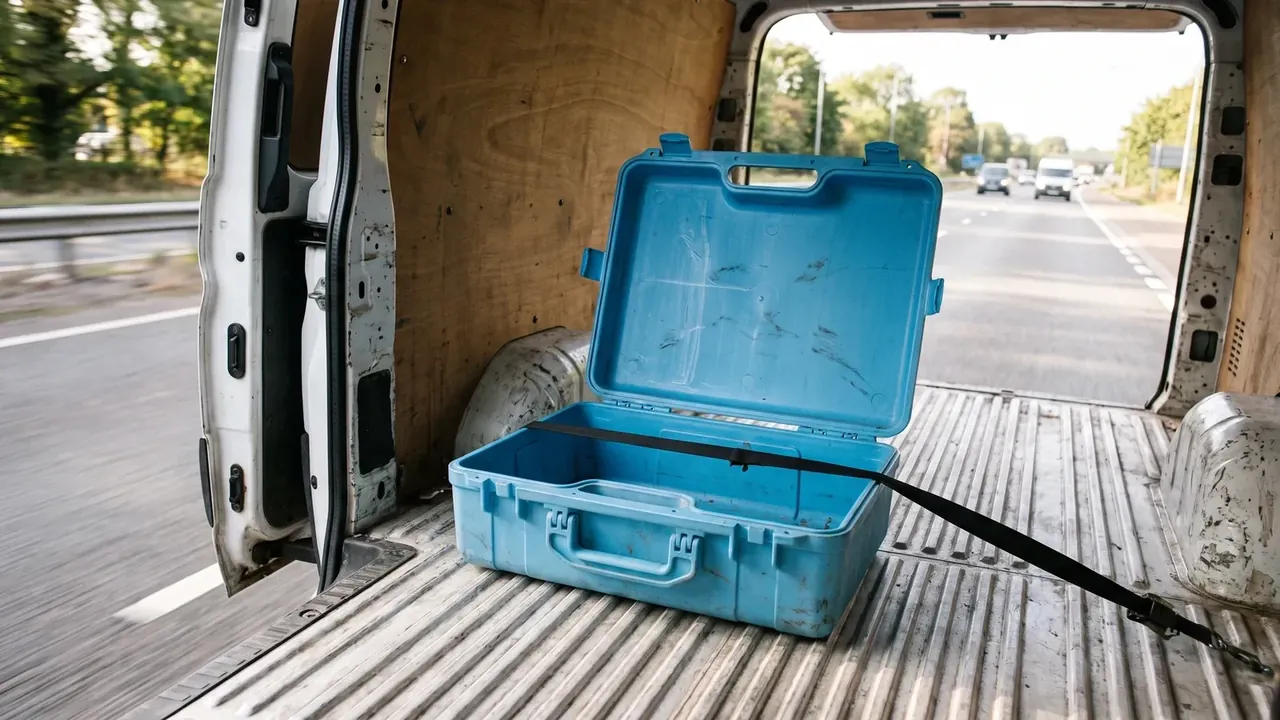
The parting line needs its own radius. A 0.5 mm offset step between lid and body reads as one smooth line under a finger; past 1 mm the step shows a white edge paint will not cover.
The lid interface converges in a fixed order: hinge pin at 3.2 mm, latch interference at 0.4 mm, then opening force. That force should land between 25 and 35 N. Below 25 N a child brushes the latch open, above 35 N an adult cannot work it one-handed. Hinge bore wear must stay under 0.15 mm after 5,000 cycles, simulated at the mould stage, since first shot is too late.
Conclusion
The specification of a Kids Tool Box runs one way only: the tool list gives the cavity, the cavity gives the grid, the grid and the load give the thickness, and thickness then governs radii and latch force. Any link settled out of order pushes rework downstream. Three rounds of sampling bought a sequence rather than three numbers.
This article discusses only the container (case body) side of specifications and design intent, and does not cover any handling, loading or use of the contents.
Related Reading
- How to compare Kids Tool Box options
- Lid types and how they open
- Specification logic for a full tool kit
Related Products
- 8 Series — Gun Cases; Military Equipment Cases; Camera Equipment Cases; Drone Cases; Watch Cases; Knife Cases; First Aid Cases; Electronics Equipment Cases
- WL8-2812 PP Gun Case — model WL8-2812
- All protective cases and toolboxes: 7 series, 158 models