

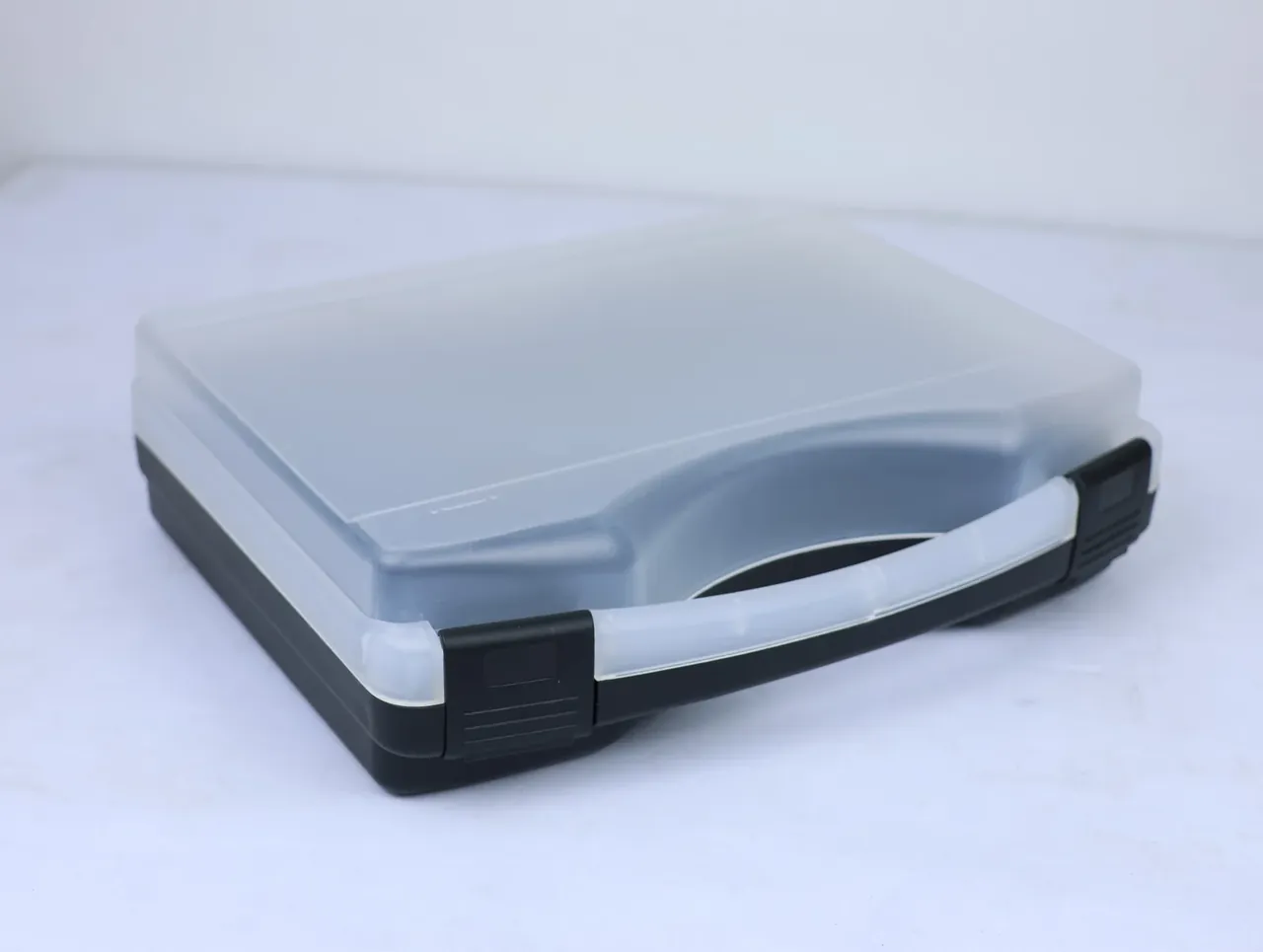
Quick answer: Work three clocks, a shift, a week and a quarter, across four points. Gasket compression below 20%, hinge end-play past 0.3 mm and a foam crease past 1 mm are the replacement lines.
Table of contents
- Three inspection tiers: what a knife case needs each shift, week and quarter
- Cleaning: dried coolant does more damage than swarf
- Gaskets and hinges: the point where parts get replaced
- Inserts: repair or replace, measured at two depths
- Service life: storage, stacking and UV
- FAQ
1. Three inspection tiers: what a knife case needs each shift, week and quarter
Across an 8-hour shift the box is under load for less than 1 minute. Inspection looks for what that minute leaves: a whitening latch root, a hinge pin drifting sideways, a rim imprint getting shallower. All three sit in plain view; 90 seconds covers one box.
Run the clocks at 60 times each other's frequency: safety parts each shift, moving parts weekly, performance parts quarterly. Combined into one job, the safety part gets skipped.
| Interval | Check | Limit | Action |
|---|---|---|---|
| Each shift | Latch spring-back, handle root | Latch seats itself on an empty close | Adjust the keeper before hand-over |
| Weekly | Hinge end-play, rim imprint | Play over 0.3 mm | New pin, or a hinge pair if the bore opened |
| Quarterly | Gasket compression, insert sag | Under 1.4 mm | New gasket or new insert |
| Yearly | Wall thickness, thread bosses | Loss over 0.2 mm | Downgrade to fixed indoor storage |
A logbook of dates is not a logbook. Write the number: 0.2 mm of play, 1.6 mm of compression. The trend decides a swap long before one reading does.
2. Cleaning: dried coolant does more damage than swarf
Swarf is visible; coolant is not. Emulsion on a handle runs down the blade, pools in the base and leaves a pale stress mark within a week. Above pH 9 and 48 hours of contact the surface chalks, and chalked patches hold chips.
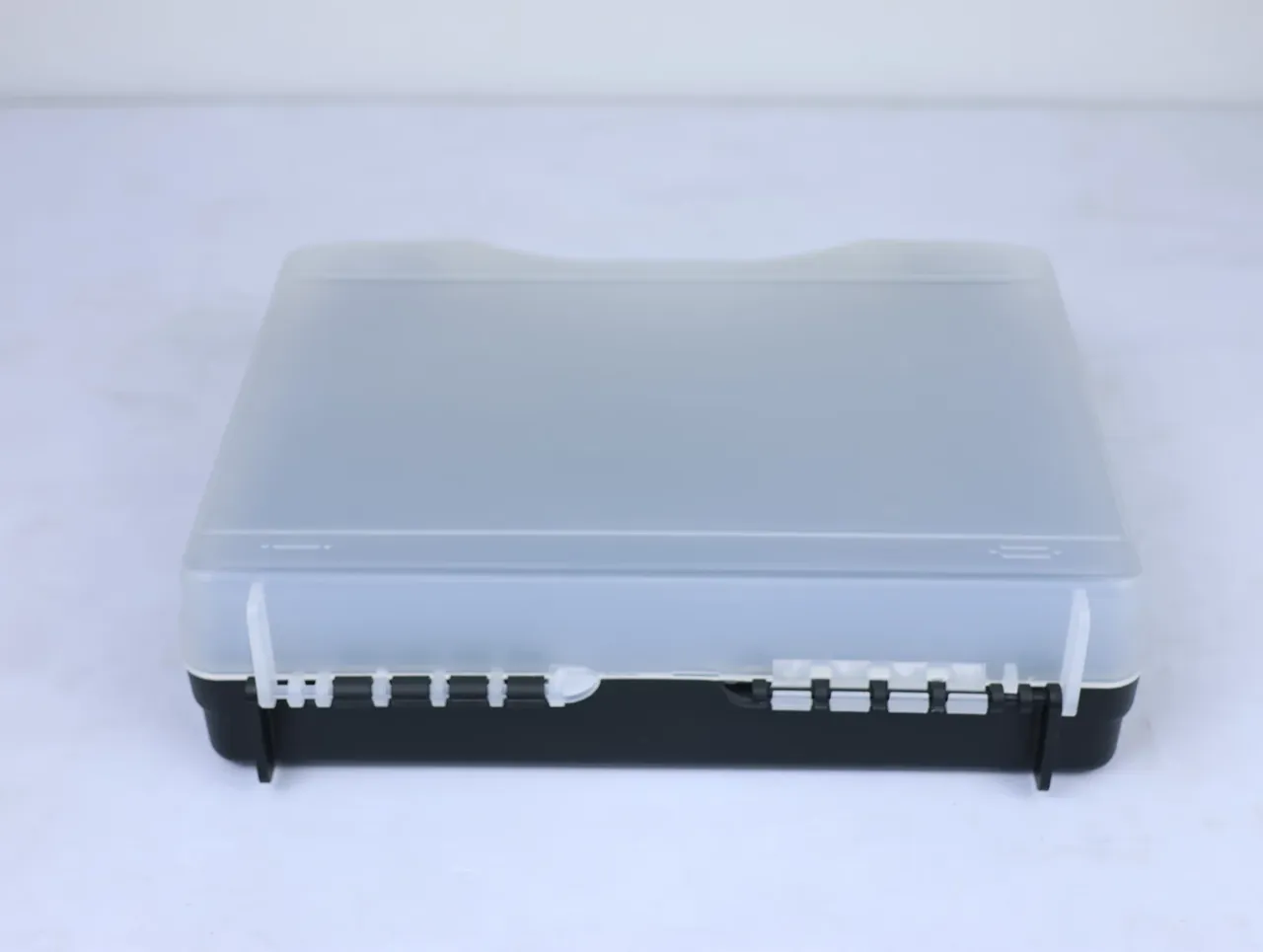
Wash with 1% neutral detergent at 40 °C, soaking no longer than 15 minutes. A strong alkaline bath lifts the insert adhesive and crazes the shell where moulded stress sits. Use a soft brush; a wire pad leaves 0.1 mm scratches that hold aluminium powder through the next shift. Dry before closing, because 5 ml of water in the base rusts steel within 3 days; in the wet season, stand the box upside down on a pallet for 2 hours.
3. Gaskets and hinges: the point where parts get replaced
A gasket is spent by compression, not age. A new profile measures 6 mm and sits at 4.2 mm closed, which is 30%. By month 18 it reads 4.6 mm, or 23%: the lid still closes, the seal no longer holds IP65.
Set the line at 20%, a height of 4.8 mm. Below that the rubber cannot keep up, and 10 minutes after closing a finger along the rim finds a gap. Measure the same way each time: close, wait, open, caliper four points, take the lowest.
Hinges are judged on play and noise. Past 0.3 mm the lid shifts sideways as it closes, loading one edge of the gasket; a stiff pin needs a cleaned bore and molybdenum disulphide grease. Latches go by count instead: a moulded tongue is rated near 5000 cycles, which at 6 closes a shift is 3000 in two years. From 4000, watch the root for a whitening line, and once it shows the break is on a countdown.
4. Inserts: repair or replace, measured at two depths
Repair depends on two depths. A groove worn into a slot wall by the blade spine is patchable to 0.5 mm; a white crease in the foam under the edge means replacement past 1 mm. The first takes a 2 mm EVA shim; the second cannot be patched.
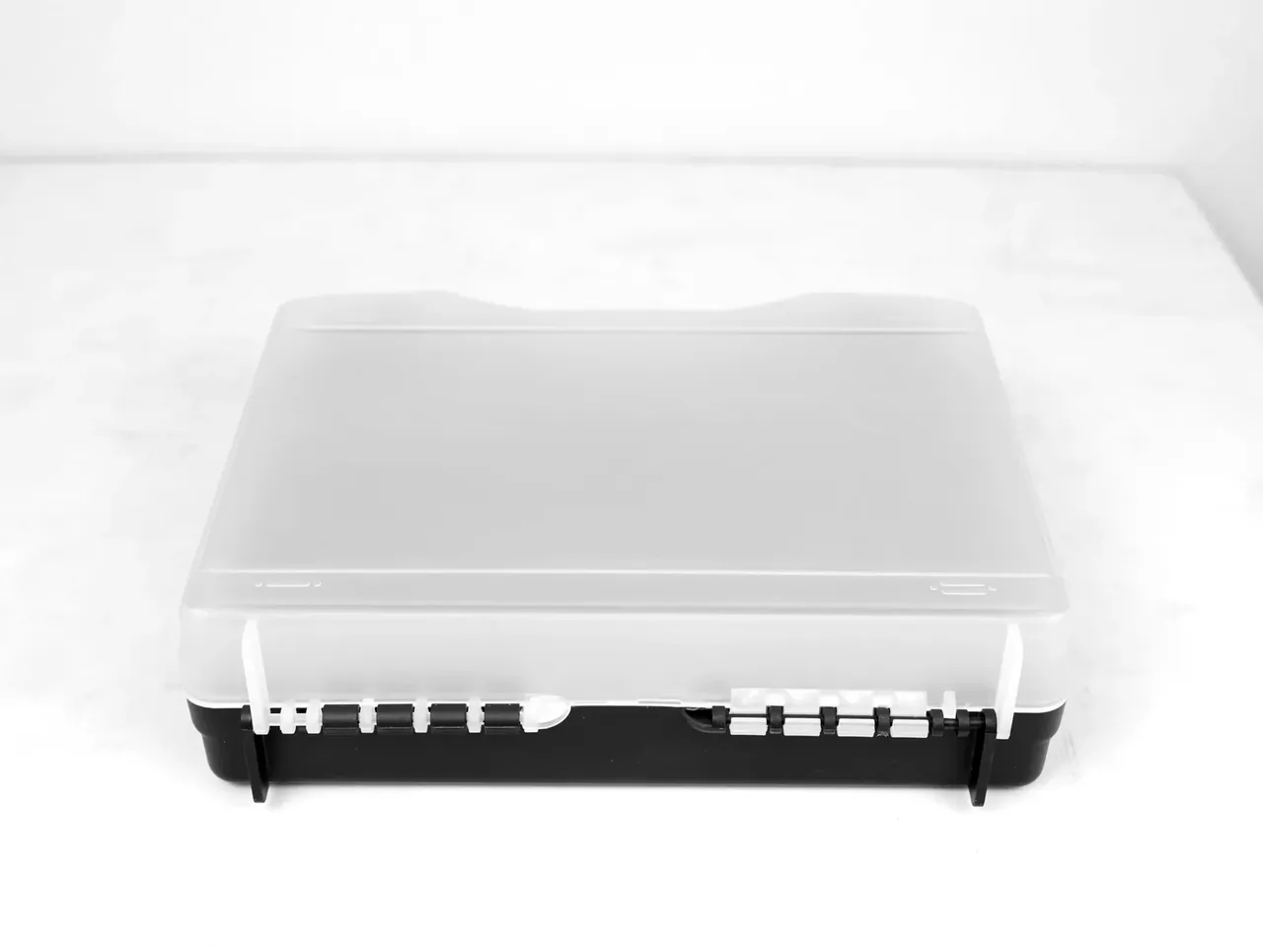
Whole inserts age by compression set. A 30 mm EVA settled to 24 mm has lost 20%, a third of its travel, and a 1.0 m drop that peaked at 45 g now peaks near 70 g. Pocket accuracy sets the other deadline: after 800 picks, a handle face moved more than 0.4 mm against the rim means the wall locates nothing.
| Part | Repairable while | Replace when | Cost |
|---|---|---|---|
| Slot wall | Wear under 0.5 mm | Worn through to the base | 12 yuan shim |
| Edge foam | Crease under 1 mm | Crease past 1 mm | 86 yuan insert |
| Lid pressure strip | Lift under 30 mm | More than half lifted | 8 yuan re-bond |
| Whole insert | Set under 15% | Set past 20% | 86 yuan insert |
5. Service life: storage, stacking and UV
Half of service life is storage: below 65% relative humidity, 100 mm off the floor and 200 mm off the wall. Outdoors, cover with a tarp but never seal it, because at 55 °C inside a sealed box condenses under the lid.
Stack on separate rules, four high empty and two high loaded. At 24 kg a full box, four high puts 72 kg on the bottom one, past what the side walls carry, and within a year the rim rolls outward.
UV is the slowest item. After 1500 hours outdoors the degraded layer on polypropylene is about 0.1 mm thick and rubs off as powder; load rating holds, impact strength drops roughly 30%, and that is when to retire the box. Kept this way a box runs 5 years without a structural fault; kept badly, it averages 30 months.
Conclusion
Inspection frequency decides whether a fault is found or met, cleaning method decides whether a shell ages or corrodes, replacement limits decide whether a box lasts 2 years or 5. None of that is complicated; the hard part is writing the numbers down and letting them form a trend. Do that and knife case upkeep becomes a matter of records rather than feel.
This article discusses only the container (case body) side of specifications and design intent, and does not cover any handling, loading or use of the contents.
Related Reading
- How slots and locating blocks are laid out
- Writing an inspection log for storage cases
- When to change a shell box gasket
Related Products
- 8 Series — Gun Cases; Military Equipment Cases; Camera Equipment Cases; Drone Cases; Watch Cases; Knife Cases; First Aid Cases; Electronics Equipment Cases
- WL8-2812 PP Gun Case — model WL8-2812
- All protective cases and toolboxes: 7 series, 158 models