

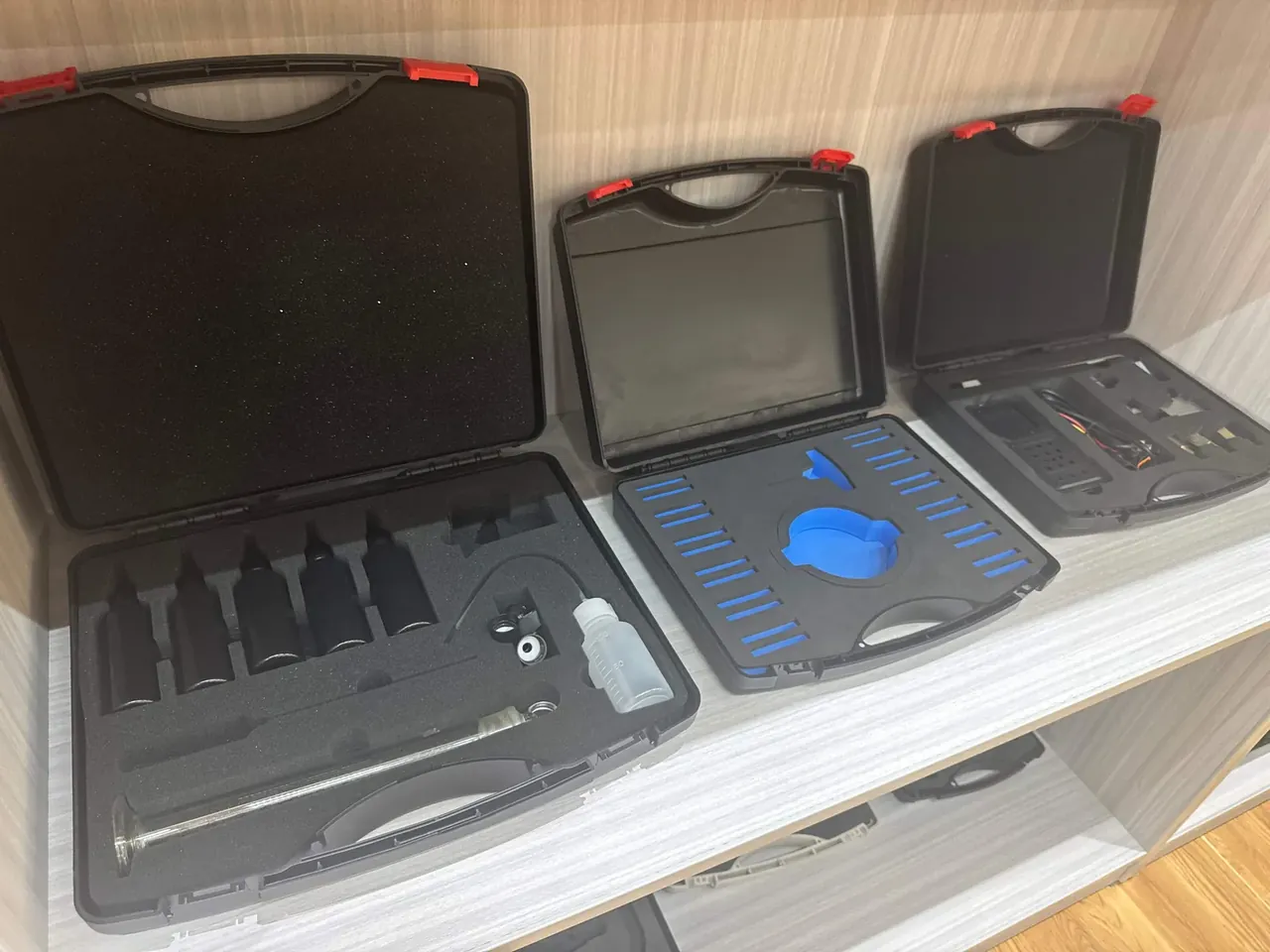
Quick answer: A knife case is defined by three features: the slot sets how the blade lies, the locating block pins it to one coordinate, and the edge guard keeps soft material at the edge. All three share one dimension chain, from spine thickness to block interference to edge clearance.
Table of contents
- How a Knife Case Is Layered
- Slots: Width, Depth and Tilt
- Locating Blocks: One Fixed Coordinate
- Edge Guards: A Soft Layer at the Edge
- The Dimension Chain and Inspection
- FAQ
1. How a Knife Case Is Layered
A knife case reads in three layers: shell, insert, knife position. The shell carries stacking and drop loads, usually 2.5 to 3.5 mm of PP or ABS. The insert is a 20 to 30 mm EVA block at 45 to 60 kg/m³. The knife position is the face cut into it: slots, blocks and guards in one pass. Slots govern posture, blocks coordinate, guards isolation; the three only work together.
2. Slots: Width, Depth and Tilt
Slot width on a knife case follows spine thickness t with 0.75 to 1.0 mm per side. Too wide and the knife rocks; too narrow and the spine stretches the foam.
Depth runs at one third to one half of blade height: a 40 mm blade in a 15 mm slot leaves 25 mm for finger purchase. Buried fully it cannot be lifted; sunk 5 mm it climbs out in a drop. Keep 6 mm between slots.
Tilt comes third: 0 degrees for straight edges, 3 to 5 for curved ones so the tip follows the floor.
| Knife type | Spine (mm) | Slot width (mm) | Depth (mm) | Tilt |
|---|---|---|---|---|
| Thin straight | 2.0 | 3.5–4.0 | 12 | 0 degrees |
| Standard straight | 3.0 | 4.5–5.0 | 15 | 0 degrees |
| Curved | 2.5 | 4.0–4.5 | 14 | 3–5 degrees |
| Heavy spine | 5.0 | 6.5–7.0 | 18 | 0–2 degrees |
3. Locating Blocks: One Fixed Coordinate
A locating block is not a spacer: it returns the knife to the same coordinate, either a 15 by 20 mm EVA block butting the spine or a collar around the handle end.
Interference reads against foam compression. EVA rebounds best at 10 to 15 percent, so 1 mm is squeezed out before the latches close. At zero the knife creeps with each carry; above 1.5 mm the latch lives preloaded.
Contact should cover 60 percent of spine length, or point loading presses a dent within a few hundred cycles. Block and slot must be cut in one pass, since a 0.5 mm seam offset tilts the knife.
4. Edge Guards: A Soft Layer at the Edge
The knife case guard sits on the edge side, one grade softer than slot foam: EVA at 25 to 35 kg/m³ or a 3 to 5 mm PE pearl strip. That step lets the edge sink in rather than meet a firm wall.
Clearance runs 2 to 3 mm. Under 2 mm the slit travels along the bevel and spends the guard in one drop; over 3 mm the edge gains travel and strikes the strip itself. Keep 10 mm from edge to wall.
A tip is a stress riser: leave 5 mm ahead of it. At closing, lid foam should press the spine by 1 to 2 mm: enough to stop movement, not to load the latch.
5. The Dimension Chain and Inspection
Internal height equals bottom insert plus blade height plus lid foam plus compression. A 30 mm insert, 40 mm blade, 25 mm lid foam and 2 mm compression need 97 mm, so a 95 mm case crushes the stack.
| Check | Instrument | Tolerance | Pass condition |
|---|---|---|---|
| Slot width | Vernier caliper | ±0.3 mm | No rock with the knife seated |
| Slot depth | Depth gauge | ±0.5 mm | Spine 1–2 mm below the face |
| Block interference | Feeler gauge | 0.5–1.0 mm | Slight resistance, rebound on opening |
| Edge clearance | Feeler gauge | 2–3 mm | Edge never touches hard material |
| Lid compression | Feeler gauge | 1–2 mm | Latches close fully, no rim gap |
Build three first articles: one empty for slot geometry, one loaded for compression, one dropped 1.2 m. Most knife case rework traces to one wrong number.
Conclusion
Taken apart, a knife case is a closed dimension chain: spine sets slot width, blade height sets depth, internal height works back to insert and lid foam, and the guard is the last 2 to 3 mm at the edge. Read from one chain, the blade lands in the same place after hundreds of cycles, so most assembly arguments about a knife case end before the first build.
This article discusses only the container (case body) side of specifications and design intent, and does not cover any handling, loading or use of the contents.
Related Reading
- How slot layout works in pre-cut foam inserts
- Dividers versus foam: where each insert type fits
- Foam types used inside protective cases
- Shell and hardware on heavy-duty tool cases
Related Products
- 8 Series — Gun Cases; Military Equipment Cases; Camera Equipment Cases; Drone Cases; Watch Cases; Knife Cases; First Aid Cases; Electronics Equipment Cases
- WL8-2812 PP Gun Case — model WL8-2812
- All protective cases and toolboxes: 7 series, 158 models