

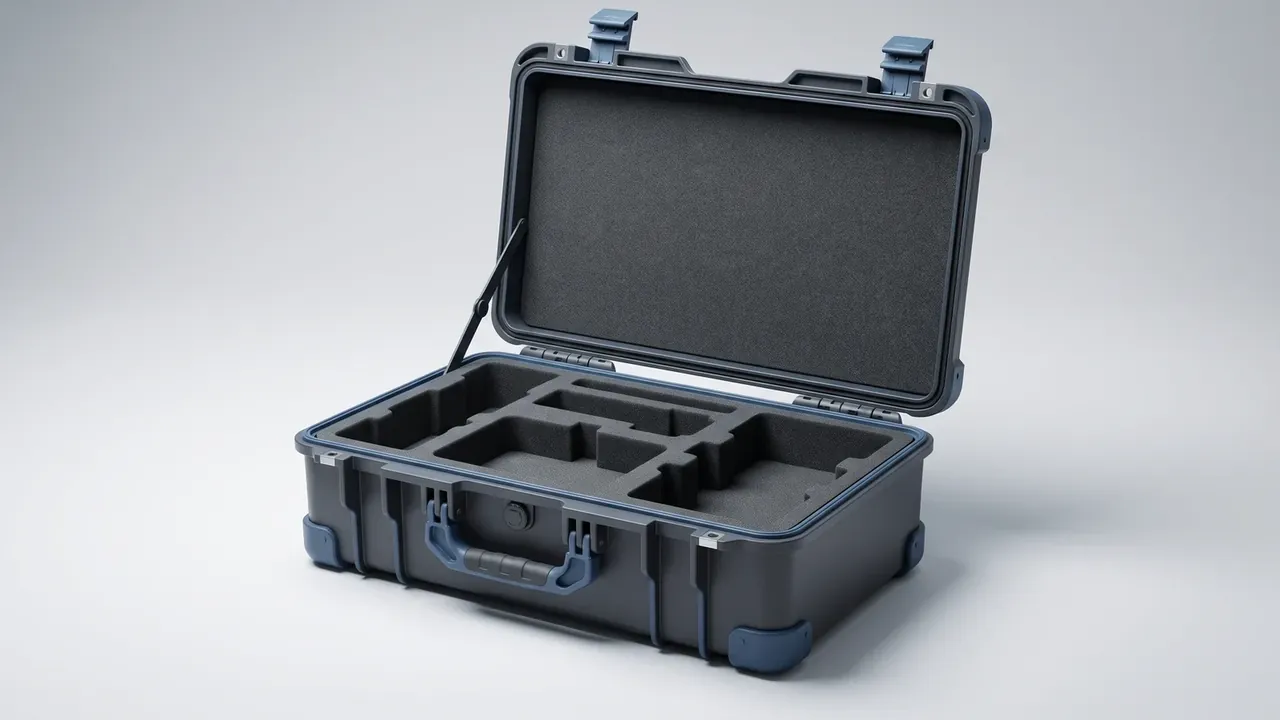
Quick answer: A custom plastic case is specified cavity first, wall and rib second, load and closure last: clearance around the largest item fixes the cavity, cavity plus wall plus rib fixes the envelope, filled weight fixes the thickness tier.
Table of contents
- How Custom Plastic Case Specifications Begin With Cavity Size
- Wall Thickness Tiers and Rib Spacing Decide Drop Height
- Load Ratings: Static, Stacking and Drop
- Latch Count, Hinges and Sealing Specifications
- Sampling Parameters and Acceptance Checklist
- FAQ
1. How Custom Plastic Case Specifications Begin With Cavity Size
Most forms ask for outside dimensions first, which is backwards. Cavity is the constraint, envelope the output: take the largest item, add 8 mm per side wall, 6 mm between items and 10 mm of headroom.
The shell then follows as cavity plus two walls plus rib height. A 460 × 360 × 185 mm cavity with a 2.5 mm wall and 6 mm rib lands near 500 × 400 × 220 mm, held to ±1.5 mm cavity, ±3 mm envelope and 0.8 mm base flatness.
| Outside mm | Cavity mm | Volume L | Empty mass kg | Load kg |
|---|---|---|---|---|
| 400×300×180 | 360×260×150 | 14 | 2.1 | 12 |
| 500×400×220 | 460×360×185 | 30 | 3.4 | 22 |
| 600×450×280 | 555×405×240 | 54 | 4.8 | 32 |
| 760×560×380 | 705×510×335 | 120 | 7.6 | 55 |
2. Wall Thickness Tiers and Rib Spacing Decide Drop Height
Wall thickness in a custom plastic case follows drop height and stack count, not feel: 1.8 to 2.0 mm suits loads under 15 kg, 2.5 mm is the general tier, 3.0 mm covers 30 kg and five-high stacking, and 4.0 mm only pays beyond a 700 mm span.
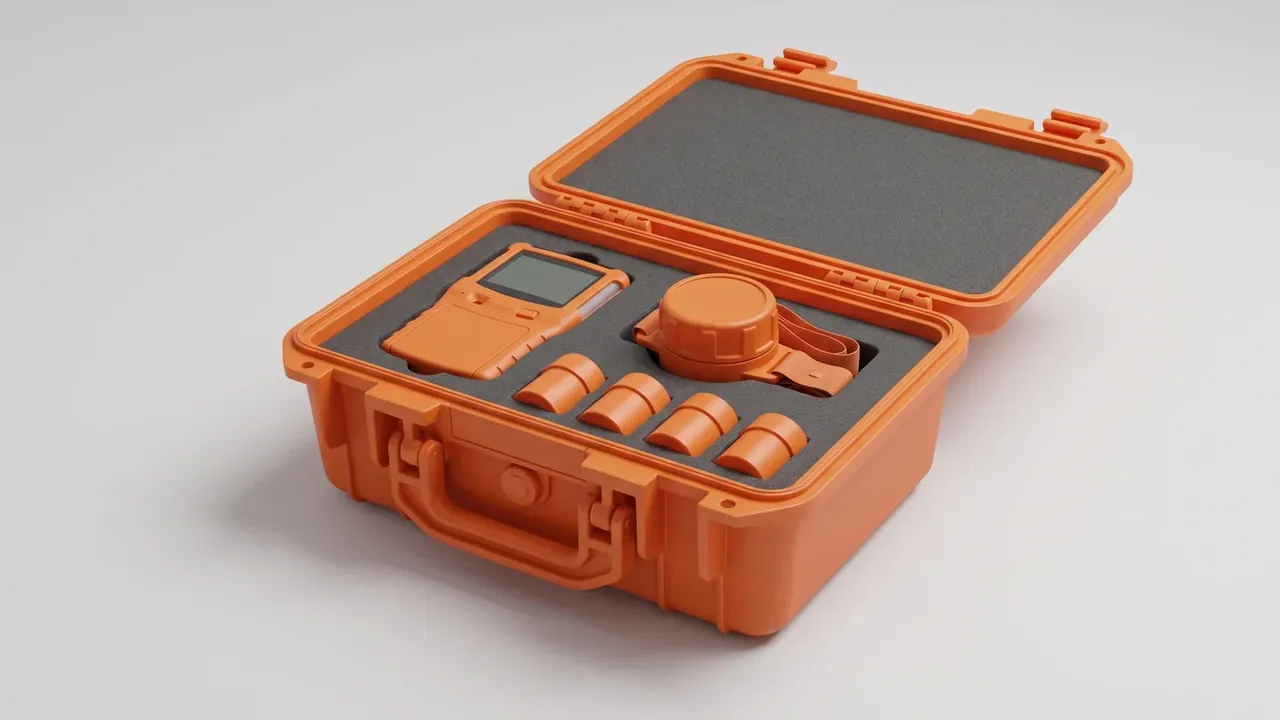
Ribs and wall are one parameter set: rib thickness 0.6 of the wall, spacing 90 to 150 mm, root radius R1.5, draft 1 degree. Tall ribs pull sink marks outward, wide spacing lets the panel bulge.
The press must agree: at 0.24 m² projected area, 2.5 mm to 3.0 mm lifts clamping force from 900 t to 1300 t, and forcing thickness on a smaller machine gives flash and short shots in one cycle.
3. Load Ratings: Static, Stacking and Drop
Static load is filled weight, where 32 kg on a 2.5 mm wall is routine; dynamic load is transit impact at twice static; stack load is what the bottom unit carries, so five high means four times that.
Stacking reads 5 layers, 72 hours at 23 °C, deflection under 3 mm, drifting to 4.5 mm at 45 °C. A custom plastic case is dropped from 1.8 m over six faces, three edges and one corner: bumpers come through uncracked, unbumpered walls whiten at 1.2 m.
4. Latch Count, Hinges and Sealing Specifications
Latch count for a custom plastic case is outside length divided by 300: two at 500 mm, three at 760 mm, opening force 120 to 180 N. Lighter catches release in transit, heavier ones get levered with a screwdriver.
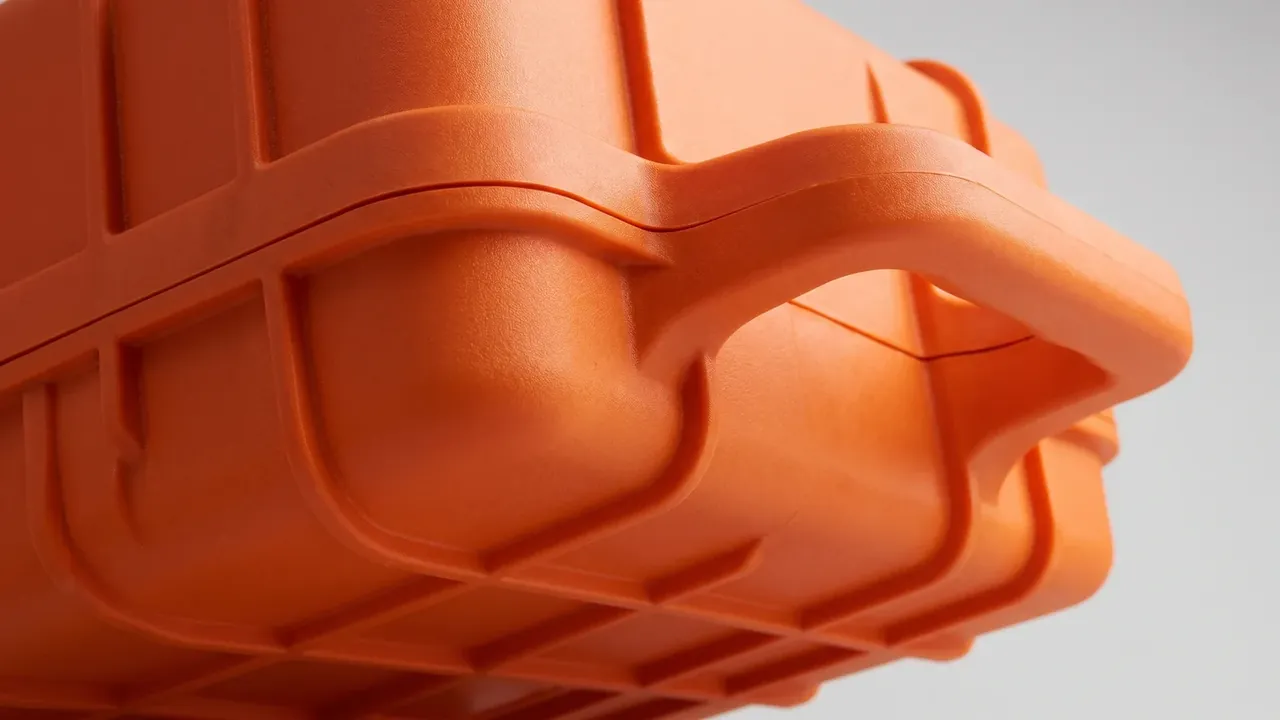
Hinge pins in 304 stainless hold 96 hours of neutral salt spray, and EPDM gaskets at 55 Shore A compressed 30% need a groove 0.3 mm narrower than the cord. IP54 takes a 4 mm single lip, IP67 a 6 mm double lip plus over-centre feel.
5. Sampling Parameters and Acceptance Checklist
First articles run 50 pieces at 45 °C mould temperature, 230 °C melt, 45 MPa packing and 22 s cooling; one out-of-tolerance cavity, wall or latch force stops the pilot batch.
| Item | Value | Method |
|---|---|---|
| Cavity dimensions | ±1.5 mm | Caliper, three points |
| Wall thickness | ±0.15 mm | Ultrasonic, five-point mean |
| Latch opening force | 120–180 N | Push-pull gauge |
| Metal salt spray | 96 h no red rust | Neutral salt spray |
| Stacking | 5 layers, 72 h, ≤3 mm | Ambient load |
| Thermal cycling | −20 °C to 60 °C, 24 h | Climatic chamber |
Datum choice matters: cavity from the inner base, envelope from the outer base, or ±1.5 mm becomes 3 mm.
Conclusion
Specification is not a size list but four groups holding each other in place: cavity, wall, load and closure. Fix the cavity and its tolerances first, choose thickness and rib spacing from filled weight, then let latch count and gasket geometry deliver the ingress rating. A custom plastic case is hard to specify not because it must be big, but because every size tier has to stay reproducible.
This article discusses only the container (case body) side of specifications and design intent, and does not cover any handling, loading or use of the contents.
Related Reading
- Protective case size selection guide
- PP versus ABS case material comparison
- Injection machine tonnage and case projected area
- Foam insert specification parameters
Related Products
- 8 Series — Gun Cases; Military Equipment Cases; Camera Equipment Cases; Drone Cases; Watch Cases; Knife Cases; First Aid Cases; Electronics Equipment Cases
- WL8-2812 PP Gun Case — model WL8-2812
- All protective cases and toolboxes: 7 series, 158 models