

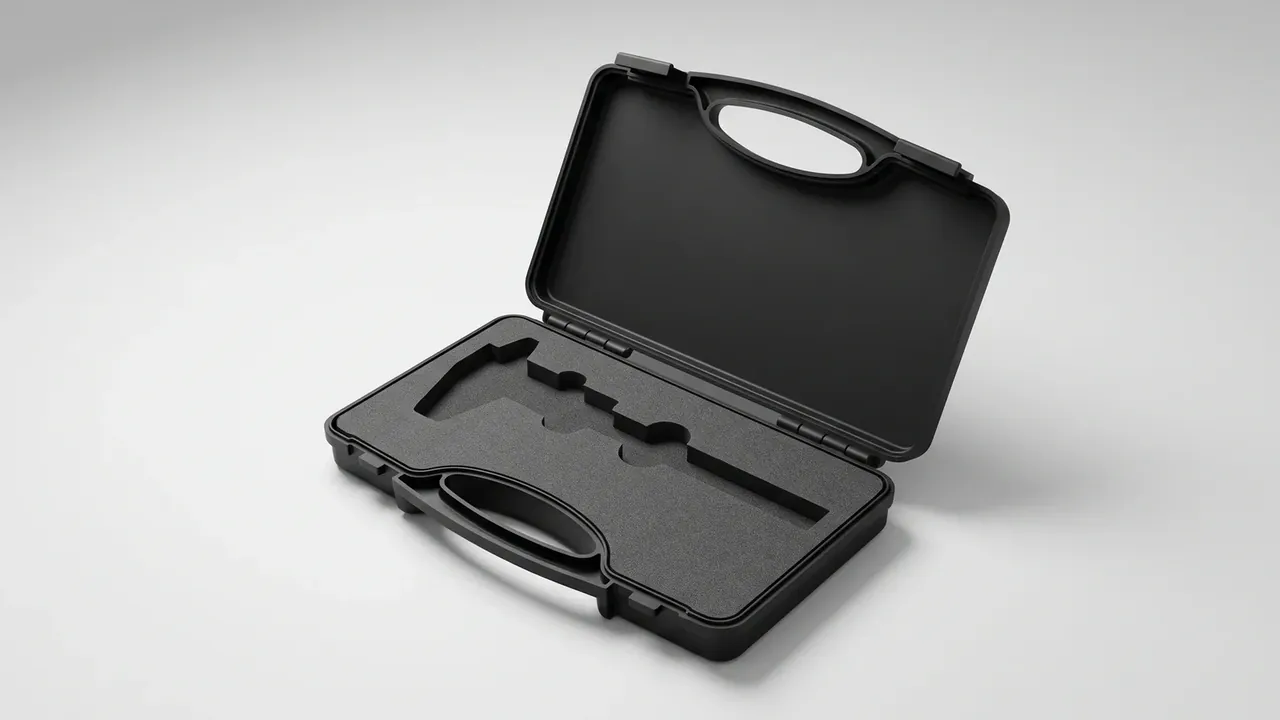
Quick answer: Size a custom protective case by how it moves, not by a catalogue. Past a 600 mm cavity the shell is rotomolded at 5.0 to 8.0 mm, stacking is proven at three layers over 24 hours, and wheeled versions rate the castors separately.
Table of contents
- Sizing a custom protective case from the carry method
- Converting outer dimensions into usable cavity space
- Wall thickness tiers for rotomolded shells
- Load, stacking and corner reinforcement
- Latch count and gasket compression
- FAQ
1. Sizing a custom protective case from the carry method
The first line of the sheet answers who lifts the box. Past a 600 mm cavity one hand is impossible, leaving two carriers, four carriers, or a wheeled shell towed behind.
A custom protective case does not scale evenly from inside out: grip relief, a castor bay or forklift apertures all sit outside the cavity.
| Carry tier | Outer L×W×H | Cavity | Side wall | Empty | Loaded |
|---|---|---|---|---|---|
| Two-person | 880×520×360 mm | 800×440×290 mm | 5.0 mm | 11.2 kg | 32 kg |
| Wheeled | 1180×560×420 mm | 1100×480×350 mm | 6.5 mm | 16.8 kg | 52 kg |
| Four-person, forklift | 1480×620×480 mm | 1400×540×410 mm | 8.0 mm | 24.6 kg | 78 kg |
The step is not decorative: a 52 kg wheeled unit resists turn side load through its own walls, while a 78 kg unit lands as vehicle mass.
2. Converting outer dimensions into usable cavity space
Buyers quote the cavity; moulders build the outside. On the wheeled tier, 1180 minus 1100 divided by two leaves 40 mm per side, consumed by six features.
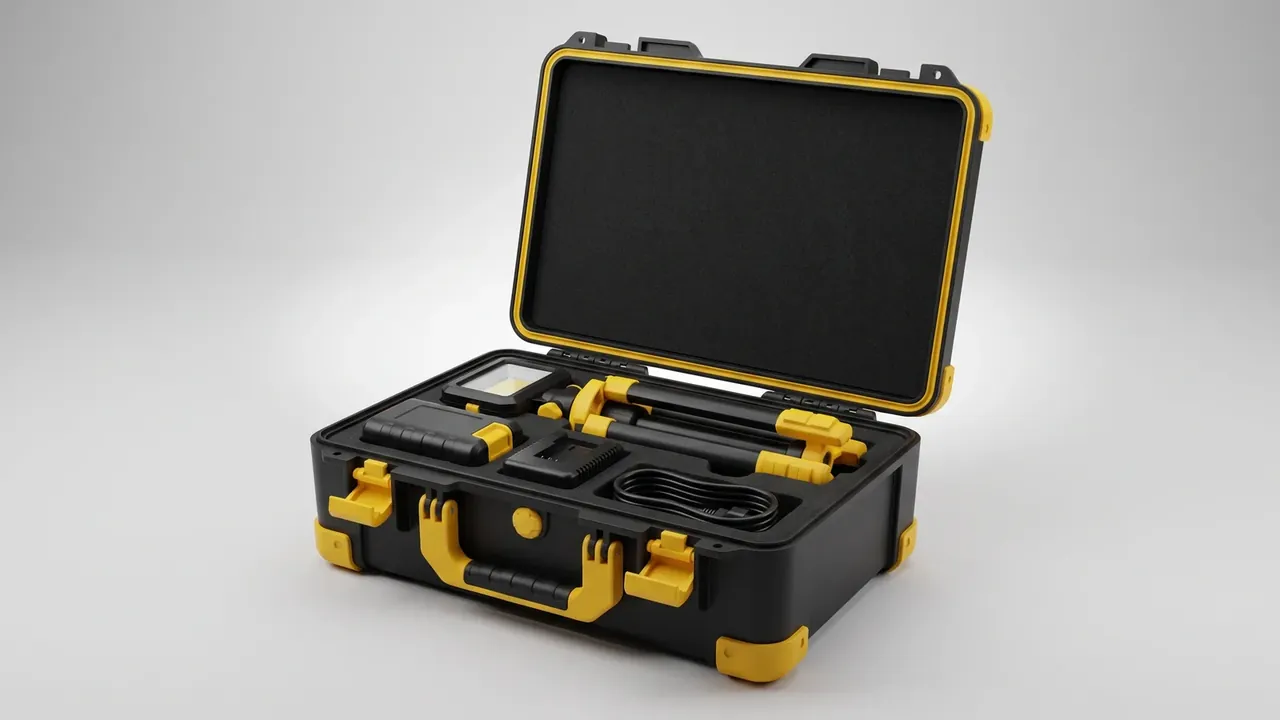
| Allowance | Per side | Note |
|---|---|---|
| Side wall | 6.5 mm | Lowest of four readings |
| Vertical rib | 12 mm | 140 mm pitch, inward |
| Corner radius | 8 mm | Space lost to an R25 corner |
| Gasket groove | 6 mm | Paired with a 9 mm cord |
| Lid step | 2.5 mm | Stops edge bite |
| Moulding and assembly | 5.0 mm | Shrinkage plus foam compression |
| Total | 40 mm | 1180 minus 1100, halved |
Length and width split this way; height does not. The wheeled tier runs a 350 mm cavity in a 420 mm shell, with 18 mm of the 70 mm gap lost to the castor bay.
3. Wall thickness tiers for rotomolded shells
Past 600 mm a custom protective case is rotomolded, not injection moulded. Aluminium tooling keeps cost down but leaves thickness to powder charge and oven time, so ±0.2 mm becomes ±0.8 mm.
The window sits beside the wall figure: 275 °C oven, 26 minutes, a 4:1 dual-axis ratio, 12 minutes of forced cooling. Ten degrees cooler and the powder never fuses.
Thickness is written per zone: 6.5 mm side walls, 8.0 mm base for abrasion, 10 mm corners, 12 mm hinge bosses. Corners take the first contact in a drop.
4. Load, stacking and corner reinforcement
For a custom protective case, load splits into static weight and towing fatigue.
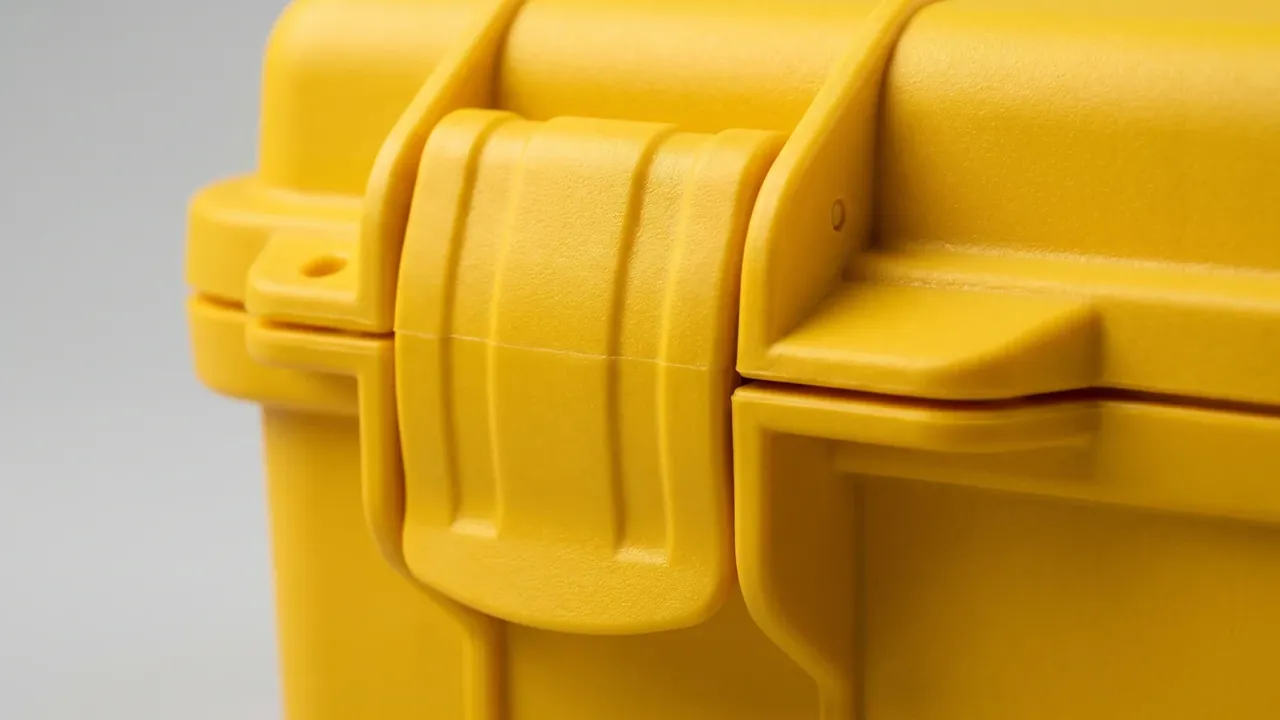
A loaded wheeled unit at 52 kg stacks three high, so the bottom shell carries 104 kg; a 1.5 factor lifts the design value to 160 kg, held 24 hours against 2.0 mm deflection. Four 75 mm castors rate 45 kg each.
Ribs matter during towing, when a shell dragged over a threshold loads corners in turn. Drops run at 1.2 m on six faces, three edges and one corner; at -30 °C the height falls to 0.9 m.
5. Latch count and gasket compression
Latch count follows cavity length: two under 800 mm, four at 1100 mm, six at 1400 mm, spaced 240 to 280 mm. Past 300 mm the gasket lifts the lid between latches.
A 9 mm cord in a 6 mm groove lands at 30 percent compression. Below 25 percent it leaks; above 35 percent the lid needs body weight.
| Tier | Latches | Holding force each | Gasket cord | Compression | Rating |
|---|---|---|---|---|---|
| Two-person | 2 | 320 N | 7 mm | 28% | IP65 |
| Wheeled | 4 | 420 N | 9 mm | 30% | IP67 |
| Four-person, forklift | 6 | 480 N | 11 mm | 32% | IP67 |
Hinge pins are 8 mm 304 stainless, cleared at 480 hours of salt spray. The gasket is EPDM, rated -30 °C to 60 °C.
Conclusion
The chain runs backwards from handling: tier, shell, cavity, wall. A custom protective case is calculated and proven, never picked from a page.
This article discusses only the container (case body) side of specifications and design intent, and does not cover any handling, loading or use of the contents.
Related Reading
- How to read heavy-duty protective case specifications
- Large protective case structure and limits
- Selection points for wheeled protective cases
- Choosing by protective case size range
Related Products
- 8 Series — Gun Cases; Military Equipment Cases; Camera Equipment Cases; Drone Cases; Watch Cases; Knife Cases; First Aid Cases; Electronics Equipment Cases
- WL8-2812 PP Gun Case — model WL8-2812
- All protective cases and toolboxes: 7 series, 158 models