

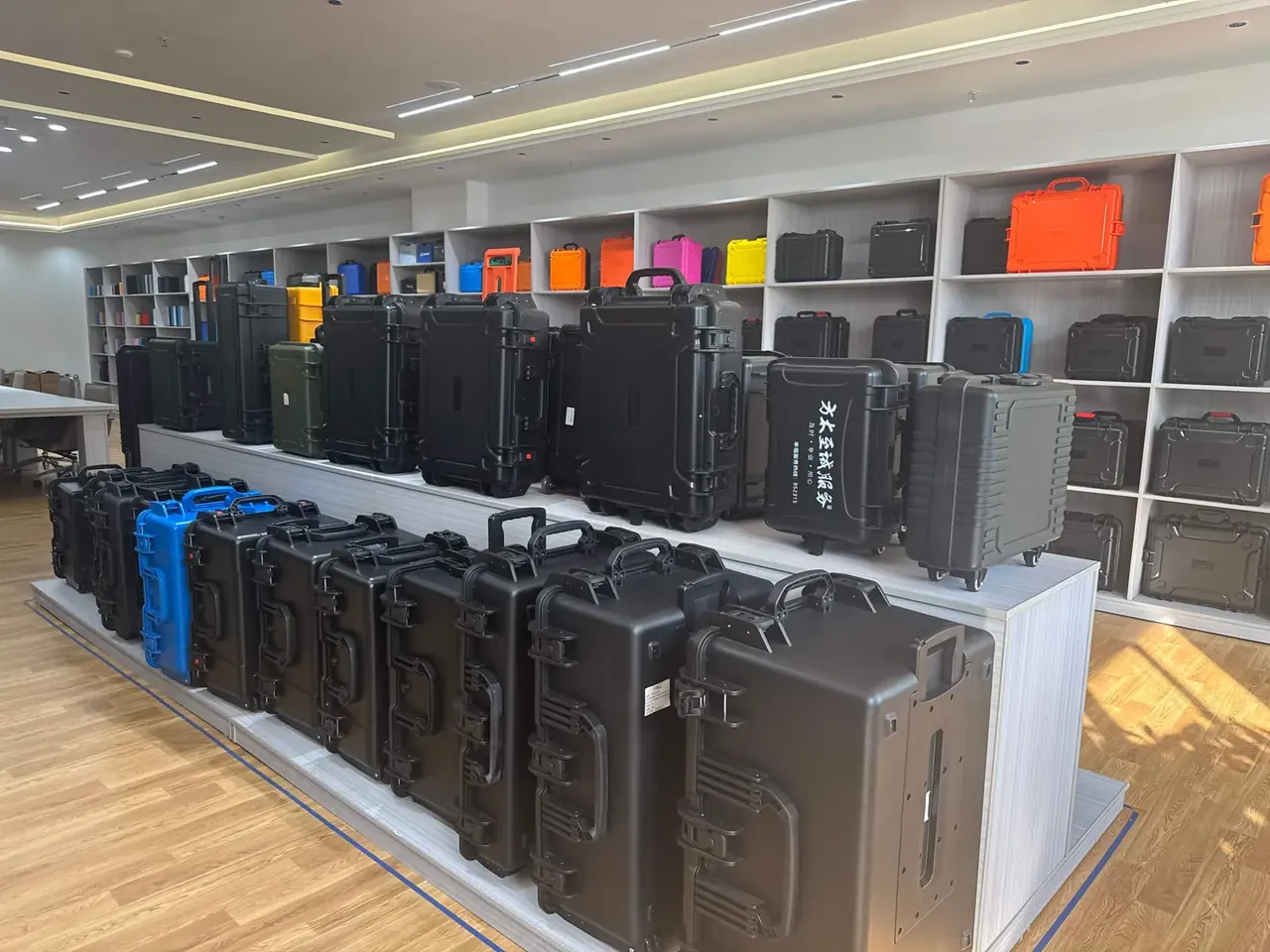
Quick answer: A Large Protective Case is sized in order: length and total weight first, wall thickness second, ribs and lift points last. Past 800 mm outside length and 12 kg empty, rotomoulded walls run 8 to 10 mm, ribs sit on a 300 mm grid, and each lift point is rated at four times its working load.
Table of contents
- Where a Large Protective Case Begins in Size
- Wall Thickness from 6 to 12 mm
- Rib Grid and Rib Height
- Lift Points: Position and Load per Point
- Rim Flatness and Three-High Stacking
- FAQ
1. Where a Large Protective Case Begins in Size
A Large Protective Case has no fixed threshold: outside length past 800 mm, cavity over 120 litres, empty weight over 12 kg. Past two markers, handling needs two people or a trolley.
Scaling is not proportional: stiffness rises with the cube of thickness and falls with the cube of span, so doubling the length deflects a panel eight times as far.
| Class | Length | Cavity | Empty | Process |
|---|---|---|---|---|
| Large | 700–1000 mm | 80–150 L | 8–15 kg | either |
| Extra large | 1000–1500 mm | 150–350 L | 15–28 kg | rotomoulding |
| Special | >1500 mm | >350 L | >28 kg | rotomoulding + frame |
2. Wall Thickness from 6 to 12 mm
Rotomoulded walls follow the powder charge: 6, 8, 10, 12 mm. A 1000 mm body starts at 8 mm; ten suits bases over 0.6 square metres, where impact bending grows fast.
Every millimetre costs weight: a 1000 by 600 by 500 mm body carries 2.8 square metres, so 1 mm is 2.5 kg of PP. Corners at 12 mm save 18 percent of material.
| Wall | Process | Length | Empty | 1.2 m drop |
|---|---|---|---|---|
| 6 mm | injection | <700 mm | 6 kg | corner cracks |
| 8 mm | injection | <1000 mm | 10 kg | passes |
| 8 mm | rotomoulding | <1200 mm | 14 kg | passes |
| 10 mm | rotomoulding | <1500 mm | 19 kg | passes |
| 12 mm local | rotomoulding | >1500 mm | 24 kg | passes |
3. Rib Grid and Rib Height
Ribs fight panel bulge, not overall stiffness. A 1000 mm Large Protective Case with bare walls bulges 3 to 4 mm at mid-panel under 20 kg, and past 5 mm the gasket leaks.
Pitch is 300 mm: such a bay in 8 mm wall deflects 0.9 mm under 20 kg, while 400 mm jumps to 2.1 mm. A 1200 mm Large Protective Case takes four ribs on the long side.
Height runs 8 to 10 mm at 0.8 times the wall, R3 at the root, 1.5 degrees of draft: thick ribs sink the face, thin ones void at the crest.
4. Lift Points: Position and Load per Point
Lift points are sized on dynamic load: 2 g at pickup and 1.15 for a 60 degree sling, so weight times 2 over points, times 1.15. An 80 kg case on four points carries 46 kg each, rated 185 kg.
Position fails more often than rating: four points sit a fifth of the length in from each end, their quad enclosing the centre of gravity.
Inserts are moulded in: an eye bolt bites 8 mm of wall and lets go below 1.5 kN, while a 12 mm stainless insert with a 2 mm boss holds on a Large Protective Case. Castors carry rolling weight only.
| Total | Points | Static | Design | Insert |
|---|---|---|---|---|
| 40 kg | 2 | 20 kg | 46 kg | M8 |
| 80 kg | 4 | 20 kg | 46 kg | M10 |
| 150 kg | 4 | 38 kg | 87 kg | M12 |
| 250 kg | 4 | 63 kg | 145 kg | M16 |
| 400 kg | 6 | 67 kg | 154 kg | M16 |
5. Rim Flatness and Three-High Stacking
Long rims are hard to hold flat: a 1200 mm rim shrinks 1.8 percent as it cools, so 1.5 mm of flatness comes from a mould cut 1 mm low in the middle.
Flatness is sealing: a 30 percent squeeze on a 12 mm gasket leaves 8.4 mm, and a 2 mm low spot leaves 13 percent.
Stacking is set by the bottom rim: 120 kg on a 1.4 m length bends 0.6 mm at 8 mm wall. A lid recess with a boss 3 mm smaller keeps the tier aligned, and a Large Protective Case needs both.
Conclusion
Three numbers decide it: thickness from span and load, ribs on a 300 mm grid, lift points at four times the working load. Get them right and a Large Protective Case keeps its stiffness as it grows.
This article discusses only the container (case body) side of specifications and design intent, and does not cover any handling, loading or use of the contents.
Related Reading
- Case Wall Thickness and Strength
- How Reinforcement Ribs Are Laid Out
- Wheels and Trolley Handle Load Design
- Rotomolded Cases: Rotational-Moulded Shell Structure & Pro…
Related Products
- 8 Series — Gun Cases; Military Equipment Cases; Camera Equipment Cases; Drone Cases; Watch Cases; Knife Cases; First Aid Cases; Electronics Equipment Cases
- WL8-2812 PP Gun Case — model WL8-2812
- All protective cases and toolboxes: 7 series, 158 models