

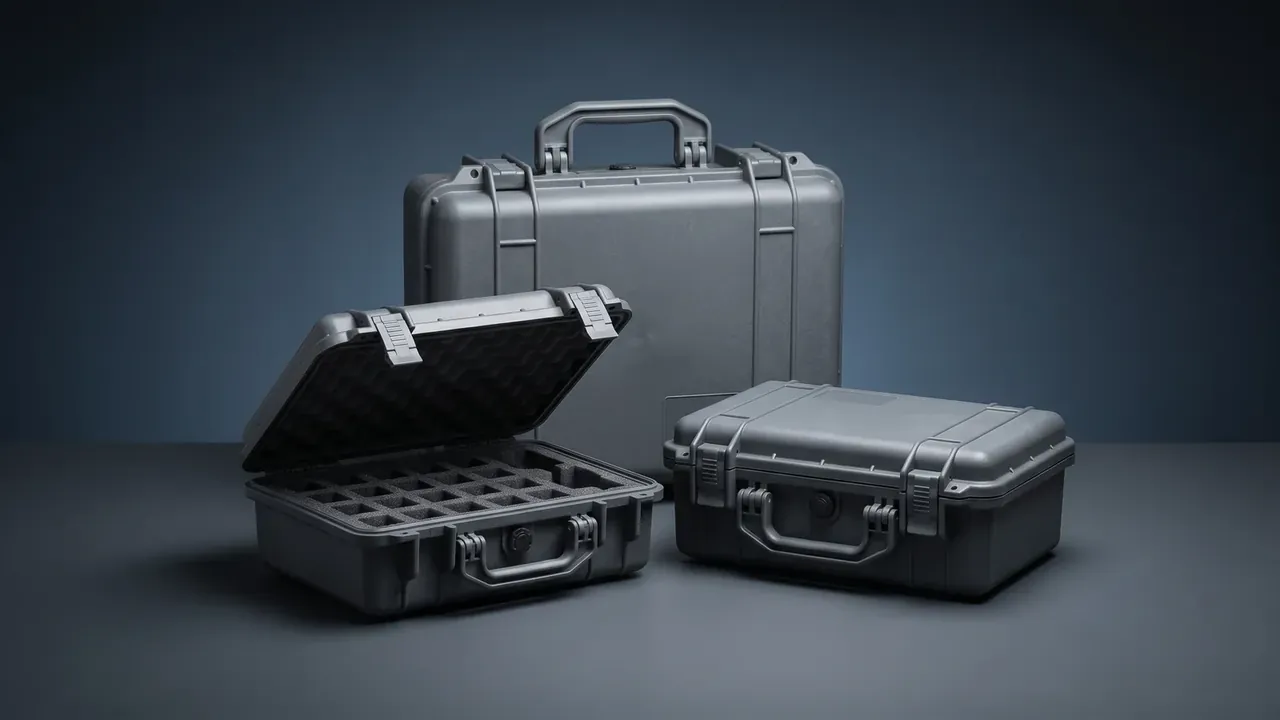
Quick answer: Most battery storage case failures show up in the warehouse: a stack sagging at level three, a peeling label, condensation inside the wall in the wet season. Settle stack load, pallet layout, label fields and a humidity range before ordering.
Table of contents
- How a Battery Storage Case Carries Stack Load
- Pallet Layout and Zoning
- Label and Traceability Fields
- Temperature, Humidity and Airflow
- Counting, Rotation and Inspection
- FAQ
1. How a Battery Storage Case Carries Stack Load
Stacking is long-term pressure. A 500 by 400 mm footprint gives 2,000 square centimeters of top face. At five levels the bottom unit carries 96 kg, about 0.05 kg per square centimeter, for thirty days.
Creep decides more than momentary strength: hold 96 kg evenly for thirty days and the lid should sink no more than 1.2 mm, with rib spacing of 120 mm or less and two cross ribs on the lid. Beyond that, level four tilts.
| Stack levels | Load on bottom | 30-day creep | Location |
|---|---|---|---|
| 3 | 48 kg | 0.8 mm | Middle shelf |
| 4 | 72 kg | 1.0 mm | Floor pallet area |
| 5 | 96 kg | 1.2 mm | High bay |
| 6 | 120 kg | 1.5 mm | Needs a deck board |
Above six levels, move to racking.
2. Pallet Layout and Zoning
A 1200 by 1000 mm pallet holds a 500 by 400 mm battery storage case two across and three deep: 12 per layer, 60 per pallet at five levels, with an 18 kg pallet keeping the load under 1.5 tonnes.
Zone by status, not model: 100 mm yellow borders for inspection, released and hold areas, aisles at 1.2 m, widened to 1.5 m where the turning circle is tight. One pallet carries one batch: the walls are too close in color to sort later.
3. Label and Traceability Fields
A label answers four questions: what it is, which batch, when it arrived, where it goes. Fix six fields: item code, batch, production date, quantity, location, status. Print at 100 by 70 mm, 30 mm in from the top right corner.
An ordinary warehouse takes coated stock rated from minus 20 to 80 degrees Celsius; a cold store needs synthetic stock that will not lift after condensation. Set the QR module at 15 mm for reading within 1.2 m and characters at 8 mm.
| Position | Content | Size | Durability |
|---|---|---|---|
| Front, top right | Item code and batch | 100 by 70 mm | Coated |
| Short side | Quantity and location | 80 by 50 mm | Synthetic |
| Lid | Status color dot | 60 mm round | Waterproof |
4. Temperature, Humidity and Airflow
Humidity control here is about condensation, not cooling. Hold the room at 5 to 35 degrees Celsius and below 65 percent relative humidity; the risk is the swing, where 32 degrees by day and 12 at night puts the wall below dew point.
Start dehumidifiers when room temperature sits within 3 degrees Celsius of dew point; above a 5 degree gap, ventilation is enough. Log every 30 minutes with the probe at 1.5 m. Airflow runs at 2 to 4 air changes per hour, with cases 0.3 m off the wall and 100 mm off the floor.
5. Counting, Rotation and Inspection
Count by pallet, verify by month. Check three battery storage cases per pallet against the six fields, run a full count monthly, and trace any variance above 0.5 percent. First-in-first-out applies at 90 days: a batch untouched that long gets a yellow hold tag.
Inspection covers cracks, latches and labels. Cycle life is designed at 2,000 trips; after that, a loose batch is replaced, not rewrapped.
| Task | Frequency | Limit | Record |
|---|---|---|---|
| Field check | 3 per pallet | Six fields present | Scanner |
| Full count | Monthly | 0.5% variance | Count sheet |
| Latch effort | 10 per quarter | No slip or bind | Hand check |
| Label scan | 10 per quarter | First-read success | Scan log |
Set shelf height at 1.8 m with 0.4 m clearance, then freeze case height.
Conclusion
Choosing a battery storage case means writing the warehouse into the specification. Stack load follows creep, pallets follow case count, labels follow field completeness, climate follows dew point. Settle those four and the bay, the count and the rotation rest on one basis, which keeps a battery storage case predictable through the wet season.
This article discusses only the container (case body) side of specifications and design intent, and does not cover any handling, loading or use of the contents.
Related Reading
- Battery safety case selection guide: a five-step checklist
- Battery safety case versus alternatives: structure, cost and lead time
- Case and pallet marking standards: label position, type size and durability
- Maintenance points for reusable shipping and storage containers
Related Products
- 8 Series — Gun Cases; Military Equipment Cases; Camera Equipment Cases; Drone Cases; Watch Cases; Knife Cases; First Aid Cases; Electronics Equipment Cases
- WL8-2812 PP Gun Case — model WL8-2812
- All protective cases and toolboxes: 7 series, 158 models